
Futures
Access hundreds of perpetual contracts
CFD
Gold
One platform for global traditional assets
Options
Hot
Trade European-style vanilla options
Unified Account
Maximize your capital efficiency
Demo Trading
Introduction to Futures Trading
Learn the basics of futures trading
Futures Events
Join events to earn rewards
Demo Trading
Use virtual funds to practice risk-free trading
CFD
Stock CFD Derivatives
US Stocks
Access real US stocks and ETFs
HK Stocks
Trade quality Hong Kong-listed stocks
Korean Stocks
SK Hynix
Real Korean stocks and top assets
Stock Futures
High leverage, 24/7 trading
Tokenized Stocks
Backed by real stock assets
IPO Access
Unlock full access to global stock IPOs
GUSD
3.8%
Mint GUSD for Treasury RWA yields
Stocks Activities
Trade Popular Stocks and Unlock Generous Airdrops
Launch
CandyDrop
Collect candies to earn airdrops
Launchpool
Quick staking, earn potential new tokens
HODLer Airdrop
Hold GT and get massive airdrops for free
IPO Access
Unlock full access to global stock IPOs
Alpha Points
Trade on-chain assets and earn airdrops
Futures Points
Earn futures points and claim airdrop rewards


Promotions
AI
Gate AI
Your all-in-one conversational AI partner
Gate AI Bot
Use Gate AI directly in your social App
GateClaw
Gate Blue Lobster, ready to go
Gate for AI Agent
AI infrastructure, Gate MCP, Skills, and CLI
Gate Skills Hub
10K+ Skills
From office tasks to trading, the all-in-one skill hub makes AI even more useful.

Who Will Own the Most Bitcoin in 2026? Analysis of the Largest BTC Holders and Institutional Positions Worldwide
As of July 2026, answering “who owns the most Bitcoin” is not as straightforward as checking a billionaire ranking. Bitcoin addresses do not directly reveal real identities; the same entity can control thousands of wallets, and the BTC in exchanges, custodians, and ETF addresses may belong to millions of users or fund investors, respectively.
Based on currently identifiable wallet ownership, Satoshi Nakamoto is still widely viewed as the largest individual Bitcoin holder in the world. Arkham’s July 2026 on-chain attribution results show that wallets potentially linked to the early “Patoshi Pattern” may have accumulated about 109.6 thousand BTC; another, more conservative estimate is about 968 thousand BTC. Since Satoshi Nakamoto has never published a wallet list, these figures are conclusions from on-chain research rather than assets confirmed through the person’s own verification.
Among active institutions, the situation is even more complex. The underlying BTC size held by BlackRock’s IBIT is substantial, but economically those assets belong to ETF shareholders—not to BlackRock’s own company assets. Strategy, by contrast, directly lists Bitcoin on the company balance sheet. As of July 5, 2026, Strategy held 843,775 BTC, the largest Bitcoin treasury among publicly listed companies.
The data in this article is mainly cross-checked for July 20–27, 2026. Since corporate filing dates, daily fund holdings, on-chain balances, and government dispositions can all change, the BTC figures in the article should be treated as dynamic data with a clearly defined time cutoff.
Who owns the most Bitcoin right now?
If we separate holders of different types, the answer can be summarized as:
| Holder category | Current representative entity | Identifiable BTC size | How to interpret | | --- | --- | --- | --- | | Largest individual holder | Satoshi Nakamoto | About 968 thousand to 109.6 thousand BTC | Inferred from early mining patterns; identity and wallet attribution not ultimately confirmed | | Largest publicly listed company | Strategy | 843,775 BTC | Company-owned BTC on the balance sheet | | Largest single U.S. spot Bitcoin ETF | BlackRock IBIT | About 74 thousand BTC | Held for ETF investors’ custody; not BlackRock’s own company assets | | Largest government holder | U.S. government | 328,372 BTC | Mainly from law-enforcement seizures and government-managed assets | | Large exchange wallets | Multiple centralized exchanges | Some single cold wallets over 200 thousand BTC | Most are customer-custodied assets and cannot be equated with ownership by platform shareholders |
BlackRock data shows that as of July 22, 2026, IBIT’s net assets are about $1.1M, with outstanding shares of about 1.3094 billion; each subscription basket corresponds to about 22.65 BTC. Based on the fund’s basket size and outstanding shares, its underlying holdings are estimated at about 741 thousand BTC. Because fund data can change daily, the actual amount should follow BlackRock’s latest holdings files.
Strategy’s latest public filings show that the company sold some BTC in early July 2026 to replenish its U.S. dollar reserves and make distributions related to preferred stock. As of July 5, its holdings fell from 847,363 BTC to 843,775 BTC, with an average acquisition cost of about $75,476.
Therefore, Satoshi Nakamoto may be the largest Bitcoin individual holder; IBIT is one of the largest single fund holding pools; Strategy is the largest publicly listed company holder of company-owned BTC; and the U.S. government is the largest identifiable government holder.
How Bitcoin ownership works—and why it’s hard to count accurately
Bitcoin’s blockchain can publicly show every address’s balance and transaction history, but it does not automatically reveal the natural person or institution behind an address. Research organizations can only infer which wallet belongs to whom by combining trading behavior, address clustering, miner patterns, public disclosures, and custody relationships.
One person can own multiple addresses, and one address can represent multiple economic owners. Exchange cold wallets are the most typical example: a wallet might store 200 thousand BTC, but those assets are usually jointly owned by millions of users—the platform merely controls the private keys and performs custody.
When analyzing Bitcoin holders, at least four concepts must be distinguished:
For example, Coinbase may custody ETF, corporate, and individual clients’ large amounts of BTC, but those assets cannot all be counted as Coinbase’s corporate treasury. IBIT’s BTC is held under the fund structure; BlackRock manages the product, but the fund investors are the primary economic beneficiaries.
This is also why many “rankings of the largest Bitcoin wallets in the world” can be misleading. They typically rank address balances, not final beneficial ownership.
Is Bitcoin really decentralized? Ownership concentration based on holding structure
Bitcoin’s decentralization is mainly reflected in accounting, verification, and the fact that monetary policy does not depend on a single institution—but it does not mean Bitcoin must be evenly distributed across all users. Even if a small number of addresses hold large amounts of BTC, as long as those entities cannot unilaterally change the issuance cap or transaction rules, the Bitcoin protocol can still maintain decentralized operation.
However, concentration of holdings still affects the market. When large holders sell assets, it may increase short-term supply; concentrated ETF subscriptions can continuously absorb spot liquidity; and government transfers of seized assets may also create expectations of potential auctions or sales.
BitcoinTreasuries shows that as of July 2026, publicly listed companies in total hold about 126.3 thousand BTC, government entities hold about 650 thousand BTC, and ETFs plus exchange categories sum to about 162.3 thousand BTC tracked. Different categories may overlap in custody or statistical scope, so these figures cannot simply be added up and treated as independent final ownership.
What matters is not the large wallet itself, but whether holdings are concentrated among a small number of entities that share similar behavioral patterns. For example, ETF assets may be concentrated across a small number of custodial addresses, but behind them could be hundreds of thousands of investors, making economic ownership relatively more dispersed.
Why the largest Bitcoin holders affect markets and policies
Large holders’ actions change spot supply, market expectations, and liquidity structure. When Strategy announces large purchases, the market assesses the incremental demand; when the government transfers seized wallets, traders may front-run expectations of auctions or sales; when ETFs continuously flow in or out, it reflects risk preferences from traditional financial channels.
Large holders mainly affect the market in the following ways:
At the same time, large holders’ positions do not mean they can control the Bitcoin protocol. Even if an entity holds 1 million BTC, it cannot unilaterally raise the 21 million maximum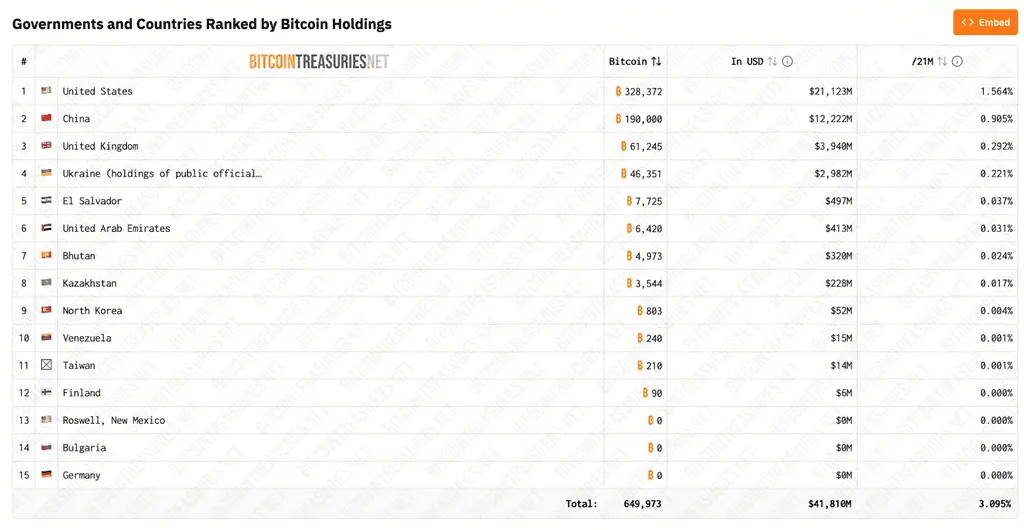 supply cap or cancel other users’ legitimate transactions.
How to monitor large Bitcoin holders and ownership trends
There is no single data source that can fully reflect global BTC ownership. A more reliable approach is cross-verification of on-chain data, company filings, fund holdings, and government documents.
When tracking large holders, focus on:
On-chain transfers also cannot directly be equated with buying or selling. If BTC moves from one cold wallet to another address, it may simply be an internal custody adjustment; BTC flowing out from an ETF custody address may also correspond to normal redemptions rather than the fund manager actively taking a bearish stance.
Summary: Who owns the most Bitcoin, and what does it mean?
As of July 2026, Satoshi Nakamoto is still the most likely largest individual Bitcoin holder worldwide, with estimated holdings of about 968 thousand to 109.6 thousand BTC. Since his identity and wallets were never formally verified, this conclusion is still based on analyses of early mining patterns.
At the institutional level, BlackRock IBIT holds about 741 thousand underlying BTC, but those assets serve ETF share investors; Strategy holds 843,775 BTC and is the largest listed-company holder of company-owned Bitcoin treasury; the U.S. government controls about 328,372 BTC, the largest identifiable government holder today.
Some wallets controlled by exchanges and custodians may be even larger, but controlling private keys does not equal owning all economic interests. When discussing the largest BTC holders, what matters most is not a simple comparison of address balances, but distinguishing final beneficial ownership, company treasuries, fund custody, and users’ assets.
Bitcoin ownership has expanded from early miners and individual crypto whales to ETFs, publicly listed companies, private enterprises, and governments. However, institutionalization of holdings has not changed Bitcoin’s protocol rules; the real changes are in market liquidity, asset custody methods, and the linkage between BTC and the traditional financial system.
FAQ
If you invested $1,000 in Bitcoin 10 years ago, what would it be worth now?
On July 27, 2016, the Bitcoin price was about $654.35, meaning $1,000 could buy about 1.528 BTC. At a price of about $65,236 on July 27, 2026, these BTC would be worth about $99,700, excluding trading fees, taxes, and custody costs.
This means the nominal return over 10 years is close to 99x, but the actual result will depend on the specific buy time, sell time, trading fees, and whether you held long-term.
What happens when all 21 million Bitcoin are owned?
Bitcoin will not suddenly become “nobody can buy it” on one day. “21 million” refers to the maximum theoretical issuance, not that it must be held by 21 million different people. Existing BTC can continue to be split and traded; each BTC can be divided into 100 million satoshis.
A small amount of BTC is expected to be issued through block rewards around before 2140. After that, miners will rely mainly on transaction fees for income, but the network can continue processing and confirming transactions.
Does Elon Musk personally hold Bitcoin?
Elon Musk has publicly said in the past that he personally holds Bitcoin, but he has not disclosed a verified current amount, so he cannot be accurately included on an individual BTC holdings leaderboard.
Unlike individual assets, Tesla’s company holdings are subject to public filings. Tesla submitted its Q2 10-Q filing in July 2026, and publicly tracked data shows its company treasury still holds about 11,509 BTC.