
Futures
Access hundreds of perpetual contracts
CFD
Gold
One platform for global traditional assets
Options
Hot
Trade European-style vanilla options
Unified Account
Maximize your capital efficiency
Demo Trading
Introduction to Futures Trading
Learn the basics of futures trading
Futures Events
Join events to earn rewards
Demo Trading
Use virtual funds to practice risk-free trading
CFD
U.S. stock CFD derivatives
US Stocks
Access real US stocks and ETFs
HK Stocks
Trade quality Hong Kong-listed stocks
Korean Stocks
SK Hynix
Real Korean stocks and top assets
Stock Futures
High leverage, 24/7 trading
Tokenized Stocks
Backed by real stock assets
IPO Access
Unlock full access to global stock IPOs
GUSD
Mint GUSD for Treasury RWA yields
Stocks Activities
Trade Popular Stocks and Unlock Generous Airdrops
Launch
CandyDrop
Collect candies to earn airdrops
Launchpool
Quick staking, earn potential new tokens
HODLer Airdrop
Hold GT and get massive airdrops for free
IPO Access
Unlock full access to global stock IPOs
Alpha Points
Trade on-chain assets and earn airdrops
Futures Points
Earn futures points and claim airdrop rewards


Promotions
AI
Gate AI
Your all-in-one conversational AI partner
Gate AI Bot
Use Gate AI directly in your social App
GateClaw
Gate Blue Lobster, ready to go
Gate for AI Agent
AI infrastructure, Gate MCP, Skills, and CLI
Gate Skills Hub
10K+ Skills
From office tasks to trading, the all-in-one skill hub makes AI even more useful.


The Saylor Pivot: How Strategy's $2 Billion Buyback Exposed Wall Street's Biggest Cognitive Blind Spot
Strategy's enterprise mNAV — the ratio comparing the company's total market value to its Bitcoin holdings — had just slipped below 1.0 for the first time in history. The stock was trading at $82, a level not seen since early 2024. Nine consecutive days of losses had pushed the market cap to $29.5 billion, while the company sat on 847,363 Bitcoin worth over $50 billion. Wall Street was essentially saying: "We value your company at less than the digital gold in your vault."
Then came the announcement: a $2 billion buyback program, funded by up to $1.25 billion in authorized Bitcoin sales. MSTR surged 12.6% in a single session. The nine-day losing streak snapped. But beneath the headline lies a story about human psychology, institutional bias, and what happens when the world's most aggressive Bitcoin bet collides with reality.
The Cognitive Trap: Why Investors Missed the Signal This is where most analysis fails. They focus on the numbers. They miss the psychology.
Let me introduce a concept I call the "Saylor Discount Paradox" — the market's persistent inability to price Bitcoin treasury companies correctly because of cognitive dissonance between traditional equity valuation models and digital asset reality.
Here is what happened. When MSTR traded at a 2.4x mNAV premium in 2025, investors piled in. They loved the leverage. They loved the story. They ignored the risk. This is classic recency bias — the tendency to overweight recent experiences when making decisions. Bitcoin had just hit all-time highs. Everyone assumed it would continue.
Then Bitcoin fell 52% from its October 2025 peak. MSTR followed. But here is the critical part: the fall was not linear. It was emotional. Each drop triggered loss aversion — the psychological pain of losing money is roughly twice as powerful as the pleasure of gaining it. Investors who bought at $300, $400, $500 felt trapped. They sold into weakness. The selling became self-fulfilling.
When mNAV hit 0.99, something broke in the collective psychology. The "never sell" narrative collapsed. The market was pricing Strategy as if its Bitcoin holdings were worth less than spot. This is anchoring bias in reverse — investors anchored to the premium and could not accept the discount.
The Framework: Digital Credit Capital Reimagined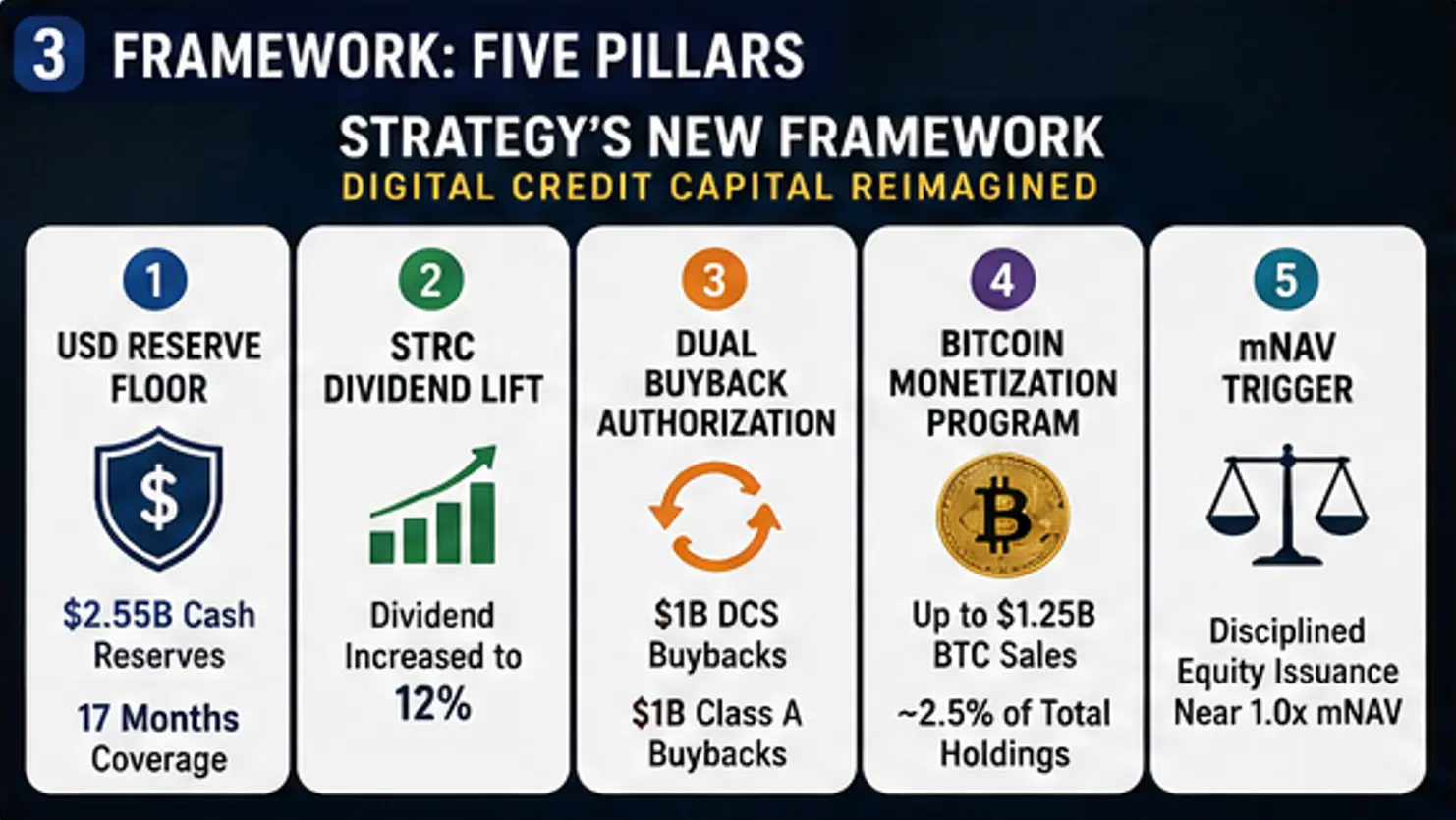 Strategy's new framework is not just a buyback. It is a complete restructuring of how Bitcoin treasury companies survive downturns. Let me break down the five pillars:
Bull Case: Why This Could Be the Bottom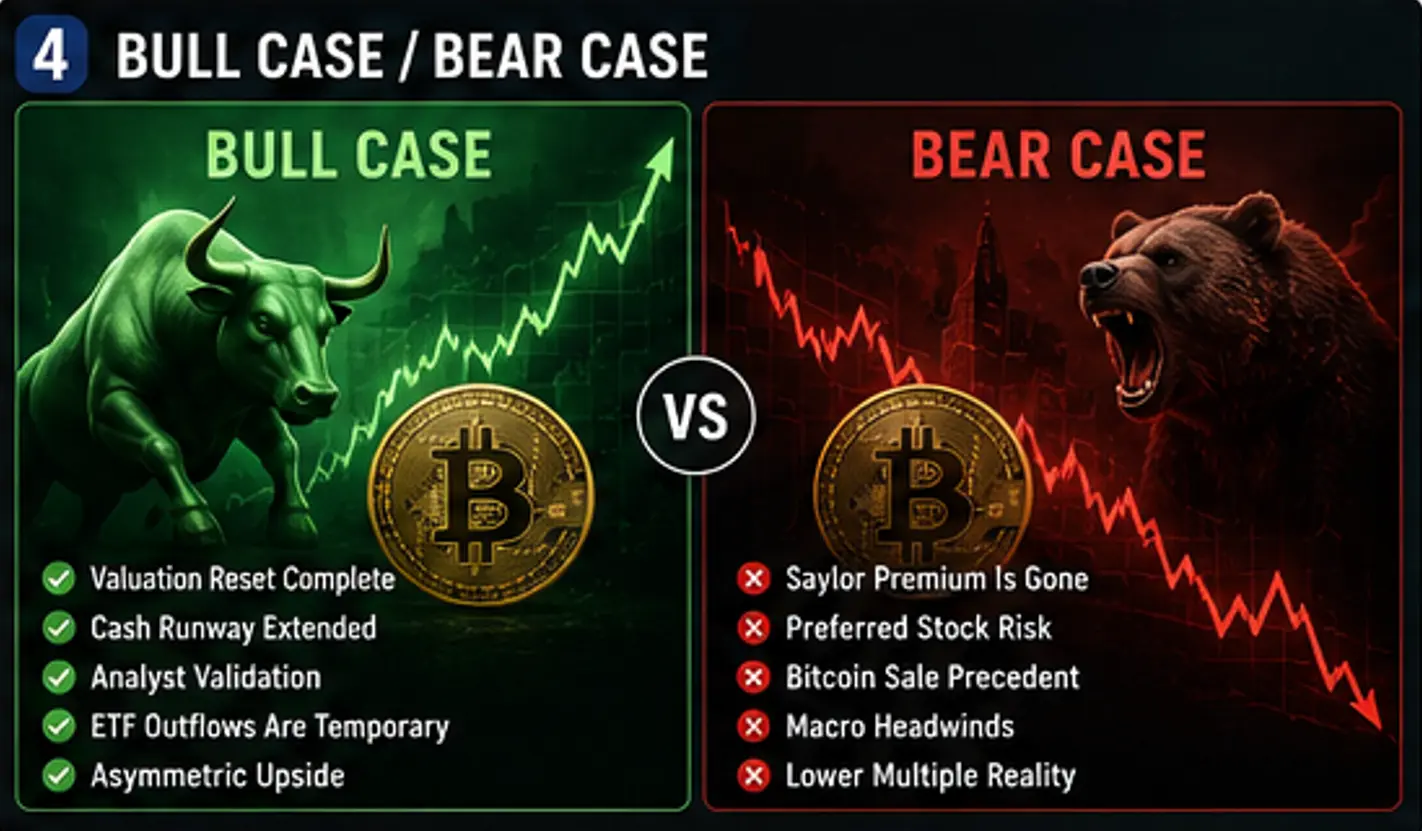 The buyback announcement triggered a 12.6% single-day rally. That is not retail enthusiasm. That is institutional relief. Here is the bull argument:
Valuation Reset Complete MSTR had fallen 80% from its all-time high. The market cap was $29.5 billion against $50+ billion in Bitcoin holdings. Even after the rally, the stock trades at a structural discount to NAV. If Bitcoin stabilizes above $60,000, the upside is asymmetric.
Cash Runway Extended The $2.55 billion reserve buys 17 months of breathing room. The company can weather further Bitcoin volatility without forced selling. This removes the existential risk that was haunting the stock.
Analyst Validation Benchmark reiterated a $570 price target — representing over 500% upside from current levels. Cantor analyst Ramsey El-Assal called the framework "a positive step toward addressing investor concerns about liquidity."
Bitcoin ETF Outflows Are Temporary Spot Bitcoin ETFs have seen $181 million in weekly outflows. But this is a sentiment cycle, not a structural shift. When the macro environment improves, flows will reverse. Strategy is positioned to benefit disproportionately.
Bear Case: The Risks Are Real No honest analysis ignores the downside. Here are the key risks:
The Saylor Premium Is Gone For years, investors paid a premium for Saylor's conviction. That premium evaporated when mNAV hit 0.99. The stock may never again trade at 2x or 3x Bitcoin holdings. The narrative has shifted from "Bitcoin maximalism" to "prudent capital management." That is a lower-multiple story.
Preferred Stock Death Spiral STRC trading at $74.57 is a warning sign. If the price keeps falling, Strategy cannot raise capital through its primary vehicle. The dividend coverage is already tight at 14 months. One more leg down in Bitcoin could force a liquidity crisis.
The Bitcoin Sale Precedent Saylor swore he would never sell. Now he has authorization to sell $1.25 billion. What stops him from selling more if Bitcoin drops to $50,000? Or $40,000? The "never sell" narrative was Strategy's core brand. Without it, the stock is just a leveraged Bitcoin ETF with worse liquidity.
Macro Headwinds Bitcoin is correlated with risk assets. If the Federal Reserve stays hawkish, if recession fears intensify, if AI stocks continue sucking capital out of crypto — Bitcoin could fall further. MSTR would fall harder.
The Psychology Playbook: What Smart Money Is Watching Forget the price targets for a moment. Here is what matters for the next 90 days:
July 15 Dividend Payment Strategy moved to semimonthly dividends. The next payout is July 15. If they make it, the market will breathe easier. If they miss it or cut it, the stock could crater.
Bitcoin Price Action $58,000 was tested last week and held. If Bitcoin breaks below that level, MSTR will retest $80. If Bitcoin reclaims $65,000, MSTR could run to $120.
STRC Price Recovery The preferred stock needs to get back above $85 to signal that institutional buyers are returning. Until then, the funding window remains closed.
Bitcoin Monetization Execution Watch for actual sales. If Strategy starts selling Bitcoin to fund buybacks, the market will react negatively at first. But if they sell small amounts at opportunistic prices and the stock rallies, sentiment could shift.
Future Outlook: The New Era of Bitcoin Treasuries Strategy's pivot is not just about one company. It is a template for how Bitcoin treasury strategies survive bear markets.
Metaplanet in Japan trades at 0.9x enterprise mNAV. Nakamoto sits at 0.92x. Strive is the outlier at 1.24x. The entire sector is being repriced. The days of infinite premium are over.
But here is the opportunity: the companies that survive this downturn will emerge stronger. Strategy has $50 billion in Bitcoin, $2.55 billion in cash, and now a framework for managing both. When the next Bitcoin bull market begins — and it will — Strategy will still be the largest corporate holder. That position has value.
The question is not whether Strategy survives. The question is what multiple the market assigns to survival.
Final Word: The Trade Setup For traders watching this story, here is the framework:
Entry Zone: $85-$95 — current levels offer asymmetric risk/reward if Bitcoin holds $58,000 support.
Invalidation: A break below $80 on heavy volume suggests the mNAV discount is widening, not closing. Cut exposure.
Target: $150-$180 in a recovery scenario where Bitcoin reclaims $70,000 and mNAV returns to 1.3x-1.5x.
Time Horizon: 6-12 months. This is not a day trade. This is a bet on Bitcoin treasury strategies surviving the winter.
The Saylor Pivot is not a surrender. It is an adaptation. The market hates uncertainty, but it hates bankruptcy more. Strategy just bought itself time. In this market, time is the most valuable asset of all.
Risk Warning: This analysis is for informational purposes only. MSTR is a highly volatile stock with significant downside risk. Past performance does not guarantee future results. Bitcoin prices can move rapidly and unpredictably. Consider your risk tolerance and consult a financial advisor before making investment decisions. #StrategyBuybackSurges12%