Futures
Access hundreds of perpetual contracts
CFD
Gold
One platform for global traditional assets
Options
Hot
Trade European-style vanilla options
Unified Account
Maximize your capital efficiency
Demo Trading
Introduction to Futures Trading
Learn the basics of futures trading
Futures Events
Join events to earn rewards
Demo Trading
Use virtual funds to practice risk-free trading
CFD
U.S. stock CFD derivatives
US Stocks
Access real US stocks and ETFs
HK Stocks
Trade quality Hong Kong-listed stocks
Korean Stocks
SK Hynix
Real Korean stocks and top assets
Stock Futures
High leverage, 24/7 trading
Tokenized Stocks
Backed by real stock assets
IPO Access
Unlock full access to global stock IPOs
GUSD
Mint GUSD for Treasury RWA yields
Stocks Activities
Trade Popular Stocks and Unlock Generous Airdrops
Launch
CandyDrop
Collect candies to earn airdrops
Launchpool
Quick staking, earn potential new tokens
HODLer Airdrop
Hold GT and get massive airdrops for free
IPO Access
Unlock full access to global stock IPOs
Alpha Points
Trade on-chain assets and earn airdrops
Futures Points
Earn futures points and claim airdrop rewards


Promotions
AI
Gate AI
Your all-in-one conversational AI partner
Gate AI Bot
Use Gate AI directly in your social App
GateClaw
Gate Blue Lobster, ready to go
Gate for AI Agent
AI infrastructure, Gate MCP, Skills, and CLI
Gate Skills Hub
10K+ Skills
From office tasks to trading, the all-in-one skill hub makes AI even more useful.


THE SAYLOR PARADOX: When Bitcoin's Biggest Corporate Bet Faced Its Greatest TestBy Dragon Fly Official Gate Square
For years, Strategy built its identity around one simple idea: buy Bitcoin, never sell it.
That philosophy turned the company into the world's largest corporate Bitcoin holder and transformed Michael Saylor into one of crypto's most influential voices. Investors rewarded the strategy with a massive premium, believing Strategy offered something more powerful than simply owning Bitcoin—it offered leveraged exposure backed by an aggressive capital strategy.
Then the market changed.
Bitcoin's sharp correction erased billions from Strategy's balance sheet. The premium investors once paid for MSTR disappeared. For the first time in years, the company's market value slipped close to—and at times below—the value of its Bitcoin holdings.
The market wasn't just questioning Bitcoin.
It was questioning the entire corporate Bitcoin treasury model.
Then came an announcement that surprised almost everyone.
Instead of doubling down on its old philosophy, Strategy introduced a $2 billion capital framework that included potential Bitcoin sales, share buybacks, stronger cash reserves, and preferred stock management.
The stock immediately rebounded more than 12%, ending a painful nine-day losing streak.
Many investors celebrated.
Others called it a complete reversal of everything Michael Saylor had promised.
But both reactions miss the bigger story.
This wasn't simply a buyback announcement.
It was the first real stress test of the Bitcoin treasury model—and it revealed something far more important than a short-term price rally.
It exposed how psychology often drives investment decisions more than facts.
That is what I call The Saylor Paradox.
Why Strategy's Premium Disappeared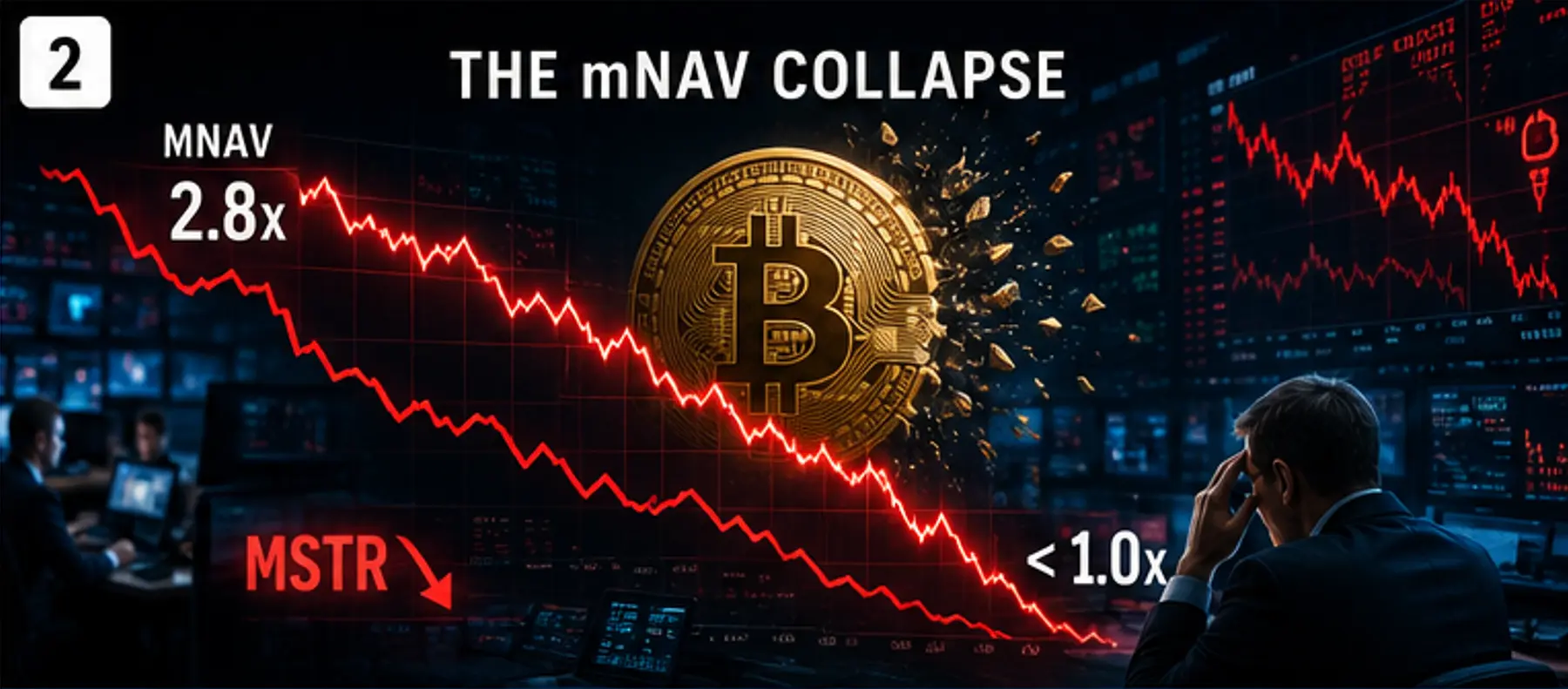
To understand why this announcement mattered so much, we first need to understand what made Strategy unique.
Unlike traditional companies, Strategy's value wasn't based primarily on software revenue.
Its valuation became heavily tied to Bitcoin.
Investors accepted paying well above the value of the company's Bitcoin because they believed Strategy could continuously raise capital, purchase more BTC, and increase Bitcoin exposure faster than ordinary investors ever could.
It became a financial flywheel.
Higher Bitcoin prices pushed MSTR higher.
A higher share price allowed the company to issue more equity.
That new capital bought additional Bitcoin.
More Bitcoin strengthened the narrative.
The cycle repeated itself.
For several years, it worked remarkably well.
At its peak, investors valued Strategy at nearly three times the value of its underlying Bitcoin holdings.
But leverage always works in both directions.
When Bitcoin corrected sharply, unrealized losses climbed into the billions.
The premium vanished.
Without that premium, raising fresh capital became far more difficult because issuing new shares would dilute existing shareholders instead of creating value.
For the first time, investors were forced to ask an uncomfortable question:
Was Strategy still a growth machine—or had it become a highly leveraged Bitcoin holding company struggling to protect its balance sheet?
That question changed everything.
The Real Story Isn't Bitcoin—It's Human Psychology
Markets rarely move on numbers alone.
They move on expectations.
They move on fear.
They move on confidence.
And nowhere is that more obvious than with Strategy.
I call this The Saylor Paradox because both bulls and bears often fall into psychological traps that prevent objective thinking.
Long-term investors still compare today's valuation with the massive premiums seen during the bull market.
Because they remain anchored to those historic levels, today's valuation automatically looks "cheap."
But markets don't always return to old pricing models.
Sometimes a premium disappears permanently after risk has been reassessed.
Assuming history must repeat itself can become an expensive mistake.
Investors who bought near the highs naturally focus on recovering losses.
That emotional pressure makes it difficult to judge today's valuation objectively.
Meanwhile, new investors see opportunity instead of pain.
Ironically, both groups are looking at exactly the same company while reaching completely different conclusions.
THE SAYLOR PARADOX: When Bitcoin's Biggest Corporate Bet Faced Its Greatest Test
By Dragon Fly Official Gate Square
Every great investment story eventually becomes bigger than the numbers behind it.
Strategy wasn't just another publicly traded company.
It became the symbol of corporate Bitcoin adoption.
Michael Saylor wasn't viewed simply as a CEO—he became the face of institutional Bitcoin conviction. Every purchase reinforced the narrative that Bitcoin was the ultimate corporate treasury asset.
But narratives are fragile.
When Strategy introduced a framework that allowed Bitcoin sales under certain conditions, many investors immediately interpreted it as abandoning the company's core philosophy.
In reality, it wasn't a rejection of Bitcoin.
It was an acknowledgment that managing a multi-billion-dollar balance sheet requires flexibility. Markets often mistake adaptation for weakness, even when it's necessary for long-term survival.
Investor psychology is heavily influenced by recent events.
During Bitcoin's rally, every headline celebrated Strategy's success. Positive news dominated social media, financial television, and analyst reports.
Then sentiment reversed.
News feeds became filled with unrealized losses, collapsing premiums, dividend concerns, and questions about liquidity.
Nothing fundamental changed overnight.
The information investors chose to focus on changed.
When the $2 billion capital framework was announced, the narrative shifted again.
Optimism returned almost instantly.
This is availability bias in action.
Investors frequently react to the loudest headlines instead of evaluating long-term fundamentals.
Breaking Down the $2 Billion Capital Framework
Behind the headlines, Strategy's announcement was much more than a simple share buyback.
It represented a complete liquidity management plan designed to strengthen the company's financial flexibility.
The framework contains five important components.
Strategy plans to maintain a significant U.S. dollar reserve capable of covering preferred dividends, interest expenses, and operating obligations for at least twelve months.
This reduces the risk of being forced to sell Bitcoin during periods of market weakness.
Liquidity becomes a defensive weapon.
The company increased the dividend on its STRC preferred shares.
On one hand, this increases financing costs.
On the other, it signals confidence that Strategy believes it can continue meeting those obligations.
It's a calculated trade-off between investor confidence and capital costs.
Rather than allowing expensive preferred securities to remain outstanding indefinitely, Strategy now has flexibility to repurchase them when market conditions become attractive.
Reducing expensive financing can strengthen the balance sheet over time.
Perhaps the most important part of the announcement.
When a company's shares trade below intrinsic value, buying back stock can increase value for remaining shareholders.
If MSTR trades below the value of its Bitcoin holdings, repurchasing shares effectively increases Bitcoin exposure per share without purchasing a single additional Bitcoin.
Ironically, buying fewer assets can sometimes create more shareholder value.
This became the most controversial element.
Strategy authorized the potential sale of up to $1.25 billion worth of Bitcoin if necessary.
Critics immediately called it a broken promise.
Supporters viewed it differently.
Selling a small portion of an asset to strengthen the overall balance sheet isn't abandoning conviction—it's capital management.
The difference between ideology and risk management often determines which companies survive difficult markets.
The Bull Case
Investors who remain optimistic see several reasons for confidence.
First, share buybacks below net asset value are mathematically attractive.
Every discounted share retired increases ownership for remaining shareholders.
Second, stronger liquidity reduces bankruptcy concerns.
A healthier balance sheet gives management greater flexibility during prolonged market volatility.
Third, if Bitcoin stabilizes or begins another major uptrend, Strategy's leverage could once again amplify returns far faster than Bitcoin itself.
In that scenario, today's depressed valuation could eventually look attractive in hindsight.
For bulls, this framework isn't surrender.
It's preparation for the next cycle.
The Bear Case
Skeptics remain unconvinced.
Their concerns are equally valid.
Strategy's greatest competitive advantage was investor confidence.
Once the market begins questioning that confidence, rebuilding it becomes difficult.
The willingness to monetize Bitcoin—even under specific circumstances—changes how investors evaluate future risks.
If Bitcoin experiences another severe drawdown, additional sales may become necessary.
Leverage also remains a double-edged sword.
While it amplifies gains during bull markets, it magnifies losses during downturns.
The company still depends heavily on Bitcoin's long-term success.
Without a sustained recovery in BTC, financial pressure could continue despite the new framework.
The Bigger Question: Is This the Future of Corporate Bitcoin?
Strategy's latest move is about far more than one company's balance sheet.
It may become the blueprint that every future Bitcoin treasury company studies during the next market downturn.
The first generation of corporate Bitcoin adopters focused on one objective: accumulate as much Bitcoin as possible.
The next generation will likely focus on something equally important—capital efficiency.
Holding Bitcoin is only one part of the equation.
Managing liquidity, protecting shareholders, maintaining market confidence, and surviving prolonged bear markets are what separate sustainable treasury companies from temporary success stories.
This may ultimately become Michael Saylor's most important lesson—not how to buy Bitcoin, but how to protect a Bitcoin treasury through every phase of the market cycle.
Key Metrics Investors Should Watch
Instead of reacting to headlines, investors should focus on a handful of indicators that genuinely matter.
Bitcoin remains the single largest driver of Strategy's valuation.
A sustained recovery above major resistance levels would strengthen the company's balance sheet and restore investor confidence.
Conversely, another sharp decline would place additional pressure on liquidity and valuation.
The premium investors assign to Strategy relative to its Bitcoin holdings tells us how much confidence the market has in its treasury model.
If the premium gradually returns, it signals renewed belief in management's long-term strategy.
If it remains weak, the market may be assigning a permanently lower valuation to leveraged Bitcoin exposure.
Cash reserves, financing costs, preferred dividend obligations, and debt maturity schedules deserve just as much attention as Bitcoin purchases.
A healthy treasury company is measured not only by the assets it owns but also by its ability to survive difficult markets without making forced decisions.
Large funds often reveal changing sentiment before retail investors notice it.
Future capital raises, analyst ratings, institutional ownership, and market liquidity will provide important clues about how professional investors view Strategy's evolving business model.
The Real Lesson Behind the Saylor Paradox
The biggest mistake investors can make is believing this story is only about Michael Saylor.
It isn't.
It's about how markets behave when conviction meets uncertainty.
During bull markets, confidence becomes contagious.
Investors willingly pay extraordinary premiums because they expect tomorrow to look like yesterday.
During bear markets, fear spreads just as quickly.
The same investors who once believed no price was too high suddenly convince themselves that every rally is temporary.
Reality usually sits somewhere between those extremes.
Strategy is neither invincible nor doomed.
It remains one of the most unique publicly traded companies in the financial markets—a company whose future is deeply connected to Bitcoin, capital markets, and investor psychology.
Understanding that relationship is far more valuable than simply predicting the next weekly price movement.
Final Verdict
The recent $2 billion capital framework should not be viewed as a victory for either bulls or bears.
Instead, it represents a strategic evolution.
For years, Strategy's identity revolved around one principle: buy Bitcoin and never sell.
Today's framework reflects a more mature philosophy.
Strong treasury management is not about refusing to adapt.
It is about ensuring that the company remains financially resilient regardless of market conditions.
Some investors will interpret this shift as a sign of weakness.
Others will see it as evidence of responsible leadership.
History will ultimately decide which interpretation proves correct.
What is already clear, however, is that Strategy has entered a new chapter.
Its future success will depend not only on Bitcoin's performance but also on management's ability to balance conviction with discipline.
For investors, that means focusing less on emotional headlines and more on measurable fundamentals.
Because in the end, markets reward preparation far more consistently than they reward certainty.
As always, Dragon Fly Official believes that successful investing begins with understanding risk before chasing opportunity. Whether you're bullish or bearish on Strategy, one principle remains unchanged: conviction should always be supported by disciplined analysis, not emotion.
Thank you for reading. If you found this analysis valuable, follow Dragon Fly Official on Gate Square for more in-depth market research, behavioral finance insights, and institutional-level crypto analysis.
Risk Warning
This article is for educational and informational purposes only and should not be considered financial or investment advice. Strategy (MSTR) and Bitcoin are highly volatile assets that can experience significant price fluctuations. Always conduct your own research, evaluate your financial situation, and understand the risks before making any investment decisions.
#SolanaEcosystemANSEMSurges