Futures
Access hundreds of perpetual contracts
CFD
Gold
One platform for global traditional assets
Options
Hot
Trade European-style vanilla options
Unified Account
Maximize your capital efficiency
Demo Trading
Introduction to Futures Trading
Learn the basics of futures trading
Futures Events
Join events to earn rewards
Demo Trading
Use virtual funds to practice risk-free trading
CFD
U.S. stock CFD derivatives
US Stocks
Access real US stocks and ETFs
HK Stocks
Trade quality Hong Kong-listed stocks
Korean Stocks
SK Hynix
Real Korean stocks and top assets
Stock Futures
High leverage, 24/7 trading
Tokenized Stocks
Backed by real stock assets
IPO Access
Unlock full access to global stock IPOs
GUSD
Mint GUSD for Treasury RWA yields
Stocks Activities
Trade Popular Stocks and Unlock Generous Airdrops
Launch
CandyDrop
Collect candies to earn airdrops
Launchpool
Quick staking, earn potential new tokens
HODLer Airdrop
Hold GT and get massive airdrops for free
IPO Access
Unlock full access to global stock IPOs
Alpha Points
Trade on-chain assets and earn airdrops
Futures Points
Earn futures points and claim airdrop rewards


Promotions
AI
Gate AI
Your all-in-one conversational AI partner
Gate AI Bot
Use Gate AI directly in your social App
GateClaw
Gate Blue Lobster, ready to go
Gate for AI Agent
AI infrastructure, Gate MCP, Skills, and CLI
Gate Skills Hub
10K+ Skills
From office tasks to trading, the all-in-one skill hub makes AI even more useful.


美光翻倍前,台股月營收早喊了五個月:用台灣財報的「時間差」,提前讀美股記憶體
June 24, 2026, After Hours: The entire market is holding its breath waiting for Micron (MU)'s Q3 earnings report, but those who understand Taiwan's monthly semiconductor revenue data saw this wave coming as early as October last year. Taiwan's semiconductor companies are required by the Securities and Exchange Act to announce last month's revenue before the 10th of each month, while Micron only releases quarterly reports once per season, with its fiscal year closing about a month earlier. Since both are selling the same DRAM/NAND supply chain, the Taiwanese manufacturers' early disclosures serve as a "trailer" for Micron's upcoming report. This article walks through a real case to demonstrate the "time lag = information gap" interpretive method.
(Background recap: Micron's strategic investment in Anthropic's Series H financing! Both parties sign a long-term HBM supply agreement, MU's stock price skyrockets past 1200.)
(Additional background: Bernstein: DRAM will continue to surge through 2027, with each wafer earning twice as much from HBM, marking the start of a super-profit era in memory chips.)
Table of Contents
Toggle
Key Takeaways
After hours on June 24, 2026, the entire market is holding its breath waiting for Micron (MU)'s Q3 earnings report. But those who truly understand Taiwan's monthly revenue data saw this wave coming as early as October last year. At that time, Nanya's stock price nearly tripled within two months, and its monthly revenue YoY growth had already surged to 262%, while most US investors only started chasing Micron this spring.
The gap between these timelines is not due to insider information but likely caused by systemic time differences: Taiwan's semiconductor companies must report last month's revenue before the 10th, while the US memory giants only release quarterly reports once per season, with Micron's fiscal year closing about a month earlier. The Q3 report covering March to May won't be released until June 24.
Since both are selling the same DRAM/NAND supply chain, the Taiwanese companies' early disclosures act as a "trailer" for Micron's report. This article uses a real example to walk through this "time lag = information gap" interpretive method.
Why can Taiwan's monthly revenue serve as Micron's high-frequency temperature gauge
First, clarify the memory supply chain relationship. Micron produces DRAM, NAND, and HBM; the Taiwanese companies that correspond to its major revenue sources are Nanya Technology (2408) and Winbond (2344), which are Taiwan's own DRAM manufacturers and serve as traditional/niche DRAM price indicators; Phison (8299) makes NAND controllers and SSDs, purchasing NAND wafers from Micron, Samsung, and others, representing NAND and enterprise storage demand; Adata (3260) is a module manufacturer that sources chips from the three major suppliers, most sensitive to shortages and price hikes. DRAM + NAND account for about 80% of Micron's revenue (FQ2: DRAM 79%, NAND 21%).
So the logic is simple: these Taiwanese manufacturers' monthly revenue, paid in real money, measures the "memory cycle" that accounts for nearly 80% of Micron's business, and it is publicly available more than a month before Micron's quarterly report, accessible to the entire market (including foreign investors). It provides a "higher frequency" signal, not insider information.
But remember one red line: this temperature gauge measures the mid-tier DRAM/NAND cycle accurately but cannot reflect HBM, which is produced in-house by SK Hynix, Samsung, and Micron, with no Taiwanese outsourcing. No Taiwanese company’s monthly revenue can reflect Micron's HBM. As for other key US memory/storage companies like Western Digital (WDC) and Seagate (STX), which are spun off as pure HDD manufacturers, their supply chains mainly involve Japanese components, so Taiwanese monthly revenue data cannot reflect their shipments or prices either. This blind spot will become critical in the third section.
From late last year to early this year, Taiwan's signals were already clear
Returning to the actual example: if you wanted to know whether to buy Micron in March 2026, you didn't need to wait for Micron's March report. The signals had been growing louder since Q4 2025 from Taiwanese companies' monthly revenue data:
Read it as a timeline: October 2025 was the first bullish signal, with Samsung suspending DDR5 contract prices and China’s CXMT abandoning DDR4, while Nanya's revenue YoY jumped from +158% in September to +262%, hitting a 50-month high. November and December confirmed the trend with Nanya and Phison both hitting monthly record highs. Phison's CEO Pan Jiancheng in early January explicitly stated that "CSP is driving NAND price increases and shortages."
By January 2026 (announced in early February), revenues exploded: Nanya +608%, Adata +199%, Phison +189%. These are all publicly available figures you could have read before buying Micron in March.
Even more telling, Taiwan's stock prices moved in sync and earlier than US stocks. Nanya's stock price rose from NT$47 in August 2025 to NT$73 in September and NT$132.5 in October—almost tripling in two months; Phison broke NT$1,000 in October, and Adata doubled. Compared to Micron: at September 2025, it was at $167, then $285 in December, reaching about $460 by mid-March of the following year. Taiwan's revenue and stock prices had already priced in the "memory cycle turning bullish"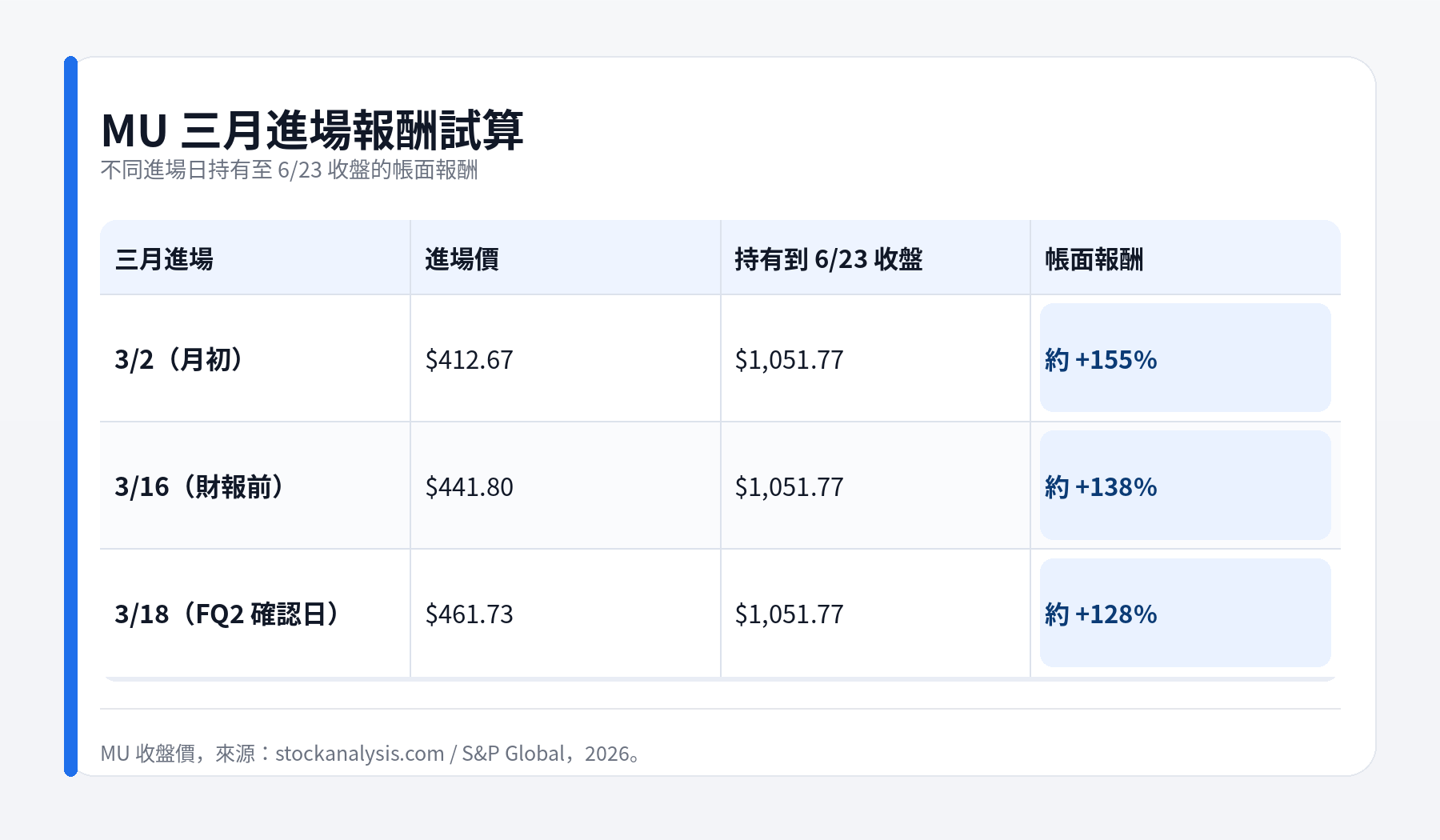 months
  ahead; Micron only confirmed it later. (Taiwan stock prices: Goodinfo monthly K; Micron: S&P Global.)
Actual test: If you followed this signal in March to buy Micron (example, not investment advice)
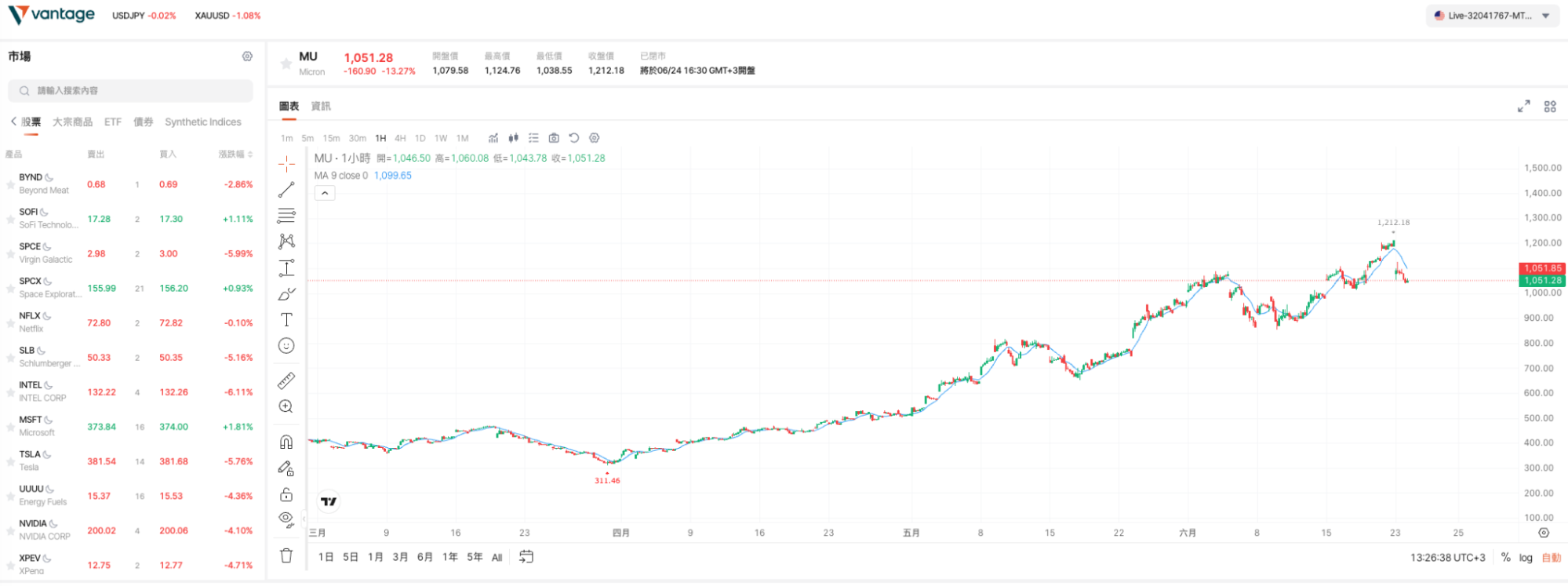
Turn the signals into actions. First, clarify: the following is a post hoc demonstration, not investment advice or real trading records. The key point is that by March 2026, Taiwanese manufacturers had been announcing five consecutive months of rising revenue, and Micron's own FQ1 (December 19 last year) had already shown a big earnings jump. Buying Micron in March and holding until late June would have yielded a paper profit of about +128% to +155%. But note, although the numbers look good, caution is still needed, as Micron did experience some dips in between. However, observing that Taiwanese memory manufacturers experienced YoY growth after a sluggish period last year, and that subsequent months continued to show large YoY increases, can be incorporated into your investment considerations. The key to this rally pattern will be explained below.
If you want to connect with more professional traders and experienced investors, join the: BlockTempo and Vantage collaboration's Mandarin-speaking official community.
Vantage is a multi-asset trading platform where you can trade Micron, Seagate, and Western Digital mentioned in this article.
This wave of rally has different "patterns" before and after
To judge what’s next, you first need to understand why this rally happened, and how the drivers have shifted over the past six months.
In the second half of 2025, the "cycle bottom + supply-side events" ignited: after the downtrend in 2022–23, memory prices bottomed out, driven by corporate capital discipline and inventory digestion; the real trigger was Samsung's suspension of DDR5 contract pricing and switching to monthly pricing (driving DDR prices up by about 25% weekly), along with China abandoning DDR4 and shifting capacity to DDR5. Traditional DRAM contract prices in Q4 were revised upward by 18–23% quarter-over-quarter. This period's "clean bullish" signals are best reflected by Nanya and Winbond's monthly revenue growth.
In 2026, the pattern upgrades to "AI-driven capacity squeeze and structural shortages": OEMs shifted almost all incremental capacity to HBM, which, due to high chip density, consumes about 20% of DRAM wafer capacity, squeezing traditional DRAM/NAND to the limit. In Q1 2026, traditional DRAM contract prices soared 90–95% quarter-over-quarter—the largest single-quarter increase in history. The most counterintuitive and illustrative change is that: even gross margins for traditional DRAM surpassed HBM (Micron CEO Mehrotra confirmed that non-HBM margins are now higher than HBM), which is the main reason Micron's gross margin surged to about 81%. This was achieved through price increases on traditional chips, not HBM. Micron's CEO described the current situation as "unprecedented," with shortages expected to continue beyond 2026. Several investment banks (like TD Cowen) have directly stated that "memory is now structural (due to AI), not cyclical."
In other words: the past half-year's rally was driven by "cyclical upturn," but the recent surge is due to "AI-driven structural shortages." How can you tell the difference? By observing the intensity of price increases in traditional DRAM revenue for Nanya and Winbond, and NAND for Phison and Macron, but the most aggressive HBM line cannot be seen in Taiwan's data—only Micron's own reports and guidance reveal that.
Tonight's Micron earnings, possible scenarios
With the above understanding, you can interpret what the market is betting on tonight (after hours on June 24). The focus isn't on this quarter's numbers—Micron's revenue is expected around $33.5 billion, with gross margins about 81%, but market consensus is higher (revenue around $34.5–$35.6 billion, EPS about $19.7–$20.6). This means the "beat" is already priced in. What will truly move the stock is the guidance for Q4 (market consensus around $38–$40 billion), HBM pricing, and visibility into 2027. The options market prices in daily volatility of 14–17%, and several investment banks just raised their target prices above $1,500 (UBS even up to $1,625). Three possible scenarios:
The Taiwanese monthly revenue can help you judge Scenario 1—whether "mid-tier demand is still hot"—but the key drivers of stock price, HBM and guidance, are in the blind spot that this temperature gauge cannot measure. Its role is clear: to help you see the cycle turning bullish months ahead (like October last year), but don’t expect it to predict tonight’s after-hours jump.
Conclusion
The time lag is a real, public, and repeatable advantage. Taiwan's memory manufacturers' monthly revenue and stock prices have already signaled this bullish turn since fall 2025, ahead of Micron's quarterly reports and even authoritative forecasts. But it only measures the mid-tier DRAM/NAND cycle accurately; it cannot reflect the most market-moving HBM, nor the HDDs of Western Digital and Seagate. Use it as a compass, not a crystal ball—anticipate the cycle turning bullish early, then confirm with Micron's quarterly reports and guidance. Tonight, June 24, Micron's report will be the final piece.
Join the official Mandarin community in collaboration with Vantage and BlockTempo to gain:
Disclaimer: This article is for industry and financial report information only and does not constitute investment advice or an offer. The stocks, data, and "actual demonstration" areas mentioned are for illustrative purposes only, not profit guarantees; all figures are based on publicly available information as of the data point, and market expectations and stock prices may fluctuate significantly after tonight's report. Memory and HDD markets are highly cyclical and volatile, and actual investments are affected by many factors not covered here. Please assess risks carefully or consult qualified professionals before investing.