South Korean Exchange Bithumb Mistakenly Distributes 2,000 KRW as 2,000 Bitcoins Due to Human Input Error, Triggering Price Flash Crash, Regulatory Intervention, and Systemic Reflection.
2,000 KRW Turns into 2,000 Bitcoins Causing Market Flash Crash
On February 6, 2026, South Korea’s well-known cryptocurrency exchange Bithumb experienced a jaw-dropping operational incident. The exchange had scheduled a promotional event called “Random Box” at 7 PM that evening, intending to award approximately 2,000 KRW (about $1.40 to $1.50 USD) as small prizes to winners. However, due to a serious internal input error, staff mistakenly set the distribution unit to Bitcoin ($BTC) instead of KRW, resulting in 695 eligible user accounts each receiving an astonishing reward of up to 2,000 Bitcoins.
This error led to an on-paper allocation of approximately 620,000 Bitcoins, which, based on the market price at the time, valued the funds at between $40 billion and $44 billion. Although these assets only existed on Bithumb’s internal ledger and no actual on-chain transfers occurred yet, it was enough to cause a catastrophic impact on the platform’s market liquidity. Many users who received this “windfall” immediately attempted to sell, causing a severe disconnect between Bithumb’s Bitcoin prices and the global market.
Bitcoin’s price plummeted from about $71,000 to a low of $55,000 within minutes, a drop of over 20%, even creating a rare “Reverse Kimchi Premium,” an abnormal phenomenon where prices within Korea fell below the global average.
Bithumb Acts Quickly to Stop the Bleeding and Fill the Gap
Faced with what analysts called a “DIY comedy” of a technical disaster, Bithumb detected abnormal trading within approximately 20 to 35 minutes after the incident and acted swiftly. The exchange immediately restricted trading and withdrawal rights for the 695 affected accounts, successfully stabilizing the market price and avoiding broader chain liquidations. According to a statement released by Bithumb on February 8, the company had successfully recovered about 618,212 Bitcoins, accounting for 99.7% of the mistakenly distributed amount.
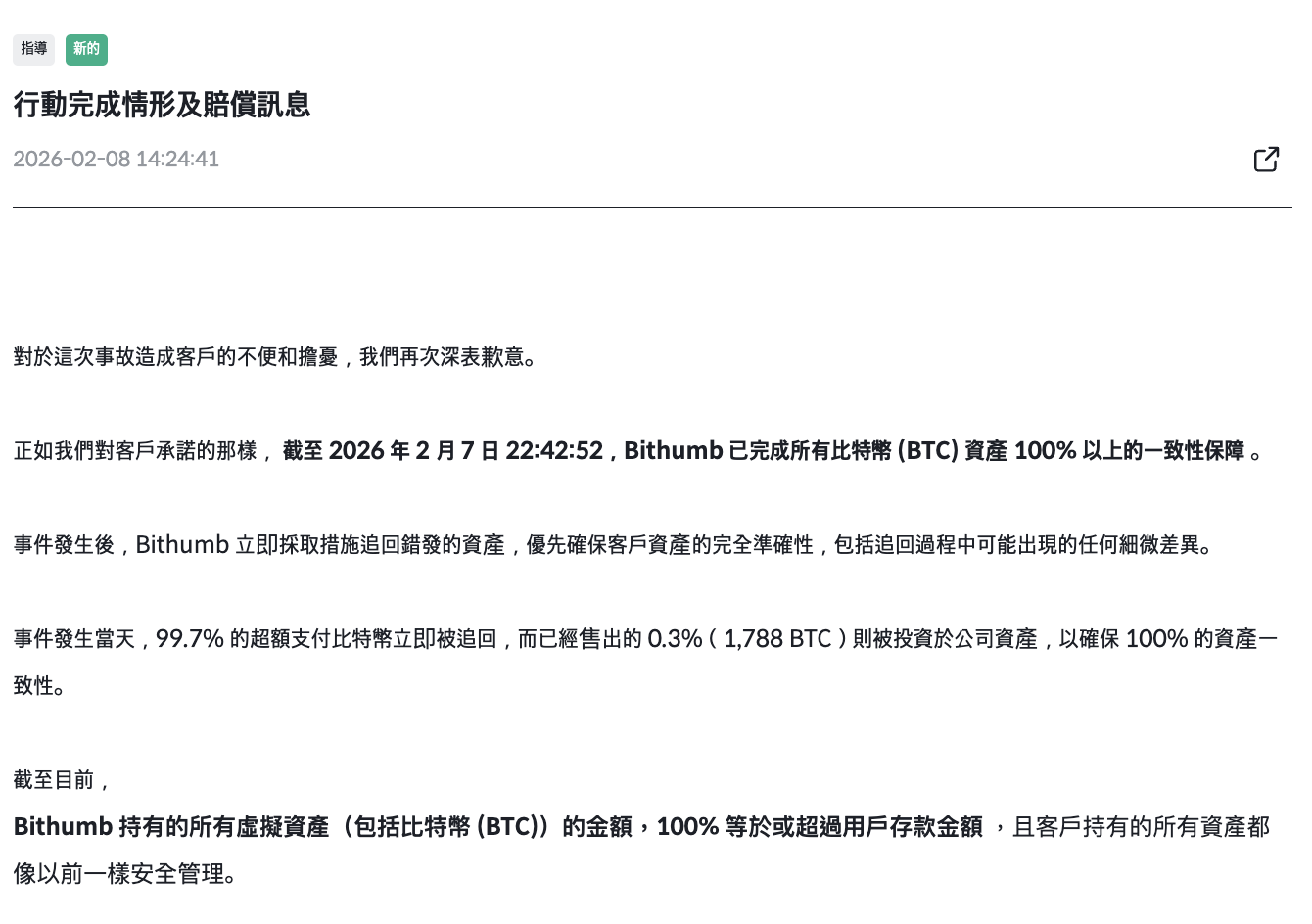
Image Source: Bithumb Bithumb issued a statement emphasizing that approximately 618,212 Bitcoins have been successfully recovered.
For the remaining 0.3%, roughly 1,788 Bitcoins, since users had already sold off their holdings before the restrictions took effect, Bithumb pledged to use its own assets to cover this gap, ensuring that the reserve ratio of all user assets remains above 100%.
Bithumb emphasizes that this incident was purely due to an internal operational software error, unrelated to external hacking or security vulnerabilities, and that customer assets stored on the platform have always been secure and under control.
Additionally, the exchange disclosed that it has recovered 93% of the KRW or other assets from affected users’ sales, with no Bitcoins transferred outside the platform.
Users Receive 110% Compensation and Trading Fee Waivers
To restore public confidence and calm affected users, Bithumb CEO Lee Jae-won issued a sincere apology and announced a series of compensation measures.
First, for users who suffered losses during the incident due to sharp price fluctuations and panic selling, Bithumb will provide up to 110% compensation, including the full sale value plus an additional 10%. Statistically, the total loss caused by panic selling was about 1 billion KRW (approximately $680,000 USD).
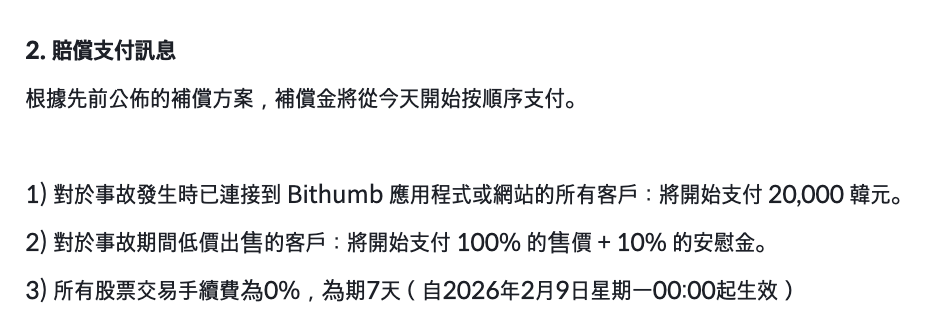
Image Source: Bithumb Bithumb’s Compensation Plan for the Incident
In addition, all users registered or active on the platform at the time of the incident, whether directly affected or not, will receive a consolation payment of 20,000 KRW (about $15 USD). To further soothe the market, Bithumb will implement a 7-day fee-free trading period starting from February 9 (Monday). The exchange also announced the establishment of a permanent “Customer Protection Fund” with a total amount of up to 100 billion KRW (about $68 million USD), dedicated to addressing future technical incidents or operational risks. This measure aims to rebuild the exchange’s reputation, especially as it pursues an IPO in the United States.
Regulatory Authorities Intervene, Exposing Structural Weaknesses
This shocking incident of mistaken fund transfer has attracted high attention from South Korea’s financial regulators. The Financial Supervisory Service (FSS) and the Financial Services Commission (FSC) have officially launched investigations, with a site inspection of Bithumb’s offices on February 7.
Regulators pointed out that the incident revealed “structural vulnerabilities” in the internal control systems of domestic virtual asset exchanges, such as employees having excessive permissions that allow them to directly distribute various assets—including KRW, Bitcoin, and Ethereum—without multiple layers of approval.
Senior management at Bithumb also reflected deeply on this. In a letter to employees, Vice President of Operations Hwang Seung-wook admitted that a single reward unit setting error could destabilize the entire exchange, highlighting systemic deficiencies.
Going forward, Bithumb plans to implement stricter asset verification processes, multi-step payment approval systems, and introduce AI-based 24-hour abnormal transaction detection systems. This incident serves as a stark warning to global crypto exchanges: even seemingly minor human typing errors, if lacking robust fail-safe mechanisms, can escalate into market disasters worth hundreds of billions of dollars.


