Zcash (ZEC) is a proof-of-work (PoW) cryptocurrency centered on privacy protection. It uses zero-knowledge proof technology to enable on-chain transfers without disclosing sensitive information such as the transaction sender, recipient, or amount. Unlike Bitcoin, where transaction records are public by default, Zcash offers both transparent and shielded transaction modes, allowing users to choose the level of transaction disclosure based on their needs.
As stablecoin payments, on-chain finance, and cross-border digital asset transfers continue to develop, the balance between privacy protection and transaction efficiency has again become a key market focus. Although Zcash has established a relatively mature shielded transaction mechanism, longer block confirmation times, wallet synchronization costs, and infrastructure compatibility issues still limit its user experience in everyday payment scenarios. The upcoming NU7 network upgrade is an important protocol adjustment designed to address these issues.
On October 21, 2026, Zcash developers further clarified the mainnet activation block height for NU7, with the upgrade expected to be completed around November 5. In addition to reducing the target block time to 25 seconds, this update involves shielded transaction capacity, legacy transaction formats, and long-term miner incentive mechanisms. Understanding NU7's impact requires distinguishing between block production speed, final transaction confirmation, privacy transaction processing capacity, and tokenomics changes.
Key Takeaways
-
The Zcash NU7 upgrade is planned to activate on the mainnet around November 5, 2026. Developers have selected block height 3,543,405, but as of October 22, the relevant deployment specifications and node software still require final integration.
-
The target block time will be reduced from 75 seconds to 25 seconds, which could theoretically reduce the average waiting time for a fixed number of confirmations by about two-thirds.
-
Privacy transaction processing capacity is expected to improve. Shorter block intervals combined with new shielded transaction limits may help improve transaction capacity and reduce the synchronization burden for light wallets.
-
NU7 will not change ZEC's maximum supply of 21 million. The protocol will adjust per-block rewards and halving intervals to preserve the existing issuance schedule as much as possible.
-
The upgrade will introduce a network sustainability mechanism that temporarily removes about 60% of transaction fees from circulation, with plans to gradually redirect the related reserves to miner rewards beginning in February 2031.
-
Faster block confirmations do not mean transactions are completed immediately, nor do they mean that the price of ZEC will necessarily rise. Wallet support, exchange confirmation rules, and network stability will still affect the actual payment experience.
What Is the Zcash NU7 Upgrade, and Why Is the Market Watching November 5?
NU7 is Zcash's seventh numbered network upgrade and an important protocol update involving changes to consensus rules. Its goals include not only allowing transactions to be included in blocks more quickly, but also optimizing shielded transaction resource limits and adjusting the network's future security incentive structure.
In September 2026, Zcash ecosystem development teams reached consensus on the scope and timing of the NU7 upgrade, setting November 5 as the target date for the mainnet upgrade. The related testnet upgrade began in early October, providing a testing environment for nodes, wallets, and other infrastructure.
The latest development on October 21 showed that developers selected block height 3,543,405 as the planned activation point. Because block production times can vary, the actual upgrade time should be determined by when the chain reaches the specified height rather than by a fixed calendar time.
As of October 22, the related activation proposal still required final integration work. Therefore, November 5 should be understood as an expected date rather than a completed mainnet upgrade.
The main elements of NU7 can be summarized as follows:
| Upgrade Area |
Main Change |
Expected Impact |
| Block production speed |
Reduced from 75 seconds to 25 seconds |
Reduces transaction confirmation waiting times |
| Shielded transaction capacity |
Adjusts transaction limits for Orchard, Sapling, and related protocols |
Improves privacy transaction processing capacity |
| Transaction fees |
About 60% temporarily removed from circulation |
Establishes reserves for future miner rewards |
| Block rewards |
Adjusts per-block rewards and halving intervals |
Maintains the existing issuance pace |
| Legacy protocols |
Prohibits legacy transactions and deactivates Sprout |
Simplifies protocol maintenance and upgrades |
| Node infrastructure |
Advances the transition from zcashd to Zebra nodes |
Improves node software maintenance and performance |
These changes show that NU7 is not simply an update to increase transaction speed. It is a comprehensive upgrade involving user experience, protocol maintenance, and long-term network security.
How Do Zcash Privacy Payments Work, and What Role Do Zero-Knowledge Proofs Play?
Zcash's privacy protection primarily relies on zero-knowledge proofs, with zk-SNARKs being one of its core cryptographic technologies.
On traditional public blockchains, transaction senders, recipients, and amounts can generally be viewed by on-chain observers. Although blockchain addresses do not necessarily correspond directly to real-world identities, external observers may still infer some of a user's financial activities through transaction records, fund flows, and address association analysis.
Zcash shielded transactions use a different approach. Users can generate cryptographic proofs that demonstrate to the network that a transaction complies with protocol rules—for example, that funds have not been double-spent and that transaction inputs and outputs meet the required constraints—without publicly disclosing all transaction details.
This enables Zcash to achieve two goals simultaneously: the network can verify that transactions are valid, while external observers cannot directly view sensitive information in shielded transactions.
Zcash's privacy system has gone through stages including Sprout, Sapling, and Orchard. Orchard is a newer shielded transaction protocol designed to provide a more efficient privacy transaction experience.
However, Zcash does not hide all information for every transaction by default. Users can still use transparent addresses, and some information in transparent transactions is public, as it is with Bitcoin. The degree of privacy protection depends on the transaction type, wallet implementation, and how funds move into and out of transparent addresses.
In addition, zero-knowledge proofs address transaction information disclosure and do not automatically shorten block production times.
Therefore, NU7's main improvement to privacy payment efficiency is not a change to the fundamental principles of zero-knowledge proofs. Instead, it improves the operating conditions of existing privacy payment mechanisms at the network level by shortening block intervals and adjusting shielded transaction resource limits.
How Will 25-Second Block Times Triple ZEC Transaction Confirmation Speed?
The most visible change in NU7 is the reduction of Zcash's target block interval from 75 seconds to 25 seconds.
Blockchain transactions generally need to be received by nodes before miners package them into blocks. For payment scenarios that wait for on-chain confirmation, block production speed directly affects how quickly users first see their transactions confirmed.
Under the existing mechanism, Zcash produces one block every 75 seconds on average. After the upgrade, the target interval will be reduced to 25 seconds, meaning that the network could theoretically produce about three times as many blocks in the same period.
Zcash NU7: Block Production and Confirmation Time Comparison
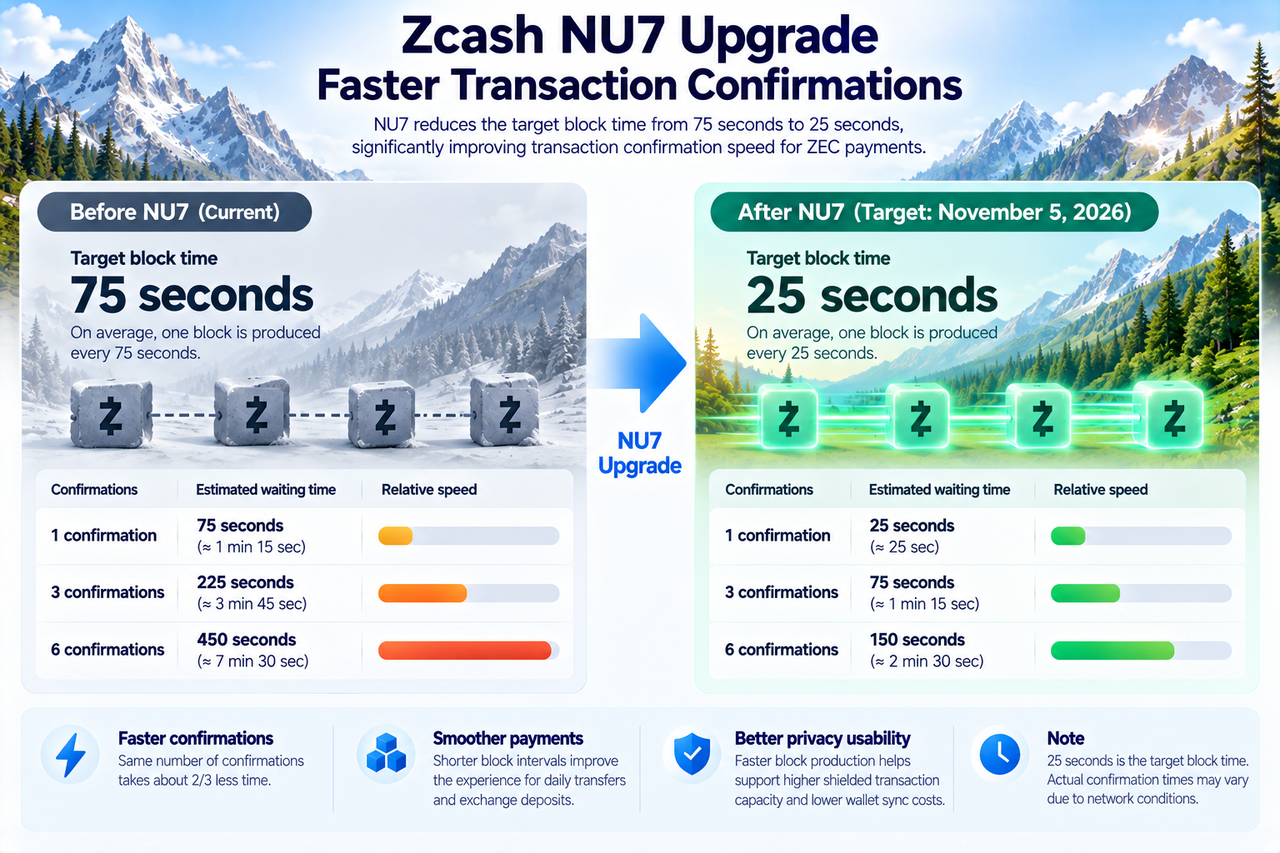
For example, if an exchange requires a user's ZEC deposit to receive three block confirmations, the theoretical waiting time under the existing mechanism would be about 225 seconds, or 3 minutes and 45 seconds. After NU7 is activated, the target time for the same three confirmations will be reduced to about 75 seconds.
For everyday payments, this change can reduce the time users spend waiting for transaction confirmation. It may also benefit exchange deposits, cross-chain bridge deposits, and other services that depend on block confirmations.
However, there is an important distinction: tripling block production speed does not mean that all transaction operations will become three times faster. Transaction broadcasting, miner inclusion, wallet proof generation, node synchronization, and service provider risk controls can all affect the actual experience. In addition, block production on proof-of-work networks is random. Twenty-five seconds is a protocol target, not a guarantee that every block will be produced on time.
Therefore, NU7 improves expected efficiency at the block confirmation level rather than providing an absolutely fixed transaction completion time.
How Will NU7 Increase Orchard Shielded Transaction Capacity and Reduce Wallet Synchronization Costs?
In addition to faster block production, NU7 also plans to adjust resource limits related to shielded transactions. Zcash privacy transactions are more complex than standard transparent transfers because the network must process operations related to zero-knowledge proofs, shielded asset states, and related cryptographic data.
Without reasonable resource limits, malicious participants could increase the processing burden on nodes and wallets through large volumes of complex transactions, affecting the user experience of regular users.
NU7 therefore introduces new per-block shielded transaction resource limits, including limits on the number of Orchard and related protocol operations, as well as corresponding limits on Sapling inputs and outputs. Technical documentation from the Zcash Foundation indicates that, when combined with shorter block intervals, these adjustments can more than double the processing capacity of the Orchard protocol while reducing the worst-case synchronization burden that malicious transactions may impose on light wallets by about 37%.
This change has two implications.
-
Higher shielded transaction capacity may support more users making private transfers and reduce potential resource competition as network activity increases.
-
Reducing the synchronization burden for light wallets can improve the experience of clients such as mobile wallets. For everyday payments, users care not only about on-chain confirmation speed, but also whether their wallets can quickly update balances, detect received funds, and remain properly synchronized.
However, NU7 does not mean that large-scale private transaction throughput comparable to traditional bank card networks has already been achieved. Actual performance will still need to be assessed after the mainnet upgrade through real transaction volumes, node performance, and wallet usage.
Why Does NU7 Adjust Transaction Fees, and What Does a 60% Fee Reserve Mean?
Another important change in NU7 is the introduction of the Network Sustainability Mechanism (NSM).
Like Bitcoin, Zcash uses a proof-of-work mechanism. Miners participate in block production by providing computing power and receive block subsidies and transaction fees.
As block rewards are periodically halved, miner income from newly issued ZEC will gradually decline. Over the long term, the network needs to consider how to maintain a sufficient security budget.
Through ZIP 235 and ZIP 237, NU7 plans to adjust the distribution of transaction fees and their future release method. Under this mechanism, about 60% of transaction fees within each block will be temporarily removed from circulation and placed into a protocol-level reserve arrangement, while the remaining approximately 40% will continue to go to miners.
Funds in the reserve are planned to begin gradually reentering the miner reward system around February 2031 under protocol rules. The purpose of this mechanism is not simply to reduce the total supply of ZEC, but to transfer a portion of current transaction fee income to the future, providing supplementary funding for network security after block subsidies gradually decline.
It is important to distinguish among three concepts:
-
Temporarily removed from circulation: The related transaction fees temporarily do not enter the general circulating market.
-
Future reissuance: Reserve funds are planned to gradually return to miner rewards in later blocks.
-
Permanent burn: Tokens permanently exit the supply system.
NU7's transaction fee reserve falls into the first two categories and is not a traditional permanent token burn.
Therefore, it should not be interpreted simply as a permanent 60% reduction in ZEC supply, and it should not be used to directly infer that the price of ZEC will rise.
Will NU7 Change ZEC's Supply Cap and Halving Cycle?
NU7 does not plan to change ZEC's maximum supply of 21 million, nor does it intend to increase the amount of newly issued ZEC per day by accelerating block production.
This is especially important for understanding the post-upgrade tokenomics. If block production frequency increased threefold while per-block rewards remained unchanged, the amount of ZEC issued each day would increase significantly, changing the original supply curve.
To avoid this outcome, NU7 will adjust per-block rewards and the number of blocks required for halvings accordingly. Specifically, the reward for each block will be adjusted for the shorter block interval, and the number of blocks included in each halving interval will also increase accordingly, helping preserve the existing time-based issuance schedule.
For example, if a certain number of blocks was originally needed before the next halving, the protocol would need to increase the number of blocks in the halving interval after the upgrade because blocks will be produced more frequently. This avoids the halving date moving significantly earlier due to faster block production.
This design reflects an important principle of NU7: improve network operating efficiency while preserving continuity in the existing monetary policy as much as possible. However, the Network Sustainability Mechanism will affect how transaction fees circulate at different times, so the actual circulating supply and miner revenue structure may still change.
For investors, assessing ZEC tokenomics requires looking beyond the issuance cap and considering new supply, transaction fee reserves, miner income, and actual market demand.
Why Will NU7 Deactivate Sprout, and What Should Legacy ZEC Users Know?
Sprout is Zcash's earliest privacy transaction protocol and part of its early technical architecture. As newer protocols such as Sapling and Orchard have been introduced, Zcash's privacy transaction technology has gradually evolved. Continuing to maintain multiple historical protocol versions increases the complexity of network implementation, wallet support, and security reviews.
NU7 therefore plans to deactivate legacy Sprout-related functions and prohibit certain legacy transaction formats. This is not only a technical maintenance issue; it also affects users holding funds in legacy shielded pools. According to upgrade reporting on October 21, funds that remain in the Sprout pool may no longer be spendable after NU7 activation. Therefore, affected users need to migrate their funds using compatible tools before the upgrade. For regular ZEC holders, whether action is required depends on their wallet, address type, and service provider support.
Users of modern wallets generally do not need to modify underlying protocol parameters themselves, but they should still follow upgrade notices from wallet development teams and trading platforms. NU7 has a more direct impact on node operators, block explorers, indexing services, and wallet infrastructure developers.
Zcash is advancing the migration from the legacy zcashd node software to the Zebra node implementation. Zebra is written in Rust and designed for asynchronous processing and parallel performance. Therefore, service providers operating legacy nodes need to confirm software compatibility in advance to avoid synchronization interruptions, deposit suspensions, or service unavailability during the upgrade.
How Does the Zcash NU7 Upgrade Differ From the Payment Experience of Bitcoin and Monero?
Zcash, Bitcoin, and Monero are all related to digital asset payments, but their design priorities are not exactly the same.
Bitcoin places greater emphasis on an open, verifiable value transfer network, with base-layer transaction records public by default. Monero, in contrast, is characterized by private transactions by default, using ring signatures, stealth addresses, and related cryptographic technologies to protect transaction information.
Zcash offers both transparent and shielded transaction modes, allowing users to choose whether to use zero-knowledge proofs to protect transaction details.
| Comparison Dimension |
Zcash (NU7 Target) |
Bitcoin |
Monero |
| Primary positioning |
Digital payments with optional privacy protection |
Decentralized value transfer and settlement |
Digital payments with privacy protection by default |
| Privacy mechanism |
zk-SNARKs |
Base-layer transactions are public by default |
Ring signatures, stealth addresses, and more |
| Target block time |
25 seconds |
About 10 minutes |
About 2 minutes |
| Is privacy enabled by default? |
Depends on the wallet and transaction method |
No |
Yes |
| Main characteristic |
Zero-knowledge proofs and optional privacy |
Network maturity and open verification |
Hides key transaction information by default |
From the perspective of target base-layer block intervals, Zcash after NU7 activation will produce blocks more frequently than Bitcoin and Monero.
However, block production speed cannot be directly equated with transaction security. Different blockchains use different consensus parameters, transaction confirmation rules, and risk models. Therefore, it is not possible to determine which chain is more secure or better suited for large payments simply by comparing the number of seconds required for one confirmation.
In addition, Bitcoin has off-chain payment solutions such as the Lightning Network, so Bitcoin's base-layer confirmation time should not be viewed directly as the actual speed of all its payment methods. Zcash's differentiated advantage remains its use of zero-knowledge proofs to provide shielded transactions while seeking to further improve the practicality of private payments.
Will the NU7 Upgrade Drive the Price of ZEC Higher?
NU7 creates clear expectations for a technical upgrade to Zcash, but there is no necessary relationship between technical progress and token market prices. From a positive perspective, shorter block confirmation times may improve the experience of using ZEC for everyday transfers, exchange deposits, and cross-chain applications.
Increased shielded transaction capacity may also encourage more users to adopt privacy payments rather than holding ZEC solely as a tradable asset. In addition, the new transaction fee reserve mechanism may alter the short-term circulation path of some ZEC, creating a new area of discussion around tokenomics.
However, whether these factors can translate into sustained demand will still need to be verified with actual data.
-
Whether users will increase the frequency of ZEC transfers because confirmation times are shorter cannot be determined from upgrade parameters alone.
-
Privacy assets still face challenges related to trading platform support, compliance reviews, and liquidity in certain jurisdictions. These factors may limit real-world adoption.
-
Technical upgrades are often priced into the market in advance. When the upgrade formally occurs, price movements may still be affected by broader crypto market sentiment, leveraged positions, and investor profit-taking behavior.
Therefore, when assessing NU7's long-term impact on ZEC, it may be more useful to monitor metrics such as the number of shielded transactions, active wallets, actual transaction fee revenue, exchange support, and network stability after the mainnet upgrade. Compared with simply predicting prices before and after the upgrade, continually tracking these fundamental indicators is more helpful for determining whether NU7 has genuinely improved Zcash's competitiveness.
Summary
Zcash NU7 is an important upgrade focused on privacy payment efficiency, network resource management, and long-term miner incentives.
Its most direct change is the planned reduction in target block time from 75 seconds to 25 seconds, reducing the theoretical average waiting time for the same number of block confirmations by about two-thirds. For exchange deposits, cross-chain bridges, and everyday ZEC payments, this may improve the user experience of waiting for transaction confirmations.
At the same time, NU7 also plans to increase Orchard shielded transaction capacity, optimize the synchronization burden for light wallets, and establish transaction fee reserves for future miner rewards through the Network Sustainability Mechanism.
These adjustments will not change ZEC's maximum supply of 21 million, but they may affect the circulation arrangement for transaction fees and the network's long-term security budget.
As of October 22, 2026, NU7 is expected to activate around November 5 at block height 3,543,405. The final node software release and mainnet execution should still be monitored.
For Zcash, the true significance of NU7 is not only faster block production, but also an effort to make privacy protection more compatible with the everyday payment experience.
FAQ
What Is the Zcash NU7 Upgrade?
NU7 is an important Zcash network upgrade that plans to adjust block times, shielded transaction resource limits, transaction fee distribution, and certain legacy protocol rules.
When Will Zcash NU7 Launch?
As of October 22, 2026, mainnet activation is expected around November 5, 2026, at the planned activation height of 3,543,405. The final timing will depend on formal deployment and on-chain activation.
How Much Will NU7 Increase ZEC Transaction Speed?
The target block time will be reduced from 75 seconds to 25 seconds, reducing the theoretical average waiting time for the same number of confirmations by about two-thirds. However, actual transaction completion time will still depend on network conditions and service provider rules.
Will NU7 Change Zcash's Privacy Technology?
NU7 primarily adjusts network performance, transaction resource limits, and protocol maintenance rules. It does not redesign the fundamental cryptographic principles of zk-SNARKs.
Will NU7 Increase ZEC's Total Supply?
It will not increase the supply cap under the current plan. The protocol plans to maintain the existing maximum supply of 21 million and issuance schedule by adjusting per-block rewards and halving intervals.
Does NU7's 60% Transaction Fee Reserve Equal a Token Burn?
No. The related transaction fees are planned to be temporarily removed from circulation and gradually redirected to miner rewards beginning around February 2031. This is not a permanent burn mechanism.
Do ZEC Holders Need to Manually Upgrade Their Wallets?
Whether regular users need to take action depends on compatibility with their wallets and service providers. Users holding legacy Sprout shielded funds should pay particular attention to migration requirements, while node operators need to update relevant software in advance.
Will the Price of ZEC Definitely Rise After the NU7 Upgrade?
Not necessarily. The upgrade may improve the network user experience, but the price of ZEC will still be affected by factors such as market demand, liquidity, macroeconomic conditions, and investor expectations.