Discussions of real-world asset (RWA) tokenization typically begin with the assets themselves: how bonds are brought on-chain, how fund shares are recorded, how stocks are represented, and how real estate interests are fractionalized. But the fact that an asset can exist in tokenized form does not mean that the transaction already has a complete financial infrastructure. Buyers need to provide payment, sellers need to deliver the assets, and both parties need to confirm whether their respective obligations have been completed as agreed.
In traditional financial markets, payment and securities settlement are often coordinated by different systems and institutions. Even after both parties have confirmed a trade, the transfer of funds, securities, and accounting reconciliation may still require multiple processing steps. For RWA markets seeking greater efficiency on the blockchain, if the assets are already on-chain while the funds remain fully dependent on a separate, fragmented process, the overall efficiency gains from the transaction will be limited.
This is why tokenized bank deposits and on-chain settlement tools have attracted attention. Through bank accounts, JPM Coin, and digital asset settlement infrastructure, Kinexys is exploring how bank funds can participate in on-chain transactions. The issue it highlights is not limited to any single product. It is a fundamental infrastructure issue that the entire RWA market must address: If assets can be brought on-chain, can payment funds also enter the same transaction flow in a verifiable, programmable, and deliverable manner?
Key Takeaways
-
RWA tokenization requires not only asset issuance and ownership records, but also a settlement mechanism capable of completing fund payments and asset delivery.
-
Delivery versus Payment (DvP) requires fund payment and asset delivery to be completed simultaneously as agreed, reducing the risk of one-sided nonperformance.
-
Tokenized bank deposits can serve as an option for institutional-grade on-chain cash, but their scope of use and settlement capabilities depend on the issuing bank, network access, and cross-institutional arrangements.
-
Kinexys has conducted cross-chain DvP tests with Chainlink and Ondo Finance, demonstrating the settlement of transactions involving tokenized U.S. Treasuries and J.P. Morgan dollar deposits.
-
Tokenized securities such as Gate gStocks represent the asset-side tokenization model. They serve a different role from tokenized bank deposits, and asset tokens should not be conflated with settlement funds.
The Next Challenge for RWA Tokenization: How Are Funds Delivered After Assets Go On-Chain?
The basic process of RWA tokenization involves using a blockchain or another digital ledger to represent real-world assets and the rights associated with them. These assets may include government bonds, money market fund shares, stocks, or other financial instruments with clearly defined ownership rights. Tokenization may improve asset registration, transfers, and lifecycle management while providing a technological foundation for automated services and cross-platform trading.
However, asset tokenization is only one part of the transaction chain. Suppose an investor purchases a tokenized bond. The transaction involves at least two actions: The buyer pays the agreed amount, and the seller or relevant registration system delivers the bond tokens to the buyer. If fund payment and asset transfer occur on separate systems, a time gap may arise in which the funds have already been debited but the assets have not yet been delivered, or the assets have already been transferred but the funds have not arrived.
Traditional financial markets manage these risks through clearing institutions, custodians, payment systems, and settlement arrangements. Blockchain markets seek to use smart contracts and shared ledgers to incorporate transaction conditions, asset transfers, and fund payments into a more closely integrated execution process. The goal is not simply to put every step "on-chain," but to enable both parties to confirm whether their respective obligations have been completed under a unified set of rules.
This makes on-chain cash an important component of RWA infrastructure. Asset tokens need a clearly defined payment medium, and trading platforms need to be able to determine whether funds are genuinely available, whether settlement conditions have been met, and whether the assets can be delivered simultaneously after payment is completed. Without this component, RWA markets may achieve a high degree of digitization on the asset side while remaining fragmented on the funding side.
How Does DvP Reduce Settlement Risk in On-Chain Asset Transactions?
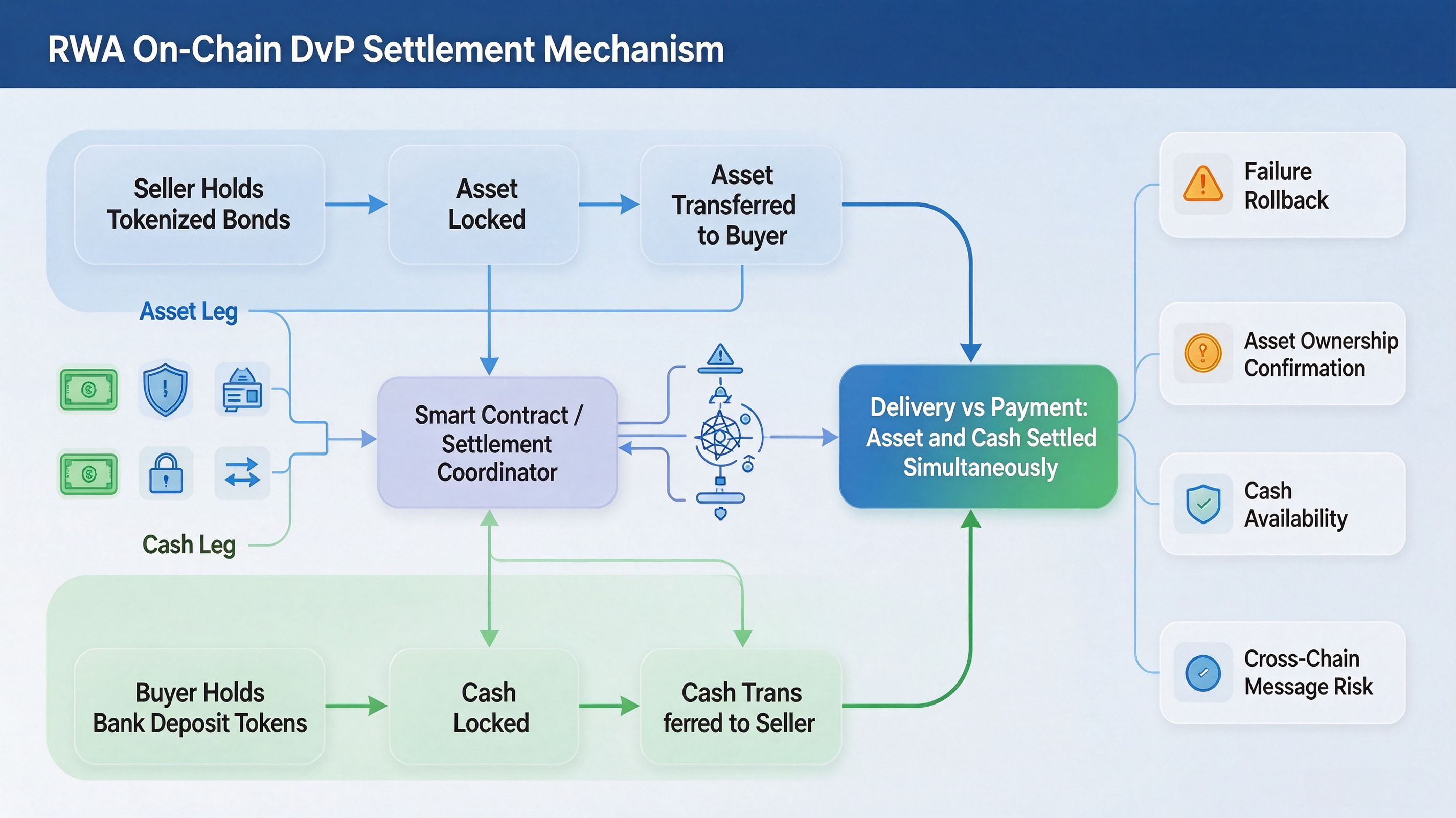
Delivery versus Payment (DvP) is an important mechanism in securities settlement. Its core principle is that asset delivery and fund payment are linked. A transaction is completed according to the rules only when the agreed settlement conditions have been met. This reduces the principal risk that one party fulfills its obligation while the other fails to do so.
In an on-chain environment, DvP can be implemented through smart contracts and transaction-state controls. Suppose a buyer needs to use U.S. dollars to purchase a tokenized bond. The transaction system can first verify that the buyer has sufficient funds and that the seller holds enough asset tokens, then coordinate the transfer of funds and assets according to predefined rules. When both conditions are met, the system executes the corresponding settlement. If the conditions are not met, the transaction is halted or handled according to the agreement.
The value of this mechanism lies in reducing the time gap between payment and asset delivery and allowing the transaction status to be confirmed more directly on a shared ledger. However, DvP does not mean that a transaction is risk-free. Smart contract errors, network interruptions, the inability to redeem a funding instrument, incomplete ownership records, or failed cross-chain messaging can all affect the settlement outcome. In particular, in a multichain environment, both parties also need to establish clear rules for finality and failure handling across different networks.
How Does Kinexys Connect Bank Deposits to RWA Transactions?
The significance of Kinexys lies not in providing a single type of on-chain token, but in its attempt to combine bank accounts, digital payments, and asset settlement capabilities. JPM Coin represents a dollar deposit token issued by a bank, while the Blockchain Deposit Account connects bank accounts with on-chain fund operations. For institutional clients, this architecture can support fund transfers, payments, and transaction settlement on eligible networks and under applicable business rules.
In May 2025, J.P. Morgan announced a cross-chain DvP test conducted in collaboration with Chainlink and Ondo Finance. The test involved Ondo's tokenized U.S. Treasury product, OUSG, and J.P. Morgan dollar deposits. The payment leg was processed through the permissioned blockchain network of Kinexys Digital Payments, while the asset leg was processed through the Ondo Chain test network. Chainlink's cross-chain interoperability protocol, CCIP, coordinated the transaction flow between the different networks.
The core value of this test was its demonstration of how bank payment infrastructure can participate in transactions involving tokenized assets on public blockchains. The asset and funding legs do not necessarily need to operate on the same blockchain, but they do require a reliable cross-chain coordination mechanism to ensure that both parties complete settlement as agreed. For the RWA market, this architecture helps explore ways to connect traditional bank funds with on-chain assets.
However, a distinction must be made between test validation and full commercial deployment. The case demonstrates that the relevant institutions successfully completed a cross-chain DvP test. It does not mean that all Ondo assets, all Kinexys clients, or any public blockchain can already use the same settlement solution. Whether a specific business activity can be conducted still depends on product availability, client access, network support, legal arrangements, and subsequent integration progress.
What Are the Options for On-Chain Cash? Tokenized Bank Deposits, Stablecoins, and Central Bank Money
RWA transactions require funding for settlement, but on-chain cash is not a single category. Common settlement assets discussed in the market include stablecoins, commercial bank deposit tokens, and tokenized central bank money being explored for wholesale financial applications. These assets may all serve payment or settlement functions, but their issuers, credit foundations, and usage boundaries differ.
Stablecoins are generally designed to maintain a value peg to fiat currency through the issuer's reserve assets and redemption mechanisms. One of their advantages is that they can provide relatively broad circulation within supported blockchain ecosystems. However, the actual risks depend on the quality of the reserves, custody arrangements, redemption channels, issuer governance, and regulatory framework. For institutions, determining whether a stablecoin is suitable as the settlement asset for a particular securities transaction also requires assessing whether the counterparty accepts it, whether the funds can be redeemed promptly, and whether the relevant legal relationships are clear.
Tokenized bank deposits connect commercial bank deposits with blockchain networks. Their credit foundation is tied to the deposit liabilities of the issuing bank, and their use is generally subject to bank-client relationships and compliance onboarding requirements. The design of JPM Coin reflects these characteristics: It is issued by J.P. Morgan, made available to eligible institutional clients, and converted and redeemed through a bank account framework. Compared with stablecoins intended for circulation across a broader market, tokenized bank deposits may place greater emphasis on institutional client identity, bank account relationships, and integration with existing payment systems.
Tokenized central bank money refers to the representation of central bank money on a digital ledger and may be used for wholesale settlement between financial institutions. In its 2025 research on the tokenized unified ledger, the Bank for International Settlements proposed incorporating tokenized central bank reserves, commercial bank money, and government bonds into a more coordinated financial infrastructure framework. This direction reflects the possibility that future on-chain financial markets may require multiple forms of money and settlement assets to operate together rather than having one type of token completely replace the others.
Gate Tokenized Stock Securities: How Do the Asset and Funding Legs Work Together?
Gate's gStocks provides a specific example for understanding the asset side of RWA. According to Gate's public materials, gStocks represents listed stocks as tokenized securities that can be traded on the platform and uses a reserve mechanism corresponding 1:1 to the underlying stocks. It primarily addresses how stock assets can enter the digital asset trading environment in tokenized form and how users can trade the corresponding securities tokens on the platform.
From a market-structure perspective, gStocks and Kinexys' tokenized bank deposits are not the same type of instrument. gStocks is on the asset side and represents a unit of tokenized securities associated with a specific stock. JPM Coin is on the funding side and represents a bank-issued deposit token that can be used in eligible payment and settlement scenarios. Their functions, legal relationships, issuers, and sources of risk all differ. The fact that both use blockchain technology does not mean that they can be directly exchanged or that they are already connected at the system level.
If stocks, bonds, funds, and other assets form more extensive on-chain markets in the future, coordination between the asset and funding legs will become increasingly important. Trading platforms will need to define the issuance and redemption rules for asset tokens, as well as determine the source of payment funds, settlement timing, counterparty access, and failure-handling mechanisms. Tokenized bank deposits can serve as an option for institutional-grade on-chain cash, but whether they can be used for specific products on Gate or other platforms must be determined based on the networks, product announcements, and business arrangements actually supported by the parties.
Therefore, Gate gStocks and Kinexys are better viewed as infrastructure examples at different layers of the RWA ecosystem. One demonstrates a path for tokenizing traditional securities assets, while the other demonstrates how bank funds can enter on-chain payment and settlement processes. Only when reliable connections are established among assets, funds, custody, and settlement systems can RWA move beyond simple tokenized issuance toward a more complete on-chain financial market.
What Practical Constraints Still Affect On-Chain RWA Settlement?
The first is the connection between legal rights and technical records. A blockchain ledger can record the holding and transfer of tokens, but the legal rights represented by those tokens still need to be established through offering documents, custody arrangements, applicable laws, and the rules of relevant institutions. The on-chain transfer of an asset token does not necessarily mean that the corresponding change in rights has been completed in the traditional registration system. Different jurisdictions may also have different interpretations of securities, fund shares, and deposit claims.
The second is liquidity and redemption arrangements. The ability to transfer a tokenized asset around the clock does not mean that the underlying asset can be sold or redeemed at any time and at the same cost. If the underlying market has trading-hour restrictions, or if asset redemption requires multiple steps involving custodians, fund managers, banks, and other parties, the continuity of on-chain trading may not match the liquidity of the underlying asset. The same applies to the funding side: The transferability of an on-chain token cannot replace the availability and redeemability of funds in a bank account.
The third is cross-chain interoperability and settlement finality. Different networks may use different consensus mechanisms, transaction confirmation rules, and permission-management systems. Cross-chain protocols can transmit messages or coordinate transactions, but the parties still need to clarify message delays, network failures, verification mechanisms, and responsibility for exception handling. If the asset and funding legs operate on different networks, a problem at any point may affect completion of the entire transaction.
The final constraint is regulatory and operational responsibility. An institutional-grade RWA market involves issuers, banks, custodians, trading platforms, technology providers, and investors. Responsibility for client onboarding, asset reserve verification, fund redemption, transaction monitoring, and dispute resolution must be clearly defined in product designs and legal documents. Blockchain can improve data sharing and process automation, but it cannot automatically resolve the allocation of responsibilities among participating institutions.
Conclusion
The long-term development of RWA tokenization depends not only on how many assets can be converted into tokens, but also on whether those assets can circulate within a reliable payment and settlement system. DvP mechanisms, on-chain cash, and cross-chain coordination are all important components in moving tokenized assets from the issuance stage into actual trading markets.
The cross-chain DvP test conducted by Kinexys with Chainlink and Ondo Finance demonstrated a possible path for coordinating the settlement of bank deposits and tokenized Treasuries across different blockchain environments. Gate gStocks offers another example from the asset side by demonstrating the tokenization of traditional stocks. The two are not the same type of product, but together they reflect a broader trend: Future RWA infrastructure will need to enable closer coordination among assets, funds, and settlement mechanisms.
FAQ
Why Does RWA Tokenization Require On-Chain Cash?
Because trading asset tokens still requires payment funds. If the assets are already on-chain while payment still depends on fragmented traditional processes, both parties may continue to face payment delays, manual reconciliation, and settlement risks. On-chain cash can help integrate payment and asset delivery into a more closely connected process.
What Is DvP?
DvP stands for Delivery versus Payment, commonly referred to in Chinese as 券款对付. It requires asset delivery and fund payment to be completed simultaneously as agreed, reducing the risk that one party fulfills its obligation while the other fails to do so.
Can JPM Coin Be Used to Purchase All RWA Assets?
That is not how it should be understood. JPM Coin is available to eligible J.P. Morgan institutional clients, and its supported networks, counterparties, and business scenarios are subject to applicable rules. Whether a specific RWA asset can be settled using JPM Coin depends on whether the issuer, trading platform, and bank have established an actual supported settlement arrangement.
Does Kinexys' Collaboration with Ondo and Chainlink Mean That Full Cross-Chain Settlement Has Already Been Implemented?
It does not mean that the solution is broadly available. J.P. Morgan announced a cross-chain DvP test involving tokenized U.S. Treasuries and dollar deposits. The test demonstrated the feasibility of technical and business coordination, but it does not support the conclusion that all assets, networks, and clients already support this settlement solution.
What Is the Difference Between Gate gStocks and JPM Coin?
Gate gStocks is a tokenized stock security representing a tokenized unit associated with an underlying stock. JPM Coin is a bank-issued deposit token primarily used for eligible institutional payments and settlement. The former is on the asset side, while the latter is on the funding side. Their legal relationships and functions are different.