zkAPI is a privacy technology solution that applies zero-knowledge proofs (Zero-Knowledge Proof, ZKP) to API access control and payment verification. Its goal is to reduce the direct exposure of users’ identities, accounts, and payment records when they access online services such as AI models. Unlike traditional access models that rely on verified accounts, API Keys, and centralized billing systems, zkAPI aims to allow users to prove cryptographically that they have valid access rights or payment credentials without disclosing their complete identity to the service provider.
As AI Agents, automated applications, and pay-per-use model services continue to develop, API payments are becoming important infrastructure for the digital economy. Although traditional billing models are mature, they generally require service providers to retain account, request, and payment records over extended periods, making it easier to associate user behavior. Zero-knowledge proofs offer a new technical approach to this problem: separating payment credentials from actual service usage to a certain extent while retaining the necessary authorization verification and anti-abuse capabilities.
This article starts with the concept of zkAPI and explains how zero-knowledge proofs can be used for AI API access authorization, payment credential verification, and usage quota management. It also analyzes the potential roles of Ethereum smart contracts, on-chain payments, and privacy technologies. In addition, the article discusses the difference between anonymous payments and complete anonymity, as well as the technical and commercial limitations that zkAPI faces in real-world deployments.
Key Takeaways
-
zkAPI is a technical solution that explores the use of zero-knowledge proofs for API access, identity verification, and payment authorization. It aims to reduce the exposure of users’ identity and payment information when they use AI services.
-
Traditional AI APIs generally rely on accounts, API Keys, and centralized billing systems, allowing service providers to associate request records with specific accounts.
-
Zero-knowledge proofs allow users to prove that they are eligible to access a service or have sufficient payment capacity without disclosing all the underlying information used for verification.
-
Ethereum and its Layer 2 networks can provide payment, smart contract, and credential verification infrastructure for related solutions. However, this does not mean that AI inference requests or all transaction information automatically receive privacy protection.
-
Real-world zkAPI applications still need to address issues such as credential reuse, quota management, request abuse, proof generation costs, and server-side billing.
What Is zkAPI? Why Did Ethereum Introduce an Anonymous AI Payment Solution?
zkAPI is a privacy-focused API payment protocol jointly developed by the Open Anonymity Project and the Ethereum Foundation. It is designed to allow users to pay for AI models and other pay-per-use services through zero-knowledge proofs without directly associating each API request with their real identity or on-chain funding address. On October 1, 2026, the Ethereum Foundation announced that zkAPI had launched on the Ethereum mainnet and published implementations for the client, server, and smart contract. The project originated from the ZK API Usage Credits design previously proposed by Vitalik Buterin and Davide Crapis, head of the Ethereum Foundation’s dAI team.
Traditional AI API services typically use API Keys to associate user requests with accounts, while those accounts are linked to bank cards or other payment methods. As users continue to use models, service providers may combine historical prompts, usage times, spending amounts, and account information into long-term records. Even if users do not actively provide their names in prompts, continuously linked account information may still create a relatively complete usage profile. For AI applications involving corporate research and development, personal financial analysis, or other sensitive information, this type of data association may create additional privacy concerns.
zkAPI attempts to change not the AI models themselves, but the payment authorization method used by model services. Users first deposit funds into an Ethereum smart contract and then use a zero-knowledge proof to show the payment server that they have sufficient available credit. The server can confirm payment eligibility without knowing which specific deposit supports the current request. At the same time, the AI service provider can process the prompts submitted by the user without knowing the on-chain funding identity associated with the request.
Therefore, the core goal of zkAPI is to make payment identities unlinkable to API usage records, rather than automatically encrypting or fully anonymizing all AI requests. This distinction is fundamental to understanding the protocol’s technical value.
How Do Zero-Knowledge Proofs Enable Private Payments for AI APIs?
A zero-knowledge proof is a cryptographic technology that allows a prover to demonstrate to a verifier that a statement is true without disclosing all the secret information used to generate the proof. For example, a user can prove that they have sufficient funds to pay for a service without revealing which specific private balance credential the funds came from.
In zkAPI, after users deposit ETH or other supported assets into a Vault smart contract on Ethereum, the system represents the available balance through a Private Note. A Note can be understood as a digital payment credential controlled by the user’s secret information. The protocol uses cryptographic Commitments to record valid credentials and organizes these Commitments with a Merkle Tree. This allows users to prove that their credentials belong to a valid set without revealing which specific credential they hold.
When a user needs to call an AI API, the local client generates a zero-knowledge proof showing that the corresponding Note is valid, has sufficient payment capacity, and meets the usage conditions specified by the protocol. After verifying the proof, the payment server can issue a temporary API Key to the user. This process does not require the server to obtain the user’s original secret information or directly link each request to a public funding address.
To prevent the same balance from being used repeatedly, zkAPI introduces a Nullifier mechanism. A Nullifier is a unique identifier generated from secret information and is used to detect whether the same spendable credit has been used more than once. If the system detects a duplicate Nullifier, it can identify potential double-spending behavior without disclosing the user’s complete identity or funding records. The official implementation uses technical components including Groth16 zero-knowledge proofs, the BN254 curve, Poseidon hashing, and Merkle Trees.
How Does zkAPI Handle Payments from Ethereum Funding to AI Model Calls?
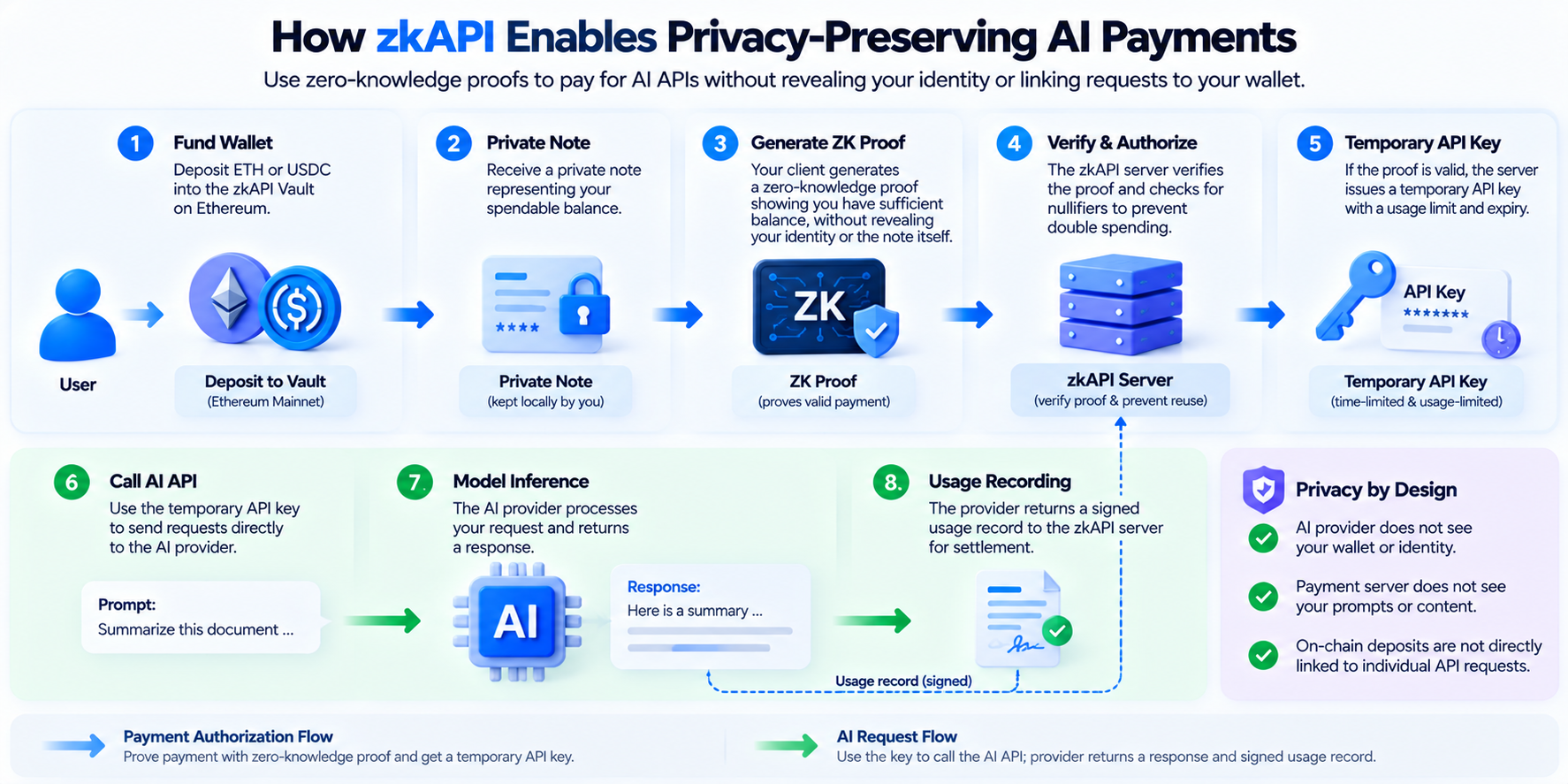
The zkAPI process can be divided into five stages: funding, payment proof, temporary authorization, model invocation, and final billing. Unlike systems that initiate an on-chain transaction for every API request, zkAPI allows users to deposit funds on Ethereum in advance and then complete multiple API access authorizations through off-chain proofs, avoiding the need to wait for blockchain confirmation every time a model is called.
First, the user funds a Vault contract on Ethereum and receives an available balance represented by a Private Note. When the user needs to call an AI model, the local client generates a payment proof and sends it to the zkAPI server. After verifying that the proof is valid, the server generates a temporary API Key for the current session with a defined expiration period and spending limit. The user can use this key to access supported AI services without directly using an API Key that is permanently linked to their personal payment account.
In the Runtime-Key model described in the official materials, the user’s prompt is sent directly to the AI model service provider rather than being relayed through the zkAPI payment server. The payment server verifies payment eligibility and handles billing, while the AI service provider handles model inference. After the session ends, the system calculates the actual fee based on signed usage records and deducts the corresponding amount from the user’s private balance. The spending limit on the temporary key is a reserved amount and does not mean that the user will necessarily be charged the entire reserved amount.
zkAPI also provides a relatively simple Proxy mode, in which a proxy server relays requests. This approach may be easier to integrate, but the proxy server can access the request traffic, resulting in a different privacy boundary from that of the Runtime-Key model. Therefore, when analyzing zkAPI’s privacy capabilities, it is necessary to distinguish between specific operating modes rather than treating all deployment methods as having the same level of data isolation.
What Roles Do the Vault, Private Note, and Nullifier Play?
The Vault is the smart contract infrastructure that zkAPI uses to manage user funds on Ethereum. Users deposit assets into the Vault through public on-chain transactions and can then use their private balances to pay for API services according to the protocol rules. Unlike transferring funds directly to a centralized service provider’s account, the Vault’s fund management and withdrawal rules are implemented through smart contracts. The official design allows users to withdraw their remaining funds through the corresponding on-chain exit process, reducing dependence on a single payment server remaining online.
The Private Note represents the private balance that the user can control. It is not a new cryptocurrency, but a cryptographic credential used to control and prove payment eligibility. Through the Note and Merkle Tree, users can prove that they hold a valid balance without disclosing the corresponding funding records for each payment. This means that a direct one-to-one relationship between public on-chain funding and specific AI service usage is no longer required.
The Nullifier prevents double spending. If a privacy payment system hides balance credentials but cannot detect repeated use, a user could potentially spend the same funds multiple times. zkAPI therefore uses Nullifiers to maintain the necessary uniqueness checks while protecting the privacy of credentials. The three components respectively handle fund management, private payment eligibility proofs, and double-spending detection, together forming the protocol’s basic payment mechanism.
It is important to note that funding and withdrawals from the Vault remain public transactions on Ethereum. zkAPI primarily hides the relationship between specific funding transactions and subsequent API usage, rather than making funding addresses, transaction amounts, or all on-chain activity completely invisible.
How Does zkAPI Differ from Traditional AI API Payment Methods?
Traditional AI APIs generally use account balances or postpaid billing. After registering an account, developers receive an API Key, and the system uses that key to identify the request source, track Token usage, and calculate fees. This model offers mature developer tools, billing management, and customer support systems, but service providers can also associate API usage records with account information over extended periods.
zkAPI uses private balance credentials and zero-knowledge proofs to verify payment eligibility, attempting to separate user identity, payment source, and specific requests. Its main difference is not whether it uses ETH for payment, but whether the service provider can directly establish a relationship between the payment account and model requests.
| Comparison Dimension |
Traditional AI API |
zkAPI |
| Payment identity |
Typically linked to a registered account |
Uses private payment credentials |
| API authorization |
Long-term API Key or account Token |
Zero-knowledge proof and temporary API Key |
| Billing method |
Account balance or periodic billing |
Private credit and actual usage records |
| Payment information linkage |
Service providers can typically link accounts and requests |
Designed to separate payment sources from requests |
| Blockchain dependence |
Typically not required |
Uses an Ethereum funding contract |
| Request content privacy |
Usually visible to the model service provider |
Still visible to the model service provider |
| Main limitations |
Centralization of account data and identity linkage |
Proof costs, protocol complexity, and privacy boundaries |
Therefore, zkAPI is not intended to completely replace traditional API Keys. Instead, it uses temporary authorization and private payment credentials to change the relationship between API Keys and long-term payment identities. For applications that only need standard billing and access management, the traditional model may still be simpler. For users or applications that want to reduce exposure of payment identities, zkAPI provides another technical option.
Can zkAPI Truly Enable Fully Anonymous AI Conversations?
zkAPI can reduce the direct link between payment identities and API requests, but it cannot guarantee completely anonymous AI conversations. The Ethereum Foundation has clearly stated in its official announcement that AI service providers can still read the prompts submitted by users and the responses generated by models because model inference requires processing this content. In other words, zkAPI protects payment-linkage privacy; it does not automatically provide end-to-end encrypted AI inference.
Network metadata is also a potential privacy risk. If a user continually accesses a service from a fixed IP address, the payment gateway or model provider may still analyze user behavior through connection times, request frequency, and other network characteristics. Even if the payment credential itself cannot be directly linked, repeated patterns at the network layer may reduce anonymity. The official materials therefore treat network anonymity as an issue requiring additional technical measures rather than a capability that zkAPI has already fully addressed.
In addition, prompts themselves may reveal identity. For example, if a user repeatedly provides the same personal background, corporate project name, or historical conversation content across different sessions, the model service provider may be able to relink those requests based on content characteristics. Even without an account name, a distinctive writing style and continuous contextual information may still provide identifying clues.
Therefore, a more accurate understanding is that zkAPI can reduce the association between payment identities and API usage records at the protocol-design level, but comprehensive AI privacy protection still requires other technologies, including network anonymity, data minimization, and privacy-preserving computation.
Why Is zkAPI Suitable for AI Agents and Machine-to-Machine Payments?
AI Agents use APIs differently from ordinary users in some respects. Traditional users typically purchase subscriptions manually through websites or applications, while AI Agents may need to automatically call multiple models, databases, or computing services based on a task. If every service requires a separate account, payment method, and long-term API Key, payment and permission management can become complex for automated systems.
The private credit and temporary authorization mechanisms provided by zkAPI offer one technical approach to pay-per-use machine-to-machine services. An AI Agent can obtain API access within a predefined funding amount and spending limit, then call the relevant services according to the actual task. Through zero-knowledge proofs, the payment server can verify the authorized credit without requiring every call to be directly associated with a long-term payment account.
In addition to AI model inference, the Ethereum Foundation has listed blockchain RPC queries, image and video generation, VPN bandwidth services, and other machine-to-machine billing as potential use cases. These services share common characteristics: they are typically billed by call, computing task, time, or traffic volume and can therefore use similar credit authorization and usage-record settlement mechanisms.
However, automated payments by AI Agents also require strict fund and permission controls. Even if the payment identity is protected, incorrect task configurations, abnormal API calls, or malicious inputs could still cause funds to be depleted quickly. Therefore, real-world deployments need to set per-call limits, session budgets, service allowlists, and abnormal-usage monitoring. Privacy payments should not be equated with automated payment security.
What Technical Limitations and Security Risks Does zkAPI Face?
The first category of challenges comes from cryptographic proofs and system complexity. Although zero-knowledge proofs can hide some underlying information, proof generation, verification, and credential management still increase development and operational costs. The protocol must ensure that users’ private balances are updated correctly and prevent double spending while also handling temporary key expiration, usage-record settlement, abnormal exits, and other situations. Compared with a traditional centralized billing database, this design requires more cryptographic and smart contract components to operate together.
The second category concerns the security of smart contracts and payment services. The Vault contract manages on-chain funds. If vulnerabilities exist in the contract, proof verification logic, or client implementation, user fund security could be affected. Although the official project has published its source code and deployed related components on the Ethereum mainnet, its GitHub repository still labels the protocol as an experimental implementation. This means that users and developers should not assume that the protocol has all the security protections of a mature commercial payment system simply because it is live on the mainnet.
The third category is the balance between privacy protection and real-world service operations. AI service providers still need to identify abuse, enforce rate limits, and handle billing disputes, while anonymous payment mechanisms may make it difficult to directly apply traditional account-based risk controls. zkAPI retains necessary billing constraints through temporary keys, spending limits, and signed usage records, but service providers still need to develop anti-abuse mechanisms suitable for privacy payment environments.
In addition, the protocol does not automatically solve network anonymity or prompt-content leakage. For AI applications that process highly sensitive information, using zkAPI alone is not sufficient to achieve comprehensive data confidentiality. It is also necessary to evaluate the model provider’s data processing policies, network connection methods, and additional privacy-preserving computing technologies.
What Does zkAPI Mean for Ethereum and AI Payment Infrastructure?
The launch of zkAPI reflects how Ethereum’s exploration of AI applications is expanding from asset payments to privacy authorization and service billing. Traditional blockchain payments generally focus on the ability to transfer assets between different addresses. zkAPI goes further by examining how to complete payments while reducing the information link between payment identities and actual service usage. This means that Ethereum smart contracts can serve not only as payment-transfer infrastructure but also as part of access control and fund management for digital services.
From a technical architecture perspective, zkAPI combines on-chain fund management with off-chain API authorization. Ethereum handles the fund contract and necessary verification logic, zero-knowledge proofs hide the link between payment credentials and specific usage behavior, and AI service providers continue to perform model inference. This division avoids putting every API call directly on the blockchain and provides a reference design for future pay-per-use services.
However, zkAPI remains in the early stages of real-world adoption. Its long-term development will depend not only on the maturity of zero-knowledge proof technology but also on whether AI service providers are willing to integrate it, whether developers can integrate it conveniently, and whether users genuinely need to separate payment identities from model usage records. For Ethereum, the more important significance of zkAPI is that it demonstrates an operational privacy payment architecture—not that all AI API services will move to on-chain payments.
Conclusion
zkAPI is a privacy-focused API payment protocol launched through a collaboration between the Ethereum Foundation and the Open Anonymity Project. Through Vault smart contracts, Private Notes, zero-knowledge proofs, and temporary API Keys, it separates users’ payment identities from their AI service usage records. Users can deposit funds on Ethereum in advance and then obtain API access through cryptographic proofs without disclosing the source of the corresponding funding for every request.
Compared with traditional AI API payment methods, zkAPI’s core innovation is not simply using ETH or stablecoins to purchase model services. Instead, it attempts to address the long-term association between payment accounts and request content. By combining on-chain fund management with off-chain usage billing, the protocol can retain quota verification and double-spending detection while improving privacy protection at the payment layer.
However, zkAPI does not mean that AI services become completely anonymous. Model providers may still read prompts, while network metadata and content characteristics may also reveal user information. Whether this type of technology can be widely applied to AI Agents, model inference, and other pay-per-use services will require further validation of its security, scalability, and commercial viability.
FAQ
1. What Is zkAPI?
zkAPI is a privacy-focused API payment protocol based on zero-knowledge proofs. It allows users to prove that they have sufficient service credit through private payment credentials without disclosing the specific funding source or long-term payment identity to the payment server.
2. Was zkAPI Officially Launched by Ethereum?
zkAPI was jointly developed by the Open Anonymity Project and the Ethereum Foundation and was announced as live on the Ethereum mainnet on October 1, 2026. It is an experimental technical implementation developed through the collaboration and is not a mandatory base-layer protocol of the Ethereum network.
3. Can zkAPI Be Used to Pay with ETH or USDC?
The Ethereum Foundation’s official materials state that assets such as ETH and USDC can be used for related funding and payment scenarios. However, the specific assets supported by the client, Vault contract, and deployment version should be determined based on the latest documentation for the relevant implementation.
4. Can zkAPI Hide the Prompts Users Submit to AI?
No. zkAPI primarily hides the relationship between payment identities and API usage records. AI model service providers still need to read prompts to generate responses, so the prompt content is not automatically encrypted simply because zkAPI is used.
5. Why Does zkAPI Need Nullifiers?
Nullifiers are used to detect whether private balance credentials have been spent more than once. The system can prevent the same credit from being reused by checking unique identifiers while avoiding direct disclosure of the credentials’ complete secret information.
6. Is zkAPI Suitable for Automated Payments by AI Agents?
zkAPI can provide AI Agents with pay-per-use billing, temporary authorization, and private payment credentials. However, real-world deployments still need budget limits, access permissions, and abnormal-usage controls to reduce the financial risks associated with automated calls.