For beginners mapping AI capability boundaries, a world model answers whether a system can anticipate action consequences, not whether it writes fluent answers. The sections below cover the definition, the prediction loop, three technical routes, World Model vs LLM task selection, differences from video generation, use cases, and evaluation boundaries; adjacent concepts appear in Gate Learn explainers on Superintelligence (ASI) and Private AI.
Key Takeaways
- The core capability is action-conditioned prediction: given a state and an action, output the next state (or next representation) for planning and control.
- Three common routes: model-based RL (MBRL) / imagination training, generative interactive simulation, and JEPA-style predictive representations.
- Large language models excel at next-token prediction and video generators at appearance continuity; neither automatically equals a plannable world model.
- Evaluation should watch for fake physics, long-horizon drift, out-of-distribution failure, hard metrics, and the boundary with hand-written simulators.
What Is a World Model, and What Problem Does It Solve?
A world model addresses a practical question: before an agent acts, can it reliably estimate what happens next? Without that skill, learning depends on real trial and error—often expensive, slow, or unsafe—and offline planning becomes hard.
In robotics, autonomous driving, game agents, and simulation training—especially for embodied agents in virtual or physical environments—feedback is costly or risky; a bad driving policy, for example, can cause a real crash before it learns. A world model moves “trying actions” into learned dynamics: roll forward in latent or observation space, then bring a stronger policy back to the real world. That goal differs from conversational systems that mainly restate knowledge; it is closer to causal foresight inside an interactive environment.
The NVIDIA Glossary entry on world models frames them as internal representations that help AI understand and predict how the physical world evolves; Yann LeCun’s A Path Towards Autonomous Machine Intelligence places predictive world models on a path toward more autonomous intelligence; and David Ha’s 2018 “World Models” work helped define the modern learning-based approach. An agent usually sees only partial observations, so the full state is not directly available. Across these views, prediction exists to support decisions.
How Does a World Model Work? State, Action, and the Prediction Loop
The most stable test of a world-model-oriented system is action-conditioned prediction: whether inputs explicitly include an agent’s action (or control signal), and whether the output is the next state or next representation conditioned on that action.
The loop usually compresses into three steps: encode observations into a state; condition on a candidate action; predict the next state, with the environment changing after that action and returning new observations, optionally rolling that prediction forward as a new starting point. A policy or planner compares imagined trajectories on reward, risk, or constraints, then executes; a fresh observation restarts encoding.
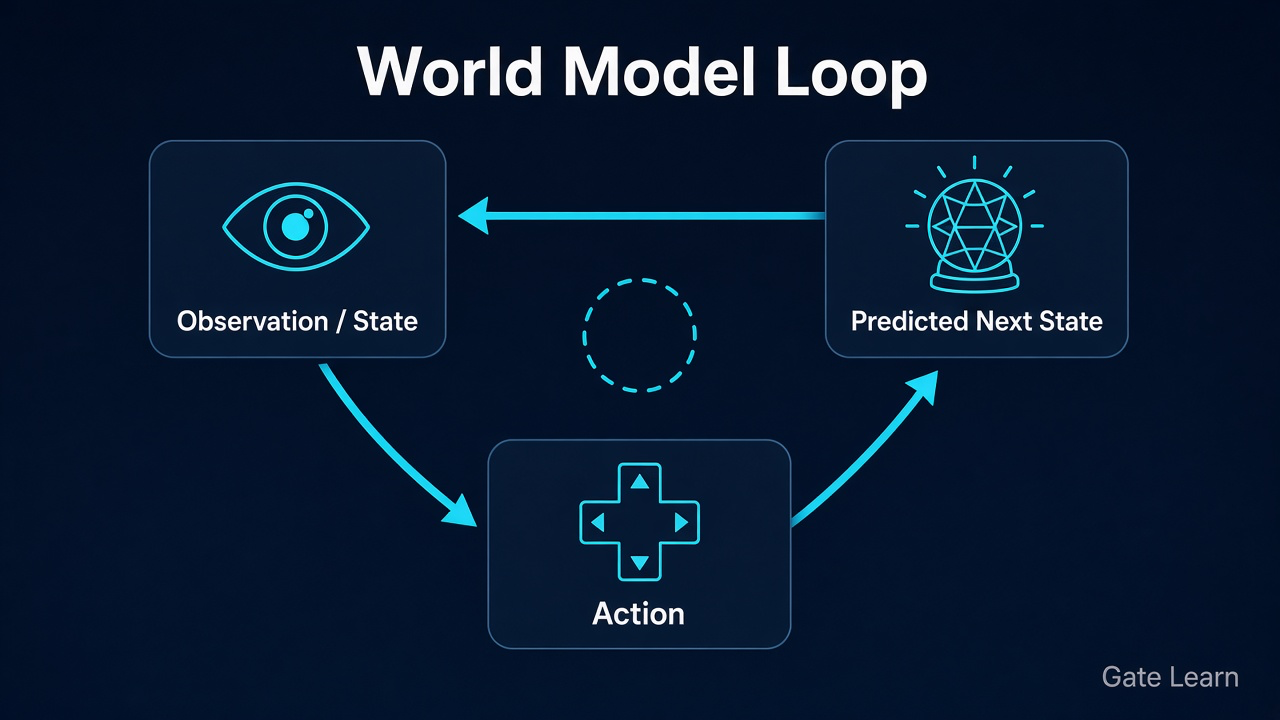
Figure 1. World-model loop: observation/state plus action yields a predicted next state that feeds the next cycle.
Many practical systems avoid long-horizon prediction in raw pixels and instead learn latent dynamics: compress high-dimensional visual data into a compact state, then roll forward in that space. Latent rollouts reduce visual noise and make imagination training cheaper; whether the latent state stays faithful to real physics still needs downstream tasks and out-of-distribution checks, especially because the physical environment is only partially observed and must be inferred through feedback.
What Are the Main Technical Routes for World Models?
“World model” is a broad label across multiple technical families, not one algorithm name. Selection starts with the job: controllable policies, interactive pixel simulation, or transferable abstract representations.
| Route |
Core idea |
Best fit |
Main cost |
| MBRL / imagination training |
Learn dynamics, then train a policy on model rollouts (Dreamer) |
Control, games, sample-efficient RL |
Model error poisons policy; drift |
| Generative interactive simulation |
Learn an interactive env that generates next frames/observations |
Data augmentation, interactive video worlds |
Appearance ≠ physics; costly eval |
| JEPA predictive representations |
Predict future/masked embeddings in representation space (I-JEPA) |
Representation learning, abstract prediction for planning |
No pixels; needs a control stack |
One route may center on a video model that predicts future frames, while another targets planning-ready latent dynamics instead of full visual reconstruction.
The three routes can coexist: Dreamer-style methods emphasize training policies in imagination; generative video world models emphasize interactive appearance simulation; Meta AI’s I-JEPA shows prediction in a joint embedding space instead of reconstructing every pixel. Different systems also choose different training recipes depending on whether they learn from input–output pairs, control rollouts, or predictive embeddings. Align the task first, then debate names.
How Do World Models Differ from LLMs and Video Generation?
All three “predict,” but within generative AI they predict different objects and differ on action conditioning: LLMs predict the next token, video generators predict the next frame’s appearance, and world-model-oriented systems predict how state evolves after an action.
| Dimension |
World model |
Large language model (LLM) |
Video generation |
| Core prediction target |
Next state / latent dynamics (often action-conditioned) |
Next token / text structure |
Next frame or clip appearance |
| Link to action |
Action-conditioned prediction is the decision axis |
Usually no physical control loop |
May condition on text/first frame, not executable |
| Typical use |
Planning, control, embodied AI |
Language, writing, tool orchestration |
Content gen, previews, interactive sims |
| Common mix-up |
Chat ability = world model |
Writing physics = physics skill |
Photoreal frames = correct dynamics |
So a Sora-like video generator can show coherent frames with high visual fidelity and even apparent spatial consistency—and may be labeled a “video world model”—but those traits alone do not prove physical understanding. Without a stable action interface, verifiable state transitions, and a planning loop, the accurate category remains generative video. A stronger system can also evaluate action sequences to support planning and decision-making, not just passively render likely views. An LLM can narrate “what if you nudge the cup,” yet that does not create rollable, evaluable environment dynamics.
Where Are World Models Commonly Used?
Embodied AI is a high-frequency setting: arms and mobile robots need spatial intelligence—reasoning about layouts, movement, and change in the physical world—plus contact and displacement forecasts before touching objects, because many interactions are hard to reverse once motion begins. Action-conditioned prediction lets systems discard failing trajectories in simulation or latent space before paying the cost of real collisions; demonstrations can initialize behavior but do not replace interaction-based learning.
Games and model-based reinforcement learning are another core arena. Dreamer-style methods improve policies on imagined trajectories so usable control can emerge with fewer real interactions. Similar ideas transfer to industrial control logs where a hand-written simulator is incomplete but observation history is abundant, because the model is trying to capture system dynamics from that history.
Autonomous driving, warehouse scheduling, and multi-agent sims also embed world-model components—not as a full replacement for planning stacks, but as a short-horizon consequence layer. Virtual testing and curated video data are often used to train and evaluate those components across scenarios before real deployment. Any control system that must “think before acting” may host a world-model module.
What Advantages, Risks, and Limits Matter When Evaluating World Models?
The upside is sample efficiency and safer trial-and-error: imagining inside a model can reduce dangerous exploration, and action-conditioned forecasts can put planning on inspectable dynamics. Limits and risks often appear when a model looks right but is not trustworthy, because a polished internal representation is not the same as behavior that survives deployment.
| Mechanism |
What you see |
Why it hides |
Check questions |
| Fake physics |
Smooth trajectories that violate conservation/contact |
Vision trusts fluency |
Do key quantities conserve? Can objects pass through? |
| Long-horizon drift |
Short rollouts OK; long ones collapse |
Demos favor short clips |
How does error grow with steps? Is there replan? |
| Out-of-distribution failure |
Breaks on new objects, lighting, or action ranges |
In-distribution scores look strong |
OOD protocol? Failure modes public? |
| Hard evaluation |
No shared “world understanding” score |
Task success absorbs the metric |
Beyond task score, is prediction error reported? |
| Boundary vs hand-written sims |
Learned models treated as verified engines |
Marketing blends simulator / world model |
Which constraints are hard-coded? Which are only fits? |
Transfer into reality is hard because of the sim-to-real gap. Good tests should ask whether the model predicts controllable outcomes under action, not just plausible visuals.
Use the table as a claim checklist: confirm an action-conditioned interface, then demand long-horizon and OOD evidence, and finally separate “looks good” from “dynamics are plannable.” Without that evidence, safer language is “includes world-model components or research goals,” not “has a complete world model.” Because agents have limited capacity, evaluation should focus on goal-relevant state rather than total scene reproduction.
Summary
World models push AI from “can talk / can draw” toward “can anticipate action consequences,” such as predicting that a robot will knock over a cup if it takes the wrong path. The working core is a closed loop of state, action, and prediction, with action-conditioned prediction as the clearest decision axis.
The three routes—MBRL/imagination training, generative interactive simulation, and JEPA predictive representations—serve different goals and are not interchangeable. Versus LLMs and video generators, compare prediction targets and action interfaces; when evaluating, prioritize fake physics, drift, OOD failure, hard metrics, and simulator boundaries.
FAQ
What is a world model?
A world model is a learned internal dynamics model that represents how an environment may change given a current state (or observation) and an action. The world at any moment is richer than what an agent can directly observe, so the model summarizes the variables that matter for planning—for example, where a robot ends up after turning left. Its purpose is to support planning and trial-and-error in imagination, not only to generate text or video appearance.
How is a world model different from a large language model?
Large language models mainly predict the next token and excel at language and knowledge orchestration; world models mainly predict how state evolves after actions for control and planning. An LLM can discuss physics without providing rollable, evaluable environment dynamics.
How does a world model work?
A typical loop encodes observations into a state, conditions on a candidate action, predicts the next state after that action, and may roll forward in latent space. A planner compares imagined rollouts, executes an action, then updates the state from a new observation.
Does Sora or video generation count as a world model?
Not automatically. If a system mainly produces appearance-coherent video without a stable action-conditioned interface, verifiable state transitions, and planning use, it is better described as a video generator. It becomes closer to a world model only when action-conditioned prediction and a plannable loop are demonstrated.
How does a world model differ from a traditional simulator?
Traditional simulators usually encode hand-written physics rules and constraints, whereas data-driven world models are often learned with neural networks. Learned models can be more flexible and closer to sensor noise, but they are also more prone to fake physics and long-horizon drift and should not be assumed equal to a verified physics engine.