For readers choosing by task, the key is not “which side is stronger,” but whether failure hurts more as fluent nonsense or as dynamics drift. The sections below compare a world model with an LLM on prediction targets, data/evaluation, fit tasks, combination rules, and misreads. Capability ceilings sit beside Superintelligence (ASI); deployment boundaries sit beside Private AI.
Key Takeaways
- World models optimize action-conditioned next-state / latent dynamics; LLMs optimize next-token and text structure.
- Prefer world models for embodied planning and control; prefer LLMs for writing, retrieval-augmented Q&A, and tool calling.
- When a job needs both a language interface and rollable environment dynamics, combine them rather than treating them as substitutes.
- Failure modes differ: LLMs often fail via language hallucination; world models via dynamics drift and fake physics.
What Is a World Model?
A world model is a learned dynamics system: given a current state (or observation) and a candidate action, it predicts how the environment will change so an agent can try moves in imagination before planning. The clearest decision axis is action-conditioned prediction—not chat fluency.
Unlike systems that only emit text or appearance, world-model-oriented stacks connect predictions into planning, control, or imagination-training loops. Common routes include model-based RL (for example Dreamer), generative interactive simulation, and JEPA-style representation prediction; goals differ, so brand names are not interchangeable.
What Is a Large Language Model?
A large language model (LLM) is a generative model trained on large text corpora with next-token prediction as the core objective. An LLM is strong at language understanding, summarization, translation, coding assistance, and multi-step text orchestration through prompts and tool interfaces.
An LLM can describe the physical world or write steps for “what happens if you push a cup,” but description is not rollable, evaluable environment dynamics. Without an action–state interface and closed-loop checks, treating an LLM as a controller or physics engine is a selection error—not a “model too small” problem.
How Do Prediction Targets Differ?
The core difference is the prediction object: a world model predicts the next state or latent dynamics after an action; an LLM predicts the next token and text structure. Both “predict,” but they do not share one success standard.
| Feature |
World Model |
LLM |
| Prediction target |
Next state / latent dynamics (often action-conditioned) |
Next token / text and instruction following |
| Link to action |
Action-conditioned prediction is the decision axis |
Usually does not model a physical control loop |
| Output form |
States, representations, trajectories, or interactive observations |
Text, code, tool-call arguments |
| Success criteria |
Checkable consequences, plannability, trackable error |
Semantic correctness, usable format, checkable citations |
| Typical failure |
Dynamics drift, fake physics |
Language hallucination, fabricated citations |
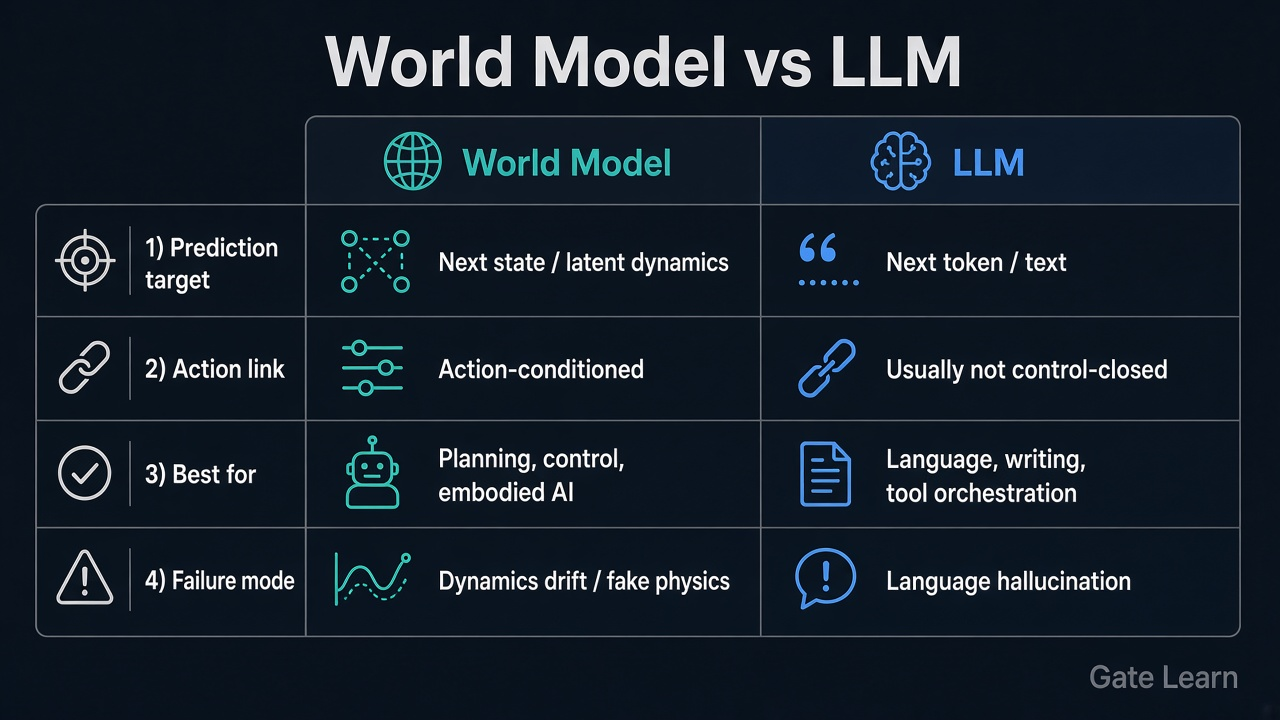
Figure 1. Four-way contrast of world models and LLMs: prediction target, action link, best-fit tasks, and failure mode.
JEPA and LLMs are often mixed up. JEPA (for example Meta AI’s I-JEPA) predicts abstract future representations in a joint embedding space and is world-model-oriented; LLMs remain language-modeling systems. Similar names do not imply interchangeability. See the NVIDIA Glossary: World Models and LeCun’s path discussion (A Path Towards Autonomous Machine Intelligence).
How Do Data, Outputs, and Evaluation Differ?
Data and evaluation follow the prediction target: world models lean on interactive trajectories, state transitions, control signals, and sometimes video; LLMs lean on corpora, instruction data, and (optionally) tool logs. Downstream consumption decides the error metrics.
| Dimension |
World Model |
Large Language Model |
| Typical data |
Observation–action–next observation / reward trajectories (sometimes including video) |
Text, dialogue, code, tool traces |
| Primary outputs |
Next state, latent dynamics, imagined trajectories |
Text, structured answers, function calls |
| Evaluation focus |
Multi-step error, task success, OOD robustness |
Correctness, faithfulness, format, and safety |
| Hard-to-catch issues |
Smooth-looking fake physics; long-horizon growth |
Fluent hallucinations; citations that fail checks |
Using “write a correct physics paragraph” to certify a world model, or “the clip looks good” to certify an LLM control loop, swaps the evaluation axis. Fix the checkable output first, then choose the model family.
Which Tasks Fit World Models Better? Which Fit LLMs Better?
Start with where failure cost lands—physics/control or semantics/communication. Prefer world models for the former and LLMs for the latter. When both must hold, use “must combine” instead of forcing one winner.
| Task condition |
Prefer world model |
Prefer LLM |
When combining is required |
| Needs explicit action → next-state prediction |
Yes |
No |
— |
| Needs a natural-language interface, docs/code generation |
No |
Yes |
— |
| Embodied planning; filter failing trajectories before contact, as in autonomous driving |
Yes |
No (LLM may only explain) |
LLM for instructions; world model for rolled dynamics |
| Retrieval-augmented Q&A, writing, tool orchestration |
No |
Yes |
— |
| Train a policy in imagination (MBRL) |
Yes |
No |
LLM may draft task text; dynamics still need a world model |
| Dialogue for goals plus an executable control loop |
Alone is not enough |
Alone is not enough |
Must combine: LLM parses goals → world model / planner executes |
“Must combine” matches a common shape: the LLM owns intent and the interface; the world model (or simulator plus learned dynamics) owns consequence prediction and trajectory filtering. Dropping either side often collapses into the other side’s failure mode.
When Should You Combine Both?
Combine them when a task includes both a language-layer goal and environment-layer consequences—do not argue substitution. A typical chain: the LLM turns goals into subgoals or constraints; the world model rolls candidate actions; a planner picks a trajectory under cost and safety; execution returns a new observation that updates state.
Combination is not “concatenate two prompts.” Interfaces must be explicit: what structured goals the LLM emits, what actions the world model accepts, and how multi-step error triggers replanning or a conservative fallback. Without that contract, systems look like “fluent speech, broken motion” or “pretty trajectories, mismatched instructions.”
Hard-stacking is also a poor fit when pure document Q&A barely needs a world model, or when low-level servoing already has reliable dynamics and does not need a general LLM. Combination value comes from division of labor—not model count.
What Misjudgments and Risks Appear When Choosing?
The most common misreads are treating “can talk about physics” as “can do physics,” and “pretty frames/trajectories” as “plannable dynamics.” The families fail differently; mixing acceptance checks raises deployment risk.
| Failure mode |
More common in |
How it shows up |
Selection risk |
How to spot it |
| Language hallucination |
LLM |
Fluent but wrong facts/citations |
Sole knowledge source or control “manual” |
Force provenance, tool checks, reject unsupported claims |
| Dynamics drift |
World model |
Short steps OK; long rolls distort |
Open-loop trust over long horizons |
Plot error vs. horizon; check replanning |
| Fake physics |
World model |
Smooth trajectories that violate contact/conservation |
Visual demos as physics acceptance |
Check penetration, energy, contact constraints |
| Treating an LLM as a simulator |
Selection mismatch |
Text description replaces state transitions |
Embodied tasks with no action-conditioned loop |
Ask for the action interface and rollable state |
| Treating a world model as a chat engine |
Selection mismatch |
Forcing state prediction into support Q&A |
High cost, weak language UX |
Ask whether text quality is the main job |
Risk checks should bind to triggers: if the job is mainly semantic correctness, govern hallucination first; if it is mainly control consequences, govern drift and fake physics first. Capability narratives do not replace acceptance checks.
Summary
World models and large language models solve different prediction problems: the former target action consequences and plannable dynamics; the latter target language and tool orchestration. For selection, fix which side carries failure cost, then use the condition table for single use or combination.
JEPA-style representation prediction is world-model-oriented and is not an LLM. At acceptance time, inspect language hallucination separately from dynamics drift / fake physics so one demo cannot hide the other failure mode.
FAQ
What is the difference between a world model and a large language model?
A world model mainly predicts the next state or latent dynamics after an action for planning and control; an LLM mainly predicts the next token for language understanding, generation, and tool orchestration. Both can “generate,” but success means checkable consequences versus usable semantics and format.
Can a world model replace a large language model?
Usually no. A world model does not naturally provide a strong language interface or large-scale text orchestration; an LLM does not naturally provide rollable action-conditioned dynamics. Prefer LLMs for language jobs and add world-model components when the task needs environment consequences.
When should you use a world model?
Use a world-model-oriented system when the task must predict the next state from state and action, then plan, control, or try moves in imagination. Typical cases include embodied planning, model-based RL, and short-horizon consequence foresight. Pure writing or document Q&A is usually not the main fit.
JEPA (Joint Embedding Predictive Architecture) predicts future or masked representations in embedding space and belongs to world-model-related representation learning; LLMs center on next-token prediction. Both can sit in an agent stack, but objectives and metrics differ—JEPA is not “another LLM.”
Can you use both together?
Yes—and for jobs that mix natural-language instructions with execution in an environment, combining is often required: the LLM parses goals and constraints; the world model or planner predicts consequences and filters trajectories. The key is a clear interface and replanning triggers, not chaining both into one prompt.