Truflation is a blockchain-enabled financial data service that publishes independent, real-time inflation and macroeconomic indexes, updated daily to give markets a faster reading of price changes than monthly government releases such as the U.S. Consumer Price Index (CPI). It was launched in December 2021 as an alternative data source for traders, analysts, researchers, institutions, and on-chain users who need economic data before official releases and revisions arrive.
According to Truflation’s November 2025 materials, the platform processes more than 100 million data streams from over 100 sources and updates its indexes daily. That matters for anyone comparing market-sensitive inflation data with official CPI, because Truflation aims to provide a more timely, transparent view of inflation that can lead government releases by about 45 days. This article examines how Truflation’s indexes are built, where the data comes from, how the TRUF token and network work, how institutions access the data through distribution channels and APIs, and how the platform compares with official CPI benchmarks.
Takeaways
Truflation provides independent, real-time inflation and macroeconomic data as an alternative to slower official releases.
Its flagship product is a set of daily inflation indexes, plus a BLS predictor that Truflation says leads official U.S. CPI prints by about 45 days.
Coverage now includes the United States, the United Kingdom, Argentina, and India, with additional indexes for PCE and employment.
The data is distributed through Truflation’s own platform, enterprise APIs, and terminals such as Bloomberg.
TRUF is the project’s token and network layer, but the core product is economic data rather than a lending or staking protocol.
Usefulness still depends on methodology, data sources, and how users interpret the difference versus official statistics.
What is Truflation?
Truflation uses blockchain technology to publish verified economic data on-chain. It aggregates high-frequency price and macroeconomic information, then publishes indexes for traders, analysts, applications, and other data consumers that need secure, accurate inflation and labor-market signals.
Unlike CPI, which is compiled by government agencies and released on a monthly schedule, Truflation updates its readings daily. The project’s stated goal is not to replace official statistics, but to provide an independent, more frequent measure of the same underlying price pressure.
Background
Truflation was developed by Tru Labs and is led by founder and CEO Stefan Rust, a former CEO of bitcoin.com, with a leadership position across the project ecosystem. In May 2021, former Coinbase CTO Balaji Srinivasan challenged the crypto community to build a censorship-resistant inflation feed. Truflation won that challenge and received a $200,000 reward.
The project later raised capital from crypto and traditional-finance backers and completed a $6 million Series A round in early 2024. It first published data on Ethereum, then expanded through Chainlink to other networks, and later announced new network development as its commercial position shifted toward institutional distribution. By 2025, Truflation’s commercial focus had shifted toward institutional data distribution: daily indexes, BLS prediction, Bloomberg terminal access, and custom index products.
Why Truflation Exists
Official inflation statistics are important, but they are slow and periodically revised. Truflation’s pitch is that markets need a faster, independently constructed signal.
In its sales materials, Truflation compares its U.S. inflation index with the BLS CPI and says its series has historically turned earlier, with an average lead time of about 45 days. It also says its CPI forecast deviates just 0.076% from BLS data and cites an overall accuracy figure of about 99.9%. These are project-reported metrics when compared with official figures, not a guarantee for future prints.
Indexes and Coverage
Truflation’s main public indexes include:
U.S. Aggregate Inflation Index
U.K. Aggregate Inflation Index
Argentina Aggregate Inflation Index
India Aggregate Inflation Index
U.S. CPI comparison index
U.S. PCE comparison index
U.S. Employment Index
A U.S. Sentiment index was listed as in development in the November 2025 deck. On Bloomberg, Truflation said its U.S. CPI and U.S. PCE series were already live, with unemployment and sentiment feeds planned.
The inflation model uses 12 consumer categories, including housing, transport, food and beverages, health, household items, utilities, clothing, communications, education, and recreation. The category list stays the same across countries; the expenditure weights change.
Data Sources and Methodology for Real World Economic Data
Truflation says it processes more than 100 million data streams from over 100 sources. The source set shown in its materials includes retail, housing, travel, jobs, commodities, and web-price providers such as NielsenIQ, Amazon, Zillow, Redfin, Numbeo, and others.
The methodology is designed to resemble CPI in structure while using more frequent, electronically collected prices. Truflation publishes methodology notes, tear sheets, and fact sheets for its flagship indexes. Users should treat the result as an independent estimate, not as the official government series.
Products
Truflation’s current product set is built around data access rather than a single crypto app:
Daily inflation and macro indexes
Enterprise API access
Custom or thematic index builds
Economic prediction models and forecasts
AI agent tools for research
It has also launched alternative indexes, including an Electric Vehicle Index, a Bitcoin Purchasing Power Index, a Hedge Index, a Divergent Index, and an AI Index.
Institutional Distribution
By late 2025, Truflation positioned itself as a real-time economic data vendor for trading desks and research teams. Its materials list users or distribution points such as Bloomberg, ARK Invest, Bridgewater, D.E. Shaw, Goldman Sachs, Morgan Stanley, Point72, Macquarie, Scotiabank, and others.
The same deck said the website had grown to nearly 500,000 monthly visitors, with more than 140 developers building on the TRUF network. As with other vendor claims, this describes distribution and usage, not token performance.
Partners and Investors
Since its inception, Truflation has been supported by partners and investors across crypto and traditional finance. World-class network architects and software engineers are responsible for Truflation’s development and management, which is overseen by a professional executive team with experience at some of the world’s most prominent companies.
How the Data Reaches Blockchains
Behind the indexes, Truflation still uses a network layer, often described as the Truflation Stream Network or TRUF.NETWORK, to store, verify, and deliver data on-chain. Chainlink oracles are used to move off-chain economic data onto networks such as Ethereum and other supported chains.
This infrastructure matters for DeFi, prediction markets, and on-chain indexes. For most users, though, the visible product is the index itself: a daily inflation or labor-market reading that can be charted, forecast, or pulled through an API.
The TRUF Token
TRUF is the project’s token. It is used around the data network for access, participation, and governance. TRUF is an ERC-20 token on Ethereum.
In October 2024, Truflation migrated TRUF to a new Ethereum contract after a multi-sig wallet incident. The current Ethereum contract is 0x243c9be13fAbA09F945ccc565547293337Da0Ad7. Users should verify the contract before transferring tokens.
The token’s original design included fees, staking, and vote-escrowed governance (veTRUF). In January 2026, the team restricted new staking rewards and stopped new or extended stakes. Existing stakers were assigned a separate allocation under updated terms. Token utility should therefore be checked against current official docs, not the original staking page.
The maximum supply is 1 billion TRUF, allocated as 25% investors, 13% team, 2% advisors, and 60% ecosystem.
How to Get TRUF on Gate
Users can buy TRUF on centralized exchanges such as Gate and on decentralized exchanges such as Uniswap, and users can obtain it on Gate, Uniswap V4, or Kraken.
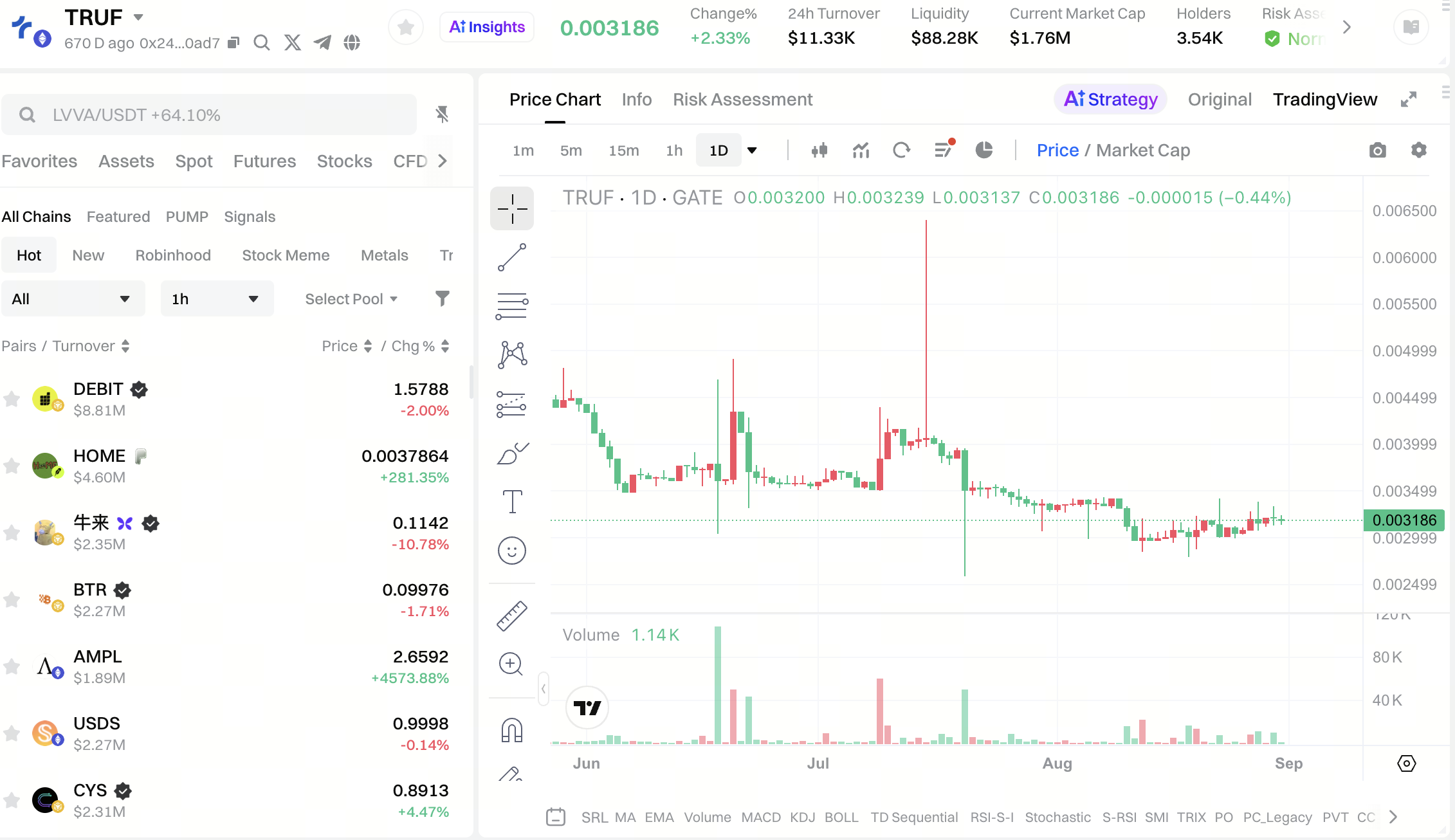
The TRUF/USDT pair recorded $21,682.01 in 24-hour volume.
Enter the amount, review the order, and place it.
After the order fills, TRUF appears in the spot account.
Verify the official contract and announcement updates before withdrawing to a self-custody wallet.
Conclusion
Truflation is best understood as an independent economic-data platform. Its main output is a set of daily inflation and macro indexes, with a predictor that the project says leads official U.S. CPI releases by about 45 days. The same data is now packaged for traders and institutions through APIs, custom indexes, and Bloomberg.
The TRUF token and network sit underneath that data business. They are not the product most users interact with first, but the infrastructure also marks a broader shift toward verified on-chain economic data for prediction markets and related games. Anyone using the indexes or holding TRUF should still review methodology, contract addresses, liquidity, and the difference between Truflation’s estimates and official statistics, and stay tuned to official project updates on token utility and network changes.
FAQ
What is Truflation?
An independent platform that publishes real-time inflation and macroeconomic indexes on-chain and through market data terminals.
How is it different from the Consumer Price Index?
CPI is an official monthly government series. Truflation publishes a daily independent estimate using a broader, higher-frequency price set.
What data does it cover?
U.S., U.K., Argentina, and India inflation indexes, plus U.S. PCE and employment, with store-level pricing from retail stores and other data providers feeding these indexes.
What is the BLS Predictor?
Truflation’s model for anticipating official BLS inflation prints. The project reports an average 45-day lead and high historical accuracy versus BLS.
Is Truflation on Bloomberg?
Yes. Truflation said its U.S. CPI and U.S. PCE series were live on Bloomberg in 2025, with unemployment and sentiment feeds planned. It is also publishing these series to terminals and other market-data services.
What is TRUF used for?
TRUF is the network token around data access, participation, and governance. Data consumers pay in TRUF to access network data, while eligible participants can participate in governance under current rules. The core commercial product is the economic data itself.
Can users still stake TRUF?
New staking was restricted in January 2026. Check official project updates before assuming staking is open.
Author: Abhishek
Translator: Piper
Reviewer(s): Matheus、Edward、Ashley、Juniper
Disclaimer
* The information is not intended to be and does not constitute financial advice or any other recommendation of any sort offered or endorsed by Gate.
* This article may not be reproduced, transmitted or copied without referencing Gate. Contravention is an infringement of Copyright Act and may be subject to legal action.
Yala is a modular Bitcoin DeFi infrastructure that connects BTC liquidity with multi-chain ecosystems through its YU stablecoin and MetaMint protocol. It enables Bitcoin holders to earn native DeFi yields across EVM and non-EVM networks securely and seamlessly.
Sui is a PoS L1 blockchain with a novel architecture whose object-centric model enables parallelization of transactions through verifier level scaling. In this research paper the unique features of the Sui blockchain will be introduced, the economic prospects of SUI tokens will be presented, and it will be explained how investors can learn about which dApps are driving the use of the chain through the Sui application campaign.
PAXG (Pax Gold) is a tokenized asset backed by physical gold, issued by the fintech company Paxos and traded on the Ethereum blockchain as an ERC-20 token. The core concept is to tokenize physical gold on-chain, with each PAXG token representing ownership of a certain amount of gold. This structure enables investors to hold and trade gold in the form of a digital asset.
Hyperliquid's vision is to develop an on-chain open financial system. At the core of this ecosystem is Hyperliquid L1, where every interaction, whether an order, cancellation, or settlement, is executed on-chain. Hyperliquid excels in product and marketing and has no external investors. With the launch of its second season points program, more and more people are becoming enthusiastic about on-chain trading. Hyperliquid has expanded from a trading product to building its own ecosystem.
PAXG (Pax Gold) is a tokenized asset backed by physical gold reserves, launched by fintech firm Paxos and issued as an ERC-20 token on the Ethereum blockchain. The core concept is to digitally represent real-world gold assets, allowing investors to hold and trade gold via the blockchain network. Because each PAXG token corresponds to a specific quantity of physical gold, its price is theoretically expected to closely track the global gold market.