Tolly (TOLLY) is the platform token of Tolly Labs, an Arc-native trading terminal, token launchpad, and on-chain data platform. It captures value from a 1% fee on every trade routed through the platform, part of which buys and burns TOLLY on the open market.
Tolly is built on Arc, the stablecoin-focused Layer-1 blockchain launched by Circle, the company behind USDC. Arc is a USDC-native chain: gas is paid in USDC, and assets on the network are quoted against USDC rather than a volatile native token. That design matters for TOLLY's liquidity model, because every launch on Tolly pairs directly against stable, dollar-denominated liquidity from the first block. Unlike a meme coin with no underlying product, Tolly operates live infrastructure on Arc mainnet: a launchpad (TollyPad), a DEX router, a market terminal, and fee-accounting contracts. TOLLY is the token associated with that ecosystem, and it should be distinguished from the platform itself and from any native Arc network token. For people researching TOLLY for the first time, the key point is that TOLLY is a platform token issued by Tolly Labs — it is not the Arc network token, is not issued by Circle, and is not used to pay gas on Arc.
The contract and token identity details are fixed reference points worth checking before any transaction:
- Token: TOLLY, issued by Tolly Labs on the Arc network
- Chain: Arc mainnet (chain ID 5042)
- Official contract address: 0xbc43ce8dec648ea298c4275559b81d6261c90b67
- Identity caveat: tokens on Arc can share a name and ticker, so only this address distinguishes the real TOLLY from duplicates
The official TOLLY contract address on Arc (chain ID 5042) is 0xbc43ce8dec648ea298c4275559b81d6261c90b67; tokens on Arc can share a name and ticker, so verifying this address before any transaction matters.
Key Takeaways
- Tolly (TOLLY) is the platform token of Tolly Labs, an Arc-native trading terminal, launchpad, and DEX — not a standalone meme asset.
- Every token launched on Tolly locks its entire supply as USDC liquidity from the first block, with no bonding curve and no migration.
- A 1% pool fee on every trade is split between creators, holders, the protocol, and TOLLY buy-and-burn; external swaps route a 0.2% interface fee to the same burn engine.
- Key risks include Arc's early-stage ecosystem, unaudited contracts, duplicate ticker confusion, and the distinction between holding a platform token and holding equity.
What Is Tolly (TOLLY)?
Tolly is the broader protocol and product ecosystem built by Tolly Labs on Arc. It combines a market terminal for discovering and analyzing Arc tokens, a launchpad for creating new tokens, a DEX routing layer, and creator tools. TOLLY is the crypto token associated with that ecosystem. For anyone searching what is Tolly TOLLY, the short answer is that Tolly is the product suite, while TOLLY is the tradable token tied to its fee flows.

This separation matters. Tolly Labs operates live smart contracts on Arc mainnet — launchpad, routing, fee-locking, holder-vault, and treasury contracts — while TOLLY is the tradable asset whose tokenomics are designed to route a share of platform activity into open-market purchases and burns. TOLLY is independent of Circle's Arc network and is not the native gas or network token of the Arc chain. Anyone can use a block explorer to review the launch, fee, and burn contracts, since all of them are public on Arc mainnet.
For traders, Tolly acts as a market interface and routing layer: traders use the terminal to find new Arc tokens and track trading volume over the past 24 hours. For creators, it is launch infrastructure — creators use TollyPad to launch a token without writing code, and they can use the built-in creator tools to manage launches. For token holders, TOLLY represents exposure to a fee-driven burn model rather than a claim on platform revenue or equity. People who use the platform regularly interact with all three roles at different times.
How Does Tolly Work on Arc?
Tolly's core mechanism is a single-transaction token launch. A creator launches a token through TollyPad in one transaction, paying only network gas. The token's entire supply is immediately converted into permanently locked USDC liquidity. There is no separate liquidity-provision step the creator could skip or manipulate, no bonding curve phase, and no later migration to a different pool. Because the launch executes atomically, there is no window of time in which the creator holds unlocked supply that could be sold ahead of later buyers.
This design is enabled by Arc's USDC-native architecture. Because Arc treats USDC as a first-class asset, Tolly can denominate every launch's liquidity in USDC from block one. Using USDC as the quote asset keeps liquidity, fees, and accounting in a stable unit rather than a volatile one. Trading begins immediately against that locked pool, and price discovery starts in real time.
For the first minutes after a launch, every wallet is capped at 3% of supply, including the creator's own first buy. Tolly calls this the Guard. The Guard uses a hard per-wallet cap during this opening time window, and the limit lifts automatically once the opening minutes pass. It is aimed at the opening-block sniper problem common on other launchpads, where a handful of bots acquire a large share of supply in the first seconds and sell into later arrivals; by the time the cap lifts, distribution has typically broadened beyond the first-block bots. This approach is designed to work automatically at launch, without any manual step from the team.
Beyond native launches, Tolly routes trades for other Arc tokens through Arc's shared Uniswap V3 liquidity. Buying a token that Tolly did not launch carries a 0.2% interface fee in USDC on the buy side; selling carries zero fees. That 0.2% is routed to the Furnace, which buys TOLLY on the open market and removes it from circulation.
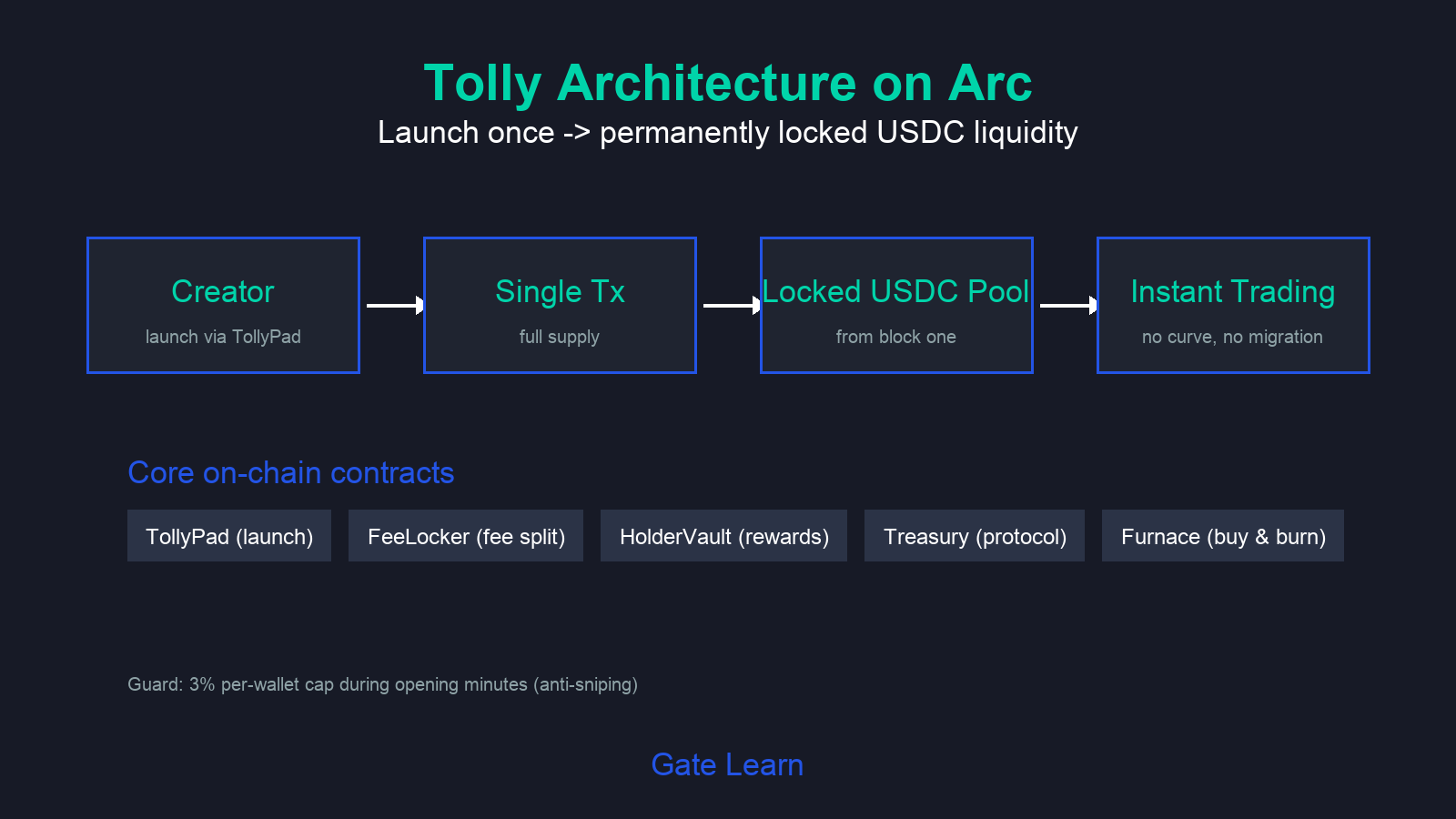
Figure 1. Tolly's architecture on Arc: a single-transaction launch from TollyPad into a permanently locked USDC liquidity pool with immediate trading, plus the core on-chain contracts and the Guard anti-sniping cap.
What Is TOLLY's Fee and Burn Model?
Tolly-native markets charge a 1% pool fee on every trade. Where the fee goes depends on the side of the trade, because the underlying Uniswap pool charges the fee in the token going in.
On a buy paid in USDC, the 1% fee splits as follows: 64% to the creator, 12% to holder rewards, 10% to the protocol, 9% to buying TOLLY and removing it from circulation, and 5% to removing the project token. In other words, the highest share of the buy-side fee goes to the creator as a launch incentive, while the 9% TOLLY allocation is smaller but mechanically persistent, executing each time a buy clears. On a sell, the fee arrives in the project's own token, and all of it is removed from circulation — the sell-side fee is burned in full rather than split. Because all of these flows settle on-chain, anyone can inspect the fee locker and verify totals over any rolling 24 hours window.
Swaps of non-native Arc tokens routed through Tolly use a separate 0.2% interface fee on the buy side. That fee goes to the Furnace, a dedicated mechanism that purchases TOLLY on the open market and sends it to a burn address. Because the fee locker and burn address are public on-chain contracts, anyone can read the fee locker and trace the flow of TOLLY to the dead address, independently verifying the burns rather than relying on project self-reports.
This creates three distinct paths by which platform activity routes value into TOLLY: the 9% share of native buy fees, the 0.2% external interface fee via the Furnace, and direct protocol-funded buybacks. In practice, the size of the burn scales with usage: the more the platform is used, the larger the cumulative burn over time, and observers can use the public burn address to track that cumulative total.
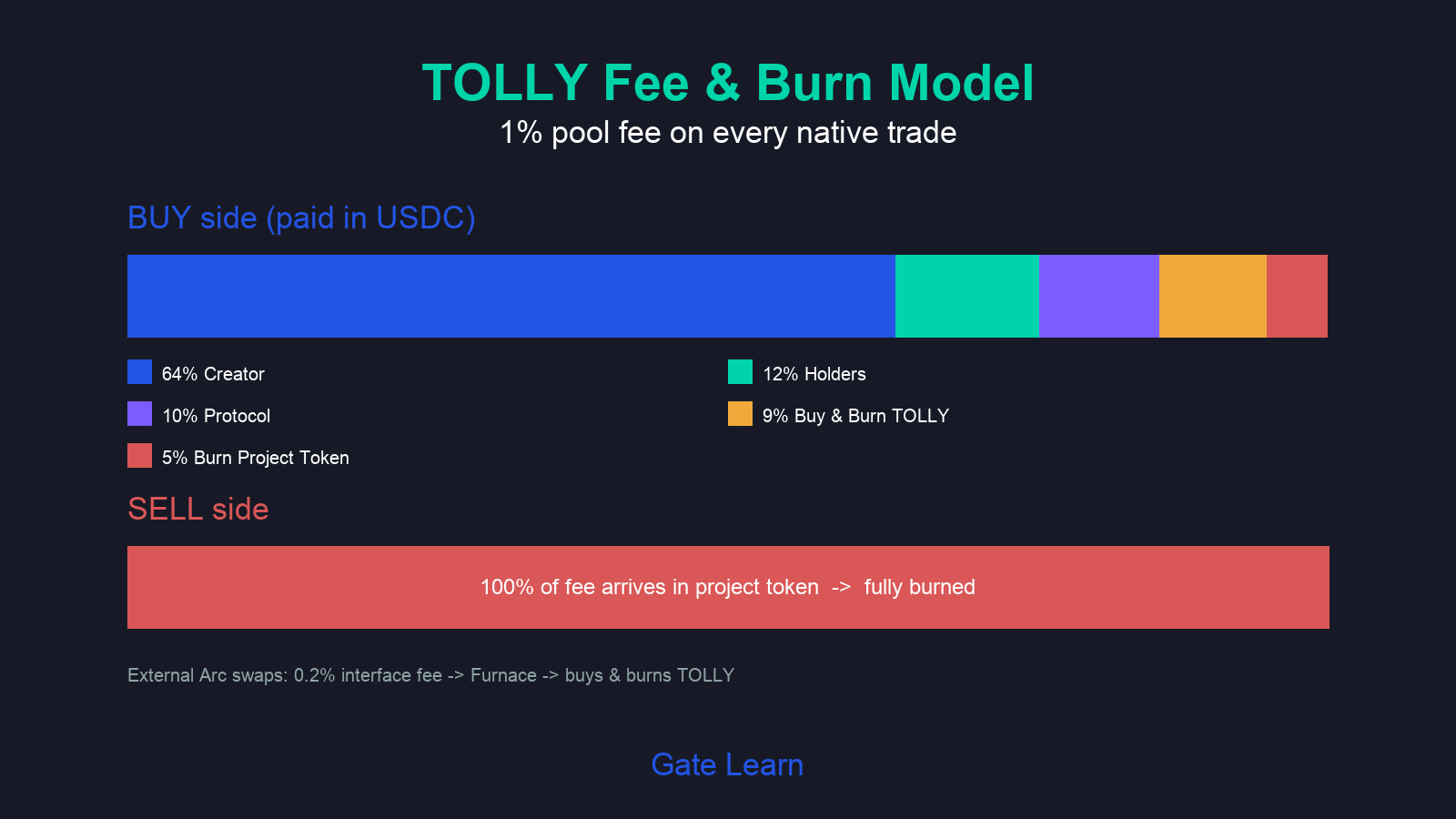
Figure 2. The TOLLY fee-and-burn model: the 1% buy-side pool fee split across creator, holder rewards, protocol, TOLLY burn, and project-token burn; the full sell-side fee burned; and the 0.2% interface fee on external swaps routed through the Furnace to burn TOLLY.
How Is Tolly Different from Traditional Launchpads?
Tolly differs from bonding-curve launchpads such as Pump.fun in its launch path, liquidity model, and fee structure. Where Pump.fun starts every token on a constant-product bonding curve and later migrates liquidity to PumpSwap, Tolly places the full supply into a permanently locked USDC pool at the moment of creation. There is no curve phase and no migration step.
The anti-sniping approach also differs. Rather than relying on curve dynamics alone, Tolly enforces a hard 3% per-wallet cap during the opening minutes of every launch. Fee design differs as well: Pump.fun charges a bonding-curve fee split between creator and protocol, while Tolly's 1% pool fee adds holder rewards and a dedicated TOLLY buy-and-burn allocation.
For a detailed side-by-side comparison, see the dedicated Tolly vs Pump.fun breakdown.
What Are the Use Cases, Token Launches, and Value Capture of TOLLY?
TOLLY's value capture is mechanical rather than discretionary. Platform trading volume generates fees (see the Tolly token and fee documentation); a defined share of those fees purchases TOLLY on the open market and removes it from circulation. Higher sustained volume therefore translates into higher burn pressure, independent of any team decision to buy back tokens. Because the mechanism runs continuously, anyone can check the burn address at any time to verify the cumulative burn instead of trusting periodic reports.
TOLLY does not represent equity in Tolly Labs, a claim on platform revenue, or governance rights unless explicitly stated by the project. Holding TOLLY is exposure to a token whose supply is reduced by platform activity, not ownership of the platform itself.
What Are the Risks of Using or Holding TOLLY?
TOLLY carries several distinct risk categories. Arc is a newly launched Layer-1, and its broader ecosystem, tooling, and liquidity are at an early stage and will take time to mature. Tolly's contracts are publicly verifiable: they are deployed on Arc mainnet, and the source code is published on Tolly Labs' GitHub, so anyone can review the logic directly and find the fee locker and burn addresses without relying on third-party summaries. Verifiable code is not the same as audited code, however — the project has explicitly stopped short of claiming a formal security audit, so smart contract risk remains.
Tokens on Arc can share a name and ticker, which creates a real risk of duplicate or impersonator TOLLY tokens; only the official contract address should be used. TOLLY's burn model depends on sustained platform trading volume, which is not guaranteed — anyone can check current activity levels, because volume over the past 24 hours is visible on-chain. Finally, holding a platform token is not equivalent to holding equity, and TOLLY does not confer a claim on Tolly Labs' revenue.
How to Buy TOLLY and Trade on Gate
TOLLY trades against USDT on Gate's spot market under the TOLLY/USDT pair. Before any transaction, verify the official contract address on Arc — 0xbc43ce8dec648ea298c4275559b81d6261c90b67 — because tokens on Arc can share a name and ticker, and duplicate tickers exist.
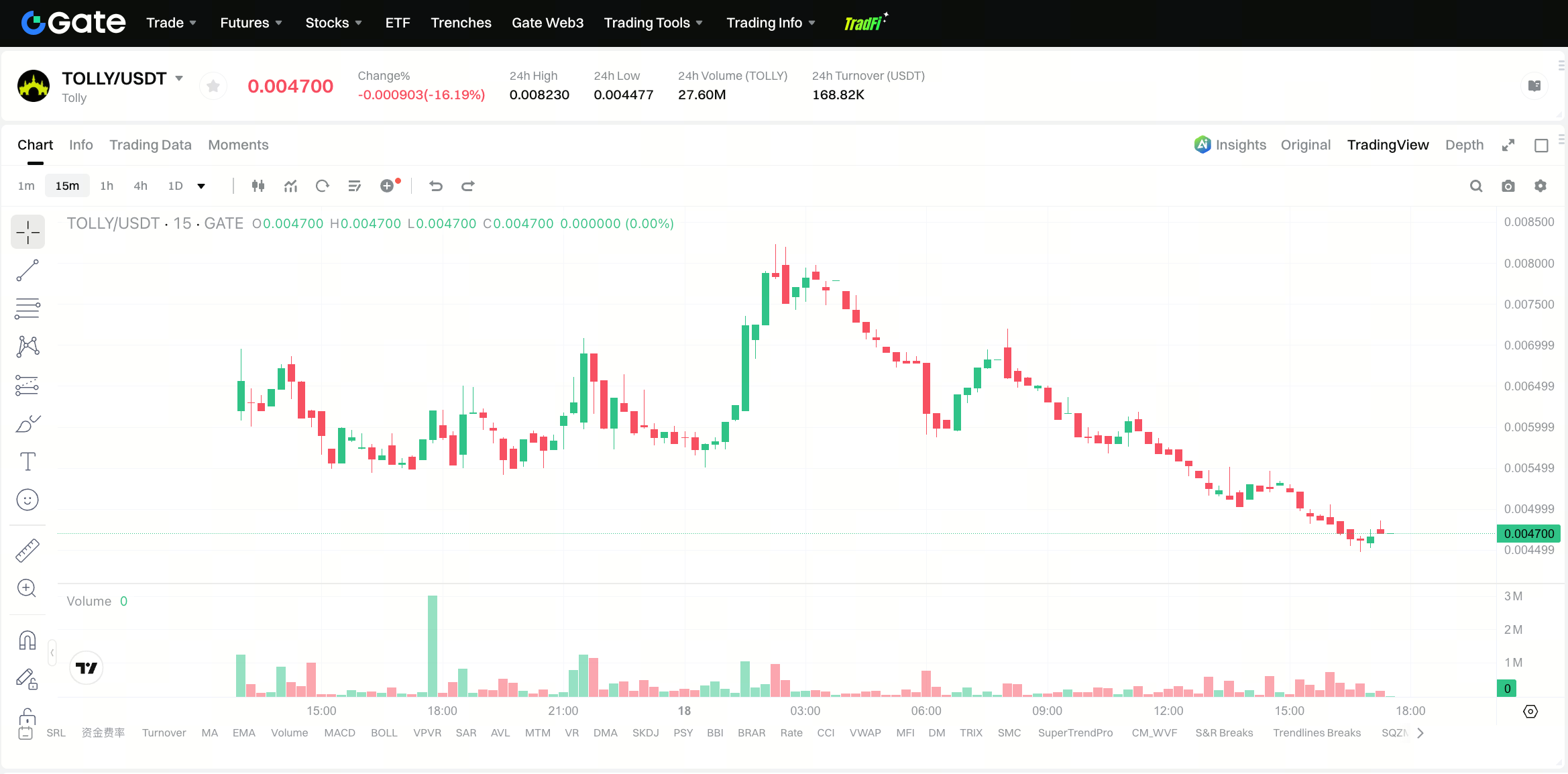
On Gate, the process follows the standard spot flow: fund an account with USDT, search for the TOLLY/USDT pair, review the order book — including volume over the past 24 hours — and place a limit or market order. Traders can review live quotes and historical trends on the TOLLY price page, find the pair through Gate's spot search, and use the order ticket to select the order type that fits their own execution preferences; taking the time to double-check the address against official sources is a basic safeguard. Gate's spot trading interface displays the applicable maker and taker fees before order confirmation, so users can work out total costs before they open a position. This is an objective description of the trading path, not a recommendation to buy or sell.
Summary
Tolly (TOLLY) is the platform token of Tolly Labs, an Arc-native trading terminal, launchpad, and DEX. Its defining features are single-transaction launches with permanently locked USDC liquidity, a 1% pool fee split across creators, holders, the protocol, and TOLLY buy-and-burn, and a Furnace mechanism that routes external swap fees into the same burn. The model's strengths are mechanical fee capture and on-chain verifiability; its risks are Arc's early ecosystem stage, unaudited contracts, duplicate ticker confusion, and the absence of any equity or revenue claim. This guide has outlined how those mechanics fit together, and readers can use the checklist above to evaluate the project before taking any position.
FAQ
What is Tolly (TOLLY)?
Tolly (TOLLY) is the platform token of Tolly Labs, an Arc-native trading terminal, token launchpad, and on-chain data platform built on Circle's Arc blockchain. It captures value from a 1% fee on every platform trade, part of which buys and burns TOLLY on the open market. Put simply, Arc is the chain, Tolly is the product suite built on that chain, and TOLLY is the token linked to that suite's fee flows — not the Arc network token. The model is transparent enough that burns over any 24 hours period can be checked directly on-chain.
What blockchain is TOLLY on?
TOLLY is on Arc, the stablecoin-focused Layer-1 blockchain launched by Circle, with chain ID 5042. The official TOLLY contract address is 0xbc43ce8dec648ea298c4275559b81d6261c90b67, and it can be verified through Arc's block explorer or Tolly's official documentation.
How does the TOLLY buyback and burn work?
On native buys, 9% of the 1% pool fee is used to buy TOLLY and remove it from circulation. On external Arc swaps routed through Tolly, a 0.2% interface fee goes to the Furnace, which buys TOLLY on the open market and burns it. Each time a qualifying trade executes, the split runs automatically, and you can use a block explorer to read each burn transaction on-chain — both flows are verifiable on-chain.
Is TOLLY safe? What are the risks?
TOLLY's contracts are publicly verifiable but not formally audited: the contracts are public on Arc mainnet and the code is published on Tolly Labs' GitHub, so anyone can use an explorer to review it, but public code is not a substitute for a formal third-party audit. Key risks are Arc's early-stage ecosystem, duplicate ticker impersonation (only the official contract address is valid), dependence on sustained trading volume for the burn model, and the fact that TOLLY is a platform token, not equity.
How is Tolly different from Pump.fun?
Tolly places full token supply into permanently locked USDC liquidity at launch with no bonding curve and no migration, enforces a 3% per-wallet opening cap, and routes a share of every fee into TOLLY buy-and-burn. Pump.fun uses a bonding curve that later migrates to PumpSwap and has a different fee split. Tolly also denominates all launch liquidity in USDC from the first block, while Pump.fun launches are denominated in SOL.