A crypto launchpad is a platform that lets a creator issue a token that becomes tradable immediately, without applying for a centralized exchange listing or hand-seeding a liquidity pool. Tolly and Pump.fun are both token launchpads that work this way, but they sit on different chains and make opposite design trade-offs. Tolly is built on Arc, Circle's USDC-native Layer-1, and places every launch's full supply into permanently locked USDC liquidity immediately. Pump.fun is built on Solana and starts every token on a constant-product bonding curve that later migrates to PumpSwap. Understanding which model fits which use case requires comparing the mechanisms directly rather than the marketing. The comparison table below lists the key differences dimension by dimension, and the full list of sections that follows explains how each launch model works, what the fees fund, and where each design is stronger or weaker.
Key Takeaways
- Tolly launches place full supply into permanently locked USDC liquidity from block one; Pump.fun starts on a bonding curve that migrates to PumpSwap after graduation.
- Tolly enforces a 3% per-wallet opening cap (the Guard); Pump.fun relies on curve dynamics with no per-wallet cap.
- Tolly's 1% pool fee funds creator rewards, holder rewards, the protocol, and TOLLY buy-and-burn; Pump.fun's bonding-curve fee splits between creator and protocol only.
- Both platforms route a share of fee revenue into a platform token model — Tolly buys and burns TOLLY, while Pump.fun has PUMP — but the mechanics and allocations differ.
- Neither model is universally better — the choice depends on chain preference, liquidity style, and tolerance for sniping risk.
What Is Tolly?
Tolly is an Arc-native token launchpad, trading terminal, and DEX built by Tolly Labs. A token launches in a single transaction, its entire supply becomes permanently locked USDC liquidity, and it trades from the first block with no bonding curve and no migration. Every trade pays a 1% pool fee split across creators, holders, the protocol, and a TOLLY buy-and-burn allocation. Creators can use the same interface to launch, trade, and track tokens without leaving Arc. Tolly is described in full in the Tolly (TOLLY) explainer.

What Is Pump.fun?
Pump.fun started as a simple memecoin launcher on Solana and grew into the chain's highest-volume launchpad, later adding its own PumpSwap AMM as the graduation destination for completed curves. The platform started with a deliberately minimal design — one click to create a coin, one curve to price it — and kept that simplicity as volume grew. Pump.fun is a Solana-based token launchpad that lets anyone create a token that trades immediately on a constant-product bonding curve. There is no order book and no seeded liquidity; price is a pure function of how many tokens have been bought from the curve. The launch path has two stages: during the bonding-curve stage, buys and sells execute against the curve itself, and once a token's curve is fully sold out, liquidity migrates automatically and irreversibly to PumpSwap, Pump.fun's native AMM. After this graduation, the token trades as a standard AMM pair on PumpSwap rather than on the curve. The bonding curve charges a fee split between the token's creator and the protocol. In short, Pump.fun works as an automated market for brand-new tokens, with the curve handling price discovery until the pool handover.
Tolly vs Pump.fun: Launch Path and Liquidity
The core difference is what happens at the moment of creation. On Tolly, a launch is a single transaction that places the token's entire supply into a permanently locked USDC liquidity pool. There is no curve phase, no graduation threshold, and no migration. On Pump.fun, a launch creates a bonding curve with virtual reserves; the token trades along that curve until it is fully sold, at which point liquidity migrates to a canonical PumpSwap pool. Graduation to PumpSwap changes how the token trades: before graduation, pricing follows the curve's formula and liquidity lives inside the launch contract; after graduation, the token trades as a standard AMM pair on PumpSwap, where anyone can swap against the migrated pool. Tolly's launch path skips this two-stage process entirely.
| Dimension |
Tolly |
Pump.fun |
| Chain |
Arc (Circle L1, USDC-native) |
Solana |
| Launch mechanism |
Single transaction, full supply to locked USDC pool |
Bonding curve, migrates to PumpSwap |
| Liquidity model |
Permanently locked USDC from block one |
Virtual reserves on curve, then AMM pool |
| Migration |
None |
Automatic, irreversible, at curve completion |
| Pool fee |
1% split: creator, holders, protocol, TOLLY burn |
Bonding-curve fee: creator + protocol |
| Holder rewards |
12% of every buy fee |
None at the protocol level |
| Anti-sniping |
3% per-wallet opening cap (Guard) |
None; curve dynamics only |
| Platform token |
TOLLY, bought and burned from fees |
PUMP (separate model) |
Tolly's model gives immediate, stable liquidity but no price-discovery curve. Pump.fun's model gives continuous price discovery but exposes early buyers to curve volatility and migration risk. Put differently, Tolly does the work of market-making up front by locking the pool, while Pump.fun lets the curve do that work gradually as buyers arrive.
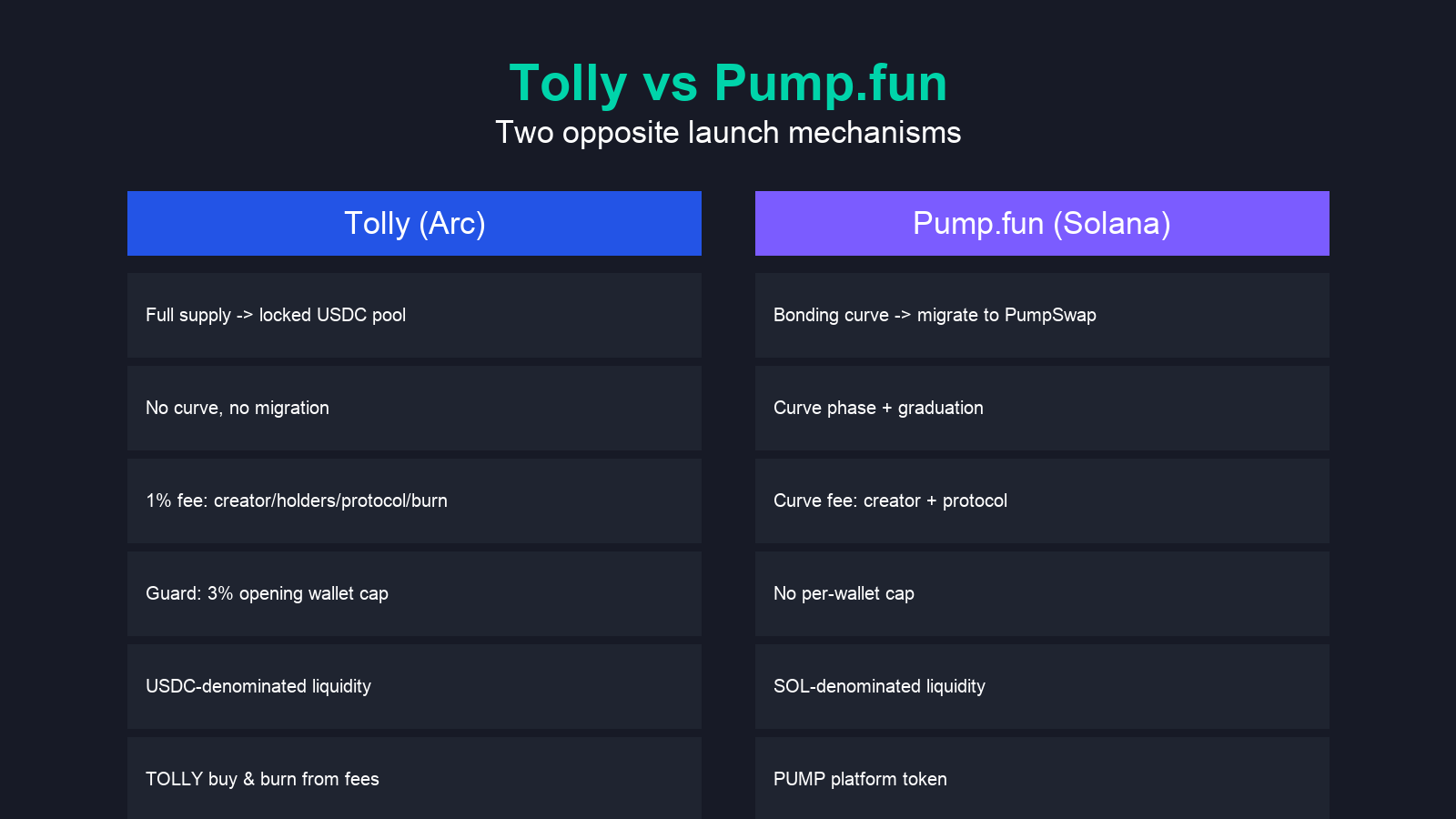
Figure 1. Tolly vs Pump.fun: the mechanical differences across six dimensions — launch path, liquidity model, fee structure, anti-sniping, quote asset, and platform token.
Tolly vs Pump.fun: Fee Structure
Tolly's 1% pool fee on native buys splits 64% to the creator, 12% to holder rewards, 10% to the protocol, 9% to buying and burning TOLLY, and 5% to removing the project token. On sells, the entire fee arrives in the project token and is burned. External Arc swaps routed through Tolly add a 0.2% interface fee that funds TOLLY burns via the Furnace.
Pump.fun's bonding-curve fee was documented at 1.25%, split between a creator fee and a protocol fee, with no holder-reward allocation. Post-graduation PumpSwap pools use a market-cap-based tiered fee. Pump.fun's model routes value to creators and the protocol; Tolly's model additionally routes value to holders and to reducing TOLLY supply.
Top launchpads typically release their own platform tokens to route a share of fee revenue back into the ecosystem, and both platforms here follow that pattern. Tolly directs 9% of every native buy fee, plus a 0.2% interface fee on external Arc swaps, to buying and burning TOLLY. Pump.fun's PUMP token is a separate platform-token model tied to the protocol's fee revenue. The structural point is the same — trading activity feeds a platform token — but the mechanics differ: Tolly's is an automatic, per-trade buy-and-burn, while Pump.fun's sits outside the bonding-curve fee itself.
Tolly vs Pump.fun: Anti-Sniping and Fair Launch
Tolly's Guard caps every wallet at 3% of supply for the first minutes after a launch, including the creator's own first buy. This is a hard, protocol-level constraint aimed at opening-block snipers.
Pump.fun has no equivalent per-wallet cap. Its bonding curve provides continuous liquidity, but a small number of bots can still acquire a large share of supply in the first seconds and sell into later arrivals. The trade-off is deliberate: Pump.fun optimizes for permissionless speed, Tolly for distribution fairness.
Which Should You Choose?
Choose Tolly if the priority is permanent USDC liquidity from the first block, a built-in holder-reward stream, protocol-level anti-sniping, and a platform token whose supply is reduced by trading activity. Choose Pump.fun if the priority is Solana's high-velocity memecoin culture, continuous bonding-curve price discovery, and the deepest existing launch volume.
In practice, creators can use either platform to reach a tradable token in minutes, and launching on a top launchpad offers clear pros: instant liquidity without manual market-making, immediate distribution to an existing trader base, and discovery through the platform's own listings and leaderboards. The trade-offs sit in the details — which chain the community is on, how liquidity is structured, and what the fees fund. This information is mechanical rather than promotional: both platforms publish their fee splits and launch rules publicly, so it is worth reading those documents before choosing. Remember that launch mechanics decide how a token trades on day one, not how it performs over months.
Neither choice is universally correct. Tolly is the younger platform on a younger chain, with less established liquidity; Pump.fun is the established incumbent with a curve model some creators prefer to avoid.
Summary
Tolly and Pump.fun solve the same problem — launching a tradable token — with opposite mechanisms, and each mechanism works differently under the hood. Tolly locks full supply into permanent USDC liquidity at creation, splits a 1% fee across creators, holders, protocol, and TOLLY burns, and caps opening wallets at 3%. Pump.fun starts tokens on a bonding curve that migrates to PumpSwap, charges a creator-plus-protocol fee, and has no per-wallet cap. Each model works best for a different kind of launch: Tolly for fair, liquidity-first distribution on Arc, Pump.fun for high-velocity price discovery on Solana. The right choice depends on chain, liquidity preference, and sniping tolerance.
FAQ
What is the main difference between Tolly and Pump.fun?
Tolly places a token's full supply into permanently locked USDC liquidity at launch with no bonding curve and no migration. Pump.fun starts every token on a bonding curve that later migrates to PumpSwap, where it trades as a standard AMM pair. Tolly also adds holder rewards and a TOLLY buy-and-burn to its fee split; Pump.fun's curve fee splits only between creator and protocol.
Is Tolly or Pump.fun better for fair launches?
Tolly enforces a 3% per-wallet cap during the opening minutes of every launch, which directly limits opening-block snipers. Pump.fun has no per-wallet cap and relies on curve dynamics, so early supply concentration by bots is more common. For launches where broad, even distribution from the first block matters, Tolly's Guard offers the stronger guarantee; Pump.fun prioritizes permissionless speed instead.
How do Tolly and Pump.fun fees compare?
Tolly charges a 1% pool fee split across creator (64%), holder rewards (12%), protocol (10%), TOLLY buy-and-burn (9%), and project-token burn (5%) on buys. Pump.fun's documented bonding-curve fee is 1.25%, split between creator and protocol only, with no holder-reward allocation. The list of fee destinations is therefore longer on Tolly, which also routes value to holders and to reducing TOLLY supply on every trade.
Does Tolly have a bonding curve like Pump.fun?
No. Tolly has no bonding curve and no migration. Every Tolly launch places its full supply into a permanently locked USDC liquidity pool in a single transaction, and trading begins immediately against that pool. Pump.fun's two-stage path — curve first, then graduation to PumpSwap — does not exist on Tolly.