TokenStocks is Gate's tokenized securities section where on-chain tokens track U.S. equity prices. Per the TokenStocks market list, tokenized stocks are blockchain representations of real-world shares—typically backed about 1:1 and held in custody by a regulated institution. Buying a tokenized stock means buying a digital price mirror, not the registered share itself. The section offers three product lines—gStocks, Ondo Stocks, and xStocks—each with different issuers and backing designs, often traded with USDT around the clock.
What Is TokenStocks?
TokenStocks maps stocks or ETFs to on-chain tokens that typically follow referenced U.S. equities. Per the Gate Help Center and the TokenStocks market page, prices usually align with the underlying under a custody-style structure and support fractional-style sizing. Users trade mainly via spot markets under the TokenStocks category—the section brings equity exposure into crypto markets rather than replacing a full brokerage account.
Three lines sit under Gate TokenStocks: gStocks (Gate in-house), Ondo Stocks (Ondo Global Markets), and xStocks (Backed Finance). Ticker suffixes G, ON, and x often identify each line.
How Does TokenStocks Work? How Is Price Pegged to the Underlying?
TokenStocks link on-chain tokens to reference equities through reserves, tracking mechanics, and market quotes. Peg quality depends on issuer design, oracle sources, and liquidity.
Peg strength varies by session. Regular U.S. hours (09:30–16:00 ET) bring tighter spreads; pre-market and after-hours see thinner depth. When U.S. markets close, on-chain tokens can still trade 24/7 without a live reference print—raising peg and liquidity risk.
| U.S. session (ET) |
Underlying liquidity |
Typical peg impact on TokenStocks |
| Regular 09:30–16:00 |
High |
Faster price updates; relatively tighter spreads |
| Pre-market / after-hours |
Lower |
Volatility may rise; order-book depth often drops |
| Closed (weekends / holidays) |
No live trade price |
On-chain trading continues; peg and liquidity risks need extra review |
The table explains session-to-session behavior differences—not a price judgment. Verify reserve disclosure and per-instrument rules on Gate product pages.
What Are gStocks, Ondo, and xStocks? How Do the Three Lines Differ?
gStocks, Ondo Stocks, and xStocks differ in issuer, backing, and ticker suffix. Confirm each instrument on its product page.
gStocks is Gate's line with 1:1 native-stock reserves and G suffix tickers (e.g. AAPLG). gStocks tokenized securities center on that reserve design, while 1:1 backing and conversion explains how shares map to tokens.
Ondo Stocks from Ondo Global Markets uses a Total-Return Tracker (ON suffix, e.g. SPYON); dividends may reinvest net of tax. The Ondo tokenized stocks section lists common ON instruments, and Ondo spot trading basics cover the USDT spot path for ON names.
xStocks via Backed Finance uses x suffix tickers (e.g. SPYx). The xStocks on-chain equity network covers how assets map on-chain, and the SPYx, AAPLx, and TSLAx lineup helps identify common symbols.
| Dimension |
gStocks |
Ondo Stocks |
xStocks |
| Issuer / operator |
Gate in-house line |
Ondo Global Markets |
Backed Finance framework |
| Typical ticker cue |
G suffix |
ON suffix |
x suffix |
| Mechanism highlight |
1:1 full native-stock reserve |
Total-Return Tracker |
On-chain tokenized securities |
| Common Gate entry |
TokenStocks filter · gStocks |
TokenStocks filter · Ondo |
TokenStocks filter · xStocks |
For a side-by-side look at fees, entry paths, and on-chain attributes, use the three-line tokenized stocks comparison.
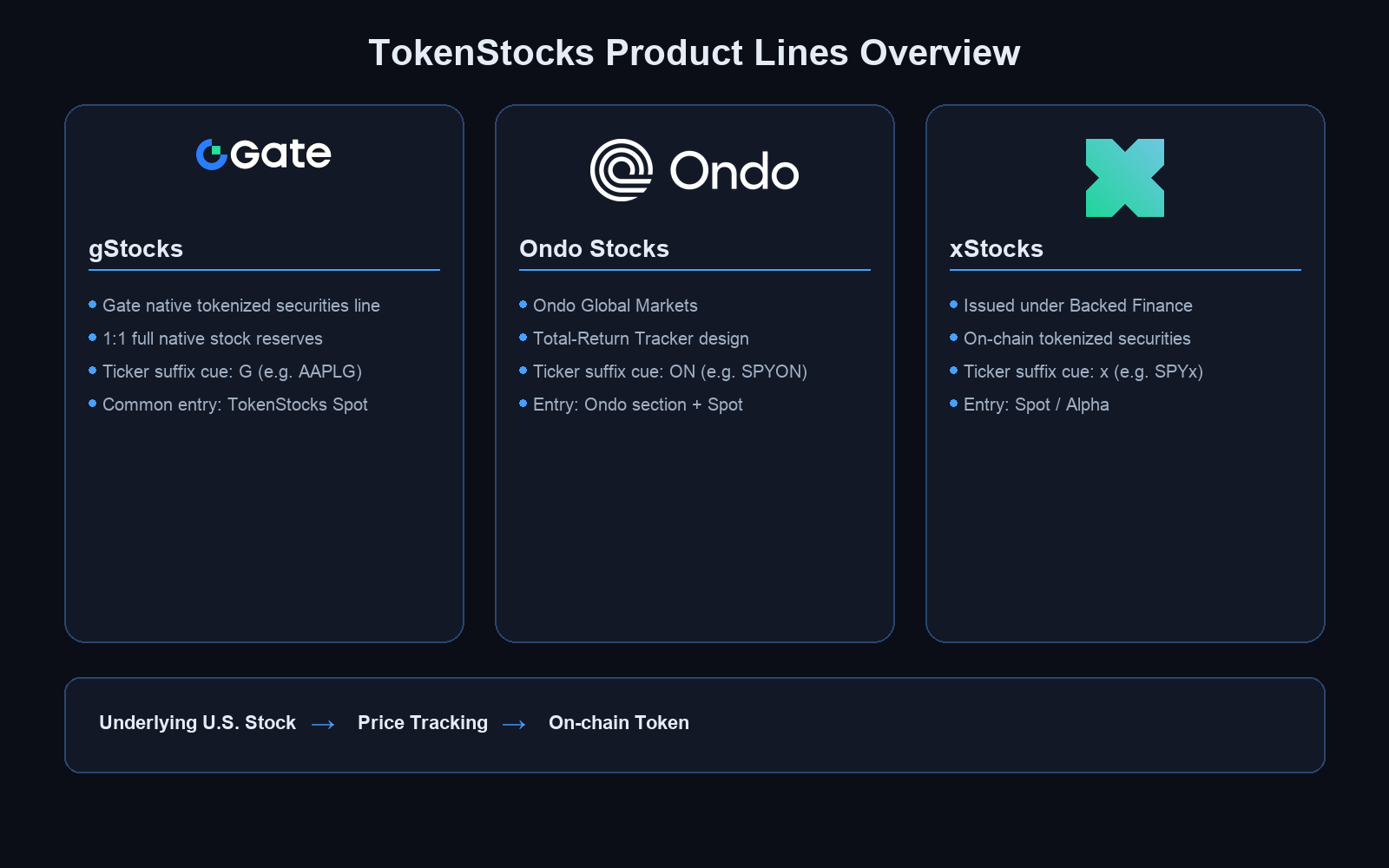
Figure 1. TokenStocks three product lines—gStocks, Ondo Stocks, and xStocks—showing issuers, mechanisms, and ticker suffix cues.
How Do TokenStocks Differ from Traditional Stocks and CFDs?
TokenStocks, traditional stocks, and CFDs all express equity price exposure but differ in legal form, holder rights, and paths. TokenStocks are on-chain price trackers—not exchange-registered shares.
Traditional stocks grant voting, corporate actions, and cash dividends under market rules, within exchange hours. Per Gate FAQ, tokenized stocks lack typical shareholder rights; splits follow issuer rules. For a clearer rights and account comparison across brokerage shares, CFDs, and tokenized exposure, see traditional stocks vs CFD paths. CFDs are contractual exposure without share transfer; TokenStocks sit on-chain, and the gap versus brokerage accounts also appears in on-chain trading vs brokerage accounts.
| Dimension |
TokenStocks |
Traditional stocks |
CFD |
| Asset form |
On-chain token |
Exchange-registered share |
Price-difference contract |
| Typical shareholder rights |
Usually no vote / cash dividend |
Yes (per market rules) |
None |
| Trading hours |
Crypto markets trade 24/7 |
Exchange session hours |
Per dealer rules |
| Entry requirements |
USDT (common) + Gate account |
Brokerage account + KYC |
Dealer account |
| Fractional sizing |
Smaller units supported |
Depends on broker and symbol |
Depends on contract spec |
The table frames differences—not a tool ranking.
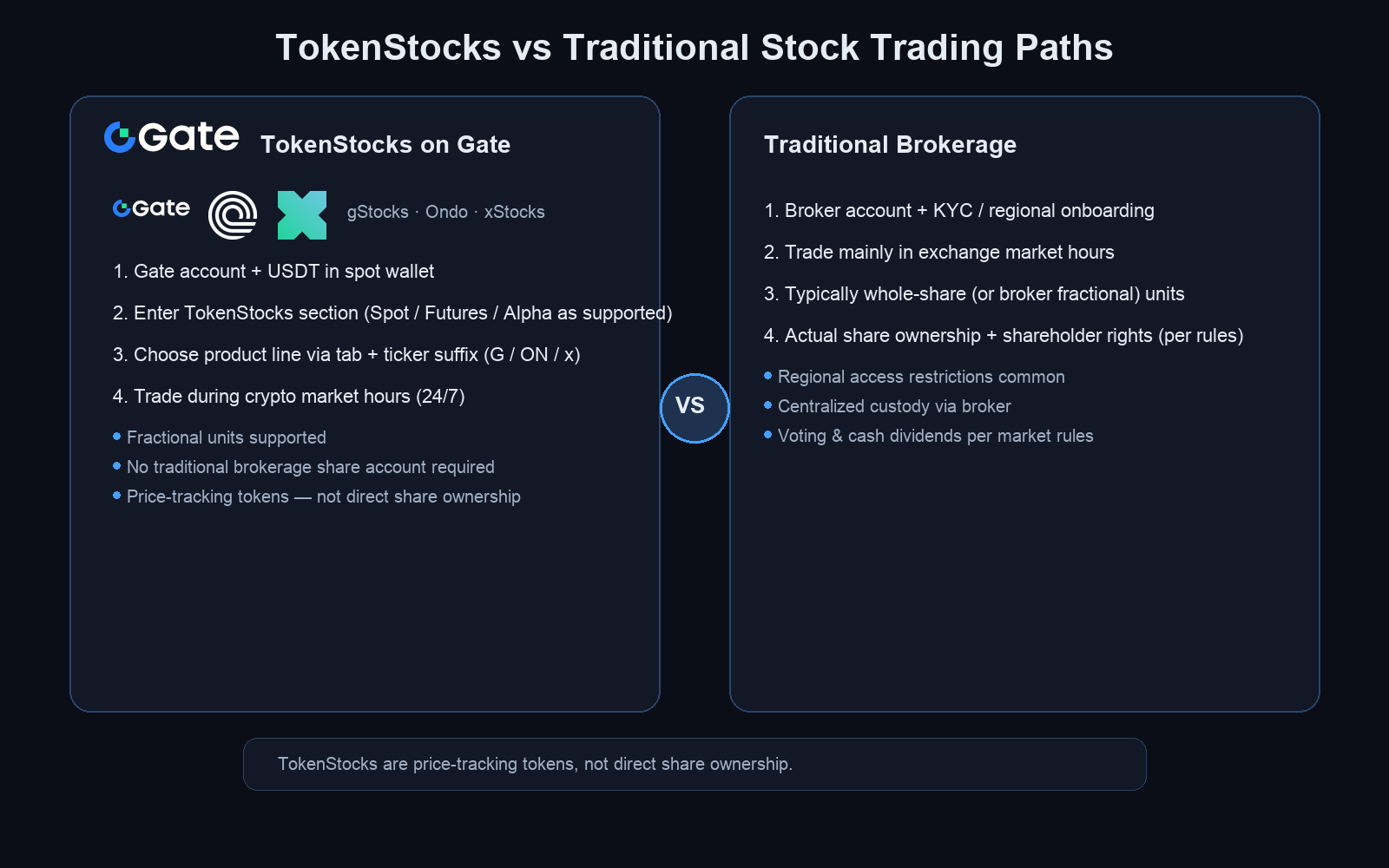
Figure 2. TokenStocks versus traditional stock trading paths—accounts, funding, session hours, and holder-rights differences.
What Are the Benefits and Risks of Holding or Trading TokenStocks?
Advantages include 24/7 trading, fractional units, USDT quoting, and filtering gStocks / Ondo / xStocks inside the TokenStocks market list before opening a spot trade (other modes only where the page supports them).
Risks fall into three buckets. Peg and liquidity can drift during closed or thin sessions. Rights gaps mean no voting or cash dividends, while Ondo reinvestment is not the same as a cash payout to holders. Issuer events such as insolvency can break pegs; common misreads on Gate’s own line are covered under risk and compliance boundaries. Gate matches and displays tokens but does not directly broker securities; fees follow product pages.
How Do You Find and Trade TokenStocks on Gate?
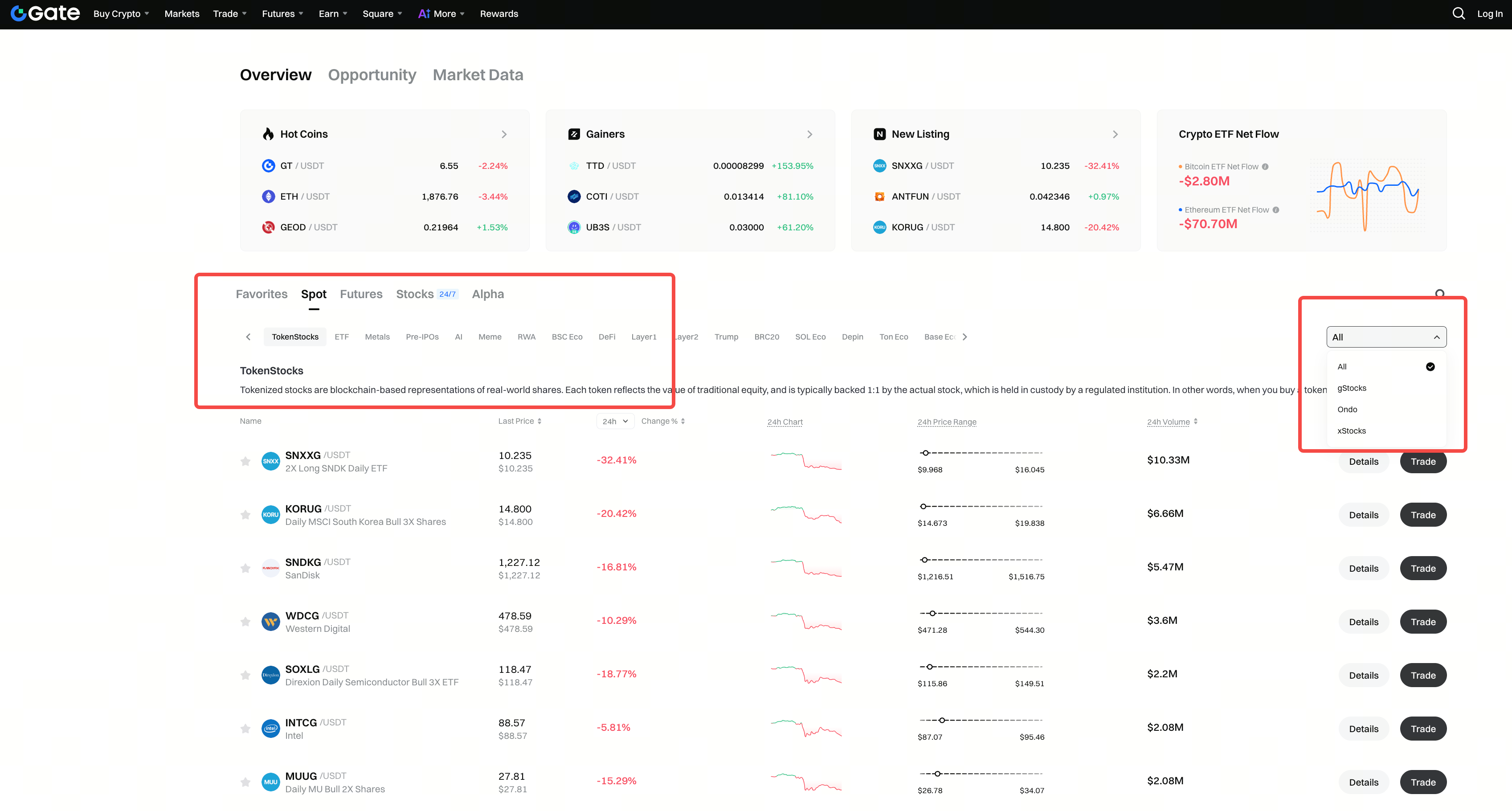
On web, open Spot markets, select the TokenStocks category at the TokenStocks market list, then use the right-side filter for All / gStocks / Ondo / xStocks. On the app, open Spot → TokenStocks and filter by product line. List rows typically offer Details and Trade actions. For funding, filters, and order-field checks, follow the USDT spot order steps; for gStocks-only prep, use the gStocks trading flow. Confirm suffix, underlying name, USDT balance, and session liquidity; other modes need separate rule checks.
Summary
TokenStocks groups gStocks, Ondo Stocks, and xStocks under one Gate hub for price-tracking on-chain equity exposure—a digital mirror of the stock, not registered share ownership, as the market list states. Issuer, backing, suffix, and filter path differ by line.
Review peg variation, missing shareholder rights, and issuer-event risk before trading. Use the TokenStocks market list, product pages, and Help Center rules as source of truth, and match tickers to the intended line.
FAQ
What is TokenStocks?
TokenStocks is Gate's on-chain tokenized securities section where token prices typically track U.S. equities. The section includes gStocks, Ondo Stocks, and xStocks, often traded with USDT in crypto markets. Tokens generally do not equal direct share ownership and usually carry no shareholder voting rights.
What is the difference between gStocks, Ondo, and xStocks?
gStocks is Gate's proprietary line with 1:1 full native-stock reserves and G suffix tickers. Ondo Stocks from Ondo Global Markets uses a Total-Return Tracker with ON suffix tickers. xStocks, issued via Backed Finance, are on-chain tokenized securities with x suffix tickers. Issuers, mechanics, and Gate entry points differ—verify each instrument's product page before trading.
Are tokenized stocks the same as real stocks? Do they have voting rights or dividends?
No. Gate Help Center FAQ states tokenized stocks are on-chain assets linked to underlying prices, not direct corporate share issuance. Holders typically lack voting, cash dividend, and governance rights. Ondo's Total-Return Tracker may reflect dividend impact through reinvestment rather than paying cash to holders—a different mechanism. Splits are issuer-determined.
How do tokenized stocks track real stock prices?
Prices usually link to underlying equities through issuer reserves, tracking mechanisms, and market quotes. During regular U.S. trading hours, liquidity is higher and pegs tend to be tighter. Pre-market, after-hours, and closed sessions can widen deviation and liquidity risk even while on-chain markets stay open. Peg design differs across gStocks, Ondo, and xStocks—check issuer and product disclosures.
Can tokenized stocks be traded 24 hours a day?
Yes. Gate Help Center notes tokenized stocks can trade around the clock in crypto markets, unlike conventional U.S. exchange hours. During closed or low-liquidity sessions, peg stability and spreads may be weaker than during regular U.S. hours—factor session characteristics into liquidity review.
How do you trade TokenStocks with USDT on Gate?
Open Spot → TokenStocks on the app, or the TokenStocks market list on web, filter All / gStocks / Ondo / xStocks, fund USDT, search the target ticker (watch G, ON, and x suffixes), open Trade, confirm the underlying name and order fields, then submit. Funding, filters, and order checks follow the same sequence as the “How Do You Find and Trade TokenStocks on Gate?” section above.