For beginners sorting AI-credit products, the naming layer matters: Teller is the permissionless lending protocol operating since 2019 (teller.org cites more than $80 million in cumulative loans processed); Debit is the consumer-facing AI finance interface; DEBIT is the onchain utility ticker on aggregators such as CoinMarketCap. Readers comparing AI-and-credit narratives can cross-read How AI is transforming the crypto industry; readers weighing onchain credit mechanics should start from DeFi.
Key Takeaways
- Teller is a non-custodial DeFi lending protocol; Debit adds a conversational AI layer for TradFi pre-qualification and onchain actions in one workflow.
- Two borrowing paths dominate the product story: unsecured cash via licensed lenders (soft credit check) versus asset-backed loans against BTC, ETH, and stocks with a no-margin-call design.
- DEBIT is a utility token for AI access and ecosystem services—not a share of loan book revenue by default; supply is capped at 100 million with vesting on the remainder.
- Risks span credit underwriting outside the protocol, smart-contract exposure, token concentration, and confusion between the legacy Teller brand and newer Debit AI marketing.
What Is Teller (DEBIT)?
Teller is a decentralized lending marketplace that has operated since 2019, offering permissionless, non-custodial credit rails across Ethereum, Base, Arbitrum, Polygon, BNB Smart Chain, and additional networks. teller.org cites more than $80 million in cumulative loans processed and a lender network of 50+ partners—figures that describe protocol activity rather than a single bank balance sheet.
DEBIT is the native utility token of the Debit AI finance platform layered on Teller infrastructure. CoinMarketCap lists the asset under the name Teller with ticker DEBIT (BEP-20 contract 0x66661c7229901f568f16bd1551b3ba826f83ce49 on BNB Smart Chain, with cross-chain references on Ethereum). The token is tagged with DeFi and Binance Alpha distribution categories on major aggregators.
The Debit interface positions itself as a single conversational agent for:
- Personal, business, auto-refi, HELOC, and credit-card comparison flows tied to TradFi partners
- No-collateral pre-qualification marketed as a soft credit check path
- Onchain swapping, bridging, borrowing, stablecoin yield, and a Teller Score credit-building narrative
Investor logos displayed on teller.org include Blockchain Capital, Franklin Templeton, Toyota Ventures, and Framework Ventures, reflecting venture rounds that predate the DEBIT token launch narrative.
How Does the Teller Lending Protocol Work?
At the protocol layer, Teller removes the traditional bank intermediary for matched borrowing and lending while keeping loans non-custodial—funds move according to smart contracts rather than a centralized custodian holding user collateral indefinitely.
Core design themes repeated across Teller documentation and third-party explainers include:
- Permissionless markets where lenders and borrowers meet onchain with programmable terms.
- Isolated, time-based pools that segment risk instead of pooling all assets into one global book.
- No margin calls on the asset-backed path—collateral rules use rolling-period benchmarks rather than intraday liquidation triggers in the marketed design.
- Multi-chain deployment so liquidity and collateral types can differ by network.
The unsecured path is different in kind: pre-qualification routes users toward licensed TradFi lenders who perform underwriting and disburse fiat to bank accounts. Teller’s AI layer aggregates eligibility checks; approval, rates, and compliance remain with the partner lender. On the asset-backed path, loan-to-value (LTV) caps how much stablecoin or crypto liquidity a user can draw against pledged BTC, ETH, or tokenized shares; “borrowing without a separate collateral account” means users need not park assets in a dedicated custodial lockbox before seeing terms—collateral still secures the onchain leg.
Loan interest on pools is paid according to pool duration and lender terms, while partner fiat loans carry APR and fee schedules disclosed at application time. If collateral value drops during an asset-backed loan, Teller’s no-margin-call framing relies on rolling-period benchmarks rather than same-day liquidations; users should still read pool rules because lower collateral value can affect renewal, LTV headroom, or eventual settlement.
For a side-by-side view of unsecured versus collateralized routes, see Teller unsecured vs asset-backed loans.
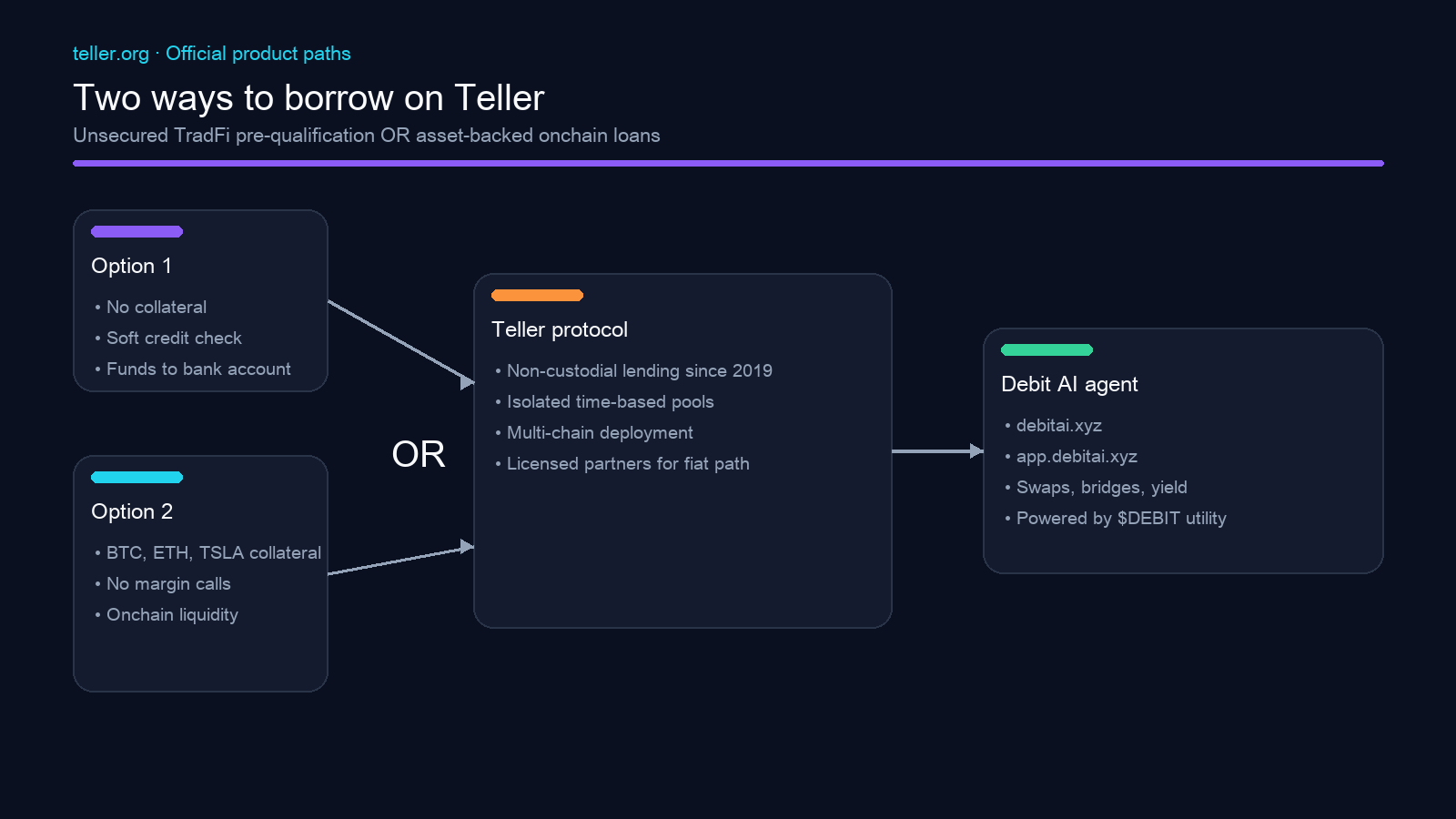
Figure 1. Official teller.org borrowing paths: unsecured fiat pre-qualification versus onchain asset-backed loans.
What Is the Debit AI Agent?
Debit markets a conversational AI agent (branded “Teller AI” on the homepage) that unifies TradFi loan shopping with onchain execution. Instead of switching between a bank portal, a wallet, and a DEX, users issue natural-language intents—check pre-qualification, compare card offers, bridge stablecoins, or open an asset-backed loan. When the agent surfaces credit-card comparisons, each approved card transaction still posts through the issuer’s network; Debit orchestrates discovery, not charge settlement. That distinction matters for users who ask why a card transaction on their statement does not match an onchain hash—the TradFi leg and the wallet leg follow different rails.
Official surfaces listed by @useteller include teller.org, debitai.xyz, app.debitai.xyz, mobile PWA installs, and mini-app channels such as Telegram and Farcaster. The agent is positioned as orchestration software: it does not replace KYC, credit bureaus, or lender licensing where those apply.
Operational steps users typically encounter:
- Connect identity and wallet where required.
- Run a soft-check pre-qualification for unsecured offers or select collateral for asset-backed borrowing.
- Review partner terms (APR bands, fees, maturity) before any hard credit pull.
- Execute onchain legs—swap, bridge, deposit collateral, draw stablecoin liquidity—inside the same session when the product path is onchain.
A practical walkthrough of agent prompts and guardrails lives in How to borrow on Teller with the AI agent.
What Can You Do on Debit Beyond Borrowing?
Debit’s scope extends past single-purpose lending:
| Capability |
User-facing goal |
Onchain / TradFi mix |
| Personal & business loans |
Cash to bank with no pledged crypto |
TradFi partners + soft credit check |
| Asset-backed loans |
Liquidity against BTC, ETH, tokenized stocks |
Onchain collateral, no margin-call framing |
| Stablecoin yield |
Deploy idle USDC/USDT-style balances |
Onchain yield venues |
| Swaps & bridges |
Move assets across chains before borrowing |
DEX / bridge integrations |
| Teller Score |
Build a reusable credit profile narrative |
Scoring model + partner acceptance |
Yield and swap modules sit inside the same account view marketed on teller.org (“Track, save, and borrow all in one app”). Each module inherits distinct risks: smart-contract bugs, bridge latency, stablecoin depeg, and counterparty risk on offchain lenders.
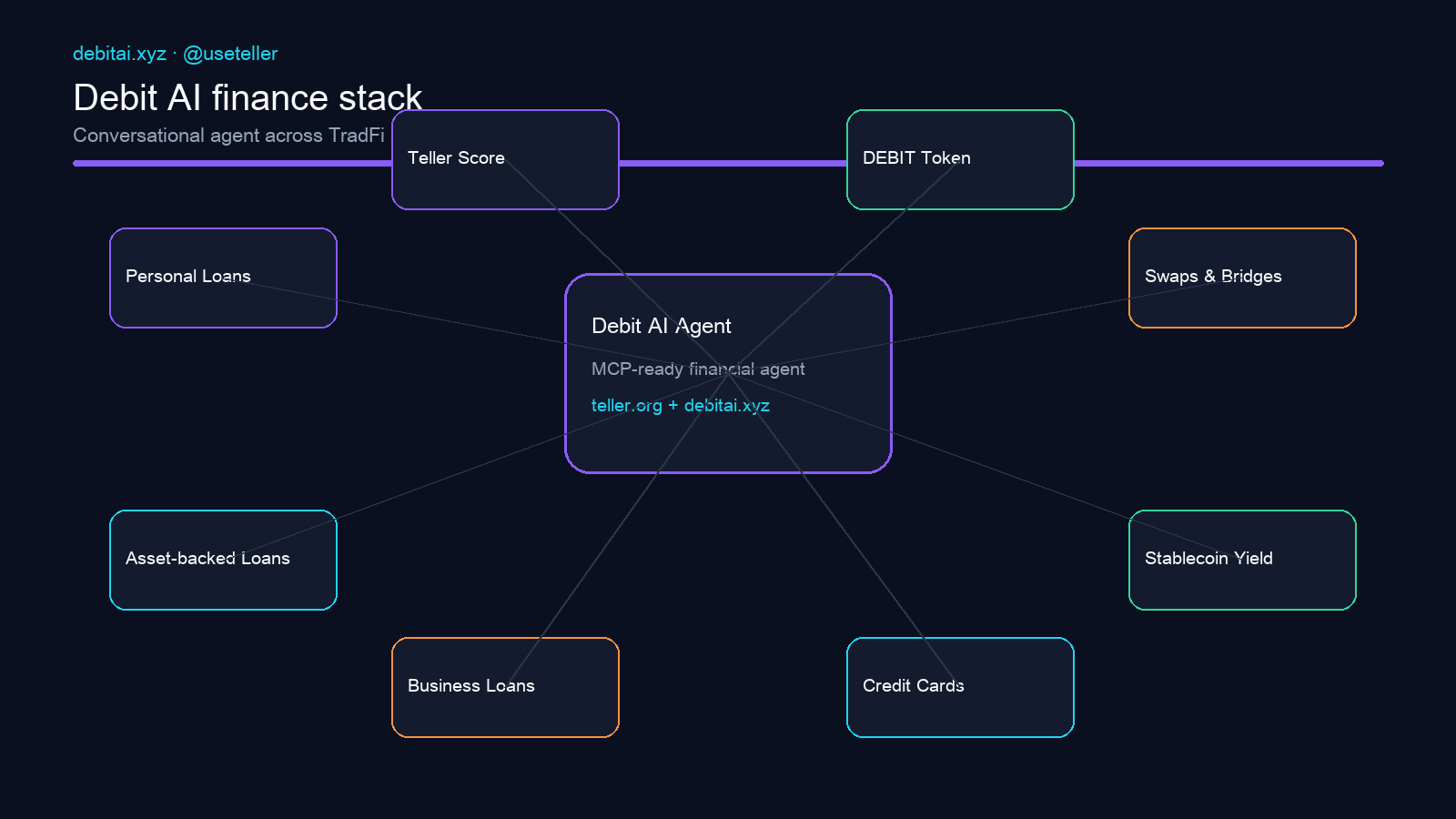
Figure 2. Debit AI finance stack: debitai.xyz agent linking TradFi credit with onchain actions.
How Does DEBIT Token Fit the Ecosystem?
DEBIT is described as a utility token that unlocks AI agent usage and platform services—not as a direct claim on loan interest from the Teller protocol. Aggregator listings show a 100 million maximum supply with roughly 17.22 million tokens in circulation at launch, implying the majority remains subject to vesting schedules (commonly cited as a multi-year unlock).
Typical utility buckets promoted in launch coverage include:
- Paying for or gating premium AI agent interactions
- Staking or rewards programs (details vary by announcement channel)
- Governance or fee-discount narratives (verify against onchain contracts before relying on them)
Token contract address consistency matters: verify 0x66661c7229901f568f16bd1551b3ba826f83ce49 on the chain you use and reject look-alike tickers. Deeper allocation tables and unlock math are covered in DEBIT tokenomics explained.
Teller (DEBIT) vs Traditional DeFi Lending
Most DeFi lending (Aave-style) requires over-collateralization and uses oracle-driven liquidations when collateral ratios breach thresholds. Teller’s positioning differs in two ways:
| Dimension |
Typical DeFi money market |
Teller / Debit positioning |
| Collateral |
Often 150%+ for volatile assets |
Unsecured path: none; asset-backed path: BTC/ETH/stocks with no margin calls |
| Underwriting |
Onchain ratios only |
TradFi partners + soft credit for fiat loans |
| UX |
Wallet + separate dApp tabs |
Single AI agent across TradFi and onchain actions |
| Custody |
Non-custodial pools |
Non-custodial onchain legs; custodial bank payout for fiat |
Teller does not eliminate credit risk—it relocates it. Unsecured loans shift default risk to licensed lenders; asset-backed loans shift collateral and smart-contract risk to the user and pool design.
What Are the Benefits, Risks, and Limitations?
Potential advantages
- Unified UX for users who want both bank-grade loan shopping and onchain liquidity without juggling five apps.
- No-collateral pre-qualification lowers the crypto pledge barrier for fiat borrowing where partners approve.
- No margin-call framing on asset-backed marketing may suit long-term holders who fear intraday liquidations—subject to actual contract terms.
- Multi-chain presence lets borrowers match collateral location with liquidity.
Risks and limitations
- Partner dependence: Unsecured rates, approvals, and disclosures are not fully onchain-verifiable.
- Smart-contract and bridge risk: Onchain modules remain exposed to exploits and oracle failures.
- Token volatility: DEBIT utility does not imply stable value; vesting overhang can affect liquidity.
- Naming confusion: “Teller,” “Debit,” and “DEBIT” overlap in search results with unrelated debit cards and legacy DeFi tutorials.
- Regulatory variance: Credit products that touch U.S. consumers implicate federal and state lending rules; availability may differ by region.
- Audit scope: Verify which components (agent, pools, bridges) received third-party review—aggregators may list ratings that do not cover the entire stack.
None of the above constitutes investment or credit advice; users should read partner disclosures and onchain permissions before signing transactions.
How to Access Teller (DEBIT) on Gate
Gate lists DEBIT in pilot and spot markets when liquidity and compliance checks are satisfied. A typical access path:
- Search DEBIT or Teller in Gate markets and confirm the contract/network matches official disclosures.
- Complete KYC if required for your region.
- Deposit or buy DEBIT through supported trading pairs; verify withdrawal network before moving to an external wallet.
- If using Debit’s AI app, connect only through teller.org, debitai.xyz, app.debitai.xyz, and the verified @useteller account.
Gate provides trading and custody rails; the Debit AI agent and TradFi loan partners operate under their own terms.
Summary
Teller (DEBIT) bundles a mature DeFi lending protocol with a newer Debit AI interface and a DEBIT utility token. Unsecured cash through licensed lenders and asset-backed onchain credit without margin calls are the two headline borrowing modes; swaps, bridges, yield, and credit-score narratives fill out the product surface. Due diligence should separate protocol track record, partner underwriting, token unlock schedules, and contract addresses before using any path.
FAQ
What is Teller (DEBIT)?
Teller (DEBIT) is the market name for an ecosystem that combines the Teller decentralized lending protocol, the Debit AI finance agent, and the DEBIT utility token. Users can pursue no-collateral fiat loans via partners, borrow against crypto or tokenized stocks onchain, or run swaps and yield from the same conversational interface.
How is DEBIT different from the Teller protocol?
The Teller protocol is the onchain lending infrastructure launched in 2019. DEBIT is a later utility token tied to the Debit AI platform that sits on top of that infrastructure. Trading DEBIT does not automatically grant loan approvals or protocol revenue rights.
Does Teller offer loans without collateral?
Debit markets a no-collateral path where users pre-qualify through licensed TradFi lenders using soft credit checks. Funds settle to bank accounts when a partner approves. This path is separate from over-collateralized DeFi pools and still requires lender underwriting. “Borrowing without a collateral account” in marketing copy usually means you do not pledge crypto upfront for that fiat offer—not that the lender assumes zero credit risk. To borrow crypto or stablecoins instead, use the asset-backed route: select collateral (for example BTC or ETH), confirm LTV and pool duration, then draw liquidity to your wallet; repeat borrowing may be allowed after repayment, subject to pool capacity.
What chains and assets does Teller support?
Teller documents cite deployment on Ethereum, Base, Arbitrum, Polygon, BNB Smart Chain, and additional networks, with 100+ assets referenced in protocol statistics. Asset-backed marketing highlights BTC, ETH, and tokenized equities such as TSLA. Always confirm live support inside the app before transferring collateral.
What are the main risks of using Teller or holding DEBIT?
Key risks include lender denial or adverse credit reporting on unsecured paths, smart-contract and bridge failures onchain, regulatory restrictions by region, token price volatility, vesting supply overhang, and phishing from unofficial “DEBIT” contracts. Verify addresses on explorers and read partner loan agreements before signing.