Beginners who need to separate AI agent tokens from platform assets, and community narratives from on-chain facts, benefit most from this framing. Ribbita appears as an agent on the Virtuals project page, while TIBBIR is the Base ERC-20 you can verify; grasping TIBBIR vs VIRTUAL is the prerequisite for reading mechanism and risk sections.
TIBBIR is often read as RIBBIT spelled backward, so communities juxtapose a “Ribbit Capital” narrative with the token—yet wordplay is not an endorsement or equity link; verification steps are covered in the Ribbit Capital narrative check. Beginner checks usually center on definition boundaries, Virtuals issuance and circulation, the TIBBIR–VIRTUAL relationship, a narrative fact-check frame, agentic-commerce limits, and holding/trading risks.
Key Takeaways
- Ribbita (TIBBIR) is a Base AI agent token in the Virtuals ecosystem (ERC-20; contract verifiable on BaseScan), mapped to project 18820 / agent 826, with a commonly cited supply near 1 billion tokens.
- TIBBIR is not VIRTUAL: holding TIBBIR is not ownership or governance of the Virtuals protocol, and it does not automatically equal equity exposure to any named VC.
- Virtuals’ platform path is typically bonding curve → graduation near 42,000 VIRTUAL → Uniswap liquidity with a long-term LP lock; those rules are ecosystem-wide, not a Ribbita-only invention.
- A ~1% buy/sell tax is common, and pairs often use VIRTUAL; community copy, exchange blurbs, and on-chain parameters must be checked separately.
What Is Ribbita (TIBBIR)? How Does It Differ From a Typical Meme Coin?
Ribbita is positioned as an AI agent persona on Virtuals Protocol, and TIBBIR is the on-chain ERC-20 tied to that persona. Virtuals tokenizes AI agents so they can form tradable markets onchain; TIBBIR belongs to that “agent token” class rather than serving as Virtuals’ platform coin.
Compared with entertainment-first meme coins, TIBBIR carries two labels at once: frog-themed community distribution, and a Virtuals agent launch rail with a verifiable contract. Dual labels do not prove product capability or revenue rights; contract patterns, paired assets, and tax settings sit closer to Virtuals AgentToken-style implementations than to a pure meme launchpad path.
Verifiable anchors include the Base contract 0xA4A2E2ca3fBfE21aed83471D28b6f65A233C6e00 (see BaseScan TIBBIR) and Virtuals project/agent IDs. If an exchange or aggregator blurb frames TIBBIR as “protocol equity” or an “official VC token,” return to those anchors.
How Is TIBBIR Issued and Circulated on Virtuals?
TIBBIR’s issuance and circulation sit on Virtuals’ Capital Formation / Launchpad rails: after an agent is created, the token typically trades first on a bonding curve paired with VIRTUAL; when roughly 42,000 VIRTUAL of liquidity accumulates, the token graduates and migrates to a Uniswap V2-style pool, with LP tokens locked for a long period. The threshold, migration, and LP lock are platform-level rules documented in the Virtuals Capital Formation Layer.
After graduation, TIBBIR circulates on Base as an ERC-20, commonly against VIRTUAL. Both buys and sells often show about a 1% project tax (read live contract parameters; rates can be adjusted via owner/factory functions, so verification must use the current on-chain state). Supply figures are usually near the 1 billion range; float and burns still belong on a block explorer.
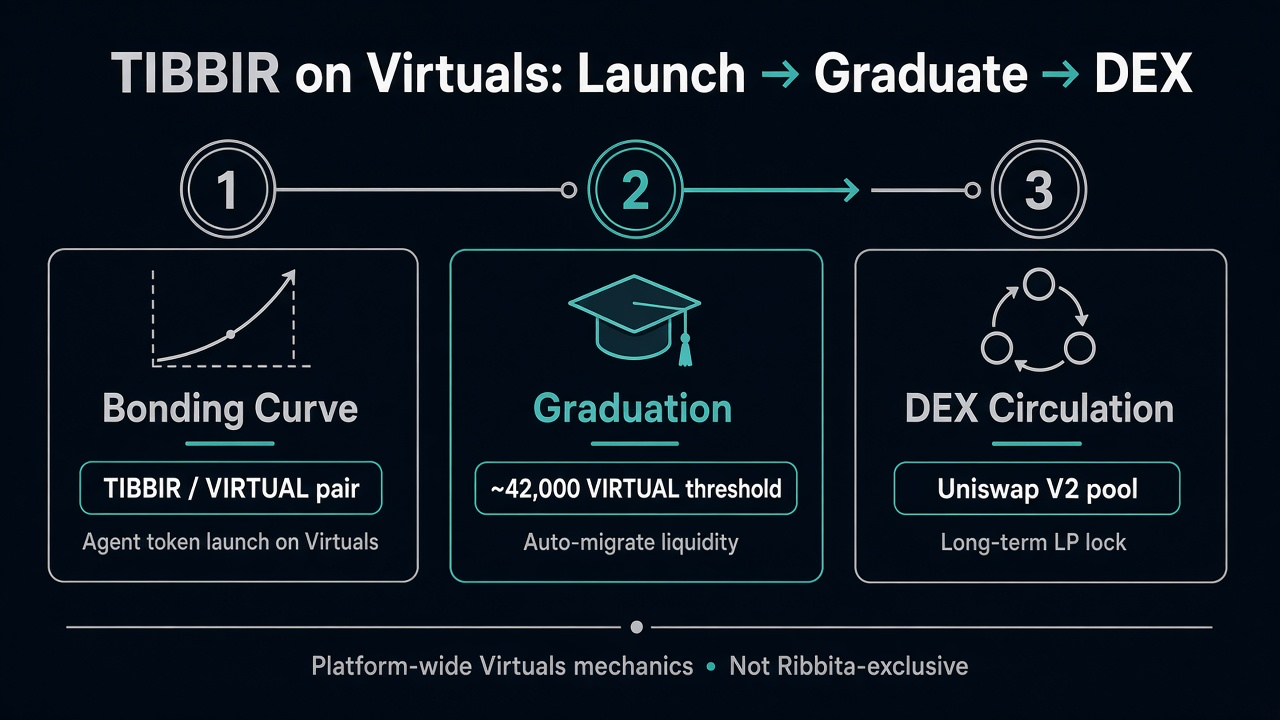
Figure 1. Shared Virtuals path for TIBBIR: Bonding Curve → ~42,000 VIRTUAL graduation → Uniswap circulation with a long-term LP lock (platform mechanics, not Ribbita-exclusive).
The practical takeaway: price discovery and depth are shaped by both TIBBIR supply/demand and VIRTUAL as the paired asset. Reading “platform mechanics” as a “project-specific promise” overstates enforceable rights.
How Are TIBBIR and VIRTUAL Related? Does Holding TIBBIR Mean Owning Virtuals?
The short answer: holding TIBBIR does not mean owning the Virtuals protocol, and it does not equal holding the full rights of VIRTUAL itself. VIRTUAL is the core asset used for launches, pairing, and liquidity formation across Virtuals; TIBBIR is tokenized exposure to one agent (Ribbita).
| Dimension |
TIBBIR |
VIRTUAL |
| Role |
Single AI agent (Ribbita) token |
Core Virtuals pairing / platform asset |
| Chain & standard |
Base ERC-20 |
Virtuals ecosystem primary token (per platform circulation) |
| What holding means |
Market exposure tied to one agent |
Exposure tied to ecosystem liquidity and launch rails |
| Protocol ownership? |
No |
No (also not “ownership of every agent”) |
The table stresses layer separation: one ecosystem can host a platform asset and many agent tokens. An agent token’s moves, tax settings, and narratives do not automatically create treasury, governance, or multi-agent rights. Treating TIBBIR as “Virtuals ownership” is a common category error.
Where Does the “Ribbit Capital” Narrative Come From? How Can You Verify It Yourself?
Because TIBBIR reads as RIBBIT backward, communities and some blurbs map the token to the venture firm Ribbit Capital. Shared naming cues and frog imagery only show narrative adjacency—not equity, investment agreements, or endorsement.
A three-step check works in practice: (1) confirm the on-chain contract and Virtuals project IDs match; (2) search whether Ribbit Capital or related disclosures name Ribbita, TIBBIR, Virtuals, or this contract; (3) compare exchange/aggregator blurbs against on-chain parameters and the project page—if a blurb cannot be traced to a clickable source, discount it.
Public filings that mention “Tibbir”-like trust names (for example in Robinhood-related disclosures) also do not automatically map to Base TIBBIR: similar spellings are common across finance and crypto. Without cross-links to the address, protocol name, and an explicit statement, the narrative stays unproven.
What Are Ribbita’s Capability Limits? How Should Agentic Commerce Be Understood?
In the Virtuals context, agentic commerce describes a frame where AI agents can join on-chain economic interaction, be tokenized, and sustain markets. Ribbita, as one agent, presents a character brand plus a tradable token; its capability boundary is best read as “an agent-market participant in the ecosystem,” not as audited equity in a standalone robotics or commerce company.
Deployment of contracts and companion objects such as an Agent DAO / veToken (when present) proves tokenization and organizational components are onchain—not a verified autonomous revenue stream or product SLA. Evaluation should separate three layers: role narrative, tradable ERC-20, and independently checkable product/revenue evidence. Without the third layer, do not extrapolate the first two into “realized agentic-commerce cash-flow rights.” Educational use of TIBBIR is exposure to that single-agent market rail and Virtuals’ shared liquidity path—not proof the agent already runs a closed commercial loop; next steps belong on named disclosures and live parameters, not undated aggregator blurbs.
What Are the Advantages and Risks of Holding or Trading TIBBIR?
Advantages are mostly structural transparency: the Base contract is public; issuance rails align with documented Virtuals mechanics; pairing and tax parameters can be re-read onchain. For beginners, that structure supports a checklist better than screenshot-only storytelling.
Risks and limits are equally concrete: agent tokens correlate with VIRTUAL through pairing; tax and privileged roles (owner/factory) imply mutable parameters; liquidity tracks narrative heat; spoof contracts and wrong-network transfers can cause irreversible loss; VC narratives that fail cross-checks amplify cognition errors.
| Risk type |
Trigger |
How to spot it |
| Layer mix-up |
Treating TIBBIR as VIRTUAL / protocol ownership |
Use the role table: agent token ≠ platform asset |
| Narrative misread |
Backward spelling treated as VC endorsement |
Search disclosures that name the contract / project |
| Parameter change |
Tax rates or fee recipients updated by privileged roles |
Read live tax / permission functions on BaseScan |
| Liquidity & pairing |
VIRTUAL moves or pool depth shifts |
Check pool address, LP lock, and depth |
| Spoof assets |
Wrong contract or wrong chain |
Accept only 0xA4A2…6e00 |
Use the table as a pre-trade self-check: every “verifiable” advantage maps to a risk you still manage yourself. This is mechanism education, not investment advice.
How Can You Learn About TIBBIR on Gate?
On Gate, treat contract and product-page fields as the objective path: confirm Base as the network, match the contract to 0xA4A2E2ca3fBfE21aed83471D28b6f65A233C6e00, then see whether TIBBIR appears under Gate Alpha or other spot/innovation surfaces. Listing status and pairs follow the live product UI; descriptive copy should still be cross-checked against BaseScan and the Virtuals project page.
Operationally, keep verification steps only: ticker, contract, chain, and project name must all match. Do not rely on a frog icon or the word “Ribbit” alone. No signup funnel, yield promises, or price forecasts belong here. On-chain trade education after graduation uses the same checklist—confirm the VIRTUAL pair when present, tax parameters, and LP lock notes—while market listings and community channels may surface attention but never replace BaseScan.
Summary
Ribbita (TIBBIR) is a Virtuals AI agent token verifiable on Base: project 18820 / agent 826, a fixed ERC-20 address, and circulation along Virtuals’ shared bonding curve, ~42,000 VIRTUAL graduation, and long-term LP lock path. TIBBIR offers market exposure to one agent—not Virtuals protocol ownership, and not a cross-disclosed Ribbit Capital equity claim.
The most useful beginner skill is splitting role narrative, token contract, platform mechanics, and external endorsement into separately checkable layers. After that separation and a contract match, assess liquidity, mutable tax settings, and spoof risk—more reusable than chasing a single storyline. Educational only; not investment advice.
FAQ
What is Ribbita (TIBBIR)?
Ribbita is an AI agent in the Virtuals ecosystem (project 18820 / agent 826), and TIBBIR is its Base ERC-20 token at 0xA4A2E2ca3fBfE21aed83471D28b6f65A233C6e00. TIBBIR reflects tokenized market exposure to that agent and does not represent ownership of the Virtuals protocol.
Is TIBBIR related to Ribbit Capital?
Communities often pair the token with Ribbit Capital because TIBBIR reads as RIBBIT backward and shares frog imagery. Name similarity is not proof of investment, endorsement, or equity. Treat only disclosures that name Ribbita, TIBBIR, Virtuals, or this contract as evidence, and verify exchange blurbs independently.
Does holding TIBBIR mean holding VIRTUAL or Virtuals?
No. VIRTUAL is the core Virtuals asset used for launches and pairing; TIBBIR is a single agent token. Holding TIBBIR does not automatically mean holding VIRTUAL, nor ownership or governance of the Virtuals protocol.
What is TIBBIR’s contract and chain?
TIBBIR is an ERC-20 on Base. The canonical contract is 0xA4A2E2ca3fBfE21aed83471D28b6f65A233C6e00. Confirm chain, contract, and Virtuals project page all point to the same asset to avoid spoofs.
Is TIBBIR a meme coin or an AI agent token? What are the risks?
TIBBIR carries both a community meme label and a Virtuals AI agent issuance rail. Key risks include correlation via VIRTUAL pairing, mutable tax parameters, liquidity and narrative swings, spoof contracts, and VC narratives that fail cross-checks. Risk typology only—not a buy or sell recommendation.