This explainer suits intermediate readers who already meet Virtuals or AI agent tokens and need a clean split between platform assets and single-agent exposure. Full framing lives in Ribbita (TIBBIR); name-play and endorsement checks belong in the Ribbit Capital narrative check. Below: hierarchy table, pairing correlation, shared rails, and misconception fixes.
Virtuals’ Capital Formation Layer standardizes agent launches as VIRTUAL pairing, ~42,000 VIRTUAL graduation, and a long-term LP lock (shared infrastructure in the whitepaper). Reading how TIBBIR relates to VIRTUAL means separating a shared launch rail from shared ownership.
Key Takeaways
- VIRTUAL serves as Virtuals Protocol’s Capital Formation pairing and launch-liquidity asset; TIBBIR is only tokenized market exposure to the single agent Ribbita.
- Agent tokens and the protocol token have different duty and rights boundaries: TIBBIR does not automatically include protocol governance, treasury claims, or multi-agent portfolio rights.
- Many TIBBIR pools pair with VIRTUAL, so single-agent exposure can correlate with pairing-asset volatility—risk transmission, not “one asset.”
- Bonding, ~42,000 VIRTUAL graduation, ~1% fees, and long-term LP locks are platform-wide rules that shape both the agent-token path and the VIRTUAL liquidity side.
What Is VIRTUAL? What Role Does It Play in Virtuals Protocol?
VIRTUAL sits as Virtuals Protocol’s ecosystem coin and, inside the Capital Formation Layer, as the core liquidity asset for agent launches, bonding-curve pairing, and graduation migration. Per the Virtuals Capital Formation Layer, agent launches pair with VIRTUAL liquidity; at about 42,000 VIRTUAL the token graduates to a Uniswap V2-style pool and LP tokens enter a long-term lock.
That role compresses into three points: pricing and pairing unit on the launch rail; liquidity source at graduation; and a protocol-side fee-structure asset (~1% fee split—70% creator / 30% Virtuals Treasury). VIRTUAL is not “owning every agent,” and it does not cover every agent token’s market outcomes.
When discussing TIBBIR, bonding, graduation, and DEX depth almost always touch VIRTUAL supply and liquidity on the other side of the pair.
TIBBIR, as Ribbita’s agent token, sits on a different layer from VIRTUAL as the platform coin: one is tradable single-agent exposure; the other is ecosystem pairing and launch capital. Ribbita appears as an agent on the Virtuals project page, while TIBBIR is the Base ERC-20 you can verify separately.
| Dimension |
VIRTUAL (protocol / pairing asset) |
TIBBIR (single agent token) |
| Ecosystem layer |
Virtuals Protocol capital-formation & pairing |
Ribbita (project 18820 / agent 826) token layer |
| On-chain form |
Ecosystem coin / pairing asset (as circulated on platform) |
Base ERC-20; contract 0xA4A2E2ca3fBfE21aed83471D28b6f65A233C6e00 |
| Core duty |
Launch, bonding, graduation liquidity; protocol-side fee structure |
Tokenized market exposure to one agent |
| Holding boundary |
Not automatic ownership of all agents or protocol “equity” |
Not automatic VIRTUAL holdings, protocol governance, or protocol yield rights |
| Common trading context |
Other side of agent pools |
Often paired with VIRTUAL |
The table locks duty and rights: one protocol can host a protocol-level asset and many agent tokens; agent narratives and tax knobs do not rewrite VIRTUAL’s Capital Formation definition. Cross-check the contract on BaseScan TIBBIR and the agent ID on Virtuals—identity only, not protocol ownership.
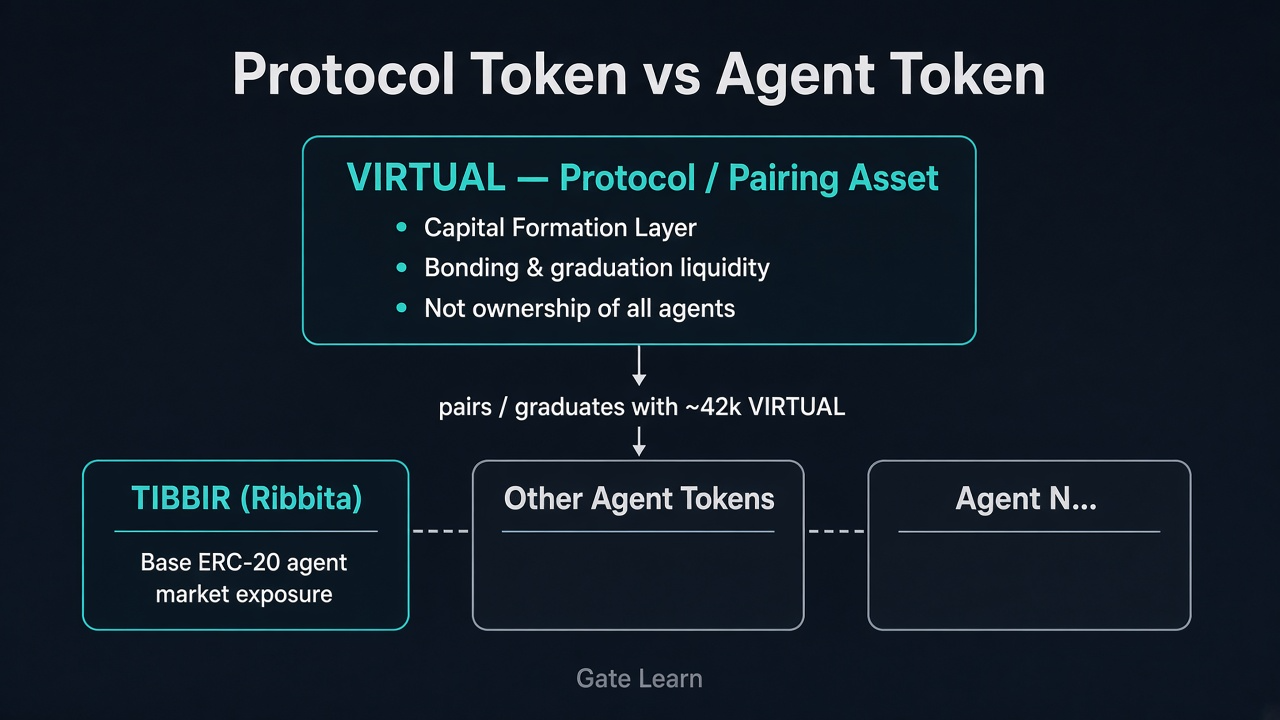
Figure 1. Hierarchy in Virtuals: VIRTUAL as protocol/pairing asset above; single agent tokens such as TIBBIR below.
Why Do Many TIBBIR Pools Pair With VIRTUAL? What Does That Mean for Exposure?
Many TIBBIR pools pair with VIRTUAL because Virtuals designs agent launch rails as “paired with VIRTUAL liquidity,” not because TIBBIR is a second protocol coin.
Mechanism in three layers: bonding price discovery runs on a TIBBIR/VIRTUAL curve, so one side is always VIRTUAL; the graduation threshold is measured as roughly 42,000 VIRTUAL of accumulated liquidity, and Uniswap-style pools after migration usually keep that pairing; when holding or trading TIBBIR, depth, slippage, and quotes can move with VIRTUAL-side liquidity and volatility—pairing correlation and risk transmission, not “buying TIBBIR equals buying VIRTUAL.”
Readable takeaway: TIBBIR exposes Ribbita’s agent market and couples to VIRTUAL via the pair; the two can move together or apart, but remain two instruments. Reading the pair as “merged holdings” or a “protocol equity certificate” overstates enforceable claims.
How Do Trading Tax, LP, and Graduation Affect Both Agent Tokens and VIRTUAL?
Trading tax, LP locks, and graduation are Virtuals shared infrastructure; they shape both the agent-token path and how VIRTUAL sits as pairing liquidity.
Per Capital Formation Layer universals: bonding curves pair with VIRTUAL; at ~42,000 VIRTUAL the token migrates to a Uniswap V2 pool; LP tokens lock long-term (docs state 10 years); a ~1% fee splits 70% creator / 30% Virtuals Treasury. For TIBBIR, those rules constrain launch, migration, and trade friction; for VIRTUAL, the same rules decide how much VIRTUAL locks into agent pools, when liquidity leaves the curve for DEX pools, and how protocol-side fees route.
Three observable links:
- Graduation threshold: Before ~42,000 VIRTUAL, liquidity mainly sits on the curve; after, depth switches to a DEX pool and both sides enter a new depth regime.
- LP lock: A long lock reduces an instant “pull the pool” path, but does not erase pairing-asset moves or guarantee fill quality on either side.
- ~1% fee: Buy/sell friction hits agent-token trades; the protocol share of fees is a Virtuals-side mechanism and does not automatically become a claimable “protocol dividend right” for TIBBIR holders.
Treat whitepaper universals and live on-chain reads as ground truth; if an agent enables extra modules (for example a dynamic tax window), verify that agent’s contract—do not rewrite module specials into universal agent rights.
Common Misconceptions: Does Holding TIBBIR Mean Holding Virtuals or Protocol Yield?
Misreads usually turn “same ecosystem” or “same pair” into “same rights.” The checklist below corrects framing only—not buy/sell advice.
| Misconception |
Correction |
Verifiable anchor |
| Holding TIBBIR = holding Virtuals Protocol |
TIBBIR is only Ribbita agent-token exposure |
Contract + Virtuals project IDs point to one agent |
| Holding TIBBIR = holding VIRTUAL |
Pair sides are two assets; balances do not auto-swap |
Wallet/explorer show separate balances |
| TIBBIR holders automatically get protocol-level yield |
Protocol fee share routes to Virtuals Treasury paths—not an agent-token dividend right |
Capital Formation Layer fee-split notes |
| Pairing with VIRTUAL = protocol equity certificate |
Pairing is liquidity design, not ownership proof |
Whitepaper “universal infrastructure” items |
| Name reverse / frog narrative = platform or VC endorsement |
Narratives need separate disclosure checks; they do not replace layer boundaries |
Narrative article handles endorsement; this page locks relationship boundaries |
Correction mnemonic: ask “which layer?” first, then “do on-chain parameters support the claim?” Shared launch rails do not imply shared ownership.
What Risks Matter When Reading the TIBBIR–VIRTUAL Relationship?
When reading how TIBBIR relates to VIRTUAL, risks center on layer mix-ups, pairing correlation, and mutable parameters—not subjective “which is better” calls.
| Risk type |
Mechanism trigger |
How to spot it |
| Layer mix-up |
Treating an agent token as protocol ownership or a VIRTUAL substitute |
Use the hierarchy table: duties and rights listed separately |
| Pairing correlation |
VIRTUAL moves affect TIBBIR/VIRTUAL quotes and depth |
Watch both sides’ liquidity and pool composition |
| Pre-/post-graduation structure shift |
Curve vs DEX depth and routing differ |
Confirm graduation status and migrated pool address |
| Fee / privilege mutability |
Tax or privileged roles can change parameters (on-chain truth) |
Read current tax/permission functions on BaseScan |
| Impersonation / wrong chain |
Wrong contract or non-Base network |
Only accept 0xA4A2E2ca3fBfE21aed83471D28b6f65A233C6e00 |
| Narrative spillover |
Treating wordplay as relationship proof |
Relationship page locks layers; endorsement needs disclosure checks |
A practical order: contract → Virtuals project/agent ID → whether the live pair is VIRTUAL → graduation and LP-lock status → current tax → then narrative claims. Mechanism and identification only—not investment advice.
Summary
TIBBIR and VIRTUAL share one Virtuals ecosystem at different layers: VIRTUAL powers Capital Formation pairing, graduation, and fee structure; TIBBIR is Ribbita’s Base ERC-20 agent token, verifiable on BaseScan. Pairing creates correlated exposure without merging rights; bonding, ~42,000 VIRTUAL graduation, ~1% fees, and long-term LP locks shape both paths without rewriting agent holdings into protocol ownership or dividend claims.
Fix boundaries with the hierarchy table, explain correlation via pairing and shared rails, then clear “same ecosystem equals same rights” errors with the misconception checklist. Name-play and endorsement need a separate verification pass. Educational only—not investment advice.
FAQ
TIBBIR is Ribbita’s agent token; VIRTUAL is Virtuals Protocol’s ecosystem coin for agent launches and pairing. They often form a trading pair and share Capital Formation Layer universals, but holding TIBBIR is not holding VIRTUAL or protocol ownership.
Does holding TIBBIR mean holding Virtuals or receiving protocol yield?
No. TIBBIR is single-agent market exposure. The Virtuals Treasury share of the ~1% fee is a protocol-side fee path—not an automatic protocol dividend or governance right for TIBBIR holders.
Why does TIBBIR so often appear in VIRTUAL pairs?
Virtuals’ Capital Formation Layer designs agent launches to pair with VIRTUAL liquidity: bonding, the ~42,000 VIRTUAL graduation threshold, and post-migration Uniswap-style pools usually keep that structure. Liquidity design—not a second protocol coin definition.
What role does VIRTUAL play in Virtuals Protocol?
VIRTUAL is the Capital Formation pairing and launch asset: it backs bonding curves, graduation liquidity migration, and the documented universal fee structure. VIRTUAL does not automatically mean “owning every agent” or a protocol equity certificate.
What risks matter most when reading the TIBBIR–VIRTUAL relationship?
Layer mix-ups and pairing correlation matter most: treating an agent token as protocol ownership, or ignoring how VIRTUAL moves transmit into TIBBIR/VIRTUAL depth. Also verify contract, graduation status, tax settings, and impersonation risk. Risk typology only—not trading advice.