Creators and traders who want to issue or buy new tokens on Robinhood Chain usually start with wallet and network setup, then choose Crowd Launch or Instant Launch through pools.trade launch and trade flows. The surface behaves more like a permissionless decentralized exchange launch layer than a curated listing desk: discovery and swaps can happen on pools.trade itself, while live tokens also appear in Uniswap’s web app, wallet, Launches feed, and the API routes wallets and DEX aggregators use.
Key Takeaways
-
pools.trade is Uniswap Labs’ launchpad for Robinhood Chain; each launch uses a fixed 1 billion token supply and settles into a Uniswap v4 pool.
-
Two formats exist: Crowd Launch (four-hour TWAP bidding with a $10k FDV threshold or full refund) and Instant Launch (live immediately via a bonding-curve-style path with no graduation minimum).
-
Liquidity is permanently locked in a protocol-held position; a 0.25% LP fee autocompounds into that locked depth, and creators may optionally take 0.05% of the 25bps fee.
-
Sniping controls include same-block creator buys and Crowd Launch bid pacing; assets remain speculative and can go to zero.
What Is pools.trade, and How Does It Relate to Uniswap v4 and Robinhood Chain?
pools.trade (often shortened to Pools) is a permissionless token launch and discovery surface built by Uniswap Labs and designed for Robinhood Chain. Uniswap Labs frames the product as an end-to-end path to launch a token, discover new ones, and trade them at pools.trade, as described in the Pools.trade launch announcement.
Robinhood Chain is the L2 environment where these launches and Uniswap v4 pools live. The launchpad does not replace Uniswap’s general-purpose swap interface; instead, it specializes in creation mechanics, launch-time distribution rules, and permanent liquidity locking, then hands trading inventory into Uniswap’s broader routing and discovery stack. That split matters for beginners: pools.trade answers “how does a new token get created and initially priced,” while Uniswap’s apps answer “where else can that same pool be swapped.”
Official product messaging also states that Pools features memecoins created for entertainment, social, and cultural purposes, with value driven by market demand and speculation rather than enterprise cash flows. That framing belongs in any educational definition because it sets expectation boundaries before fees or launch formats are discussed.
How Do Crowd Launch and Instant Launch Work on pools.trade?
Both launch modes start from the same fixed supply of 1 billion tokens and end in a Uniswap v4 pool where fees autocompound into locked liquidity. The difference is how price discovery and early allocation happen.
| Dimension |
Crowd Launch |
Instant Launch |
| Format |
Four-hour launch window |
Live immediately |
| Mechanism |
TWAP-style bids that fill gradually |
Classic bonding-curve-style path |
| Graduation |
Reach about $10k launch FDV or bids refund |
No minimum requirement |
| End state |
Deeper locked liquidity |
Locked liquidity forever |
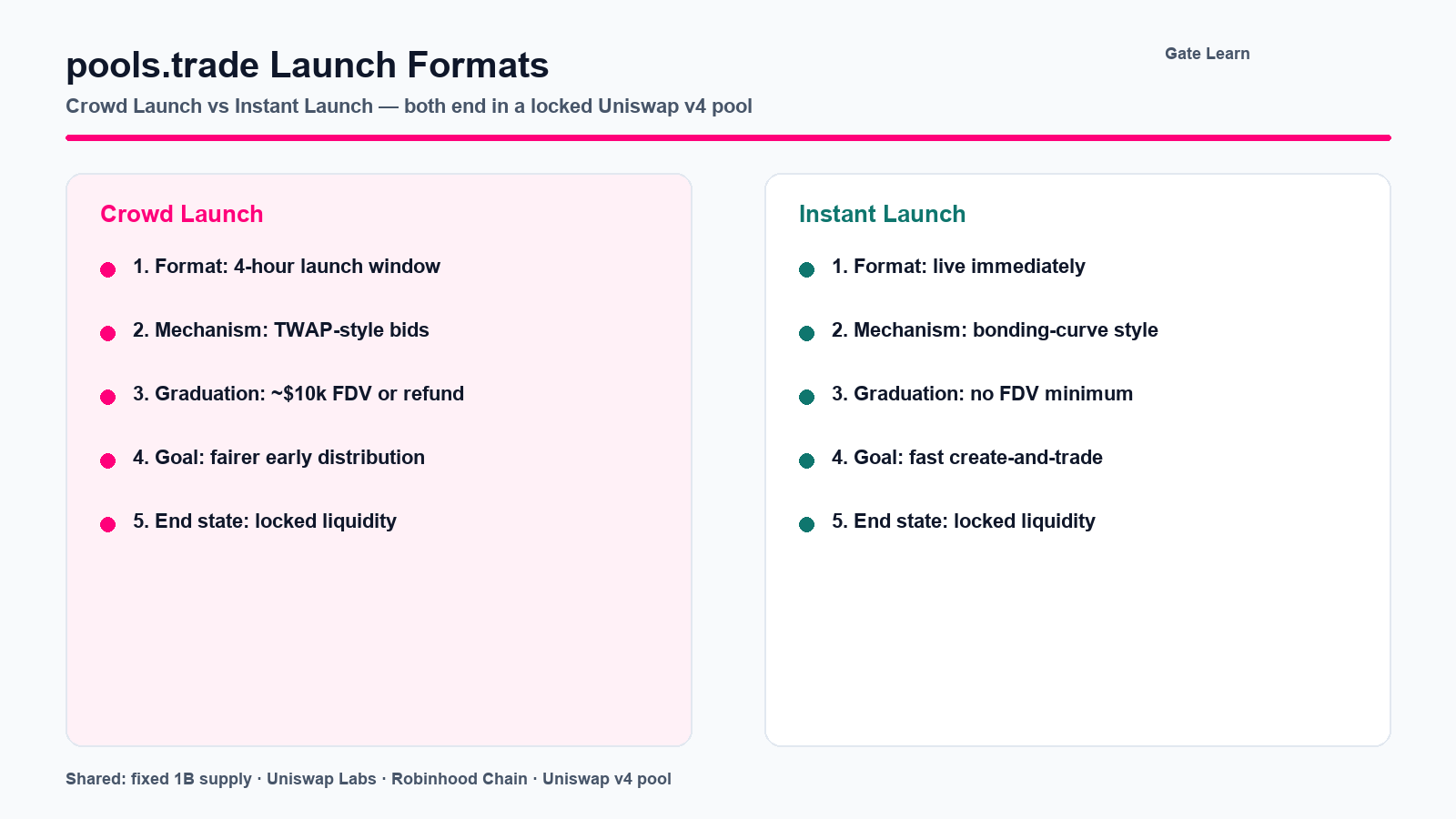
Crowd Launch is designed for fairer early distribution. Participants bid a budget; fills happen gradually over the remainder of the window, and price moves with demand so earlier bids receive better prices. Every accepted budget is meant to fill in full by the end. If the launch reaches the $10k FDV threshold, the token becomes tradable; if not, orders are refunded.
Instant Launch prioritizes speed. The token is live as soon as it is created, price rises as buyers enter, and users can buy early and swap in and out during the curve-style phase without a separate graduation gate. Uniswap Labs still describes the end state as a Uniswap v4 pool with permanently locked liquidity, letting creators use pools.trade to create a token and have it settle into a pool.
How Do Locked Liquidity, Autocompounding Fees, and Creator Fees Work?
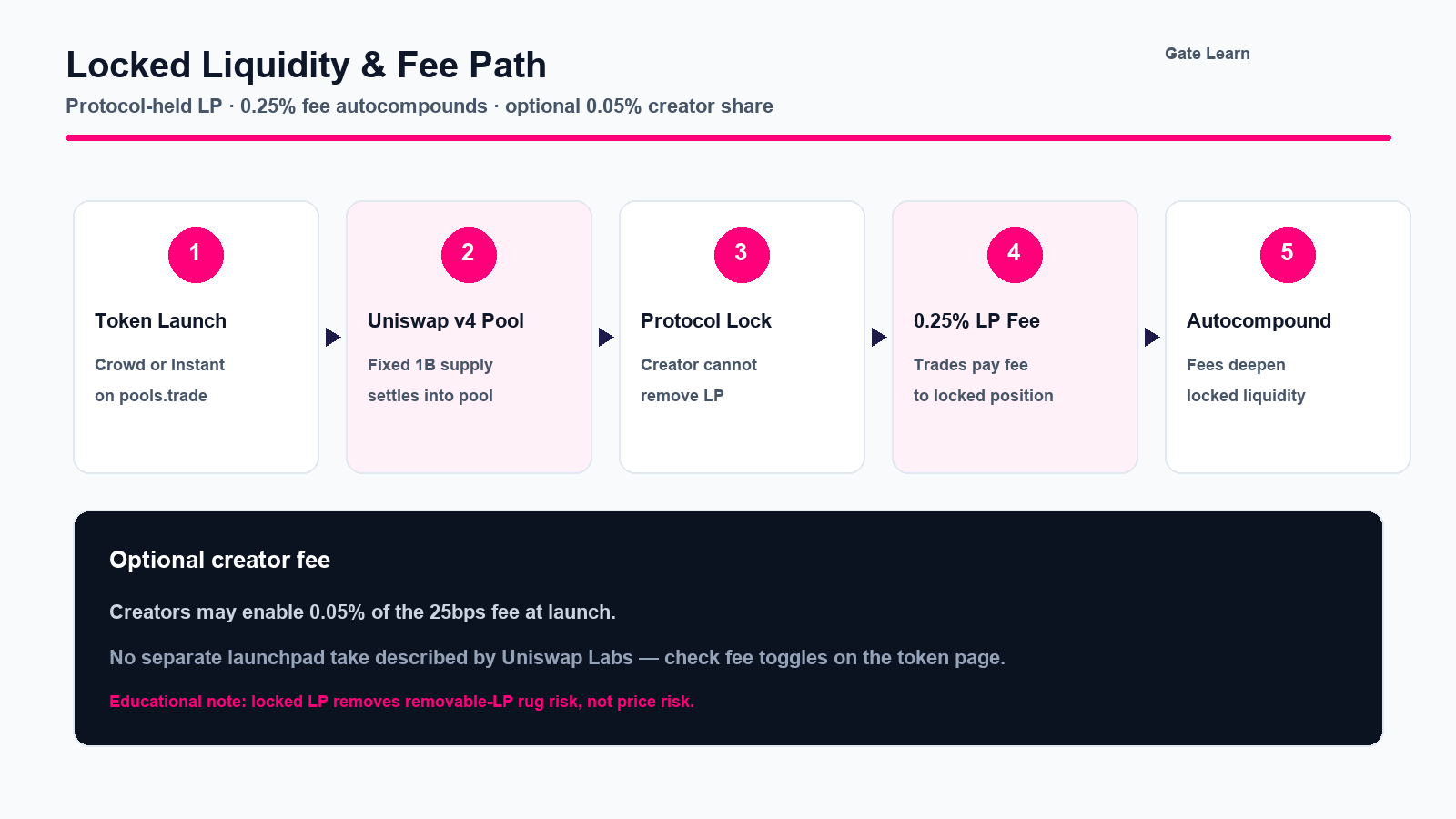
Permanent locked liquidity means tokens sit in a protocol-held pool that the creator cannot remove, unlike some liquidity-locking tools that allow partial unlocks by developers. That design targets a common launchpad failure mode: creators (or compromised keys) draining initial LP after retail buyers enter.
Each pool uses a standard Uniswap fee tier of 0.25% (25bps). Uniswap Labs states that LP fees autocompound back into the locked position, so trading activity can deepen protocol-held liquidity over time instead of paying out to removable LPs. The lock stops withdrawal of the LP position; it does not freeze token price or pool balances, so locked liquidity can still decrease if selling exceeds buying because swaps still move pool reserves. The blog also positions this 0.25% path as a fraction of the roughly 1% fee stacks common on other launchpads—useful as a mechanism comparison, not as a quality score.
Optional creator fees let a creator turn on a fee at launch and receive 0.05% of the 25bps fee. When enabled, the creator has a direct financial interest in trading volume. Educational coverage should treat that as a disclosure item: fee settings change incentives and should be checked on the token page before sizing any participation.
Uniswap Labs also states there are no separate launchpad fees on top of the pool fee path—each launch creates a standard Uniswap pool with the autocompounding 0.25% LP fee described above, and the protocol-held LP position cannot be removed by the creator.
How Does pools.trade Mitigate Sniping and Bundled Buys?
Sniping mitigation on Instant-style launches centers on creators buying in the same block the token launches, so launch actions are executed in that block and external bots are not guaranteed first fills. Crowd Launch adds a second control surface: TWAP-style bidding that fills gradually, which Uniswap Labs describes as bundle-resistant relative to single-block rush auctions and aimed at blunting bots, including snipers.
These controls reduce specific mechanical advantages; they are set to reduce bot-driven manipulation, but they do not eliminate MEV, copy trading, social spam, fake tickers, or post-launch dump risk. Readers should separate “fairer launch microstructure” from “safe asset.” Locked liquidity removes one rug vector (creator-removable LP) but leaves smart-contract risk, chain risk, and speculative demand risk intact.
Where Can Tokens Launched on pools.trade Be Discovered and Traded?
Uniswap Labs states that every token launched on Pools inherits Uniswap’s distribution surface when live:
-
Uniswap Web App and Wallet for discovery and swaps
-
Uniswap Launches, alongside other Uniswap launchpad inventory
-
Uniswap API routing can connect to public endpoints used by third-party integrators, including MetaMask, Ledger, and major DEX aggregators
Users may need to connect a wallet, move funds onto Robinhood Chain, and verify chain details before trading; builders wiring custom routes may also configure RPC or API access with infrastructure providers.
In practice, that means a pools.trade launch is not an isolated bonding-curve island after it is live: the same Uniswap v4 pool inventory can be reachable wherever Uniswap routing is integrated. Beginners still need to verify contract addresses and chain settings, because aggregator listings and social tickers can collide with lookalike tokens.
How Does pools.trade Differ From Nearby Robinhood Chain Launchpads?
Robinhood Chain hosts multiple launch surfaces with different quote assets and fee designs. A useful comparison frame for pools.trade:
-
Builder and AMM end state: pools.trade is built by Uniswap Labs and settles into Uniswap v4 pools, whose architecture can bring a broader world of routing options across a shared pool design, with protocol-held locked LP.
-
Launch formats: Crowd Launch (timed TWAP bids + FDV gate) versus Instant Launch (immediate curve-style trading).
-
Fee path: 0.25% autocompounding LP fee, optional 0.05% creator share, no separate launchpad take described by Uniswap Labs.
-
Quote / pairing design: product messaging centers ETH-native Uniswap pool trading rather than stock-token pairing narratives used by some other Robinhood Chain launchpads, which can better integrate with existing systems used by developers and integrators.
Comparison should stay mechanism-first. Adjacent products may optimize for stock-token narratives, different graduation thresholds, or different fee splits; pools.trade’s distinctive claims are Uniswap-built distribution, permanent lock + autocompound, and the Crowd versus Instant fork.
What Are the Main Risks and Limits of Using pools.trade?
Memecoin and community-token markets remain extremely volatile and can go to zero. Uniswap Labs’ own disclaimer states that Pools features memecoins for entertainment and cultural purposes, that prices are driven by speculation, and that assets may lack securities-law or other regulatory protections. The same disclaimer prohibits using Pools for non-meme asset types outside other Uniswap mechanisms such as Continuous Clearing Auctions (CCA) under separate terms.
Additional educational risk points:
-
Smart-contract and chain risk: users depend on Robinhood Chain execution, Uniswap v4 pool mechanics, and launchpad contracts. Read the mechanism details before participating.
-
Crowd Launch refund path: bids refund if the FDV gate is missed, but users still face opportunity cost and operational mistakes during bidding.
-
Creator fee conflict: optional creator fees align creator income with volume, which can encourage promotional pressure; check token-page settings and fee details carefully.
-
No endorsement: Uniswap Labs states it has not independently verified displayed tokens; appearance is not a recommendation, so review token-page settings and disclosure details.
-
Locked LP ≠ guaranteed depth: autocompounding helps locked inventory grow with fees, but thin markets can still produce severe slippage.
Summary
pools.trade is Uniswap Labs’ Robinhood Chain launchpad for creating, discovering, and trading new tokens that settle into Uniswap v4 pools with permanently locked, autocompounding liquidity. Crowd Launch and Instant Launch offer two price-discovery paths around a shared 1 billion supply design. Fee and sniping features change microstructure, but they do not convert speculative tokens into low-risk assets. Mechanism literacy—launch mode, fee toggles, contract verification, and distribution surfaces—matters more than ticker narratives.
FAQ
What is pools.trade?
pools.trade is a token launchpad built by Uniswap Labs for Robinhood Chain. It lets creators launch tokens and lets users discover and trade them, with launches ending in Uniswap v4 pools that hold permanently locked liquidity.
Who built pools.trade?
Uniswap Labs built Pools. The product is designed for Robinhood Chain and connects launches into Uniswap’s app, wallet, Launches feed, and API distribution surface.
What is Crowd Launch on pools.trade?
Crowd Launch is a four-hour launch window where participants bid budgets that fill gradually over four hours via a TWAP-style process, and earlier bids can still be refunded if the threshold is not met. The token becomes tradable if launch FDV reaches about $10k; otherwise bids are refunded.
What is Instant Launch on pools.trade?
Instant Launch makes a token live immediately along a bonding-curve-style path with no FDV graduation minimum. Users can swap during the launch path, and liquidity remains permanently locked in the Uniswap v4 end state.
How does locked liquidity work on pools.trade?
Liquidity is held in a protocol-controlled pool that creators cannot remove. A 0.25% LP fee autocompounds into that locked position, and creators may optionally enable a 0.05% creator fee share of the 25bps fee.