Infrastructure tokens in the crypto asset market often carry both a technology narrative and market expectations. Investors may become interested in a token because its project has entered popular sectors such as DePIN, AI, or decentralized cloud services. However, a project’s sector does not necessarily mean that its token has a clear value-capture mechanism. A network may have technological potential without having established a sufficiently mature business model. A token may have a clear protocol utility, while its market price can still be affected by liquidity, supply changes, and market sentiment.
Pipe Network is a case worth examining from this perspective. The project focuses on distributed infrastructure, and its current official documentation primarily introduces Pipe Storage and Firestarter nodes. PIPE is connected to network participation and ecosystem mechanisms, but researchers need to further clarify the token’s specific role in the current system, as well as which economic arrangements have already been implemented and which remain optional policies or potential future developments.
This article does not use short-term price gains as its starting point. Instead, it establishes a research framework for long-term observation of PIPE based on the project’s positioning, token utility, supply and demand structure, and risk management.
Key Takeaways
- PIPE is the token of the Pipe Network ecosystem, whose current official documentation primarily focuses on distributed object storage services.
- Firestarter nodes must hold a LovePIPE position representing at least 10,000 PIPE, but this does not mean node stakers receive fixed returns.
- Current official rules state that individual nodes receive no rewards or direct payments. Deductions from customers’ storage balances also do not constitute node revenue.
- Token supply, circulating ratio, unlock schedules, market depth, and actual demand may all affect PIPE’s price performance.
- Growth in the DePIN sector does not mean that PIPE will necessarily appreciate. The token’s value must be assessed independently based on its actual mechanisms and market data.
PIPE and Pipe Network: What Is the Relationship Between the Token and the Infrastructure?
Pipe Network aims to provide storage services through distributed nodes and network coordination mechanisms. Pipe Storage currently uses an architecture in which gateways, a control plane, and Firestarter nodes work together. Customers access the service through an S3-compatible interface, gateways process requests, the control plane coordinates nodes and tasks, and Firestarter nodes store object data and provide information related to integrity verification.
Within this system, PIPE is connected to the node participation mechanism. According to the current official documentation, operating a Firestarter node requires holding a LovePIPE position representing at least 10,000 PIPE and passing the relevant eligibility checks. It is important to distinguish between token ownership, node admission, and node operation. Holding PIPE does not automatically make someone a node operator, and meeting the staking requirement does not guarantee that a node will receive storage tasks.
In addition, the payment method customers use for Pipe Storage differs from the requirements for node participation. The current storage service uses a prepaid balance model. Customers use USDC on the Solana mainnet to purchase storage credits, after which the control plane reserves and deducts credits for authorized operations. Therefore, customer payments in USDC should not be understood as direct demand for PIPE, nor should the consumption of storage credits be equated directly with PIPE burns or node revenue.
How Should PIPE’s Token Utility and Economic Mechanisms Be Understood?
When analyzing an infrastructure token, the first step is to confirm the functions it actually performs in the current protocol. PIPE is connected to eligibility for Firestarter node participation, and node wallets must hold a qualifying LovePIPE position. LovePIPE is a liquid staking token form associated with a PIPE position. Node eligibility checks verify the holding status finalized on the Solana blockchain.
However, a staking threshold and a reward mechanism are not the same thing. The current official documentation explicitly states that Firestarter nodes do not receive separate rewards or payments. Node operators must meet the holding requirement, pass eligibility checks, and satisfy operating conditions, but this does not support the conclusion that nodes will continuously receive PIPE rewards based on storage volume, bandwidth, or uptime. This distinction is important when researching the token because it directly affects how investors assess token demand and the cost of holding it.
The official documentation also describes node eligibility, customer credit accounting, and optional treasury policies separately. If the relevant transactions are actually executed and disclosed, the treasury may consider using protocol revenue to support PIPE through measures such as buybacks, burns, or increased support for LovePIPE. However, these are optional actions. There is no publicly committed fixed percentage for net revenue distribution or automatically executed formula. Researchers should rely on actual execution records rather than treating potential measures as an already implemented token-burn mechanism.
PIPE’s Supply and Demand Structure: How Do Token Circulation and Market Demand Affect Price?
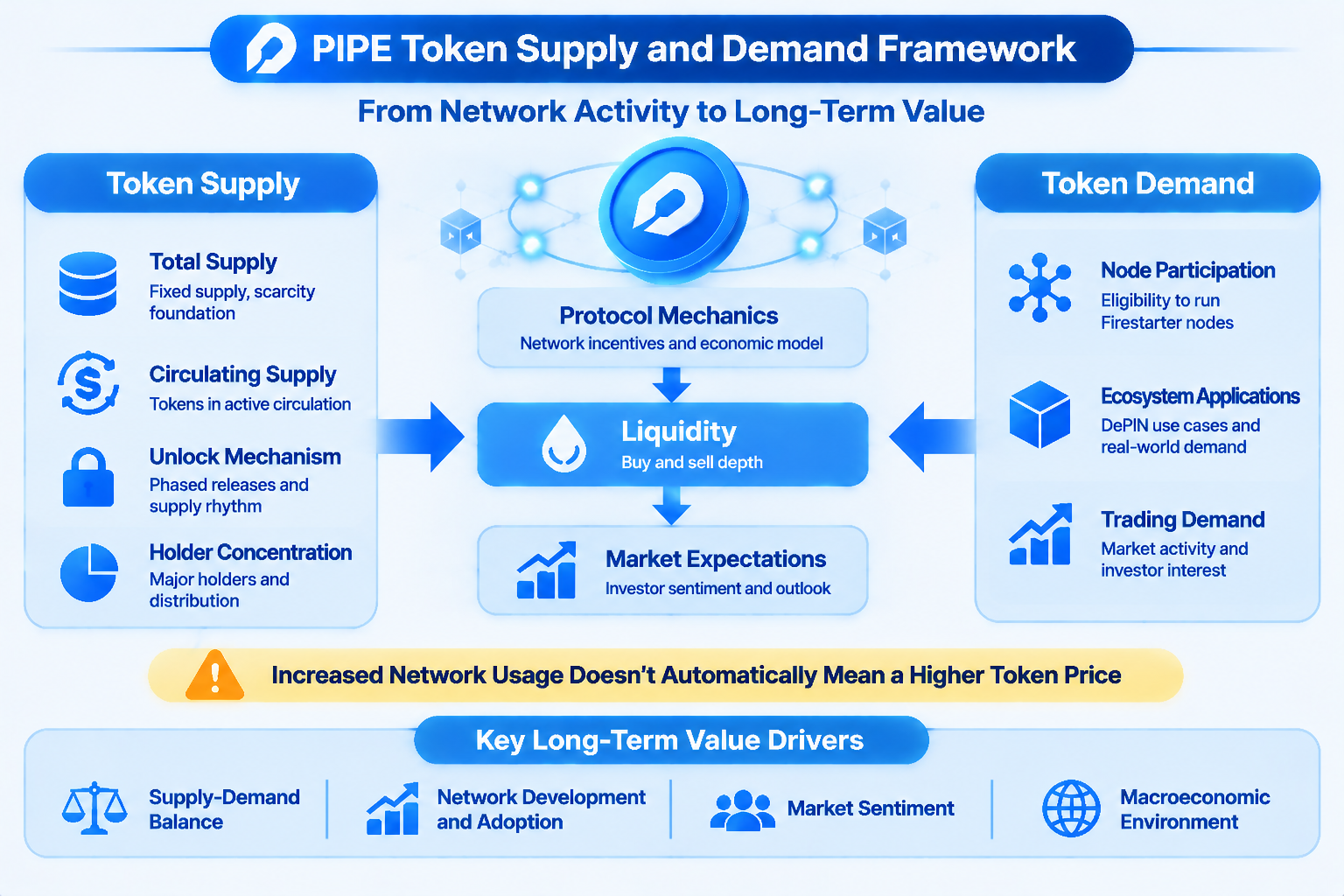
Token supply structure is an important starting point for evaluating a crypto asset. Investors should consider the total supply, maximum supply, circulating supply, unlocked tokens, and future unlock schedules together. Even if a project’s circulating supply is relatively limited, large-scale token unlocks in the future could still affect the market through potential changes in supply.
According to data displayed on CoinMarketCap, PIPE has a maximum supply of 1 billion tokens, while the displayed circulating supply is 100 million tokens. Third-party platform data may change over time, and the methodology used to calculate circulating supply may also vary. For formal valuation or supply analysis, investors should further verify the project’s official token information, on-chain data, and latest unlock schedule rather than relying solely on a single market data page.
On the demand side, it is important to distinguish between protocol usage demand and market trading demand. Protocol usage demand comes from network participation, node eligibility, and other actual applications. Market trading demand may be affected by exchange coverage, investor expectations, liquidity, and market sentiment. These two types of demand may influence each other, but they should not be conflated. In particular, when customers use USDC to purchase prepaid storage credits, it should not be assumed without verification that growth in the storage business will translate into PIPE buying demand at a fixed ratio.
How Can You Assess Whether PIPE Has Long-Term Value-Capture Potential?
Value capture is one of the most easily overlooked aspects of infrastructure token research. A project may have users, nodes, and a technology product, but that does not mean all business revenue will flow to token holders. Researchers should ask: Do users have to purchase or consume the token when using the service? Do node operators need to lock the token over the long term? Is there a clear, implemented mechanism for routing protocol revenue back to the token? Are these arrangements supported by verifiable on-chain records or official disclosures?
For PIPE, the mechanisms that can currently be confirmed include the LovePIPE holding requirement for Firestarter nodes and the node eligibility verification process described in the official documentation. At the same time, the current documentation makes clear that nodes receive no separate rewards or payments, and customer credit accounting does not constitute node revenue. Potential treasury measures, such as buybacks, burns, or support for LovePIPE, are optional policies, and no fixed revenue distribution ratio has been established.
As a result, PIPE’s long-term value capture still needs to be assessed in light of subsequent changes to its mechanisms and actual execution. If new token consumption, protocol revenue distribution, or node incentive mechanisms are introduced in the future, researchers should verify their implementation date, scope, and real-world data. Until then, potential policies or economic models from historical versions should not be treated as definitive support for the token’s current value.
Why Should PIPE’s Market Performance Be Analyzed Alongside Liquidity and Valuation?
Crypto asset prices are influenced not only by project fundamentals but also by market depth and trading structure. For tokens with relatively small circulating supplies, limited buy and sell orders may amplify the impact of individual trades, causing short-term price movements to diverge significantly from the pace of changes in the project’s fundamentals.
When analyzing PIPE, investors can monitor trading volume, bid-ask spreads, order book depth, exchange coverage, and circulating market capitalization together. An increase in trading volume may indicate greater market attention, but large trades can still result in significant slippage if market depth is limited. On the other hand, a low circulating supply may make the circulating market capitalization appear small, while a fully diluted valuation requires a broader range of potential token supply to be taken into account.
Investors should also distinguish between short-term price performance and long-term value assessments. A rapid price increase may reflect a market repricing of the project’s narrative, or it may result from short-term liquidity changes or concentrated trading by speculative capital. Price movements are more suitable for inclusion in long-term fundamental analysis only when they are corroborated by product usage, customer demand, token mechanisms, and supply structure.
What Are the Main Risks to Consider When Investing in PIPE?
The first is project execution risk. A distributed storage network must continuously address node quality, data integrity, service availability, and fault recovery. Even if its architecture is reasonably designed, actual operations may still be constrained by the number of nodes, geographic distribution, network connectivity, and operational capabilities.
The second is token economic risk. Node participation requires holding a certain amount of LovePIPE, but current rules do not provide individual node rewards. This means participants need to assess capital allocation, token price volatility, and changes to eligibility requirements rather than simply assuming that expected node income will offset the cost of holding the token. Future protocol adjustments to the relevant parameters could also change demand for token participation.
The third is market risk. PIPE’s price may be affected by overall crypto market trends, liquidity changes, token unlocks, holder concentration, and market sentiment. For assets with relatively limited circulating supplies, price volatility and trading slippage may be more pronounced. Investors should avoid assessing an asset’s value solely on the basis of a single day’s price gains or short-term trading volume.
The final risk is information and expectation risk. Earlier introductions to Pipe Network emphasized decentralized CDN services, edge nodes, and a broader infrastructure vision, while the current official mainnet documentation focuses on Pipe Storage and Firestarter nodes. Research should distinguish between the historical vision, products currently in operation, and areas that may be expanded in the future. This helps avoid misinterpreting a roadmap or an earlier economic model as a feature that has already been implemented.
How Can You Establish a Long-Term Tracking Framework for PIPE?
Users who want to research PIPE over the long term can establish four observation dimensions. The first is product progress, including customer usage of Pipe Storage, storage capacity, service experience, and application integrations. The second is network operations, including node admission, effective capacity, availability, data integrity verification, and recovery performance. The third is token mechanisms, including LovePIPE eligibility requirements, supply structure, unlock schedules, and the actual implementation of treasury policies. The fourth is market conditions, including liquidity, trading volume, order book depth, and valuation changes.
These metrics should be analyzed together rather than in isolation. For example, an increase in the number of nodes does not necessarily indicate growth in customer demand. An increase in customer usage does not necessarily create a proportional increase in demand to buy PIPE. A token holding threshold may generate participation demand, but if nodes do not receive direct rewards, its economic effect still needs to be assessed alongside participation costs and subsequent protocol policies.
The core of long-term research is to continue verifying whether the project’s technological capabilities can translate into genuine demand for its services and whether the token mechanism can establish a clear, sustainable economic connection as the protocol develops. For PIPE, this is more useful for understanding its crypto asset characteristics than tracking an isolated price movement.
Gate and PIPE: An Entry Point for Market Trading and Project Research
Users who want to conduct further research on PIPE can review the project materials, token market data, and Gate PIPE/USDT trading information together. A Gate Learn article has published an introduction to the Pipe Network project, which is useful for understanding the project’s basic positioning. The Pipe Network official documentation can also be used to verify the current storage architecture, node participation requirements, and token economic rules.
Please note that spot trading PIPE represents participation in the token market. It does not constitute directly purchasing Pipe Network storage services, operating a node, or receiving protocol revenue. Before trading, users should independently assess token supply, market liquidity, price volatility, and actual project progress based on their own risk tolerance.
FAQ
What Type of Crypto Asset Is PIPE?
PIPE is the token of the Pipe Network ecosystem. Pipe Network’s current official documentation primarily focuses on distributed storage services and the Firestarter node participation mechanism. PIPE is connected to node eligibility requirements and the ecosystem’s economic mechanisms.
Is PIPE a DePIN Token?
Pipe Network organizes storage resources through distributed nodes, giving it characteristics of a DePIN infrastructure project. PIPE is the token associated with this ecosystem, but its long-term value still needs to be assessed based on its actual utility, economic mechanisms, and network demand.
Can Holding PIPE Enable Me to Operate a Pipe Network Node?
No. Firestarter nodes currently use an invitation-based admission process. Node wallets must hold a LovePIPE position representing at least 10,000 PIPE and must also pass the relevant eligibility checks and meet operating conditions. Simply holding the token does not automatically grant node eligibility.
Can I Receive Node Rewards After Staking PIPE?
According to the current official documentation, individual Firestarter nodes do not receive rewards or direct payments. The node holding requirement is primarily related to eligibility and network participation conditions and should not be viewed as a fixed-return arrangement.
Will Growth in Pipe Network’s Business Directly Increase Demand for PIPE?
Not necessarily. It is necessary to confirm whether a clear purchase, consumption, or value-return mechanism exists between service revenue and the token. Customers use USDC to purchase prepaid storage credits, which does not automatically mean that an equivalent amount of demand to buy PIPE will be generated.
What Risks Should I Consider When Trading PIPE?
Investors should consider token supply and unlocks, liquidity and market depth, project execution, changes to node participation rules, value-capture mechanisms, and overall crypto market volatility. Short-term price performance cannot replace independent research into the project and its token mechanisms.