PHP2Shell is a recently scrutinized security topic involving the risk of remote code execution on PHP servers. It primarily refers to attackers exploiting vulnerable PHP runtime environments or related application components to execute server-side code without authorization. PHP is widely used for websites, content management systems, and various backend services. As a result, when related vulnerabilities affect internet-facing services, they may further threaten the security of user data, identity authentication, and business systems.
For the cryptocurrency industry, the risks of PHP vulnerabilities are not limited to traditional websites. Cryptocurrency trading platforms, project websites, wallet-related services, and Web3 applications also rely on servers, databases, and APIs to provide account management, market data, and trading interactions. If these systems contain serious security flaws, attackers may further access sensitive credentials or manipulate user interactions through a Web service intrusion, expanding the potential impact of the security incident.
However, server security risks and blockchain protocol security are not the same thing. A PHP vulnerability does not automatically crack wallet private keys, and a compromised server alone is not enough to determine that user assets have been stolen. This article begins with the basic concepts of PHP2Shell and explains the technical principles of remote code execution, the potential paths through which the vulnerabilities may affect crypto accounts, and how platforms, developers, and ordinary users can establish more effective security protections.
Key Takeaways
-
PHP2Shell is a recently scrutinized name associated with PHP remote code execution security risks. The core issue is that attackers may execute unauthorized code through vulnerable server-side environments.
-
Remote code execution (RCE) differs from ordinary web vulnerabilities. In severe cases, it may affect server privileges, database access, and backend business logic.
-
A compromised PHP server does not mean that the blockchain network or user private keys have been cracked. Whether crypto assets are affected depends on the permission relationships between the server and account authentication, transaction signing, and asset custody systems.
-
For centralized trading platforms, potential risks may involve user sessions, API credentials, account data, and business interfaces. For non-custodial wallets, users should primarily watch for malicious webpages, phishing interactions, and dangerous transaction signatures.
-
Installing security patches promptly, restricting server permissions, isolating sensitive credentials, enabling multi-factor authentication, and independently verifying transaction signatures are important measures for reducing related risks.
What Is the PHP2Shell Vulnerability? Why Is It a Critical Security Issue?
PHP2Shell is not a single PHP function or third-party plugin. It is a collective term for two PHP core security vulnerabilities: CVE-2026-109618 and CVE-2026-109619. The two vulnerabilities were disclosed on October 21, 2026. Both involve potential security issues in how PHP handles exceptional requests and memory states, and both received a CVSS v4.0 score of 9.2, placing them in the critical severity category.
Unlike traditional PHP application vulnerabilities, PHP2Shell occurs within the PHP runtime environment. This means that even if website developers have applied standard user-input filtering, and the application itself has no obvious SQL injection or file upload flaws, the underlying PHP components may still be exposed to attack because of the vulnerabilities.
The primary danger of PHP2Shell is that attackers may not need to log in to the target website in advance. They may have an opportunity to trigger abnormal memory operations through specially crafted requests and further achieve remote code execution. Actual exploitation conditions depend on the PHP version, server operating mode, and deployment configuration. Not all PHP websites have exactly the same attack surface.
| Vulnerability ID |
Core Issue |
Potential Security Impact |
| CVE-2026-109618 |
Memory state error during out-of-memory (OOM) exception handling |
Remote code execution |
| CVE-2026-109619 |
Use of invalid memory references during request processing and cleanup |
Remote code execution, memory information disclosure |
PHP has officially released patched versions and clearly recommends that affected users upgrade as soon as possible.
How Does PHP2Shell Trigger Remote Code Execution?
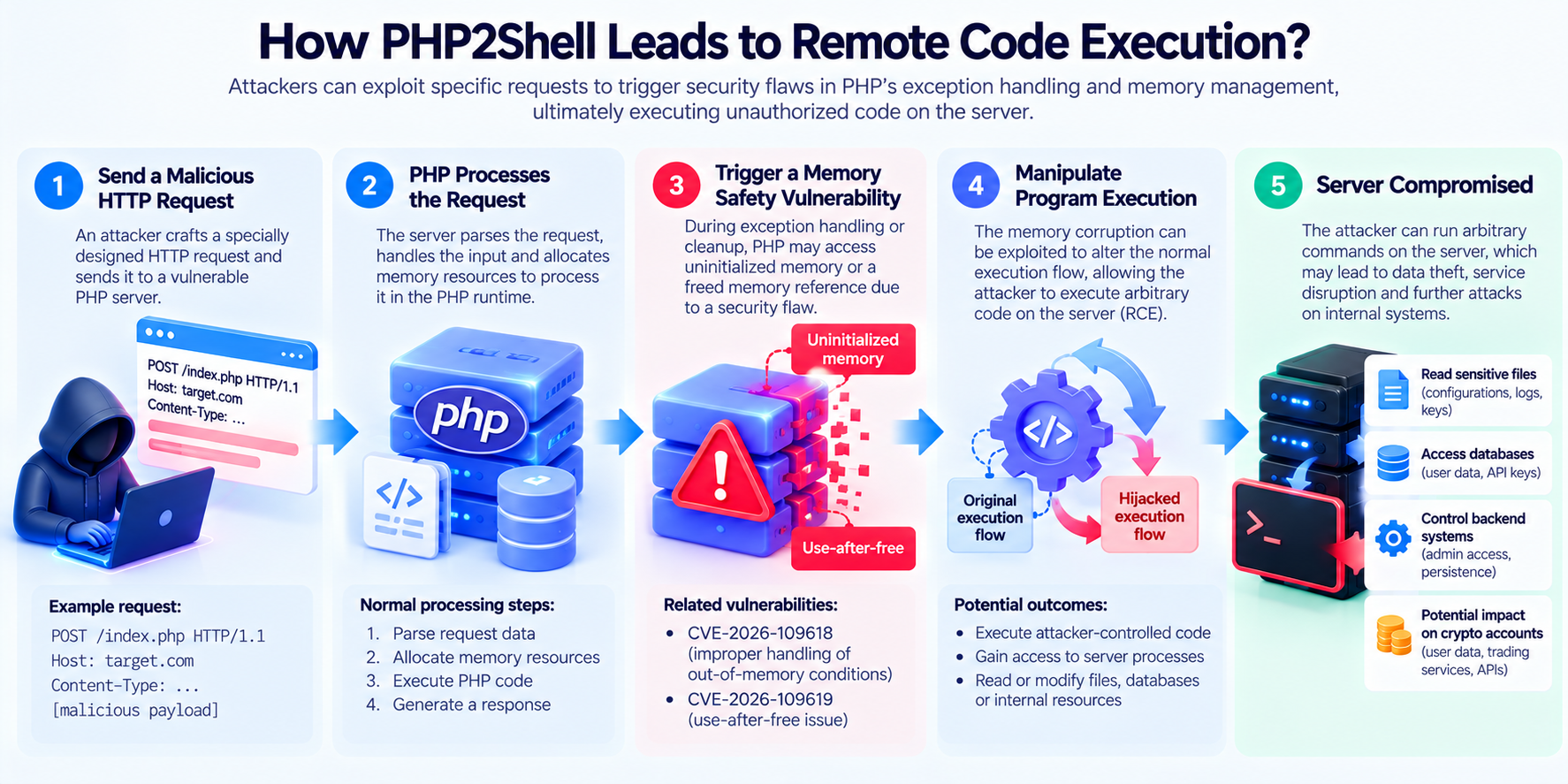
To understand the risks of PHP2Shell, it is first necessary to understand how PHP servers process user requests.
When a user visits a website, submits a form, or calls an API, the web server passes the relevant request to the PHP runtime environment for processing. PHP parses the request data, executes the application code, and returns the result to the user. During this process, the server needs to allocate memory, preserve the request state, and release related resources after the request ends.
Under normal circumstances, PHP should safely clean up allocated resources even when request processing fails. However, the two vulnerabilities associated with PHP2Shell occur precisely during exception handling and memory cleanup.
CVE-2026-109618 is related to out-of-memory handling. When a memory allocation failure occurs while PHP is parsing a request, some internal data may not yet have been fully initialized. If a subsequent cleanup routine incorrectly treats this data as a valid state, memory corruption may occur.
CVE-2026-109619 involves invalid memory references during request processing. When certain resources have already been released but the related pointers or states are retained, subsequent operations may incorrectly access memory regions that are no longer valid. This type of issue is commonly known as use-after-free.
When specific exploitation conditions are met, attackers may use these memory errors to alter the program's normal execution flow and cause the server to run unauthorized code. The execution privileges are generally limited by the permissions of the PHP worker account. However, if server permissions are configured improperly, attackers may still access sensitive files or attempt to expand their control.
It is important to note that actual risks vary across deployment modes. For example, some exploitation paths involving Apache mod_php have been validated, while the trigger conditions and exploitability of other environments, such as PHP-FPM, are not exactly the same.
Which PHP Versions and Server Environments Are Affected by PHP2Shell?
PHP2Shell affects multiple PHP versions that are still in use. On October 21, 2026, PHP released the corresponding security updates to fix the two critical vulnerabilities.
As of October 27, 2026, the primary affected and fixed versions are as follows:
| PHP Branch |
Affected Versions |
Fixed Version |
| PHP 8.2 |
Before 8.2.35 |
8.2.35 |
| PHP 8.3 |
Before 8.3.36 |
8.3.36 |
| PHP 8.4 |
Before 8.4.27 |
8.4.27 |
| PHP 8.5 |
Before 8.5.12 |
8.5.12 |
Older PHP versions may also be affected by related issues. For versions that are no longer officially maintained, developers need to confirm whether operating system distributors or commercial maintenance services provide security patches rather than relying solely on version numbers to assess risk.
In addition, some Linux distributions may fix vulnerabilities through security patch backports, applying the fix while retaining the original version number. Therefore, determining whether a server is secure requires checking both the actual package build version and the vendor's security advisories.
In terms of deployment methods, PHP2Shell may involve Apache mod_php, PHP-FPM, php-cgi, FrankenPHP, and other PHP runtime environments. However, exploitability conditions differ across modes. Server administrators need to assess the impact based on their own technology stack rather than assuming that every website using PHP can be compromised through the same attack method.
Why Might PHP2Shell Threaten the Security of Crypto Trading Accounts?
Crypto trading platforms typically consist of multiple independent systems, including user login, identity verification, trade matching, account management, asset custody, withdrawal approval, and risk control.
PHP2Shell directly affects vulnerable PHP servers, not the blockchain network itself. If a platform's public website or backend service uses an affected PHP version, attackers may attempt to access the related server through the vulnerability.
Once a server is compromised, attackers may search for database connection information, user session data, API credentials, or other sensitive configurations. If this information provides access to an account management system, it may increase the risk of account information disclosure or identity impersonation.
For example, a crypto service platform may use PHP to develop account management interfaces and store highly privileged internal API credentials on its server. If an attacker gains server access through remote code execution, they may attempt to read these credentials and use them to call business interfaces that should not be publicly accessible.
However, this does not mean that attackers can directly withdraw all user assets. Mature trading platforms generally isolate critical capabilities, such as fund custody, transaction signing, withdrawal approval, and account authentication, from public web services. They also use independent permission controls and risk verification.
Therefore, the actual impact of PHP2Shell on crypto accounts depends on server permissions, internal network isolation, sensitive credential management, and asset operation approval mechanisms. A vulnerability on a public website does not mean that the core asset custody system has already been breached.
Will PHP2Shell Directly Expose Web3 Wallet Private Keys?
PHP2Shell itself cannot directly crack blockchain wallet private keys or alter the cryptographic security mechanisms of a blockchain.
For non-custodial wallets such as MetaMask, private keys are generally managed by local wallet software or hardware devices. If a private key has never been uploaded to a vulnerable PHP server, remote code execution on that server alone generally cannot directly obtain the private key.
However, a server breach may still affect wallet users in other ways.
For example, after gaining control of a Web3 project's official website, an attacker may modify the frontend page to guide users to connect their wallets and sign malicious transactions. If users do not carefully verify the transaction details, they may unknowingly authorize token transfers or perform dangerous operations.
Another risk involves wallet-related services. Some Web3 applications rely on servers to provide transaction data, signing requests, user configurations, or cross-chain operation information. If this data is altered after a server breach, users may receive incorrect transaction parameters or malicious interaction prompts.
Therefore, it is necessary to distinguish between two types of security issues:
Private key exposure means that an attacker directly obtains the key material required to control wallet assets. Malicious signing may occur without private key exposure, when a user actively approves a transaction with dangerous permissions.
For non-custodial wallet users, the latter is often the more important indirect risk to watch for.
How Does PHP2Shell Differ From Traditional Web Vulnerabilities?
PHP2Shell, SQL injection, cross-site scripting (XSS), and file upload vulnerabilities can all threaten website security, but their technical roots and attack methods differ significantly.
SQL injection typically occurs when an application fails to properly handle database query parameters. Attackers may use malicious input to alter database query logic. XSS primarily involves improper handling of webpage output, which may cause malicious scripts to run in a user's browser.
What makes PHP2Shell distinct is that the vulnerability occurs in the PHP core runtime environment. Even if an application uses relatively comprehensive input filtering and permission verification, memory safety flaws in the underlying components may still provide an entry point for attacks.
| Comparison Dimension |
PHP2Shell |
SQL Injection |
XSS |
| Vulnerability Location |
PHP runtime environment |
Interaction between the application and database |
Web content processing |
| Primary Risk |
Remote code execution, memory disclosure |
Data disclosure, data tampering |
Malicious script execution in the browser |
| Can It Affect the Server? |
Yes |
Depends on database and system permissions |
Generally affects the browser |
| Primary Protection Measures |
Update PHP, security isolation |
Parameterized queries, least privilege |
Output encoding, content security policy |
| Impact on Crypto Users |
Indirect impact on account and service security |
May expose account data |
May induce dangerous wallet operations |
This also shows that website security cannot rely solely on application-level code review. Server runtime environments, dependencies, and system configurations also require ongoing maintenance.
For crypto platforms and Web3 projects that use PHP, the primary measure for preventing PHP2Shell is to install official security patches promptly and confirm that all PHP services currently in operation have been updated.
Because the vulnerabilities occur in the PHP core runtime environment, simply modifying website business code, adding input filtering, or deploying ordinary firewall rules cannot be considered a complete fix. PHP has clearly stated that updating to a fixed version is the reliable solution. In addition to updating versions, platforms should focus on the following areas.
-
Conduct a comprehensive review of PHP services. In addition to public websites, check administrative backends, internal APIs, test environments, legacy projects, and third-party components. Some less-maintained services may still run older PHP versions and become entry points into the internal network.
-
Implement the principle of least privilege. PHP worker processes should not have unnecessary system administrator privileges or direct access to wallet private keys, core signing systems, or highly privileged database accounts. Even if an attacker gains access to a web service, the resources they can access should remain restricted.
-
Isolate critical asset operation systems. Account services, fund custody, withdrawal approval, and transaction signing should have independent permission boundaries. For operations involving asset transfers, multi-factor authentication, transaction limits, anomalous behavior detection, and independent approval should also be used to reduce risk.
-
Strengthen credential and log management. API keys, database passwords, and other sensitive configurations should be stored through dedicated key management mechanisms and rotated regularly. For servers suspected of being compromised, check for anomalous processes, file changes, network connections, and account operation records.
-
Establish a continuous update mechanism. PHP2Shell demonstrates that serious security issues can emerge in underlying runtime environments within a short period. Project teams need to continuously monitor security advisories and establish processes for vulnerability classification, patch testing, and emergency upgrades.
For systems that cannot be upgraded immediately, measures such as access restrictions and service isolation can reduce exposure. However, these measures cannot replace security patches.
How Can Ordinary Crypto Users Protect Their Accounts and Wallets?
For ordinary users, PHP2Shell is a server-side vulnerability that generally cannot be fixed through actions on a personal device. Users should therefore pay closer attention to the security of service providers and reduce the indirect risks that a server breach may create.
-
Prioritize trading platforms and wallet services with comprehensive security mechanisms, and enable multi-factor authentication for trading accounts. For operations involving large amounts of assets, features such as withdrawal address allowlists, independent verification, and security notifications can help reduce potential losses after account impersonation.
-
Do not enter your wallet seed phrase or private key on a project website. Even if a website has operated normally for a long time, it may still be maliciously modified after a server breach.
-
When connecting to a Web3 application, verify the website domain, transaction recipient, and authorization details. Do not approve unfamiliar signing requests based solely on webpage prompts or a project's name.
-
Minimize the use of highly privileged API keys. If you need to manage a trading account through an API, configure the minimum permissions required for the intended use and avoid enabling withdrawal permissions when they are not necessary.
-
When a trading platform or Web3 project publishes a security incident announcement, first confirm the scope of the impact through its trusted channels. Do not click unfamiliar links that claim to provide emergency asset migration, wallet verification, or security compensation.
These measures cannot eliminate all server-side risks, but they can reduce the possibility that attackers will further affect user assets through identity impersonation, phishing pages, or malicious signatures.
Have Real-World Attacks Involving PHP2Shell Already Occurred?
After PHP2Shell was disclosed on October 21, 2026, security research institutions and infrastructure service providers successively published risk analyses and remediation recommendations. As of October 27, 2026, some security organizations had reported attack attempts targeting the related vulnerabilities. However, for some suspected successful intrusions, the connection between the attack vector and the specific CVEs remains uncertain.
For example, Palo Alto Networks Unit 42 reported an intrusion campaign suspected to be related to PHP2Shell. However, after further investigation, it withdrew its previous assessment on October 25 regarding the connection between the initial intrusion and a specific vulnerability, stating that it could not confirm whether the attackers used PHP2Shell to obtain initial access.
This development shows that it is necessary to distinguish between a vulnerability's technical exploitability, real-world attack attempts, and verified successful intrusions. These three situations are not exactly the same.
For the crypto industry, the severity of PHP2Shell alone is not enough to conclude that a major trading platform has been attacked. Nor can every account theft incident reported in the market be attributed to this vulnerability.
Nevertheless, PHP2Shell involves widely used server-side technology and carries a serious remote code execution risk. Developers and service providers should therefore still take timely remediation measures.
Conclusion
PHP2Shell is a collective term for two critical PHP core security vulnerabilities disclosed in October 2026: CVE-2026-109618 and CVE-2026-109619. The primary risks arise from potential security flaws in how PHP handles exceptional requests and memory cleanup. Under specific conditions, attackers may achieve unauthorized remote code execution.
For the crypto industry, the impact of PHP2Shell is primarily concentrated at the web service, account system, and backend infrastructure layers. After compromising a server, attackers may attempt to access sensitive credentials, manipulate business interfaces, or modify user-facing pages. However, this does not mean that the blockchain protocol has been cracked or that private keys in non-custodial wallets will be exposed automatically.
This incident further demonstrates that crypto asset security depends not only on blockchains and smart contracts but also on the reliability of traditional internet infrastructure. Server patch management, permission isolation, account authentication, and transaction signature verification are all important components of a comprehensive security system.
For developers, promptly upgrading affected PHP versions is the top priority. For ordinary users, protecting account credentials, carefully authorizing wallet transactions, and monitoring trusted security announcements remain basic measures for reducing risk.
FAQ
What Is PHP2Shell?
PHP2Shell is a collective term for the two PHP core vulnerabilities CVE-2026-109618 and CVE-2026-109619. They involve exceptional request handling and memory safety issues that may lead to remote code execution.
How Severe Is PHP2Shell?
Both vulnerabilities have a CVSS v4.0 score of 9.2, placing them in the critical severity category. Under specific deployment conditions, unauthenticated attackers may exploit the vulnerabilities to execute server-side code.
Will PHP2Shell Directly Steal Assets From Crypto Wallets?
It will not automatically result in wallet assets being stolen. The actual impact depends on whether the server has access to sensitive credentials, private keys, or transaction signing systems, as well as whether the attacker can bypass related security controls.
Which PHP Versions Are Affected by PHP2Shell?
The primary affected versions include versions before PHP 8.2.35, 8.3.36, 8.4.27, and 8.5.12, respectively. Older PHP branches may also be affected and should be checked against security updates provided by the relevant distributors.
How Does PHP2Shell Differ From Smart Contract Vulnerabilities?
PHP2Shell affects the server-side PHP runtime environment, while smart contract vulnerabilities occur in contract code or business logic deployed on a blockchain. Both may indirectly affect crypto asset security, but their technical roots are different.
Does PHP2Shell Require the User to Log In Before It Can Be Triggered?
Some validated attack paths do not require the attacker to log in to the website in advance. However, the specific exploitation conditions depend on the PHP version, server operating mode, and deployment configuration.
If the wallet private key is stored only locally by the user, PHP2Shell generally cannot directly obtain it. However, a compromised Web3 website may induce users to execute malicious transactions, so signing requests should still be verified carefully.
How Can PHP2Shell Be Fixed?
Install security patches provided by PHP or the operating system distributor, and confirm that the relevant PHP services have reloaded the updated runtime environment. Firewalls or input filtering alone cannot replace remediation.
As of October 27, 2026, there is not enough reliable public evidence to show that any major crypto trading platform has been successfully compromised because of PHP2Shell. The existence of a vulnerability cannot be equated directly with actual asset losses.
Enable multi-factor authentication, protect account API credentials, do not provide wallet seed phrases to websites, verify Web3 transaction signatures, and monitor platform security announcements through trusted channels.