As Ethereum, Solana, BNB Chain, and various Layer 2 networks continue to develop, crypto assets and decentralized applications are distributed across different ecosystems. Users may need to manage balances across multiple networks, prepare different Gas tokens, and complete cross-chain transfers before executing transactions. For developers, a multichain environment also increases the complexity of account integration, transaction routing, and liquidity management. Chain abstraction is an infrastructure direction developed to address these challenges.
Through components such as Universal Accounts, Universal Liquidity, Universal Gas, and Particle Chain, Particle Network aims to give users a more unified way to access multichain applications. Meanwhile, the PARTI token serves several functions within the network's economic mechanisms. This article examines Particle Network's positioning and analyzes its core architecture, cross-chain transaction process, token utility, and potential risks to help readers understand how chain abstraction can improve the Web3 user experience.
Key Takeaways
-
Particle Network focuses on chain abstraction. Its goal is to reduce the operational complexity of multichain wallet management, Gas payments, and cross-chain transactions.
-
Universal Accounts provide a unified account experience. Users can manage and use assets distributed across different networks through a unified account interface, but this does not mean that the underlying assets are actually merged onto one chain.
-
Universal Liquidity coordinates cross-chain liquidity. It supports the routing of assets and liquidity between different networks to meet transaction execution needs.
-
Universal Gas simplifies fee payments. In supported scenarios, users can pay transaction fees with designated assets instead of preparing native Gas tokens for each chain.
-
Particle Chain is important coordination infrastructure. It participates in the state management, settlement, and network coordination associated with Universal Accounts and cross-chain operations.
-
PARTI is a utility token within the project ecosystem. Its specific utility, staking mechanisms, and economic value must be analyzed in light of actual network rules and usage requirements.
-
Chain abstraction cannot eliminate cross-chain risks. Transactions may still be affected by smart contracts, cross-chain messages, liquidity, execution failures, and network security factors.
What Is Particle Network, and Why Does Web3 Need Chain Abstraction?
Particle Network is an infrastructure network built around chain abstraction. Its technology stack includes Particle Chain, Universal Accounts, Universal Liquidity, and Universal Gas. The project initially focused on wallet access and account abstraction, then gradually expanded into multichain account management, cross-chain transaction coordination, and application-layer infrastructure.
Chain abstraction refers to using unified account, transaction, and asset management interfaces to hide as many underlying blockchain operations as possible within the application flow. This allows users to avoid repeatedly handling network switching, cross-chain transfers, and the preparation of Gas tokens.
In a traditional multichain environment, users may hold ETH on Ethereum and USDC on Arbitrum while also wanting to participate in an application on Solana. Because these assets are recorded on different blockchains, users generally need to confirm the target network, asset type, cross-chain route, and transaction fees before completing the relevant operation.
This fragmentation affects individual users and increases integration costs for application developers. A dApp that aims to serve multiple blockchain ecosystems may need to handle wallet connections, transaction signing, Gas payments, and asset transfer logic separately.
Particle Network attempts to address this issue at the account layer. Through Universal Accounts, users can access a unified account and balance experience across supported networks, while the underlying transactions are still executed and recorded by different blockchains.
It is important to note that chain abstraction does not mean that all blockchains have been merged, nor does it mean that different networks have achieved fully unconditional interoperability. It is closer to a coordination layer that reduces the number of times users must directly handle multichain complexity through smart accounts, cross-chain messages, and liquidity infrastructure.
Therefore, Particle Network's core value is not simply providing a new blockchain network. It is exploring how to give multichain Web3 applications a more unified user experience.
How Did Particle Network Develop From a Wallet Service Into Chain Abstraction Infrastructure?
Particle Network began developing in 2022. In its early stages, it primarily provided Wallet-as-a-Service (WaaS) services, helping developers embed wallet functionality into applications and allowing users to access Web3 through methods such as social accounts.
Traditional wallets generally require users to manage their own private keys or seed phrases. For users new to Web3, this process may present a relatively high learning barrier. Embedded wallets and social login solutions can simplify account creation and make it easier for users to move from conventional internet applications into on-chain environments.
Particle Network later expanded its technical focus to account abstraction.
Account abstraction allows smart contracts to handle more account management functions, such as flexible transaction authorization, Gas sponsorship, batch transactions, and customized security rules. Compared with traditional externally owned accounts (EOAs), which have relatively fixed functionality, smart accounts can support more complex interaction logic.
Through smart account infrastructure, Particle Network enables developers to integrate more flexible transaction and account functions into applications. The project subsequently introduced Universal Accounts, extending account abstraction from a single network to a multichain environment.
This development process reflects three different levels of objectives:
-
Lower the barrier to creating a wallet and entering an application.
-
Improve the account operation experience within a single network.
-
Coordinate accounts, balances, and transaction activity across different networks.
In 2026, Particle Network further advanced account capabilities related to EIP-7702 and began introducing Universal Accounts V2. EIP-7702 provides a new technical path for existing EOA addresses to use smart account functionality, which may help reduce the operational cost of migrating users to smart accounts.
However, wallet abstraction, account abstraction, and chain abstraction are not identical concepts. Wallet abstraction primarily focuses on how users access wallets. Account abstraction focuses on how accounts execute transactions. Chain abstraction goes further by addressing how users complete operations across different blockchains. Particle Network's technical evolution has extended gradually from the account entry point to cross-chain execution and liquidity coordination.
What Are Universal Accounts, and How Do They Enable Unified Cross-Chain Accounts?
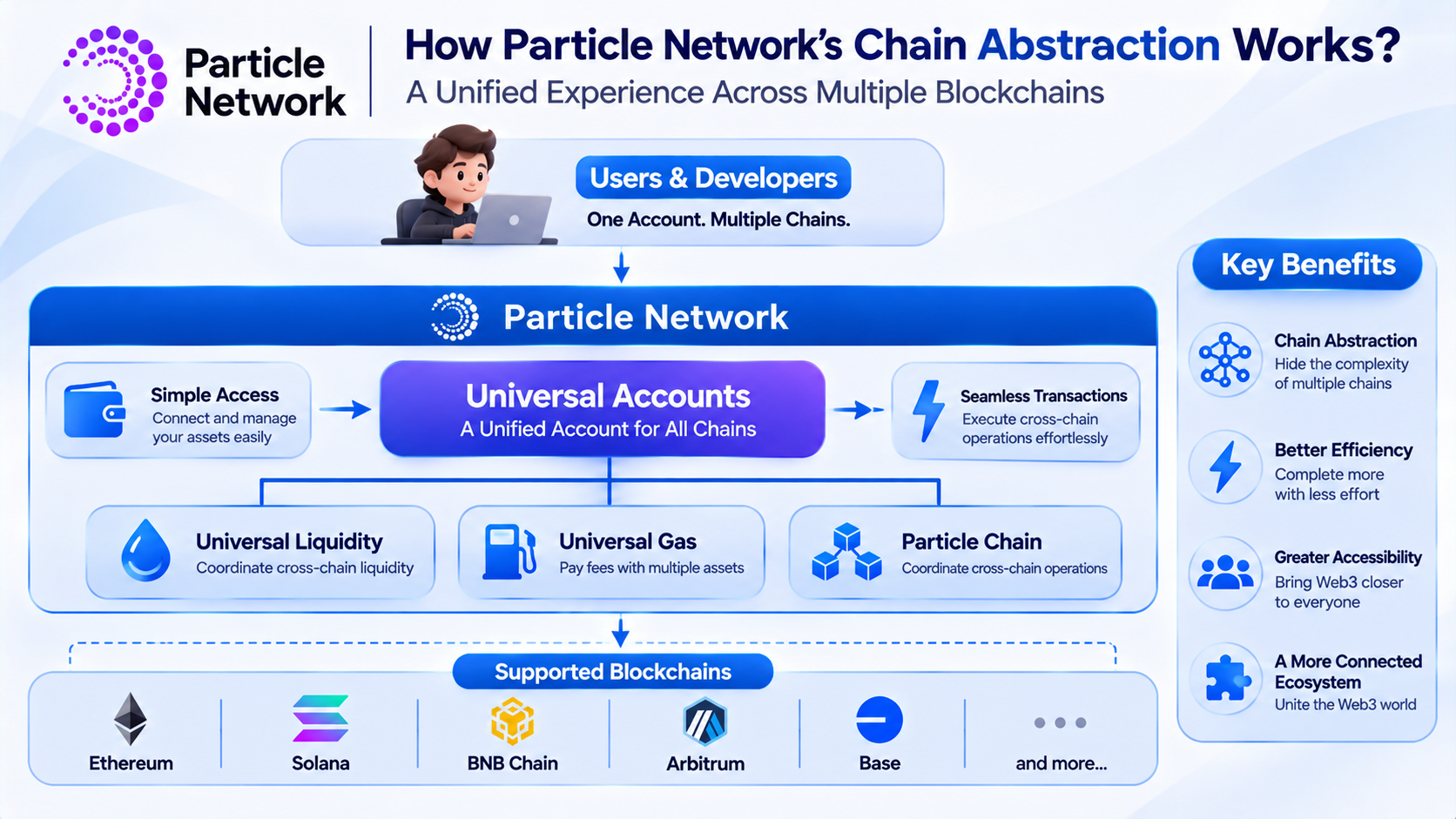
Universal Accounts are a core component of Particle Network's chain abstraction architecture. They are designed to provide users with a unified account entry point and asset usage experience across multiple blockchains. In a traditional multichain wallet, users may be able to view assets on different networks through the same wallet interface, but they still need to select the network, confirm the balance, and prepare transaction fees separately when executing a transaction.
Universal Accounts attempt to unify asset usage further. For example, a user may hold a certain amount of USDC on both Ethereum and Arbitrum and want to complete a transaction on another supported network. Under a traditional process, the user may first need to transfer the assets to the target network before conducting a swap or another operation.
With Universal Accounts, the system can identify the user's available assets across different networks through a unified account and coordinate the corresponding cross-chain operations based on the transaction requirements.
This mechanism relies on smart accounts and cross-chain coordination infrastructure. It is not simply a matter of displaying multiple wallet balances on one page.
From a technical perspective, Universal Accounts use a smart account architecture related to ERC-4337 account abstraction and coordinate account instances and states across different networks through Particle Chain. Account instances on different networks can be managed under a unified logic, reducing repetitive operations for users in supported applications. However, a unified balance does not mean that all assets have been transferred to one on-chain address. Assets remain on their respective networks, and the system must coordinate asset transfers, liquidity, and operations on the target network during transaction execution.
Therefore, the core purpose of Universal Accounts is not to change the blockchain where assets originally reside. Instead, it allows users to avoid directly handling asset distribution and network switching at every stage of a transaction. With the introduction of EIP-7702, Particle Network is also exploring ways for existing wallet accounts to obtain Universal Accounts capabilities, reducing the need to create new accounts or migrate assets.
The actual availability of this mechanism still depends on the connected wallet, supported blockchains, application integration, and specific feature version.
What Role Does Particle Chain Play in Cross-Chain Transactions?
Particle Chain is the infrastructure network that Particle Network uses to coordinate chain abstraction operations. It is also an important component of the Universal Accounts technical architecture.
Traditional cross-chain transactions involve multiple independent networks. Each blockchain has different transaction confirmation rules, state recording methods, and execution environments. To allow users to complete cross-chain operations through a unified account, the messages, transaction states, and account permissions across these networks must be coordinated.
Particle Chain's primary responsibilities include providing coordination and state management for related operations. The Master Keystore Hub is used to manage and synchronize Universal Accounts configurations and related states, allowing account instances on different networks to maintain consistent account management logic.
The Decentralized Messaging Network (DMN) is responsible for transmitting and coordinating cross-chain messages and transaction execution states. Because a cross-chain operation may involve both a source network and a target network, the system needs to confirm whether the relevant steps have been completed and handle information transmission between networks.
In addition, Bundler-related infrastructure handles account abstraction transaction operations and helps organize and submit user-initiated transaction requests to the appropriate execution environments. Together, these components support Universal Accounts operations across different blockchains.
For example, when a user wants to use assets on one chain to purchase tokens on another chain, the system needs to identify the transaction intent, determine the source of the assets, arrange cross-chain liquidity, and execute the transaction on the target network.
Particle Chain serves a coordination role in this process, but this does not mean that all underlying asset transactions occur directly on Particle Chain. Different blockchains remain responsible for recording assets and executing transactions on their respective networks. Particle Chain primarily provides the coordination, state management, and related settlement infrastructure required for cross-chain operations.
This design can improve the multichain interaction experience, but it also means that the system depends on multiple components operating together. Issues affecting cross-chain messages, account synchronization, node services, or the underlying blockchains may affect transaction execution.
How Do Universal Liquidity and Universal Gas Simplify Cross-Chain Operations?
Universal Liquidity and Universal Gas address two common challenges in a multichain environment: fragmented asset liquidity and the requirement to use different tokens to pay transaction fees on different networks.
Universal Liquidity: Allowing Assets on Different Networks to Participate in Unified Transactions
Universal Liquidity is a mechanism Particle Network uses to coordinate cross-chain assets and liquidity. In a traditional environment, users need to confirm where their assets are located and then use a cross-chain bridge or another service to transfer the assets. If the target network lacks the relevant asset, users may also need to exchange tokens.
Universal Liquidity attempts to integrate these operations into the transaction execution process. For example, a user may hold USDC on Arbitrum and want to purchase a token on Solana. Based on supported transaction routes, the system can coordinate assets on the source network with the liquidity required on the target network and complete the corresponding operations.
The key feature of this design is that users may not need to manually complete a separate cross-chain transfer first. However, the underlying process still requires asset transfers, swaps, liquidity provision, or other cross-chain execution mechanisms. Unified liquidity does not mean that assets on different blockchains can be exchanged directly without settlement costs or execution risks. Actual transactions may still be affected by liquidity depth, price slippage, cross-chain fees, and network conditions.
Universal Gas: Reducing Reliance on Different Native Gas Tokens
Different blockchains generally require designated native assets to pay transaction fees. For example, Ethereum transactions typically require ETH, while Solana transactions typically require SOL. For users who operate across multiple networks, this means that they may be unable to execute a transaction due to a lack of the relevant Gas token even when they hold sufficient transaction assets.
Through mechanisms such as Paymasters, Universal Gas allows users to cover fee costs with other assets in supported scenarios. For example, a user may hold USDC but not the native Gas token required by the target network. Where supported, the system can process the fees through fee conversion or sponsorship mechanisms.
It is important to note that Gas abstraction does not mean that transactions no longer incur fees. It changes how users bear and pay those fees. In Particle Network's economic design, PARTI also participates in underlying fee settlement, but the asset actually paid by users may vary depending on the product and transaction route.
Therefore, Universal Liquidity primarily addresses how assets can be used across chains, while Universal Gas primarily addresses how users can pay transaction fees. Together, they support the unified transaction experience provided by Universal Accounts.
How Does Particle Network Differ From Traditional Cross-Chain Bridges?
Traditional cross-chain bridges and Particle Network both involve asset operations between different blockchains, but their primary objectives and user interaction methods differ. Cross-chain bridges generally focus on asset transfers. Users need to select the source network, target network, asset type, and transfer amount before completing the cross-chain operation through the relevant protocol. Some bridges use asset-locking and mapping mechanisms, while others use liquidity pools or cross-chain messages to transfer assets.
Particle Network's chain abstraction architecture focuses more on the user's ultimate objective. For example, the user's goal may not be to transfer USDC from Arbitrum to Solana, but to directly use funds on Arbitrum to purchase a token on Solana.
Under a traditional process, users may first need to bridge their assets and then connect to a trading application on the target network to complete the swap. Under a chain abstraction model, applications can use Universal Accounts and related infrastructure to integrate asset coordination with the target transaction into a more unified process.
The primary differences are as follows:
| Comparison Dimension |
Traditional Cross-Chain Bridge |
Particle Network Chain Abstraction |
| Core objective |
Complete an asset transfer across chains |
Simplify cross-chain account and transaction operations |
| User interaction |
Users generally need to select the source and target chains |
Reduces manual selection in supported scenarios |
| Asset management |
Primarily focused on individual asset transfers |
Emphasizes a unified cross-chain balance experience |
| Gas payments |
Users generally need to account for fees on the target network |
Payments can be simplified through Universal Gas |
| Transaction execution |
The cross-chain transfer and subsequent transaction may be separate |
Cross-chain assets and the target transaction can be coordinated |
| Primary risks |
Bridge contract, verification, and liquidity risks |
The same underlying cross-chain risks, plus reliance on coordination components |
It is important to emphasize that chain abstraction is not a complete replacement for cross-chain bridges. Particle Network still needs to rely on cross-chain messaging, liquidity, and transaction execution infrastructure. The difference is that these operations can be integrated into a unified account and application interaction flow.
Therefore, chain abstraction is better understood as a user experience and execution coordination layer built on cross-chain infrastructure, rather than a completely new transaction method that does not require cross-chain technology.
What Are the Uses of the PARTI Token in Particle Network?
PARTI is the native utility token of the Particle Network ecosystem. It primarily participates in network fee settlement, staking and governance, and economic activities related to cross-chain liquidity. From the perspective of the network's economic structure, PARTI's role mainly involves three areas:
-
Gas settlement: Particle Chain uses PARTI as its native Gas token. Under the Universal Gas mechanism, users may pay fees with different assets, while the relevant fees can be converted or settled as PARTI through the underlying settlement mechanism. This establishes an economic connection between PARTI and network transaction activity.
-
Staking and governance: PARTI is designed to support network staking and governance activities. Staking can provide an economic foundation for network security and participant incentives, while governance allows token holders to participate in certain ecosystem decisions. However, specific staking rewards, lock-up conditions, governance rights, and execution rules must be assessed based on the distinction between protocol design and actually available functions. Users should not infer that holding a certain amount of tokens necessarily grants a particular return or decision-making right.
-
Cross-chain liquidity: In the economic design of Universal Liquidity, PARTI may serve as an intermediary asset in liquidity coordination and settlement and support related liquidity provision activities. This mechanism means that the token may participate in the economic flow generated by cross-chain transactions, but actual demand still depends on transaction volume, settlement routes, and protocol rules.
The initial tokenomics plan for PARTI set the total supply at 1 billion tokens, with allocations covering community growth, the team and advisors, private financing, liquidity, ecosystem reserves, and other categories. The token completed its TGE on March 24, 2025, and the relevant allocations are being released gradually under different vesting arrangements. It is important to note that increased usage of Particle Network does not necessarily mean that the price of PARTI will rise.
On the one hand, increased network activity may raise certain fee and settlement requirements. On the other hand, actual token demand is also affected by fee levels, settlement efficiency, liquidity structure, token unlocks, and market trading activity.
For example, if network transaction volume increases while the cost per transaction continues to decline, or if the protocol can complete more settlements with less PARTI, token demand may not grow in line with transaction volume. In addition, token unlocks may increase the circulating supply, while staking withdrawals and changes in early investors' asset allocations may also affect market supply and demand. Therefore, assessing PARTI's long-term economic value requires observing network usage, protocol revenue, token demand mechanisms, and supply changes together. Project ecosystem expansion should not be equated with an increase in the token price.
What Are the Main Use Cases of Particle Network?
Particle Network's chain abstraction capabilities are primarily designed for multichain trading, wallet access, DeFi applications, and other scenarios that require interaction across networks.
Multichain Asset Trading
Multichain trading is a direct use case for chain abstraction. Users may hold USDC, ETH, or other assets on different networks while wanting to purchase a token located on another blockchain. In supported trading applications, Universal Accounts can coordinate asset usage and transaction execution, reducing the number of manual cross-chain steps.
UniversalX is an application in the Particle Network ecosystem that uses Universal Accounts. It integrates multichain balances and transaction execution into a unified interface, allowing users to trade assets across supported networks. However, the specific tradable assets, network coverage, fees, and execution conditions still depend on the application's actual support.
DeFi Applications and Asset Management
DeFi users often need to find liquidity, manage assets, and participate in protocols across different networks. Chain abstraction can help applications reduce network switching and asset preparation steps. For example, a DeFi application can use a unified account to identify a user's available assets across different networks and then coordinate the relevant transaction.
However, cross-chain asset operations still involve smart contract, liquidity, and protocol risks. A unified account experience does not replace the need to assess the security of the underlying protocols.
Web3 Wallet and Application Access
For developers, the wallet access, account abstraction, and chain abstraction components provided by Particle Network can be used to build applications that support multichain interactions. Through relevant SDKs, developers can integrate account creation, wallet connection, Gas abstraction, and transaction execution functions, reducing the need to maintain multiple sets of account logic separately.
The EIP-7702-related features advanced in 2026 also provide additional implementation paths for existing wallet addresses to use smart account capabilities.
AI Agents and Automated On-Chain Operations
As AI Agents begin participating in on-chain information queries, asset management, and automated trading, the complexity of multichain operations may become an issue that automated systems need to handle. Chain abstraction can provide these applications with unified account and transaction interfaces, allowing Agents to coordinate operations across different networks where supported. However, automated trading still requires clearly defined authorization scopes, fund limits, and risk controls. Chain abstraction addresses transaction execution complexity but cannot automatically determine whether a transaction is safe or appropriate.
Therefore, Particle Network's potential applications include not only multichain trading for individual users but also developer infrastructure that requires unified accounts and cross-chain execution capabilities.
What Technical and Ecosystem Development Challenges Does Particle Network Face?
Although chain abstraction can simplify multichain operations, its development still faces challenges related to technical security, liquidity, network compatibility, and ecosystem adoption.
-
Cross-chain security: Universal Accounts may involve multiple blockchains, smart contracts, cross-chain messages, and transaction execution components. Even if users only need to initiate one operation, the underlying process may contain multiple steps. If a smart contract vulnerability, message verification issue, or execution failure occurs at any stage, the transaction result may be affected.
-
Account permissions and state synchronization: Unified accounts need to coordinate account configurations and authorization states across different networks. Delays in permission updates, signature verification, or cross-chain state synchronization may affect transaction execution and account security. Account features such as EIP-7702 also involve delegated authorization. Users need to pay attention to the authorized parties, permission scopes, and revocation mechanisms to avoid increasing asset risk through incorrect authorization.
-
Liquidity and transaction costs: Universal Liquidity depends on actually available cross-chain liquidity. For assets with insufficient trading depth, the system may face high slippage, additional fees, or failed transactions. Even if users do not need to bridge assets manually, the related execution costs do not disappear.
-
Network compatibility: Different blockchains vary in transaction formats, confirmation mechanisms, smart contract environments, and account models. The networks and functions that Universal Accounts can support depend on specific technical integrations and versions.
-
Ecosystem adoption and commercial sustainability: The long-term development of chain abstraction infrastructure depends not only on whether the technology is feasible but also on whether developers are willing to integrate it and whether users obtain practical benefits from the unified account experience. If the relevant functions lack sustained demand, infrastructure transaction volume, fee revenue, and ecosystem activity may be limited.
For PARTI, it is also necessary to assess whether the tokenomics can establish a sustained connection with actual network usage. The relationship between network activity, fee settlement, token supply, and staking demand will affect the long-term performance of its economic mechanisms.
Therefore, evaluating Particle Network requires more than examining the concept of chain abstraction itself. It also requires observing actual application integration, transaction execution quality, security, and ecosystem usage.
Conclusion
Particle Network is a Web3 infrastructure project built around chain abstraction. Through components such as Universal Accounts, Universal Liquidity, Universal Gas, and Particle Chain, it aims to improve account management, asset usage, and transaction execution in a multichain environment.
Its core technical approach is to integrate complex cross-chain operations into unified account and application interaction flows, allowing users to use assets more conveniently across supported networks without manually handling network switching, asset transfers, and Gas preparation every time.
Universal Accounts serve as the primary user entry point for this architecture, while Particle Chain is responsible for cross-chain coordination and account state management. Universal Liquidity and Universal Gas support cross-chain asset routing and fee abstraction, respectively, and together form the foundation of the chain abstraction experience.
The PARTI token participates in network Gas settlement, staking and governance, and liquidity-related economic mechanisms. However, increased project usage does not necessarily translate into an increase in the token price. Its long-term economic performance still depends on actual usage demand, protocol fees, token releases, and market conditions.
From an industry development perspective, chain abstraction provides a technical path for addressing Web3's multichain fragmentation, but it cannot eliminate the security and liquidity risks inherent in underlying blockchains and cross-chain transactions. Whether Particle Network can develop sustainable ecosystem value will require further validation through application adoption, transaction execution efficiency, and network economic activity.
FAQ
What Is Particle Network (PARTI)?
Particle Network is a Web3 infrastructure project focused on chain abstraction. Through technologies such as Universal Accounts, Particle Chain, Universal Liquidity, and Universal Gas, it helps users and developers simplify multichain asset management and transaction operations. PARTI is the native utility token of its ecosystem.
What Does Chain Abstraction Mean in Particle Network?
Chain abstraction refers to using unified accounts, transaction interfaces, and cross-chain coordination mechanisms to reduce the need for users to directly handle underlying operations on different blockchains. It does not mean that different blockchains have been merged. Instead, it improves the multichain interaction experience through infrastructure.
How Do Universal Accounts Differ From Regular Web3 Wallets?
Regular multichain wallets can generally display assets on different networks, but users still need to manage networks, Gas, and cross-chain operations separately. Universal Accounts use smart accounts and cross-chain coordination mechanisms to allow users, in supported scenarios, to complete transactions with a unified account and balance.
What Is Particle Chain?
Particle Chain is the infrastructure network Particle Network uses to coordinate chain abstraction operations. It participates in Universal Accounts state synchronization, cross-chain message coordination, and related transaction processing.
What Are the Uses of the PARTI Token?
PARTI is primarily used for Particle Chain Gas settlement, network staking and governance, and liquidity and settlement activities related to Universal Liquidity. Specific functions are subject to the actual network rules.
How Does Particle Network Differ From Cross-Chain Bridges?
Cross-chain bridges primarily help users transfer assets between different blockchains, while Particle Network focuses on integrating cross-chain asset usage and target transactions into a unified process. Its underlying operations still require cross-chain messaging and liquidity infrastructure.
Can Particle Network Support All Blockchains?
It should not be assumed that Particle Network supports all blockchains. Actual availability depends on network compatibility, account functionality, liquidity, and the integration of specific applications.
Will Increased Particle Network Usage Drive the Price of PARTI Higher?
Not necessarily. Network usage may affect fee settlement and liquidity demand, but the token price is also influenced by supply releases, market liquidity, investor expectations, and overall market conditions.