As Ethereum, Solana, BNB Chain, and various Layer 2 networks continue to develop, crypto assets have become increasingly distributed across different ecosystems. Although users can view their assets through multichain wallets, they may still need to switch networks, prepare native Gas tokens, use cross-chain bridges, and wait for assets to arrive when carrying out actual transactions. This process not only adds more steps to a transaction but also raises the barrier to entry for ordinary users participating in multichain applications.
The core problem Universal Accounts attempts to solve is not merging all blockchains into a single network, but reducing the extent to which users need to perceive differences between underlying chains during operation. This article focuses on the account architecture of Universal Accounts, its Unified Balance mechanism, the execution process for cross-chain transactions, and how Universal Liquidity, Universal Gas, and ERC-4337 work together to support this experience. It also discusses the potential technical and security risks involved.
Key Points
-
Universal Accounts uses smart accounts to provide a unified cross-chain experience. Users can manage and use assets across supported networks without manually handling every cross-chain step each time.
-
A Unified Balance does not mean that assets are stored in one place. Assets on different networks remain recorded on their respective blockchains. The system provides a unified usage experience through account and liquidity coordination.
-
Universal Liquidity handles cross-chain asset routing. It helps the system coordinate assets on source networks with liquidity on target networks based on transaction requirements.
-
Universal Gas simplifies fee payments. Where supported, users can pay transaction fees with other assets, reducing their reliance on native Gas tokens from different networks.
-
ERC-4337 provides the technical foundation for smart account execution. Components such as Bundlers, UserOperations, and Paymasters support more flexible transaction authorization and fee processing.
-
Chain abstraction does not mean that cross-chain risks disappear. Smart contracts, cross-chain messaging, liquidity, authorization management, and transaction execution can still affect asset security.
Why Is Multichain Asset Management Still Complex?
The development of multichain ecosystems gives users more applications and asset choices, but it also makes wallet management and transaction execution more complex. In the traditional Web3 environment, different blockchains have independent state records, transaction confirmation processes, and fee mechanisms. For example, ERC-20 assets on Ethereum and SPL assets on Solana follow different technical standards. Even when the same stablecoin exists on multiple networks, its on-chain balance and transfer records must still be handled separately.
For ordinary users, these differences are mainly reflected in three areas.
-
Distributed assets. Users may hold ETH on Ethereum, USDC on Arbitrum, and other tokens on BNB Chain. Although some wallets can display these assets together, displaying balances together does not mean that the assets can be used directly across networks.
-
Transaction fees. Different blockchains typically require specific assets to pay Gas. For example, transactions on Ethereum and Arbitrum generally require ETH, while transactions on Solana require SOL. Even if users hold enough stablecoins, they may be unable to complete a transaction because they lack the native Gas token.
-
Multiple cross-chain transaction steps. If a user wants to use USDC on Arbitrum in a DeFi application on another network, they typically need to select a cross-chain service, confirm the source and target networks, and then complete the asset transfer and subsequent transaction.
This process may involve multiple signatures, different transaction confirmation times, and additional cross-chain fees. For users who are unfamiliar with underlying networks, selecting the wrong network, asset, or authorization target can increase operational risk.
Multichain wallets have already improved the experience of viewing assets and connecting wallets, but they do not necessarily solve the problems of cross-chain asset routing and transaction execution. Universal Accounts is designed to extend multichain asset management beyond simply displaying balances, enabling assets to be used and transactions to be executed through a unified account.
What Are Universal Accounts? How Do They Differ from Ordinary Wallets?
Universal Accounts is a smart account system built by Particle Network around the concept of chain abstraction. It is designed to let users access assets and applications across multiple blockchains through a unified account entry point. Its core idea is to coordinate users’ account operations across different networks, so users do not always need to handle underlying steps such as network switching, cross-chain transfers, and preparing transaction fees themselves.
In an ordinary multichain wallet, users can typically view assets on multiple networks through a single interface, but balances on different networks must still be used separately. For example, a user may hold 100 USDC on Ethereum and 200 USDC on Arbitrum. The wallet may display a combined balance of 300 USDC, but if the target transaction takes place on Arbitrum, the 100 USDC on Ethereum generally cannot be used directly as the local balance on that network.
Universal Accounts attempts to provide a more unified balance and transaction experience in supported applications. The system can identify available assets across different networks and coordinate the corresponding asset routing during transaction execution.
The main differences are as follows:
| Comparison Dimension |
Ordinary Multichain Wallet |
Universal Accounts |
| Account experience |
Unified wallet interface with separate management for each network |
Unified account logic and cross-chain operational experience |
| Asset balances |
Typically displayed separately by network |
Can provide a unified available balance experience |
| Cross-chain transactions |
Users may need to use a cross-chain bridge manually |
The system can coordinate cross-chain steps in the background |
| Gas payments |
Usually requires the fee asset for the corresponding network |
Can be simplified through Universal Gas |
| Transaction execution |
Signed and submitted separately for each network |
Multiple operations can be coordinated through a smart account |
| Underlying assets |
Recorded separately on different blockchains |
Still recorded separately on different blockchains |
It is important to note that Universal Accounts does not mean that all assets are transferred to Particle Chain, nor does it mean that assets on different blockchains have become the same type of native asset. It is closer to a cross-chain account coordination mechanism: while preserving the independence of underlying networks, it allows users to use assets distributed across different networks through unified account logic.
Therefore, the key difference between Universal Accounts and ordinary wallets is not simply how assets are displayed, but whether cross-chain asset usage and transaction execution can be integrated into a unified operational process.
How Does Universal Accounts Aggregate Asset Balances Across Different Blockchains?
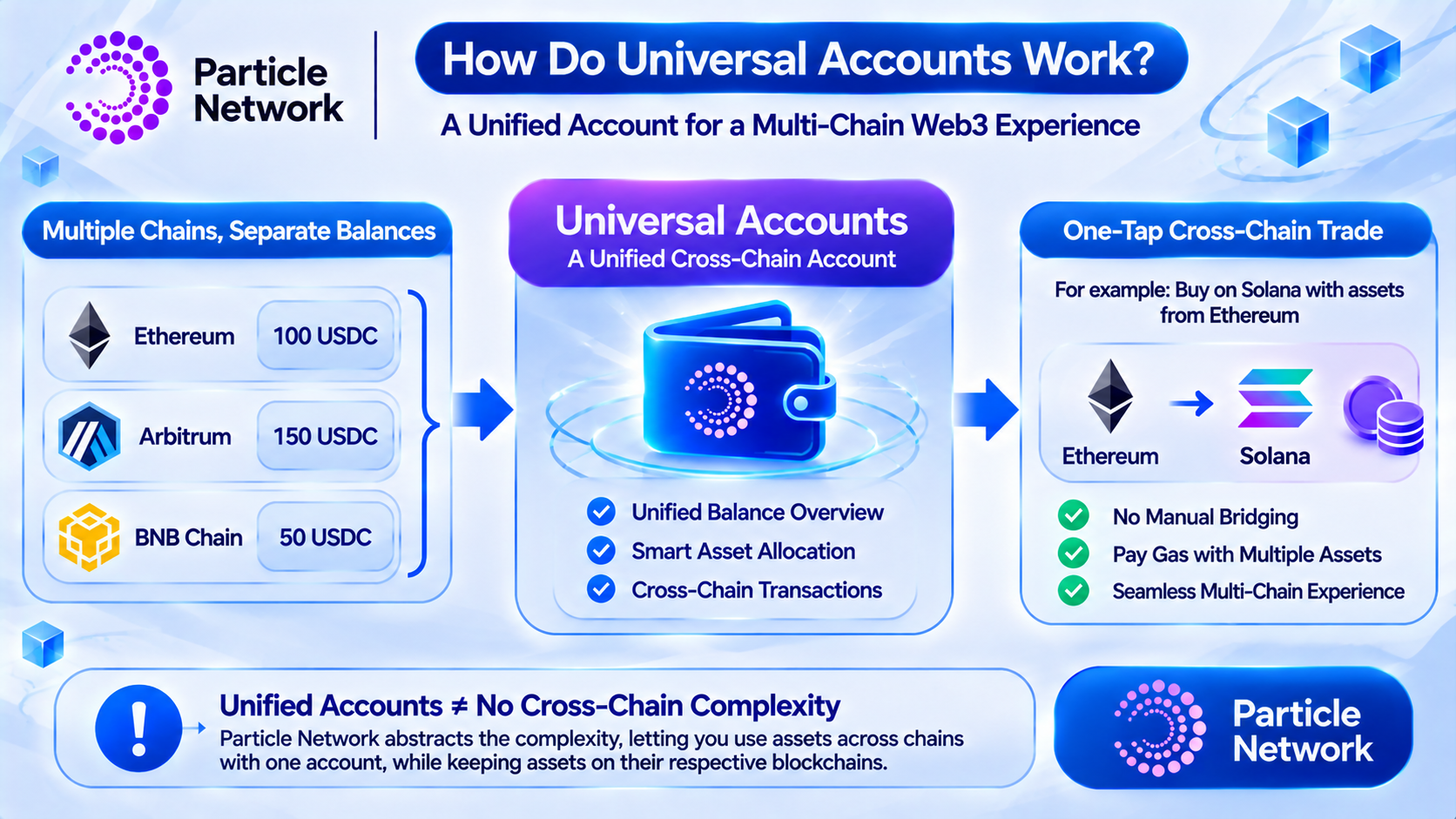
The Unified Balance mechanism of Universal Accounts is an important foundation of Particle Network’s chain abstraction experience. It allows users, in supported applications, to treat assets distributed across different networks as a combined source of funds for transactions.
In traditional wallets, asset balances are usually recorded separately by blockchain network. Even if users hold the same type of stablecoin, balances on different networks cannot be directly combined for a transaction on a particular chain. Universal Accounts incorporates these distributed assets into a unified transaction process through account identification and cross-chain liquidity coordination.
For example, suppose a user holds $100 worth of USDC on Ethereum, $150 worth of USDC on Arbitrum, and $50 worth of other tokens on BNB Chain. If these assets and their respective networks are supported, the application can include them in a unified view of available assets. When the user wants to complete a transaction worth $200 on a target network, the system can select appropriate asset sources based on available balances, conversion paths, and liquidity conditions.
However, it is important to distinguish between displaying a unified balance and using a unified balance.
-
A unified displayed balance is primarily an interface-level feature. An application can read asset information from different networks and aggregate it based on price.
-
A unified usable balance requires actual transaction execution capabilities. If the target transaction requires a specific asset on a particular chain, the system still needs to coordinate the conversion of source assets, cross-chain liquidity, and settlement on the target network.
Particle Network uses Universal Liquidity to support this process, allowing the Unified Balance to function as more than an asset display feature and to participate in actual transactions in supported scenarios. However, a Unified Balance does not mean that users can use all assets unconditionally. Some tokens may lack sufficient liquidity, certain networks may not yet be connected to the relevant services, and transactions may also be subject to fees, slippage, and minimum transaction limits.
Therefore, the Unified Balance of Universal Accounts should be understood as a usage experience built on actual assets and cross-chain execution capabilities, rather than as the direct merging of assets on different blockchains into a single ledger.
How Does Universal Liquidity Coordinate Cross-Chain Liquidity?
Universal Liquidity is an important mechanism that enables Universal Accounts to provide a unified cross-chain balance experience. Its core objective is to coordinate assets and liquidity across different blockchains based on actual transaction requirements. Traditional cross-chain operations generally require users to select a cross-chain bridge, specify the source and target networks, and enter the transfer amount manually. Universal Liquidity attempts to integrate these steps into the transaction execution process.
For example, suppose a user holds $100 worth of assets on Polygon and wants to purchase $80 worth of tokens on another network. In supported scenarios, Universal Liquidity can identify the user’s asset source and coordinate the delivery of funds on the target network through the relevant conversion path and liquidity providers. Its underlying process may involve exchanging tokens on the source network, having a liquidity provider receive the assets, and releasing assets of corresponding value on the target network. From the user’s perspective, these steps can be integrated into a single transaction interaction.
Liquidity providers (LPs) play an important role in this process. By providing available assets on different networks, they help complete transactions on the target network without requiring users to wait for each traditional cross-chain asset transfer themselves. Particle Network’s cross-chain coordination infrastructure manages the relevant transaction steps and execution status, allowing operations on the source and target networks to be completed according to predefined logic. However, cross-chain liquidity coordination does not mean that assets can move between different networks without cost.
Liquidity providers may charge fees, asset conversions may incur slippage, and the target network may also charge transaction fees. If a transaction path lacks sufficient liquidity, the system may need to select another path or may be unable to complete the transaction. In addition, cross-chain transactions involve multiple independent networks, and their execution status must undergo the corresponding verification. Even if a protocol uses an atomic or coordinated execution design, actual transactions may still be affected by network congestion, messaging errors, and smart contract risks. Therefore, the value of Universal Liquidity lies primarily in simplifying user operations and coordinating cross-chain liquidity, not in eliminating the technical costs and risks of cross-chain transactions themselves.
How Does Universal Gas Support Paying Fees with Different Tokens?
Universal Gas is a mechanism designed by Particle Network to improve the multichain fee payment experience. In traditional blockchain transactions, users generally need to hold the native token designated by the target network to pay transaction fees. For example, transactions on Ethereum require ETH, while transactions on Solana require SOL.
This design is relatively straightforward on a single network, but users operating across multiple networks may need to prepare different fee assets separately. Universal Gas attempts to reduce this burden through account abstraction and fee sponsorship. One of its important technical components is the Paymaster. Within the ERC-4337 account abstraction architecture, a Paymaster can cover transaction fees for users according to predefined rules or charge users in other assets for the corresponding fees.
For example, a user may want to execute a transaction on a supported network but lack that network’s native Gas token. If the application supports Universal Gas, the user can pay the fee with another eligible token, while the relevant mechanism handles the actual network fee settlement.
Particle Network’s design combines Universal Gas with Universal Liquidity, allowing fee assets to be coordinated in a cross-chain environment. PARTI also participates in its underlying fee settlement mechanism.
It is important to note that Universal Gas does not mean that all transactions are free. Blockchain transactions still require payment of underlying network fees, and cross-chain asset routing and fee conversion may also incur additional costs. Universal Gas changes how users pay transaction fees; it does not eliminate those costs. Different applications may also use different fee sponsorship models. Some applications may subsidize fees for users, while others may deduct the corresponding fees from the assets selected by users.
Therefore, users still need to pay attention to the actual fee, payment asset, conversion price, and final amount of assets received before executing a transaction. The primary purpose of Universal Gas is to eliminate the need for users to prepare fee tokens separately for each blockchain, thereby reducing the operational complexity of multichain transactions.
What Happens in the Background When a User Initiates a Cross-Chain Transaction?
The core experience of Universal Accounts is allowing users to initiate transactions through a unified account without handling every underlying cross-chain operation individually. From a technical perspective, however, a cross-chain transaction still involves multiple stages, including account authorization, asset identification, liquidity coordination, and execution on the target network. Suppose a user holds USDC on Arbitrum and wants to purchase a token on Solana. Traditionally, the user would first need to complete the cross-chain transfer and then connect to a trading application on Solana to execute the exchange.
With Universal Accounts, the relevant process can be integrated into a single user interaction.
Step 1: Connect a wallet. The user connects a Web3 wallet, and the system identifies the Universal Account and multichain asset balances.
Step 2: Initiate the transaction. The user selects the target token and transaction amount, and the system identifies the target network and required fees.
Step 3: Determine the transaction route. Universal Liquidity coordinates a cross-chain transaction route based on available assets and liquidity.
Step 4: Confirm authorization. The user confirms the transaction by signing with the wallet. The underlying process may involve multiple on-chain operations.
Step 5: Coordinate cross-chain liquidity. Liquidity providers and components related to Particle Chain coordinate asset routing, cross-chain messages, and execution status.
Step 6: Execute the transaction. The system submits the transaction on the target network and completes the token exchange or other operation.
Step 7: Update the transaction status. The system synchronizes the execution result and displays the transaction status and changes to the account balance.
This design allows users to focus more on the transaction objective rather than the cross-chain process itself. However, whether the transaction succeeds still depends on the status of the underlying networks, liquidity, transaction authorization, and smart contract execution. A unified operational process cannot guarantee that every transaction will be completed immediately.
UniversalX is one application example of Universal Accounts. By integrating a Unified Balance with cross-chain transaction execution, it allows users to trade assets across supported networks.
How Does Universal Accounts Integrate with ERC-4337 Account Abstraction?
ERC-4337 is an account abstraction standard in the Ethereum ecosystem. It allows smart contract accounts to implement more flexible account operations through specialized transaction processing mechanisms. Traditional externally owned accounts (Externally Owned Accounts, EOAs) primarily rely on private key signatures to initiate transactions, and their account logic is relatively fixed.
Smart accounts can define transaction validation, permission management, and execution rules through smart contracts. For example, a smart account can support batch operations, Gas sponsorship, and custom authorization mechanisms. Particle Network’s Universal Accounts uses a smart account architecture related to ERC-4337 and extends account management capabilities to the cross-chain environment. Three important concepts are involved.
1. UserOperation: Describes the Account Operation the User Wants to Execute
A UserOperation is a data structure used in ERC-4337 to describe a smart account operation. Unlike a traditional transaction submitted directly by an EOA, users can use a UserOperation to describe the operation they want to execute and then have the relevant infrastructure process it.
For example, if a user wants to complete a token approval and exchange, the smart account can organize the relevant operations according to the specific implementation. For Universal Accounts, this type of mechanism helps separate the user’s transaction intent from the underlying execution process.
2. Bundler: Processes Smart Account Operations
A Bundler collects eligible UserOperations and submits them to the relevant contracts on the blockchain for processing. In Particle Network’s architecture, the Bundler is also an important infrastructure component that supports the organization and execution of smart account operations. Relevant modules on Particle Chain also include the Decentralized Bundler, which coordinates the processing of account abstraction operations.
3. Paymaster: Supports Flexible Fee Payments
A Paymaster can cover the Gas fees required for smart account operations according to specific rules. This provides the technical foundation for applications to subsidize transaction fees and for users to pay fees with non-native tokens. Particle Network’s Universal Gas combines the relevant fee processing mechanisms with cross-chain liquidity coordination to further improve the fee payment experience in a multichain environment.
However, ERC-4337 itself primarily addresses smart account transaction execution and fee management. It does not directly provide a complete unified cross-chain balance capability. Universal Accounts also needs to coordinate assets and account states across different networks through Particle Chain, Universal Liquidity, and cross-chain messaging infrastructure. In addition, ERC-4337 is mainly designed for networks compatible with its account abstraction mechanism. For blockchains such as Solana that use different account models, Particle Network needs to complete integration through specialized implementations rather than simply deploying EVM smart contracts on every network.
Therefore, ERC-4337 provides an important account abstraction foundation for Universal Accounts, but a complete chain abstraction experience also depends on cross-chain coordination and liquidity infrastructure.
What Security and Execution Risks Do Unified Cross-Chain Accounts Involve?
Universal Accounts can reduce the number of manual operations users perform, but they do not eliminate the technical risks inherent in cross-chain transactions. On the contrary, because the system needs to coordinate multiple networks and infrastructure components, users also need to understand the potential sources of risk behind a unified account.
Smart Contract and Account Authorization Risks
Universal Accounts relies on smart accounts and related contracts to execute transactions. If a smart contract contains a vulnerability or a user authorizes an untrusted application, asset security may be affected.
In addition, smart accounts may support more flexible permission management, but this flexibility also means that users need to pay attention to the scope, validity period, and revocation method of authorizations. In particular, when using batch transactions or automated operations, an incorrect authorization may affect multiple transactions.
Cross-Chain Messaging and State Synchronization Risks
Cross-chain transactions require information to be transmitted between different blockchains and require confirmation that the relevant operations have been completed. Particle Network coordinates account states and cross-chain execution through components such as Particle Chain, Master Keystore Hub, and Decentralized Messaging Network. If cross-chain messaging, state synchronization, or the operation of an underlying network encounters an issue, the transaction may be delayed, fail, or require additional processing.
Liquidity and Price Slippage Risks
Universal Liquidity depends on actually available assets and transaction routes. If an asset has insufficient liquidity or the market price changes rapidly during the transaction, users may face significant slippage. Fees charged by cross-chain liquidity providers, conversion routes, and transaction costs on the target network may also affect the final amount of assets received. Therefore, a Unified Balance does not mean that all assets can be exchanged instantly at a fixed price.
Transaction Execution and Network Risks
A cross-chain transaction may involve operations on multiple networks. Even if the user only needs to provide one confirmation, the underlying process may still execute multiple transactions. Network congestion, transaction failures, or changes in execution conditions may affect the final result. In highly volatile markets, in particular, price changes between transaction submission and actual completion may cause the final execution result to differ from the quote initially displayed to the user.
Application Integration and Compatibility Risks
Different applications may offer different levels of integration with Universal Accounts. Some features may only be available for specific networks, assets, or wallet types. Even if an application supports a unified account, this does not mean that every transaction can use the full range of cross-chain liquidity and Gas abstraction features.
Users need to confirm the networks, assets, transaction rules, and authorization methods actually supported, rather than assuming that all features are available based solely on the product name. Overall, Universal Accounts shifts multichain complexity from the user interface to the infrastructure layer, but the associated technical risks remain. For users, a simpler operational process needs to be combined with transparent fee displays, clear authorization management, and reliable transaction status tracking to provide a more complete experience.
Conclusion
Particle Network’s Universal Accounts is a smart account system built around chain abstraction. Its core objective is to let users manage and use assets distributed across different blockchains through a unified account while reducing the need to switch networks, conduct cross-chain transfers manually, and prepare fee assets. Compared with ordinary multichain wallets, Universal Accounts focuses not only on displaying assets across different networks but also on coordinating actual cross-chain transaction execution through Universal Liquidity and Particle Chain. A Unified Balance represents the ability to use assets in a unified manner in supported scenarios, not the storage of all assets on a single blockchain.
Universal Liquidity coordinates cross-chain assets and liquidity based on transaction requirements, while Universal Gas reduces users’ reliance on native Gas tokens from different networks through fee sponsorship and asset conversion mechanisms. The smart account architecture provided by ERC-4337 offers an important technical foundation for transaction authorization, batch operations, and flexible fee payments.
However, chain abstraction cannot eliminate the complexity of underlying cross-chain transactions. Smart contract security, account permissions, liquidity, cross-chain messaging, and network execution status can still affect transaction results.
Therefore, the long-term value of Universal Accounts depends not only on whether it can simplify user operations, but also on whether its cross-chain execution capabilities, security mechanisms, transaction costs, and application compatibility can meet practical needs. As multichain applications continue to develop, unified accounts may become an important infrastructure direction for improving the Web3 user experience. However, their actual effectiveness still needs to be validated through continued application use and technical operation.
FAQ
What Are Universal Accounts?
Universal Accounts is cross-chain unified account infrastructure developed by Particle Network. Through smart accounts, Unified Balance, and cross-chain transaction coordination mechanisms, it enables users to manage and use assets more conveniently across supported networks.
How Do Universal Accounts Differ from Ordinary Multichain Wallets?
Ordinary multichain wallets primarily help users view and manage assets on different networks, while Universal Accounts further attempts to integrate cross-chain asset routing and transaction execution into a unified account process.
Does the Unified Balance of Universal Accounts Mean That Assets Are Stored in One Place?
No. Assets on different networks remain recorded on their respective blockchains. The Unified Balance is implemented through account identification, liquidity coordination, and cross-chain execution mechanisms.
What Is Universal Liquidity?
Universal Liquidity is a mechanism used by Particle Network to coordinate assets and liquidity across different networks. It supports users in using assets from other supported networks when initiating a transaction.
Does Universal Gas Mean That Transactions Do Not Require Fees?
No. Universal Gas primarily changes how transaction fees are paid, allowing users to pay transaction fees with other assets in supported scenarios. Underlying network fees and related execution costs still apply.