Neocloud (a new model for cloud compute) refers to an emerging cloud computing model that provides GPU clusters, compute resource rentals, and related infrastructure services for AI training, inference, and high-performance computing. As generative AI, large language models, and enterprise AI applications continue to develop, compute resources are expanding beyond traditional CPU-dominated, general-purpose cloud services toward GPU-accelerated computing and dedicated AI infrastructure.
This shift is not only affecting the cloud computing industry but also reshaping the direction of cryptocurrency mining companies. In the past, Bitcoin miners primarily generated revenue by deploying ASIC miners, securing low-cost electricity, and competing for a share of the network's hash rate. Today, some mining companies are beginning to use their power resources, data center sites, and infrastructure development capabilities for AI data center hosting, with some also exploring GPU cloud computing.
However, Neocloud and Bitcoin mining differ significantly in their technical architectures, customer needs, and revenue models. Access to power resources does not mean a company can directly operate high-performance AI clusters, and signing long-term data center contracts does not mean it has established consistent profitability. Starting with Neocloud's definition and business models, this article analyzes how demand for AI compute is driving mining companies to diversify. It also examines the opportunities and risks behind this trend through examples including CoreWeave, IREN, and Core Scientific.
Key Takeaways
-
Neocloud (a new model for cloud compute) is an emerging cloud service model centered on GPU clusters, AI model training, and inference. Representative companies include CoreWeave, Nebius, Lambda, and Crusoe.
-
Compared with traditional cloud services such as AWS and Microsoft Azure, Neocloud focuses more closely on supplying AI compute, high-performance GPU clusters, and dedicated computing infrastructure. However, the two service categories are gradually converging.
-
Growing demand for AI compute is making power capacity, data center locations, cooling systems, and high-speed networks important infrastructure resources.
-
Bitcoin mining companies have some experience with power resources and data center operations, so they are beginning to explore AI data center hosting and GPU cloud services. However, ASIC miners cannot directly replace AI GPUs.
-
Moving from crypto mining to Neocloud is not a simple business upgrade. Companies face higher capital expenditures, different technical standards, long-term contractual obligations, and customer concentration risk.
-
When evaluating a mining company's transition, it is important to distinguish among three different business models: traditional Bitcoin mining, AI data center hosting, and operating GPU cloud services.
What Is Neocloud, and How Does It Differ from Traditional Cloud Computing?
Neocloud generally refers to companies or infrastructure platforms that provide GPU cloud services specifically for AI and high-performance computing. Their core business involves deploying high-performance GPUs, building high-speed interconnect networks and supporting storage systems, and then providing computing capacity through on-demand rentals, long-term compute contracts, or dedicated clusters.
Traditional cloud computing platforms typically offer a comprehensive range of services covering compute, storage, databases, networking, security, and application development. Hyperscale cloud providers such as AWS, Microsoft Azure, and Google Cloud have broad enterprise customer bases and mature software ecosystems. Neocloud companies typically invest more resources in building and operating AI GPU clusters, offering specialized services for model training, inference deployment, and high-performance computing.
For example, when an AI model developer needs thousands of GPUs for large-scale training, it must consider more than GPU models and rental prices. It also needs to assess cluster network bandwidth, communication efficiency between GPUs, storage throughput, and workload scheduling capabilities. Neocloud's competitiveness depends not only on how many GPUs a provider owns, but also on whether it can organize that hardware into a stable, efficient computing system.
| Comparison Dimension |
Neocloud |
Traditional Cloud Computing |
| Core focus |
Dedicated GPU compute services for AI |
Comprehensive cloud computing services |
| Primary compute resources |
GPU-accelerated computing clusters |
CPUs, GPUs, and various compute resources |
| Typical applications |
AI training, inference, HPC |
Enterprise applications, databases, storage, AI |
| Primary customers |
AI labs, model developers, research institutions |
Businesses across industries, developers, AI companies |
| Business model |
GPU rentals, dedicated clusters, long-term compute contracts |
Pay-as-you-go pricing, reserved instances, comprehensive cloud services |
| Main challenges |
GPU depreciation, capital expenditures, customer concentration |
Overall operating costs, service complexity, competitive pressure |
It is important to note that Neocloud is not a technical framework entirely separate from traditional cloud computing. Large cloud providers also offer AI GPU services, while Neocloud companies may gradually expand their software platforms and enterprise service capabilities. The distinction lies more in business priorities, resource allocation, and market positioning than in strict technical boundaries.
Why Is Demand for AI Compute Driving the Neocloud Market?
AI model training and inference require substantial parallel computing resources. Large-scale language models, multimodal models, and complex reasoning systems place particularly demanding requirements on GPU performance, GPU memory capacity, and cluster interconnects.
During model training, companies typically need to connect many GPUs into a unified computing cluster, using high-speed networks to synchronize parameters and exchange data. As models grow larger, the performance of a single GPU is no longer the only determining factor. Overall cluster computing efficiency, network stability, and storage performance are equally important.
During model inference, compute demand comes from continuously running AI services. Chatbots, coding assistants, enterprise agents, and multimodal applications need to perform computations and return results after users submit requests. As the number of AI application users and their usage frequency increase, inference services also need to keep expanding their compute resources.
This is gradually extending AI infrastructure requirements beyond chip purchases to power, land, data centers, liquid cooling systems, and high-speed networks. Even if a company can purchase enough GPUs, it cannot put them into operation promptly without the necessary power capacity and suitable data center facilities.
Neocloud companies have developed against this backdrop. By purchasing GPUs in bulk, building dedicated computing clusters, and offering flexible compute rental services, they aim to help AI companies reduce the complexity of building their own infrastructure.
However, growing market demand does not necessarily lead to consistent profitability. GPU purchase prices, hardware replacement cycles, electricity costs, financing terms, and customer utilization all directly affect Neocloud companies' operating performance. As more competitors enter the market, compute rental prices may also respond to changes in supply and demand.
Why Do Bitcoin Mining Companies Have a Foundation for Moving into AI Data Centers?
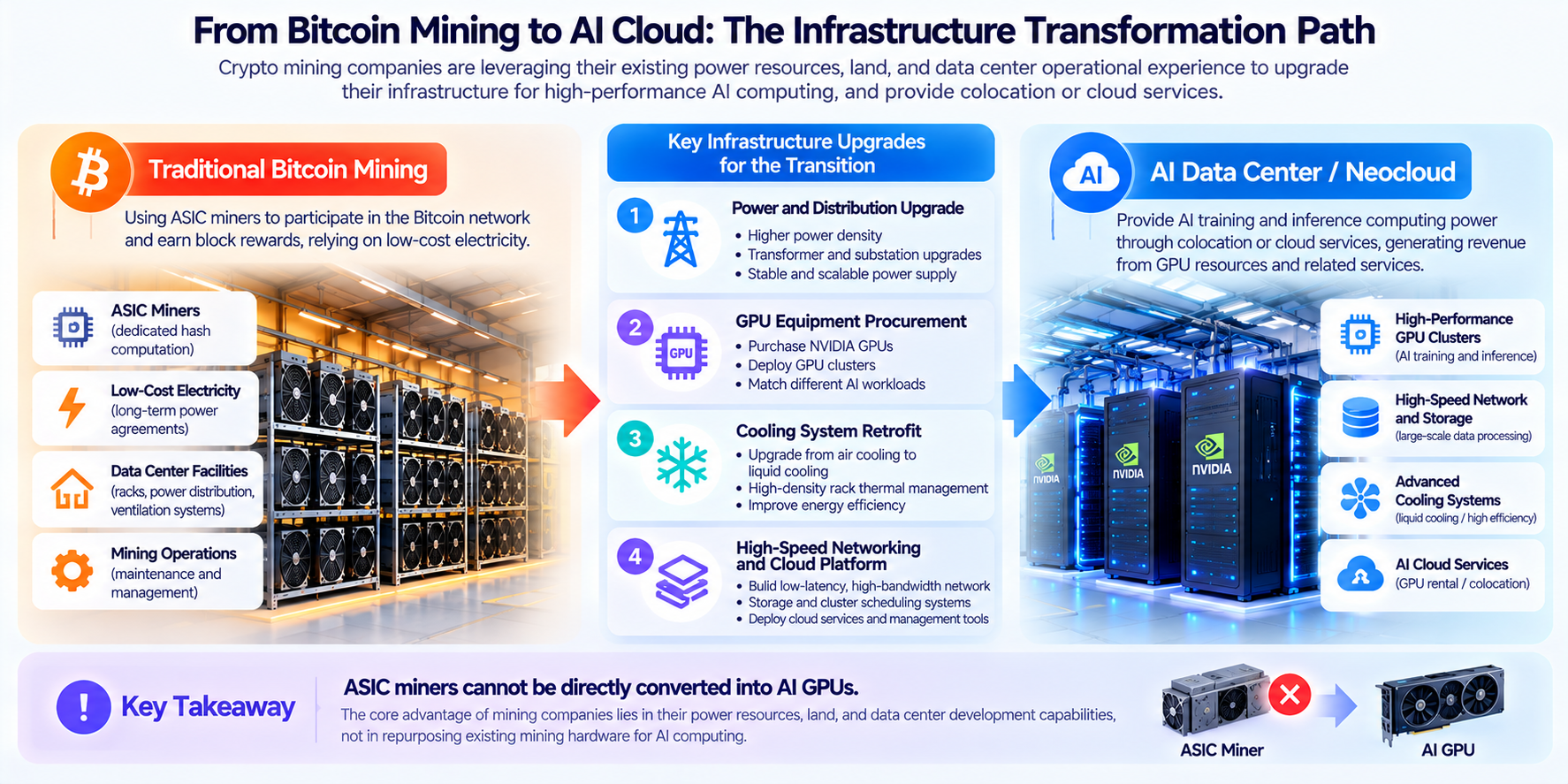
Although Bitcoin mining and AI cloud computing use different computing hardware, both depend heavily on electricity and data centers. As a result, some large mining companies have already accumulated infrastructure resources that they can use for new businesses.
Power. Bitcoin mining requires large numbers of ASIC miners to run continuously. Mining companies typically build facilities in regions with relatively low electricity prices and sufficient power supplies, establishing long-term relationships with electricity providers. As AI data centers' electricity needs increase, sites with secured power capacity, substation facilities, or room for expansion may have considerable development value.
Land and data center operating experience. Large mining facilities typically involve land leases, facility construction, electrical equipment maintenance, heat management, and around-the-clock operations. Although these facilities are not directly equivalent to AI data centers, the experience companies have gained in building, operating, and maintaining large computing facilities can provide a foundation for entering new businesses.
Financing and customer partnership opportunities. Unlike mining revenue, which depends primarily on Bitcoin prices, network difficulty, and block rewards, AI data center hosting may establish relatively clear revenue arrangements through multiyear contracts. This contract structure can help companies plan investments and may also support project financing.
However, companies need to assess the value of existing mining facilities individually. Some sites have substantial power capacity but lack cooling systems, high-speed networks, or redundant power infrastructure suitable for GPU clusters. If conversion costs are too high, existing facilities may offer no advantage over building new AI data centers.
Can ASIC Miners Be Used Directly for AI Training? What Must Mining Companies Upgrade?
Bitcoin miners and AI GPUs perform fundamentally different computing tasks. Bitcoin mining primarily uses ASIC chips to execute specific hash calculations and compete in the network's proof-of-work process. ASICs have highly specialized designs and can typically perform only a limited range of computing tasks efficiently.
AI model training and inference, by contrast, require extensive matrix operations, tensor computations, and parallel data processing. GPUs have stronger general-purpose parallel computing capabilities and supporting software frameworks, making them better suited to complex AI workloads. This means a mining company's transition to AI does not involve converting ASIC miners into GPUs. It requires deploying new computing equipment and systematically upgrading the data center.
Upgrades typically cover four areas: power, cooling, networking, and software.
-
For power, AI GPU racks may have higher power density, requiring suitable power distribution equipment, backup power supplies, and power management systems.
-
For cooling, high-density GPU clusters may use liquid cooling. The air-cooling systems common in existing mining facilities may not meet these requirements.
-
For networking, large-scale AI training requires frequent data exchanges between GPU nodes, making high-speed, low-latency network architectures necessary. Traditional miners typically perform computing tasks independently and depend less on high-speed communication between nodes.
-
For software, AI cloud services also require cluster scheduling, resource isolation, container management, monitoring, storage, and customer service capabilities. These are typically not core competencies of traditional mining companies and require additional investment or partnerships.
The power resources and sites mining companies own can therefore shorten parts of the infrastructure development process, but they cannot remove the technical barriers associated with AI cloud computing hardware, networks, and software.
What Are the Main Business Models for Moving from Bitcoin Mining to Neocloud?
Participating in the AI infrastructure market does not mean every mining company needs to become a full-service Neocloud provider. Based on asset investment and operating responsibilities, there are three main models.
| Business Model |
Primary Revenue Sources |
Core Assets and Capabilities |
Main Risks |
| Bitcoin mining |
Block rewards, transaction fees |
ASICs, mining facilities, power |
BTC price, mining difficulty, halvings |
| AI data center hosting |
Fees for facility space, power, and infrastructure services |
Data centers, power supply, cooling |
Conversion costs, delivery timelines, customer concentration |
| GPU cloud services (Neocloud) |
GPU rentals, compute contracts, managed cloud services |
GPUs, networking, storage, cloud software |
Chip depreciation, financing costs, utilization |
The first is traditional Bitcoin mining. Companies deploy ASIC miners and earn revenue by participating in computation on the Bitcoin network. Profitability is closely tied to Bitcoin's price, total network hash rate, block rewards, and electricity costs.
The second is AI data center hosting. Companies primarily provide facility space, power capacity, cooling, and related infrastructure, while customers deploy or use GPU equipment. This model does not necessarily require mining companies to purchase all the GPUs themselves, so it may involve less hardware depreciation risk than a full AI cloud service.
The third is GPU cloud services. Companies not only build data centers but also purchase GPUs, deploy networks and software platforms, and provide AI compute directly to customers. This model covers more parts of the service chain, but it also requires greater capital investment and more advanced technical operations.
In practice, companies may use several models at the same time. For example, they may use some data centers for Bitcoin mining, others for AI hosting services, and some facilities for their own GPU cloud computing operations.
When analyzing a mining company's progress in transitioning to AI, it is therefore necessary to examine its actual revenue mix. An announcement that it will build AI data centers is not enough to classify it as a mature Neocloud company.
How Do CoreWeave, IREN, and Core Scientific Participate in the AI Compute Market?
The connection between Neocloud and crypto mining companies' transitions can be seen in the different paths companies have taken.
CoreWeave was founded in 2017, with its early business involving cryptocurrency mining and GPU computing resources. As demand for AI computing grew, the company gradually shifted its focus to GPU cloud services and developed into a platform specializing in AI training, inference, and related infrastructure.
Rather than simply renting out servers, CoreWeave has integrated GPU clusters, high-speed networks, storage, resource scheduling, and development tools into a cloud service ecosystem. The company listed on Nasdaq in March 2025 under the ticker symbol CRWV.
CoreWeave's development shows that infrastructure companies originally serving crypto computing can enter AI cloud computing by building technical capabilities and shifting their market focus. However, its business model also depends heavily on GPU purchases, data center construction, and external financing, exposing it to different financial and operating risks than traditional mining companies.
IREN: Expanding from Bitcoin Mining into AI Cloud Services
IREN is one example of a mining company transitioning toward AI cloud services. Initially focused on Bitcoin mining, the company subsequently used its existing data centers, power resources, and infrastructure development capabilities to gradually expand its GPU cloud services business.
In November 2025, IREN signed a long-term GPU services agreement with Microsoft. The disclosed total contract value was approximately $9.7 billion, with services deployed in phases and scheduled to continue through 2031. In May 2026, IREN also signed a five-year cloud services contract with NVIDIA with a total value of approximately $3.4 billion.
For the fiscal year ended June 30, 2026, IREN reported approximately $128.8 million in AI cloud services revenue and approximately $578.2 million in Bitcoin mining revenue. Although its AI business grew significantly, its realized annual revenue mix shows that the transition was still underway.
IREN's example demonstrates that mining companies can build on existing power and data center assets to expand into GPU cloud computing and software services. However, this process requires ongoing investment and does not mean AI revenue can immediately replace the existing mining business.
Core Scientific: From Mining Operations to High-Density Data Center Hosting
Core Scientific's transition differs from those of CoreWeave and IREN. One of its main directions is converting existing Bitcoin mining infrastructure into high-density data centers that provide hosting services for AI and high-performance computing customers. In 2024, Core Scientific expanded its partnership with CoreWeave, with plans to provide approximately 200 MW of digital infrastructure capacity for high-performance computing. The company subsequently continued its data center transition and disclosed new long-term lease arrangements in 2026.
For example, in July 2026, Core Scientific signed a lease agreement with AMD covering approximately 377 MW of critical IT capacity and another lease agreement with a Neocloud customer covering approximately 152 MW of capacity. These arrangements reflect the company's expansion from operating mining facilities to supplying AI data center infrastructure. This example shows that mining companies do not necessarily need to purchase large numbers of GPUs themselves to participate in the AI value chain. Providing infrastructure such as power, facility space, and cooling can also give them a place in the Neocloud supply chain.
The distinction is important: Core Scientific primarily provides data center infrastructure and hosting. Its customers' status as Neocloud companies does not mean all of its business can be directly classified as GPU cloud services.
Why Does Neocloud Require Substantial Capital? What Risks Does the Business Model Face?
Neocloud's rapid development rests on substantial upfront capital investment. Unlike traditional software services, GPU cloud computing requires companies to purchase expensive hardware, build data centers, and deploy power and networking infrastructure before gradually recovering costs through customer usage and long-term contracts.
-
GPU depreciation risk. AI chip technology advances quickly, and new GPU generations may offer advantages in performance, energy efficiency, and cost per unit of computation. If a company purchases large amounts of equipment at high prices but cannot maintain sufficient utilization over the equipment's economic life, it may face asset impairment and pressure on profitability.
-
Financing costs. Some Neocloud companies fund expansion through debt, equipment financing, or financing arrangements backed by long-term customer contracts. When financing rates rise and capital markets' risk appetite declines, companies may face higher funding costs.
-
Customer concentration. Demand for large AI training clusters may be concentrated among a small number of technology companies and model developers. Although long-term contracts improve revenue visibility, a provider's cash flow may suffer if major customers reduce compute purchases, change deployment plans, or fail to meet contractual obligations.
-
Infrastructure delivery risk. AI data center projects require coordination of grid connections, chip supplies, construction schedules, cooling systems, and network deployments. Even after signing compute contracts, companies may be unable to deliver on schedule because of equipment or power supply delays.
In October 2026, market attention to Neocloud companies' debt burdens, financing capacity, and long-term profitability models increased significantly. These discussions highlight an important distinction: growth in demand for AI compute and Neocloud companies' ability to generate sustainable returns are two questions that require separate assessments. Companies transitioning from Bitcoin mining must also account for impairment of existing mining equipment, data center conversion costs, and revenue changes during the transition. A larger AI business may improve the long-term revenue mix, but it may also increase capital expenditures and financial pressure in the short term.
How Can You Assess Whether a Crypto Mining Company's Neocloud Transition Is Successful?
Evaluating a mining company's AI transition requires more than looking at the megawatts of data center capacity it has announced or the value of its long-term contracts. More importantly, it requires determining whether these resources have become deliverable computing services and whether they can generate sustainable cash flow.
Distinguish among planned capacity, capacity with secured power access, capacity under construction, and capacity already in operation. Large-scale power or data center development plans do not mean all facilities can already provide services.
Examine actual AI business revenue. The total value of a long-term contract usually spans several years and cannot be treated as current-period revenue. Even if a company announces compute agreements worth billions of dollars, it must recognize the associated revenue gradually as equipment is deployed and services are delivered.
Analyze capital expenditures and financing structures. For companies operating their own GPU cloud services, focus on GPU purchase costs, equipment utilization, depreciation, and financing interest. For data center hosting companies, examine facility construction costs, the share of equipment investment borne by customers, and the performance obligations in long-term lease contracts.
Compare the economic performance of the AI business with that of the existing Bitcoin mining business. Although mining depends on BTC prices and network difficulty, it has a relatively mature operating model. AI may generate long-term contract revenue while also introducing new technical and funding risks.
Assess whether the company can operate AI infrastructure on an ongoing basis. GPU cloud computing is not just a one-time equipment investment. It also involves network maintenance, software updates, customer support, and compute resource scheduling. The ability to provide stable service over time is an important factor in determining whether a company can truly enter the Neocloud market.
How Will Neocloud Change the Crypto Mining Industry?
Neocloud's development is changing how the market views the infrastructure value of crypto mining companies.
In the past, mining companies' core competitiveness primarily depended on mining equipment efficiency, electricity costs, mining scale, and BTC holding strategies. As demand for AI compute grows, power capacity, data center locations, infrastructure development capabilities, and long-term customer contracts are also becoming important factors in evaluating some mining companies.
This may lead to greater business differentiation within the crypto mining industry. Some companies will continue focusing on Bitcoin mining, improving competitiveness by upgrading ASIC equipment and optimizing power procurement and operating efficiency. Others will redirect some resources toward AI data center hosting or develop GPU cloud services.
However, not every mining company is suited to making this transition. Some mining sites are in regions without high-quality network connectivity or cannot meet AI data centers' cooling and power redundancy requirements. For these companies, continuing to optimize mining operations may fit their existing resources better than large-scale conversion.
AI compute and Bitcoin mining also use electricity differently. Some mining operations can adjust their operating loads flexibly based on electricity prices and grid demand, while AI data centers with long-term service commitments typically require greater operational stability. This difference means mining companies must also adjust their existing power management strategies.
From a broader industry perspective, Neocloud does not mean AI computing will inevitably replace crypto mining. Instead, it offers a new commercial option for mining companies with suitable infrastructure. Future competition may center on both BTC mining efficiency and the ability to deliver AI infrastructure.
Conclusion
Neocloud is an emerging cloud computing model centered on GPU clusters, AI model training, and inference services. As AI applications develop, competition in compute infrastructure has expanded beyond chip purchases to include power, data centers, networking, cooling, and software platforms.
This shift offers a new direction for some crypto mining companies. Companies with power resources, land, and data center operating experience can enter the AI data center hosting market by converting existing facilities. They can also invest further in GPUs and cloud software to develop more comprehensive Neocloud services.
CoreWeave, IREN, and Core Scientific illustrate different paths: CoreWeave has established a dedicated AI cloud platform, IREN is expanding from Bitcoin mining into GPU cloud services, and Core Scientific is focusing on high-density data center hosting.
However, growing demand for AI compute does not mean every transition project will generate consistent returns. GPU depreciation, financing costs, customer concentration, and project delivery capabilities remain key factors in determining whether companies can establish sustainable business models.
For the crypto industry, the most notable change associated with Neocloud is that some mining companies are moving from compute operators dependent on block rewards to businesses providing infrastructure and computing services to AI customers. This transition may change their revenue mix and valuation framework, but it ultimately requires validation through actual delivery, revenue growth, and cash flow performance.
FAQ
What is Neocloud?
Neocloud is an emerging cloud computing model focused on GPU cloud computing, AI model training, and inference services. It typically provides customers with compute resources through GPU rentals, dedicated clusters, and long-term compute contracts.
How does Neocloud differ from AWS and Azure?
Neocloud focuses more closely on dedicated GPU infrastructure for AI, while traditional cloud providers such as AWS and Azure offer comprehensive services covering compute, storage, databases, and enterprise applications. Their business scopes overlap.
Why are Bitcoin mining companies moving into AI compute?
Some mining companies already have power capacity, land, and data center operating experience. As demand for AI data centers grows, they may use these resources to develop new hosting and cloud computing businesses.
Can Bitcoin ASIC miners be used for AI training?
Generally, no. ASIC miners are designed for specific hash calculations, while AI training and inference primarily rely on accelerated computing hardware such as GPUs. Mining companies typically need to purchase new equipment and upgrade data centers to make the transition.
Is CoreWeave a Neocloud company?
Yes. CoreWeave is a representative company focused on AI GPU cloud services, providing GPU clusters, networking, storage, and related software platforms.
Is IREN still a Bitcoin mining company?
IREN is transitioning from Bitcoin mining to AI cloud services. Based on its disclosed fiscal 2026 data, Bitcoin mining still contributed a substantial share of realized revenue, while its AI cloud services business was expanding.
Is Core Scientific a Neocloud company?
Core Scientific is better described as a provider of high-density data centers and hosting infrastructure. It provides facilities services to customers including Neocloud companies, but this does not mean all of its business involves operating its own GPU cloud services.
How does Neocloud make money?
It primarily generates revenue through on-demand GPU rentals, long-term compute contracts, dedicated clusters, and related cloud services. Some infrastructure companies earn revenue through data center leasing and hosting fees.
What are the biggest risks for Neocloud?
The main risks include high capital expenditures, GPU depreciation, financing costs, customer concentration, and data center delivery delays. Growing compute demand does not necessarily translate into profitability.
Will the growth of AI compute replace Bitcoin mining?
Not necessarily. The two use different computing equipment and have different revenue sources and operating requirements. Some mining companies may operate both Bitcoin mining and AI infrastructure businesses.