CoreWeave and IREN are two companies with different growth paths in the AI cloud computing infrastructure market. CoreWeave primarily provides AI cloud computing services through high-performance GPU clusters, while IREN is expanding its AI cloud services business based on Bitcoin mining, power resources, and data center operations. Both companies benefit from growing demand for AI computing, but their resource bases, business maturity, and revenue structures differ.
As demand for AI model training and inference increases, competition in the computing market is expanding beyond GPU procurement to data center construction, power supply, high-speed networking, and long-term customer partnerships. For AI cloud service providers, the ability to deploy GPU clusters quickly is important, but the ability to deliver computing services consistently, control financing costs, and improve equipment utilization is equally important to the sustainability of their business models.
Comparing CoreWeave and IREN helps illustrate two AI infrastructure development paths: one builds its business around cloud computing capabilities, while the other leverages existing energy and data center resources to expand into cloud computing. This article analyzes their different positions in the Neocloud market based on their backgrounds, GPU cloud service models, revenue sources, infrastructure advantages, and financial risks.
Key Takeaways
-
CoreWeave and IREN both participate in the AI computing infrastructure market, but their development paths differ: CoreWeave has established a business centered on GPU cloud services, while IREN is expanding into AI cloud services from a foundation in Bitcoin mining and power infrastructure.
-
CoreWeave’s competitive focus is on GPU cluster deployment, cloud software platforms, customer service, and support for large-scale AI workloads. IREN’s differentiated resources primarily come from power capacity, data center development, and infrastructure operations.
-
Both companies need to invest substantial capital to build AI computing capacity, but they differ in their historical assets, revenue structures, and stages of business transformation.
-
Long-term customer contracts can improve revenue visibility, but total contract value does not equal realized revenue and cannot directly represent profit.
-
When comparing the two companies, investors should look beyond GPU counts and data center size. They should also consider operational capacity, GPU utilization, capital expenditures, financing costs, and cash flow.
How Do CoreWeave and IREN Differ in Their Development Paths?
CoreWeave and IREN both have backgrounds related to crypto computing, but they entered the AI cloud computing market in different ways.
Founded in 2017, CoreWeave initially participated in cryptocurrency mining and GPU computing resource businesses before gradually shifting its focus to AI and high-performance computing. The key to its transformation was developing GPU resources into a complete cloud computing service that includes computing clusters, high-speed networking, data storage, resource scheduling, and customer management platforms.
As a result, CoreWeave’s business focus is not limited to building data centers. It also provides AI customers with computing environments that they can use directly. The company needs to manage the performance, stability, and resource utilization of its GPU clusters while supporting different types of AI workloads through cloud software and related services.
IREN, by contrast, began with a stronger focus on Bitcoin mining infrastructure. The company has operated large-scale mining sites for years, accumulating experience in power procurement, data center development, and computing equipment operations. As demand for AI computing increased, IREN began using some of its infrastructure resources for GPU cloud services and expanding its supply of computing resources to AI companies.
This difference means that CoreWeave is closer to a scaled AI-focused cloud service provider, while IREN is converting its existing energy and data center resources into AI cloud service capabilities. However, IREN also directly provides GPU cloud computing and therefore cannot simply be classified as an infrastructure company that only rents out data center space.
What Is CoreWeave’s AI Cloud Services Business Model?
CoreWeave’s business model is built on high-performance GPU clusters and an AI cloud services platform. The company provides model training, inference, and other high-performance computing services by deploying NVIDIA GPUs and building high-speed interconnects and supporting storage systems.
Its revenue primarily comes from customers’ use of GPU computing resources and related cloud services. Some customers use long-term contracts that specify computing resources, service periods, and delivery conditions in advance. Other customers may select different computing configurations based on their specific business needs.
CoreWeave’s value comes not only from the GPU hardware itself but also from the software and operating systems built around that hardware. For example, an AI training task may require thousands of GPUs to run simultaneously. If cluster scheduling is inefficient or network communication becomes a bottleneck, customers may fail to achieve their expected training efficiency even if they have access to a sufficient number of GPUs.
CoreWeave therefore needs to continue investing in resource scheduling, network optimization, storage, and system monitoring. As AI customers expand from training into inference, the cloud platform must also support computing tasks with different scales and operating cycles.
This model has certain platform characteristics but is also highly dependent on capital investment. The company must bear GPU procurement, data center deployment, and related financing costs before fully realizing customer revenue.
As of the end of the second quarter of 2026, CoreWeave reported a Revenue Backlog of approximately $104 billion, reflecting the future revenue associated with signed contracts. However, this revenue still depends on conditions such as contract delivery and service availability and cannot be treated directly as realized operating revenue.
How Is IREN Transitioning From Bitcoin Mining to GPU Cloud Computing?
IREN’s AI cloud computing business is built on its existing Bitcoin mining infrastructure. Its early business model primarily relied on using ASIC miners to participate in computing on the Bitcoin network and generating revenue from block rewards and transaction fees.
As demand for AI computing increased, IREN began reallocating some of its data center resources and expanding its business from Bitcoin mining into GPU cloud services. Unlike traditional mining companies, this requires IREN to manage not only power and data center facilities but also GPU procurement, high-speed network construction, and computing service delivery to AI customers.
IREN’s primary transformation advantages come from its existing power and data center development resources. For companies that need to deploy GPUs at scale, power access and data center construction timelines can become expansion bottlenecks. If existing sites can meet AI infrastructure requirements, they may help shorten the construction timeline for some projects.
However, mining sites cannot be converted directly into mature AI data centers. ASIC miners cannot replace AI GPUs, and existing cooling systems, network architectures, and power facilities may also require extensive upgrades. IREN’s transformation therefore involves new equipment investment, infrastructure upgrades, and the development of cloud service operating capabilities.
Financial data shows that IREN’s AI business has begun contributing revenue, but it had not fully replaced its Bitcoin mining business in fiscal year 2026. The company reported approximately $128.8 million in AI cloud services revenue and approximately $578.2 million in Bitcoin mining revenue for fiscal year 2026, reflecting that it remains in a business structure transition phase.
What Are the Key Differences Between CoreWeave’s and IREN’s Business Models?
Both companies provide AI computing capacity, but they differ significantly in their stages of development, resource bases, and operating priorities.
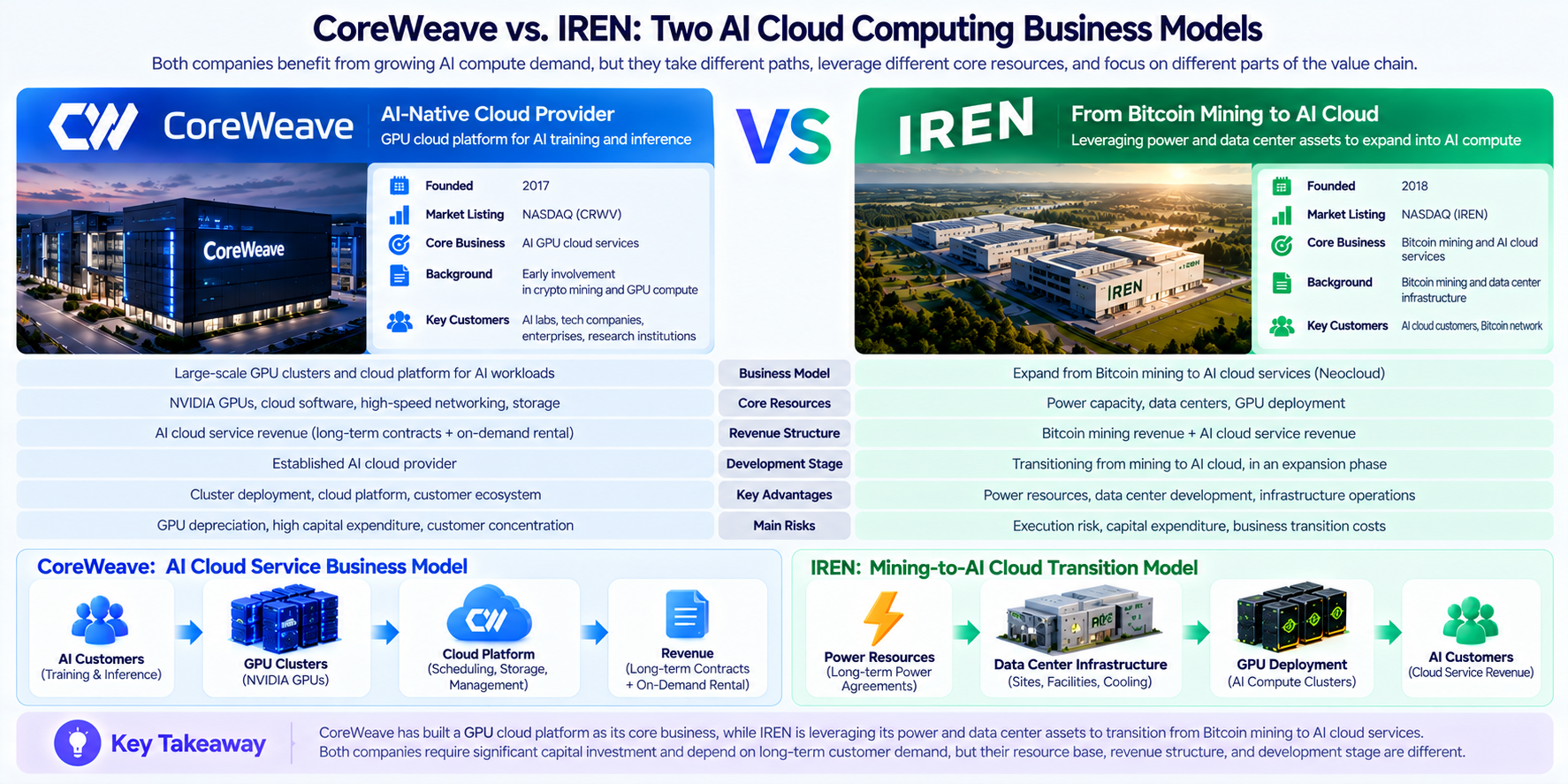
It is important to note that the differences shown in the image reflect the companies’ development stages as of October 2026 rather than permanently fixed business models. As IREN expands its AI cloud services, it may gradually compete more directly with CoreWeave.
From an industry chain perspective, CoreWeave’s development places greater emphasis on the scaled delivery of cloud computing platforms, while IREN’s transformation focuses more on converting its existing power and data center resources into sellable AI computing capacity.
Both companies ultimately need to solve the same problem: how to continue generating sufficient customer demand as investment in GPUs and data centers expands, and how to convert contracted revenue into operating cash flow.
Competition in AI computing infrastructure generally involves two key areas: whether a company can obtain sufficient power and data center capacity, and whether it can convert that infrastructure into stable and efficient GPU cloud services.
For IREN, power resources are an important starting point for its transformation. The company originally built data centers around Bitcoin mining and therefore accumulated experience in site development, power facilities, and computing equipment operations. As AI data centers’ power requirements increase, these resources may help the company enter a new market.
However, power capacity alone cannot directly generate AI cloud services revenue. The capacity can only be converted into actual computing services after data center upgrades, GPU deployment, network connections, and customer delivery are completed. When evaluating IREN, it is therefore necessary to distinguish between planned power resources, completed data centers, and GPU clusters that are actually operational.
CoreWeave relies more heavily on complete cloud platform capabilities. Its customers need not only GPUs but also stable networking, data storage, cluster scheduling, and software environments. For large-scale AI model training, a performance bottleneck in any part of the cluster can affect overall computing efficiency.
CoreWeave also requires substantial power and data center capacity. In the second quarter of 2026, the company reported approximately 1.5 GW of active power capacity and approximately 3.7 GW of contracted power capacity, indicating that its expansion also depends on energy and infrastructure resources.
Therefore, the two companies do not simply focus exclusively on power or cloud software. Rather, they have accumulated resources in a different order. IREN is expanding from power and data centers into GPU cloud services, while CoreWeave is continuing to expand its infrastructure on the foundation of an existing AI cloud platform business.
How Do Long-Term AI Computing Contracts Affect the Companies’ Revenue Models?
Long-term computing contracts are one of the important business models for Neocloud companies. Compared with short-term, on-demand rentals, multiyear contracts generally provide service providers with clearer demand planning, allowing them to plan GPU procurement and data center construction around customer commitments.
For CoreWeave, long-term customer contracts provide an important foundation for large-scale GPU infrastructure investment. The company can deploy computing resources according to contract terms and recognize revenue as it continues providing services. Its Revenue Backlog reflects the potential scale of future contracted revenue, but it does not equal cash already received and does not mean that all revenue is free from performance risk.
For IREN, long-term contracts have another significance: they help the company gradually shift from a revenue model that depends on Bitcoin prices and mining difficulty to service revenue based on AI customers’ computing demand. Compared with mining revenue, long-term contracts may improve the predictability of some future revenue.
In August 2026, IREN disclosed that its Contracted ARR for capacity scheduled to be deployed in 2026 had reached approximately $4 billion, while the annualized revenue corresponding to its operational business at that time was approximately $1 billion. The significant gap between these two figures primarily reflects computing capacity that had been contracted but not yet fully brought online.
Three concepts should be distinguished here: total contract value, annualized revenue metrics, and actual operating revenue reported in the financial statements.
Total contract value generally covers the entire service period. An annualized revenue metric estimates the annual revenue level based on the business scale at a specific point in time. Actual operating revenue, however, must be recognized as services are delivered in accordance with accounting rules.
Therefore, CoreWeave’s Revenue Backlog cannot be directly compared in scale with IREN’s Contracted ARR. The two metrics use different measurement definitions and do not convey exactly the same business information.
How Do CoreWeave and IREN Compare in Revenue Scale and Profitability?
Financial data more clearly reflects the different stages of development of the two companies. CoreWeave has already established AI cloud services revenue at significant scale. According to the company’s second-quarter 2026 financial results, quarterly operating revenue was approximately $2.53 billion, more than double the prior-year period, indicating that its AI cloud services business is expanding rapidly. IREN’s AI cloud services revenue remains at an earlier stage of scaling. In fiscal year 2026, its AI cloud services revenue was $128.8 million, a significant increase from $16.4 million in the previous fiscal year. However, Bitcoin mining revenue still reached $578.2 million during the same period.
Revenue growth does not necessarily translate into corresponding profit growth. Neocloud companies must bear GPU depreciation, data center construction, financing interest, and operating expenses. As a result, they may continue to report net losses even when operating revenue is growing rapidly.
IREN’s fiscal year 2026 financial statements particularly highlight the cost of its business transformation. The company reported approximately $638.8 million in asset impairment charges for the year, primarily related to the retirement of certain Bitcoin mining machines and the conversion of related sites to AI cloud services.
This shows that transforming a mining company involves more than adding a new revenue source. It may also require retiring existing assets and reassessing their financial value. Therefore, assessing the sustainability of the two companies’ business models requires consideration of revenue growth, equipment depreciation, asset impairments, capital expenditures, and cash flow rather than relying solely on revenue scale or contract value.
What Different Capital Expenditure and Financing Risks Do CoreWeave and IREN Face?
AI cloud computing is a capital-intensive business. Companies generally need to complete GPU procurement, data center construction, network deployment, and related equipment installation before receiving all service revenue. Financing capabilities therefore directly affect the pace of expansion.
For CoreWeave, capital pressure primarily comes from the expansion of its large-scale GPU clusters. The company needs to continue purchasing next-generation computing equipment and support construction through debt, equity, and other financing methods. In the second quarter of 2026, CoreWeave reported approximately $640 million in net interest expense and a net loss of approximately $626 million, indicating that financing costs had a significant effect on its financial performance.
For IREN, capital expenditures include not only GPUs and data center construction but also the costs of upgrading infrastructure as it transitions from Bitcoin mining to AI cloud services. Its financing arrangements may combine GPU equipment financing, customer prepayments, and other sources of capital to support the delivery of new projects.
The risks facing the two companies are not identical. CoreWeave needs to manage the debt and equipment replacement pressures associated with continued expansion at an already significant business scale. IREN needs to demonstrate that its newly built computing capacity can be delivered as planned and that its signed contracts can be converted into actual revenue.
However, this does not mean that one company’s financing model can be simply judged as safer than the other’s. Debt costs, customer credit quality, contract terms, equipment depreciation, and project returns all need to be analyzed alongside specific financial data.
How Can the Sustainability of CoreWeave’s and IREN’s AI Cloud Computing Businesses Be Evaluated?
When comparing the two companies, the first consideration should be operational GPU computing capacity rather than only the number of devices planned for deployment. Computing resources can generate stable service revenue only after data center construction, GPU installation, network testing, and customer delivery are complete.
-
The relationship between actual operating revenue and future contract commitments should be monitored. CoreWeave’s Revenue Backlog and IREN’s Contracted ARR can both reflect customer demand, but they are calculated differently and neither can replace realized revenue reported in the financial statements.
-
Equipment depreciation and replacement cycles should be monitored. GPU technology continues to develop. New hardware may improve computing efficiency per unit while also affecting the leasing competitiveness of older equipment. Companies need to maintain sufficient utilization throughout the economic life of their equipment to cover procurement, financing, and operating costs.
-
The relationship between operating cash flow and capital expenditures should be examined. Fast-growing Neocloud companies may continue to require substantial external financing even as their reported revenue grows. Therefore, an increase in revenue does not necessarily mean that a company has achieved self-financing.
-
Customer concentration and contract performance risk should be assessed. Long-term contracts can improve revenue visibility, but companies may still face operating pressure if customer concentration is too high or if the infrastructure associated with a contract is not delivered on time.
From this perspective, comparing CoreWeave and IREN is not simply about determining which company has more GPUs. It is about understanding how two development paths convert infrastructure investment into sustainable AI cloud services revenue.
How Can You Trade CoreWeave (CRWV) and IREN (IREN) Through Gate Stock Trading?
As AI computing infrastructure has become an important investment theme in the U.S. stock market, CoreWeave (NASDAQ: CRWV) and IREN (NASDAQ: IREN) have also attracted increasing investor attention. The two companies represent, respectively, a Neocloud model centered on GPU cloud platforms and a transformation path from Bitcoin mining to AI cloud services. In addition to monitoring growth in AI computing demand, investors should consider company financial statements, long-term customer contracts, capital expenditures, and financing costs when evaluating the operating performance of different business models.
Gate has launched stock trading services that allow users to participate in the U.S. stock and ETF markets using USDT. Users can enter the Gate stock trading page, search for CRWV or IREN, view relevant market information, and select an available trading method based on their account location, trading eligibility, and the actual support shown on the page. Unlike tokenized stock products, Gate stock trading provides securities market trading services through partner brokers. Specific trading hours, fees, and order rules are subject to the platform page.
Conclusion
CoreWeave and IREN are both important participants in the AI computing infrastructure market, but they differ significantly in their development paths and business maturity.
CoreWeave has established a business centered on GPU cloud services. Its competitive strengths primarily come from large-scale computing clusters, cloud software platforms, and customer delivery capabilities. IREN, by contrast, is expanding its AI cloud services business by leveraging its existing power and site resources from Bitcoin mining and data center infrastructure. It remains in a revenue structure transition phase.
Both companies depend on long-term customer demand and continued capital investment, but their operating priorities differ. CoreWeave needs to manage large-scale GPU investment and financing costs, while IREN needs to convert its power and data center resources into operational AI computing services as it completes its business transformation.
This comparison also reflects a core characteristic of the Neocloud industry: power and data centers determine whether computing capacity can be deployed, GPUs and cloud software determine whether that capacity can be delivered, and customer revenue and cash flow ultimately determine whether the business model can be sustained.
For the crypto industry, IREN’s transformation shows that some infrastructure resources accumulated by Bitcoin mining companies can extend into the AI computing market. However, moving from mining site operations to a mature Neocloud platform still requires long-term development of technical capabilities, capital resources, and customer relationships.
FAQ
What Is the Biggest Difference Between CoreWeave and IREN?
CoreWeave has established a business centered on AI GPU cloud services, while IREN is transitioning from Bitcoin mining and data center operations into AI cloud services.
Is CoreWeave a Neocloud Company?
Yes. CoreWeave is a cloud service provider focused on AI computing demand. It provides GPU clusters, networking, storage, and related cloud software services.
Is IREN Also a Neocloud Company?
IREN is developing a GPU cloud services business and can be viewed as a company transitioning from crypto mining to Neocloud services. However, its fiscal year 2026 revenue still included a substantial Bitcoin mining business.
Do CoreWeave and IREN Both Have Crypto Mining Backgrounds?
Both companies have historical ties to the crypto computing sector, but their starting points and transformation paths differ. CoreWeave was involved in GPU mining in its early years, while IREN has operated Bitcoin ASIC mining businesses for an extended period.
Why Are IREN’s Power Resources Important?
AI data centers require large amounts of stable power. IREN’s existing power and data center development resources may help it deploy GPU clusters, but the relevant facilities must still meet the power, cooling, and networking requirements of AI computing.
What Are CoreWeave’s Main Sources of Revenue?
CoreWeave primarily generates revenue by providing GPU cloud computing and related services. Its customers include AI development companies, large technology companies, and other institutions that require high-performance computing resources.