KOR Protocol targets creators, labels, agencies, platforms, and AI agents that need machine-speed licensing rails rather than a new Layer-1 chain. KOR Protocol reports more than one million lifetime sign-ups, about four hundred thousand connected wallets, over one thousand IP partners, and more than $2 million in gross product revenue, with partners such as Black Mirror, Beatport, mau5trap, Imogen Heap, Banijay Group, and KDDI. Token unlock detail sits in KOR tokenomics; rights-stack contrast sits in KOR vs Story Protocol.
Key Takeaways
-
KOR Protocol is a Base-deployed creative-asset clearinghouse, not a standalone blockchain with its own validators.
-
Three engines coordinate the lifecycle: Verify (origin, ownership, clearance), Route (demand matching via agents; in development), and Settle (stablecoin splits that write commercial history back to the asset).
-
Core primitives include IP Assets (ERC-721), token-bound accounts (ERC-6551), onchain license terms, and programmable royalty distribution.
-
Consumer products such as Korus, VRSNS, Pacer, Streamline, and KOR Hubs are live in production, while protocol Route remains early.
-
KOR is a utility and governance token; holding it does not guarantee returns, and onchain records do not automatically resolve off-chain legal disputes.
What Is KOR Protocol as a Creative Asset Clearinghouse and What Problem Does It Solve?
KOR Protocol frames a commercial gap rooted in infrastructure from a different era that no longer fits the ai era: as AI lowers the cost of producing music, video, and other media, creation scales faster than the systems that prove who owns a work, who may license it, and how royalties clear, increasing monetization pressure on creators and rights holders and making an upgrade unavoidable. Traditional stacks often separate registry databases, deal desks, and quarterly reconciliation. KOR positions itself as a single onchain clearing environment for creative work in the ai economy, where registration, commercial state, routing signals, and settlement share one attestation graph.
The protocol does not run a sequencer or validator set. KOR Protocol composes against Base so applications inherit Ethereum-aligned security assumptions, low fees, and native USDC rails. That design choice matters for readers comparing “IP L1” narratives with application-layer clearinghouses: KOR’s value proposition is workflow and settlement, not consensus.
How Do Verify, Route, and Settle Work Together?
KOR Protocol organizes three engines that form a loop.
| Engine |
Question answered |
Status notes (per docs) |
Standards cited |
| Verify |
What is real, who owns it, is it clear to move? |
Live focus of current release |
ERC-721 registration; EAS-style attestation graph |
| Route |
Where should the asset move commercially? |
In development |
Planned ERC-8004 agent identity; A2A messaging |
| Settle |
How does value clear back to participants? |
Live focus of current release |
ERC-6551 accounts; USDC stablecoin settlement |
-
Registration — A creator registers an asset, creating a canonical onchain identifier, seeding an attestation graph with the initial ownership claim, and deriving clearance state from that graph.
-
Routing — Once an asset is clear-to-move, specialized agents are intended to pitch, hand off deal flow, and match demand-side parties. Route is explicitly marked in development.
-
Settlement — Closed commercial matches clear through Settle: splits are programmatic, denominated in stablecoin, and executed atomically.
-
Feedback — Each settlement writes royalty history (timestamps, counterparties, deal types) back to the asset and can update reputation signals for later routing.
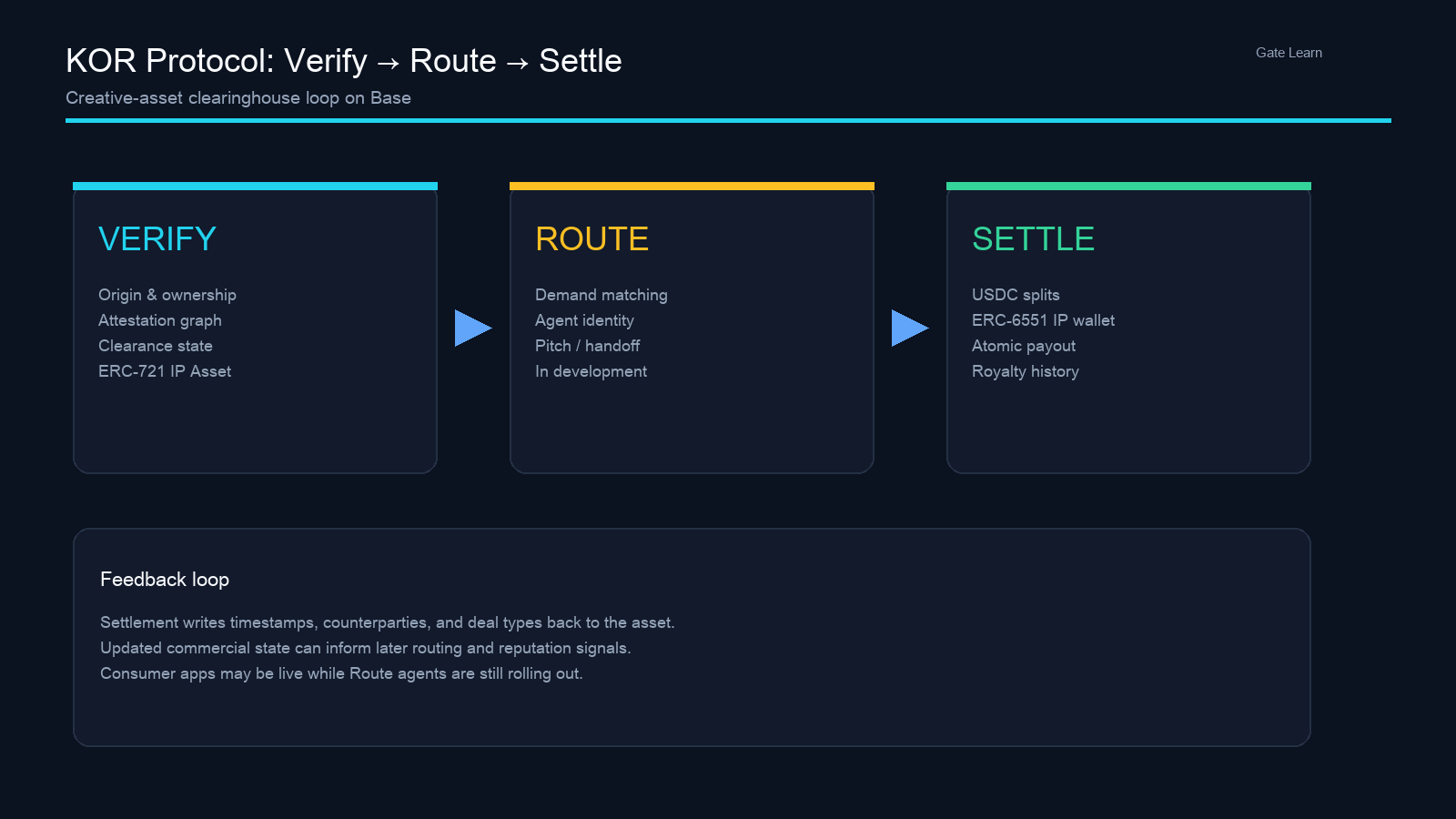
Figure 1. KOR Protocol coordinates Verify, Route, and Settle, then writes settlement outcomes back into the asset’s commercial state.
KOR SDK flows typically use a two-step pattern: a backend validates and encodes a transaction, then the user’s wallet signs and pays gas on Base. That keeps users in control of assets while allowing server-side validation of API keys and payload structure.
What Are KOR’s Core Primitives: IP Asset, Token-Bound Accounts, and Royalties?
Four primitives recur across Verify and Settle modules.
IP Assets. Creative works—music, video, images, code—register as onchain assets. Each registration yields a stable identifier plus an off-chain content pointer (for example IPFS or Arweave) and signed metadata that can include format and AI-provenance context.
Token-bound accounts (ERC-6551). Every IP Asset receives a smart-contract wallet controlled by the IP NFT, not only by a creator’s personal wallet. The IP account can receive licensing revenue, hold balances, and execute programmed payouts. This matters when splits involve producers, vocalists, managers, and labels simultaneously.
Licensing. License terms attach to the IP: who may use the work, under what conditions, and at what price. Downstream contracts are expected to read those terms rather than rely solely on invoice chasing.
Royalty distribution. Splits declared at registration (and updated by attestation as relationships evolve) execute when revenue arrives. Docs illustrate multi-party splits encoded up front so distribution can run atomically.
Clearance state is derived, not manually stamped in isolation: an asset is “clear-to-move” for a given action only when the attestation graph satisfies that action’s conditions. Transient licenses, sample licenses, and full transfers can require different graph conditions.
What Is the KOR Token Used For?
KOR launches as an ERC-20 on Base. The KOR MiCA-style white paper and Foundation tokenomics describe a total supply of 10,000,000,000 KOR, with about 22.87% circulating at TGE from ecosystem, foundation, community, liquidity, and marketing buckets—while team and investor allocations do not unlock at TGE and follow a twelve-month cliff before monthly vesting.
Documented utilities include:
-
Governance — Parameter votes for protocol rules.
-
Bonding / collateral — Slashable deposits that back claims hard to verify mechanically (authorship, sample clearance, AI provenance, high-value matches or settlements).
-
Payments and fee discounts — Accepted across live consumer products; locking tiers can discount AI-workflow compute costs.
-
Rewards and ecosystem access — Creator rewards and premium intelligence / matching features under product rules.
-
Staking for service roles — Labels, verification providers, and agent operators may stake as performance collateral.
Series A financing of $7.5 million at a $100 million valuation, with capital provided by 1kx and Blockchain Capital and continued support from existing investors, funds efforts to expand into infrastructure for creators, brands, and platforms. KOR's Licensing Module embeds usage terms directly within IP assets. Token utility is not a return promise; unlock calendars and bonding rules change circulating supply and participant incentives over time. Allocation tables belong in the dedicated tokenomics cluster.
How Does KOR Protocol Differ From Traditional Copyright Filing, Music NFTs, and the AI Economy?
A short orientation table helps set search intent before the full comparison cluster.
| Dimension |
Traditional copyright / collecting-society rails |
Music NFT mint-and-sell |
KOR Protocol clearinghouse |
| Primary record |
Legal registry / society database |
Onchain ownership of a tokenized collectible |
Attestation graph + commercial state |
| Demand matching |
Human A&R / sync desks |
Marketplace discovery |
Planned agent Route layer |
| Payment clearing |
Invoices, net-60 cycles |
One-time or marketplace payouts |
Programmable USDC splits to IP TBA |
| Legal finality |
Court and statute |
Usually weak without off-chain contracts |
Onchain state ≠ automatic legal ownership |
KOR therefore sits closer to “commercial clearing” than to “proof of collectible ownership alone.” Readers comparing programmable IP stacks should open the Story Protocol comparison cluster for licensing-template and chain-design differences.
What Risks Should Users Know Before Using or Holding KOR?
-
Product vs protocol maturity — Consumer apps may be live while Route and agent rails remain incomplete; feature screenshots are not the same as full clearinghouse coverage.
-
Attestation trust — Graphs encode claims; disputed authorship or uncleared samples still need human and legal processes.
-
Token unlock and liquidity — Circulating supply rises as cliffs end; staking and fee discounts do not remove market volatility.
-
Bonding / slashing — Collateral that backs false claims can be slashed under protocol rules.
-
Chain and stablecoin dependencies — Settlement quality inherits Base availability, USDC issuer risk, and SDK/backend operational risk.
-
No investment advice — Education pages describe mechanisms; they do not recommend buying, selling, or sizing positions.
How Can Readers View and Trade KOR on Gate and KOR Hubs?
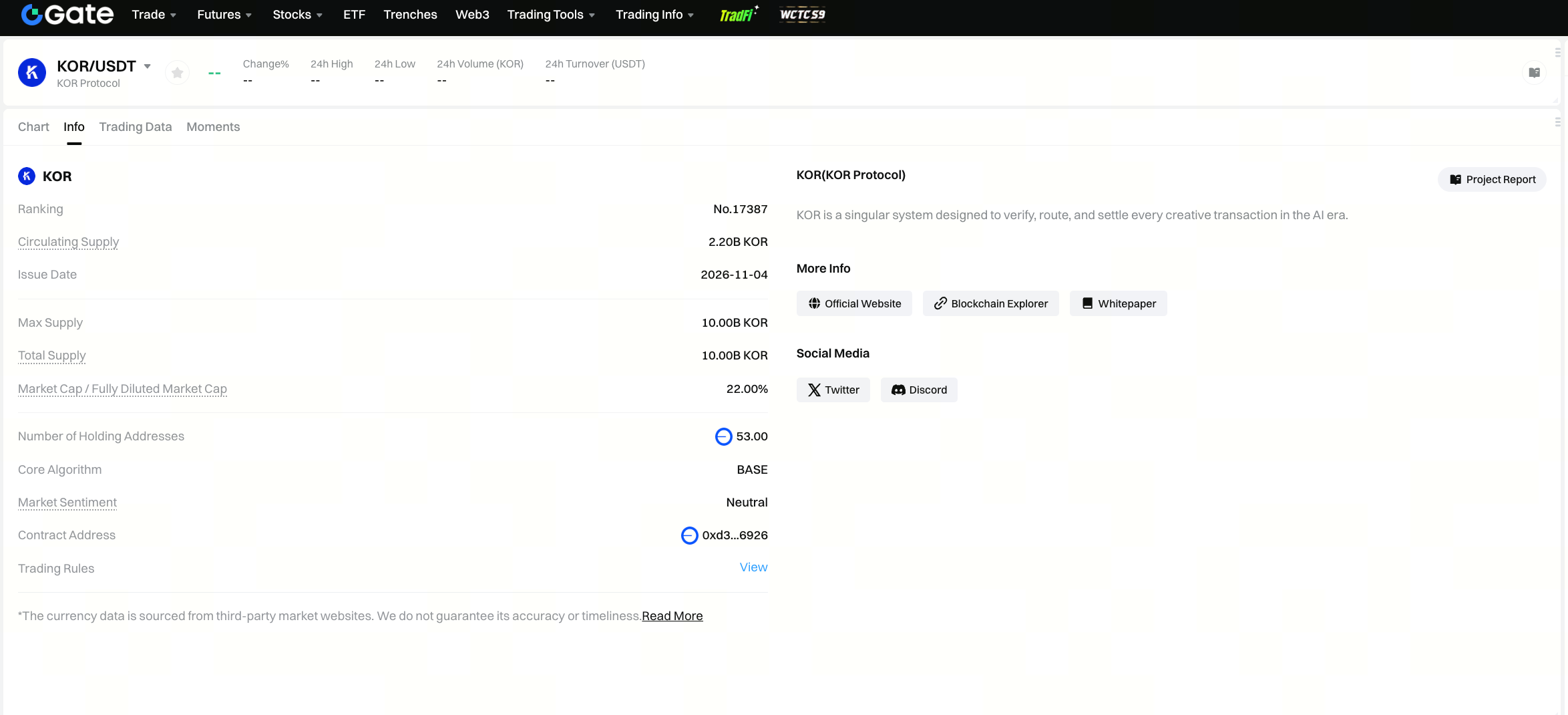
On Gate, readers can open the KOR Protocol price page for market context and the KOR/USDT spot market for trading. Before transferring tokens, confirm the Base network contract against KOR Protocol and Gate listings (KOR has cited 0xD3679306360705ba3580BC4130b56460FB4e6926). Spot trading on an exchange is separate from registering IP or settling royalties inside KOR apps.
Summary
KOR Protocol is a protocol layer for creative assets on Base, built to verify works, route them toward commercial demand, and settle value in stablecoin with programmable splits. Verify and Settle are the present core; Route is still being built. The KOR token coordinates governance, fees, bonding, product access, and participation by developers without converting protocol participation into guaranteed yield. For rights-stack comparisons and unlock schedules, continue with the linked clusters.
FAQ
What is KOR Protocol?
KOR Protocol is an onchain creative-asset clearinghouse on Base that performs three functions across a creative work’s lifecycle: verifying origin and ownership for artists and other creators, routing assets to the right partners, and settling licensing and royalty payments in stablecoins.
How do Verify, Route, and Settle differ?
Verify establishes origin, ownership, clearance, and authenticity so a work can be proven genuine; Route matches verified assets to demand via agents (in development), including labels and agencies; Settle clears USDC splits and writes commercial history back to the asset, with transactions distributed automatically to participants once value clears.
What is the KOR token used for?
KOR is described as a utility and governance token for fees, premium product access, staking or bonding roles, creator rewards aimed at helping artists and other talent get paid through licensing and royalties, and parameter voting; it also supports tools used across entertainment products in the ecosystem, not as a claim on guaranteed profit.
How do you buy KOR on Gate?
Open Gate’s KOR/USDT market after verifying the official contract and network; exchange spot trading is independent of IP registration inside KOR products.
What are the main risks of KOR Protocol?
Early Route maturity, attestation disputes over how an asset or track is used, token unlock dilution, slashing on bonded claims, and dependence on Base plus stablecoin rails are primary mechanism risks—separate from price volatility; automated systems may monitor licensing compliance, but offchain disputes can still remain. These issues can become harder to manage at world scale as ai agents create more small, fast settlements.