Readers comparing stacks usually want a decision lens—not a winner list. The three engines and IP primitives are already covered in What is KOR Protocol; this comparison page isolates differences in chain design, licensing templates, demand routing, settlement currency, and legal boundaries. Supply, cliffs, and fee discounts are unpacked in the KOR tokenomics model.
Key Takeaways
- KOR emphasizes a clearinghouse loop (verify, route, settle) on Base with stablecoin-native payouts; Route is still in development.
- Story emphasizes programmable IP assets, license tokens, and PIL terms that map legal clauses to onchain parameters.
- Traditional copyright rails remain the default for statutory ownership, enforcement, and collecting-society distributions in many markets.
- Shared ideas (IP accounts / TBA-like wallets, license modules, royalty graphs) can look similar while solving different primary jobs.
- Neither protocol substitutes for legal counsel when rights are disputed across jurisdictions.
How Do KOR Protocol, Story Protocol, and Traditional Registries Differ at a Glance?
| Dimension |
KOR Protocol |
Story Protocol |
Traditional copyright / societies |
| Primary job |
Creative-asset clearinghouse for commercial verify → match → pay |
Programmable IP registration and licensing network |
Legal ownership record + collection/distribution |
| Chain posture |
App protocol on Base (no own L1 validators) |
Dedicated IP-oriented chain / protocol stack |
Off-chain registries; bank rails |
| Licensing model |
Attach terms; mint licenses; settle in USDC |
PIL template maps legal terms to onchain params; license tokens |
Contracts, licenses, society mandates |
| Demand routing |
Planned agent Route (ERC-8004) |
App/ecosystem discovery; less “clearinghouse agent desk” framing |
Human A&R, sync agents, publishers |
| Settlement |
Atomic stablecoin splits to IP token-bound accounts |
Onchain royalty modules and IP account flows |
Invoices, statements, net cycles |
| Legal bridge |
Attestations encode commercial claims |
Explicit PIL legal document mapped onchain |
Statute, courts, collecting societies |
The table is a map, not a ranking. Teams shipping AI remix products may care more about clearance graphs and agent payments; teams shipping open remix graphs with legal templates may care more about PIL composability. In practice, the “right” stack is the one that makes the commercial path easy to audit for the specific job—clearance, composable licenses, or statutory proof—rather than the one with the loudest token narrative.
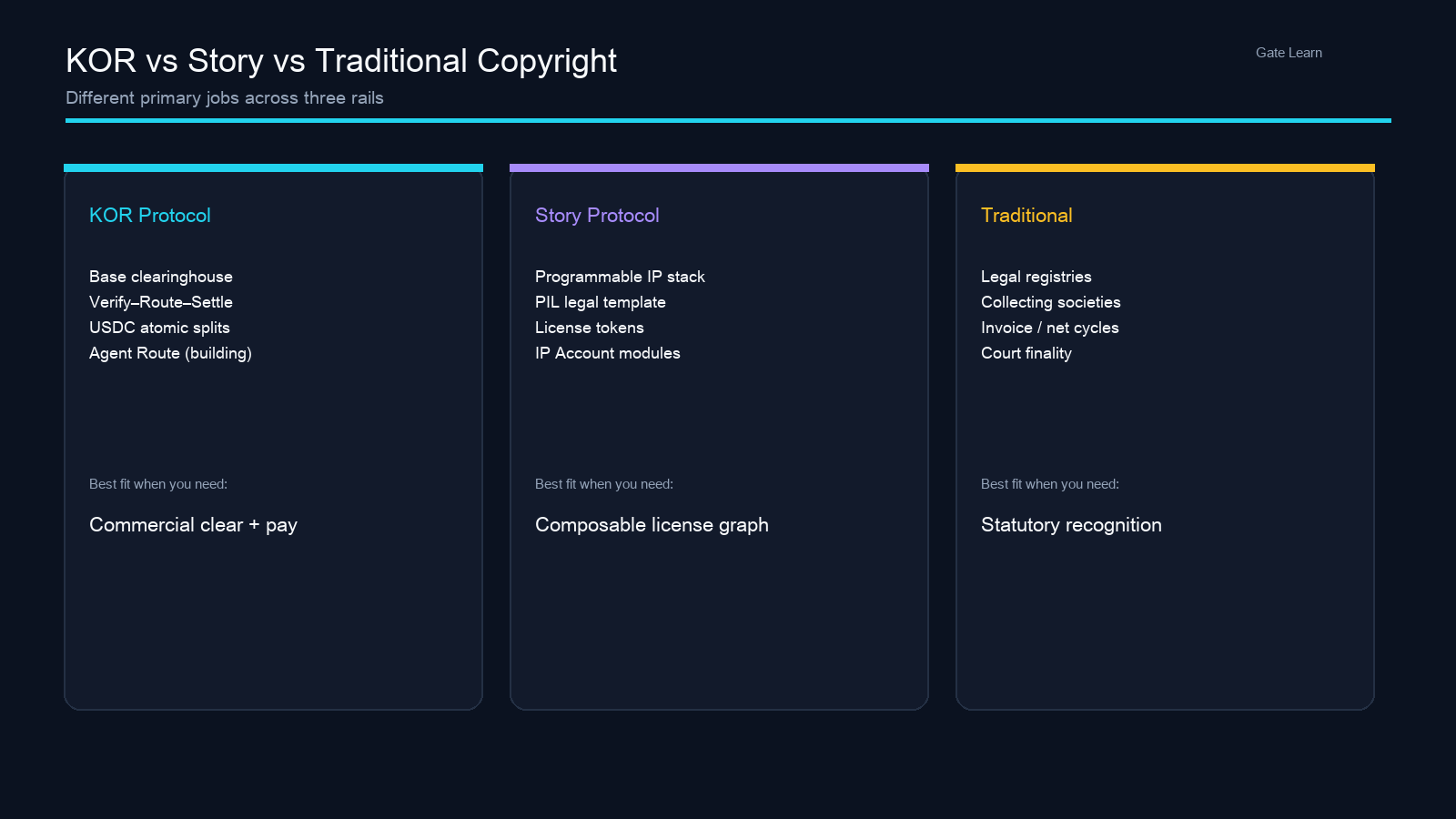
Figure 1. KOR, Story Protocol, and traditional copyright rails optimize different primary jobs across clearing, programmable licensing, and statutory recognition.
What Job Does Each System Optimize For?
KOR Protocol markets itself as infrastructure for the moment after a work exists: prove origin and clearance, push the asset toward labels or brands, and clear payment when a deal closes. KOR Protocol stresses AI-native volume—more assets, more micropayments, more agents—and stablecoin settlement written back as royalty history. The product thesis is that making creative output cheaper does not automatically make rights clearance or payout routing cheaper, so a clearinghouse sits between creation and commerce.
Story Protocol markets programmable IP: register an NFT as an IP Asset, deploy an IP Account, attach license terms from templates such as the Programmable IP License (PIL), mint license tokens, and register derivatives under those terms. The PIL is described as an off-chain legal document whose parameters (commercial use, minting fee, derivatives attribution, and related fields) are mirrored onchain so contracts can read the same structure. Programmable IP makes rights legible to software: agents and apps can query terms instead of parsing static PDFs alone.
Traditional systems optimize for legal recognition and collective administration. A copyright filing or society registration does not by itself give a creator USDC micropayouts, but it remains the reference many counterparties and courts use when ownership is contested. Copyright protection and copyright registration are related but not identical: many jurisdictions grant protection automatically upon fixation, while registration is a separate administrative act that can improve remedies, notice, and public-record searchability. Onchain protocols do not erase that distinction.
How Do Registration and “IP Accounts” Compare?
Both KOR and Story use an “IP as account” pattern, but the surrounding stack differs. A useful mental model is four layers that often appear together in programmable IP designs: (1) a content pointer or media hash, (2) an ownership or control token, (3) an account that can hold value and execute calls, and (4) a graph of licenses, derivatives, and commercial claims. KOR and Story populate those layers with different defaults.
On KOR, registration creates an ERC-721-indexed IP Asset, seeds an attestation graph, and opens an ERC-6551 token-bound account that can receive USDC royalties. Clearance is a derived state of the graph: different actions (transient license vs sample license vs transfer) can require different claim sets. That design place the commercial “may we move this asset?” question next to settlement, which is why Route and Settle are marketed as siblings of Verify.
On Story, creators typically start from an NFT, register it through the IP Asset Registry, and receive an IP Account / IP id that modules (licensing, royalty, dispute) read and write. Derivative registration creates parent–child relationships constrained by license terms. How programmable licensing works in practice is closer to “mint a license token under declared terms, then register a child IP that inherits constraints” than to “open a sync desk ticket.”
Traditional registries record claimants and deposits according to national law. They rarely expose a programmable wallet per work that AI agents can pay into atomically. Public-record search tools and group-registration workflows matter for portfolios of two-dimensional artwork or catalogs, but they are administrative UX—not machine-speed settlement rails.
How Do Licensing and Royalty Paths Diverge?
KOR’s Settle modules attach license terms, mint licenses, set royalty splits, distribute, and claim. Splits are declared early so multi-party catalogs can clear without quarterly spreadsheet reconciliation—subject to the accuracy of those declarations. Machine-readable terms help software route payments; they do not mean self-enforcing rights everywhere, especially when an exclusive grant already exists off-chain.
Story’s Licensing Module attaches terms, mints license tokens, and registers derivatives. Because PIL terms are framed as a legal template mapped onchain, Story’s narrative leans harder into “code + law” coupling. Royalty modules then move value according to those graphs. Automatic protection under copyright law may already cover a work; registration and onchain licensing still matter for notice, licensing logistics, and composable derivatives.
Traditional licensing still dominates high-value sync and catalog deals: negotiated paper, territory exclusivity, and society distribution rules. Onchain systems can automate subsets of that workflow; they do not erase territory law or exclusive grant conflicts recorded only off-chain. When teams use both worlds, a practical pattern is: keep statutory registration where remedies require it, encode day-to-day commercial use terms onchain, and keep human counsel for contested ownership.
Where Do Music NFTs Fit in This Comparison?
Music NFTs often prove collectible ownership or fan membership. They may include royalty-share experiments, but many drops stop at mint-and-trade without a clearance graph, agent routing, or atomic collaborator splits. Making a collectible easy to trade is not the same job as making a catalog easy to license. KOR’s pitch is clearinghouse behavior beyond the collectible. Story’s pitch is programmable licensing beyond the JPEG. Treating all three as interchangeable “IP coins” collapses the search intent this comparison is meant to protect.
NFT marketplaces also sit in a different category. General collectible venues optimize discovery and secondary sales; they are not substitutes for a clearinghouse attestation graph or a PIL-style license template. Venue choice matters for sales UX; rights infrastructure matters for commercial use of the underlying work.
What Remains Off-Chain No Matter Which Stack Is Used?
- Statutory ownership and infringement remedies still run through courts and national law.
- Sample clearance, moral rights, and territory exclusivity can invalidate a “clear-to-move” assumption even if an attestation exists.
- Collecting-society mandates may still apply to public performance or mechanical rights in some markets.
- Consumer apps built on a protocol can be live while agent routing or cross-chain settlement remain incomplete—especially relevant for KOR’s Route roadmap.
- Why registration matters in the legal sense (evidence, damages pathways, public notice) is separate from why onchain registration matters (machine-readable commercial state). Conflating the two makes diligence harder, not easier.
Static rights documents do not answer machine-speed questions such as “is this stem clear for a brand edit in this territory at this price?” Programmable stacks try to answer those questions in software, but disputed facts still escalate offline.
Summary
KOR Protocol, Story Protocol, and traditional copyright rails answer overlapping questions with different primaries: commercial clearing on Base, programmable legal-mapped licensing on Story’s IP stack, and statutory administration offline. Choose the comparison lens that matches the job—settlement speed, license composability, or legal recognition—and return to the three-engine primer when definitions still matter. The durable takeaway is operational: pick the stack that makes the next commercial action easy to verify, not the stack that merely mints another token.
FAQ
Is KOR Protocol the same as Story Protocol?
No. KOR is a Base clearinghouse centered on verify–route–settle commercial workflows; Story centers programmable IP assets and PIL-style license templates on its IP stack.
Does registering IP on KOR replace copyright registration?
No. Onchain registration and attestations support commercial automation; statutory copyright protection and enforcement still follow applicable law.
Which system handles royalties automatically?
Both KOR and Story describe onchain royalty modules. KOR highlights USDC atomic splits to token-bound IP accounts; Story routes value through IP account and royalty modules tied to license graphs. Traditional societies use statement cycles.
Why does Route matter in the KOR comparison?
Route is KOR’s planned agent layer for matching supply to labels and brands. That clearinghouse desk metaphor is weaker in Story’s core docs and absent from classic copyright filing alone.
Can music NFTs substitute for either protocol?
Usually not. Collectible mints rarely provide clearance graphs, multi-party settlement, or legal-mapped license templates by default.