This page covers supply, vesting, and utility only: it continues the token section in What is KOR Protocol, without restating the full Verify–Route–Settle loop or replacing the rights-stack contrast in How KOR Protocol differs from Story Protocol and traditional copyright. Figures below follow the KOR Foundation tokenomics post and MiCA-style white paper; re-check those primary pages before operational decisions.
Key Takeaways
- Total supply is fixed at 10 billion KOR on Base; TGE circulating supply is stated near 2.2867 billion (22.87%).
- TGE unlocks come from ecosystem, foundation, community, liquidity, and marketing allocations—not team or investor tranches.
- Team and investor tokens share a 12-month cliff, then unlock monthly; investor vesting completes at 36 months post-TGE, team at 48 months (per Foundation post).
- Utility spans governance, fee payment (often discounted vs other assets), staking for service roles, slashable bonding for hard-to-verify claims, product payments, and lock-tier compute discounts.
- Token mechanics describe coordination incentives; they are not price forecasts or return guarantees.
What Are the Headline KOR Supply Numbers?
| Metric |
Public figure |
Notes |
| Token |
KOR |
Utility + governance |
| Network |
Base |
ERC-20 |
| Total supply |
10,000,000,000 |
Fixed headline supply in Foundation materials |
| Circulating at TGE |
2,286,666,667 (22.87%) |
Ecosystem-style buckets only at TGE |
| Team / investor at TGE |
0% unlock |
Subject to cliff then vesting |
Financing context often cited alongside token launch planning is about $7.5 million raised (Series A messaging at a $100 million valuation with 1kx and Blockchain Capital among named capital providers, plus earlier strategic backers and other investors across entertainment and crypto). Fundraising is a company/protocol funding fact, not a valuation of circulating tokens on spot markets, and it does not confirm a future market price.
How Do Allocation and Vesting Work?
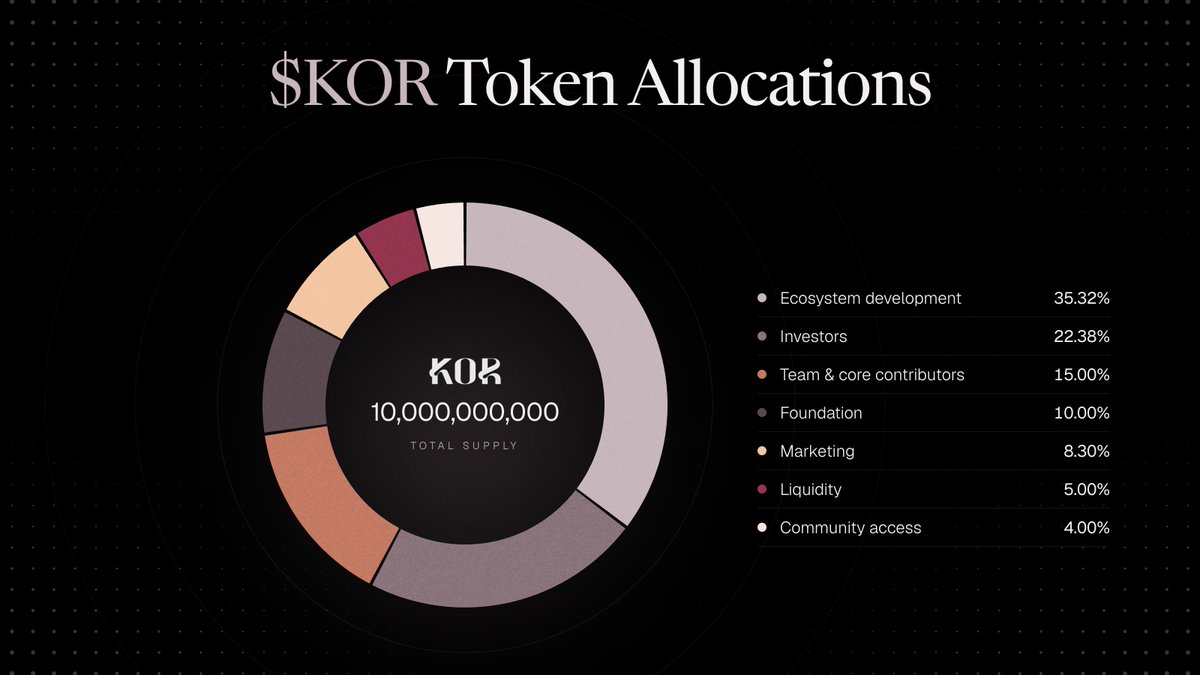
Foundation communications state a design principle: bootstrap ecosystem float at TGE without releasing insider allocations immediately. That allocation system is meant to keep early investors and the team aligned on multi-year timelines while still leaving open enough float for community programs and liquidity.
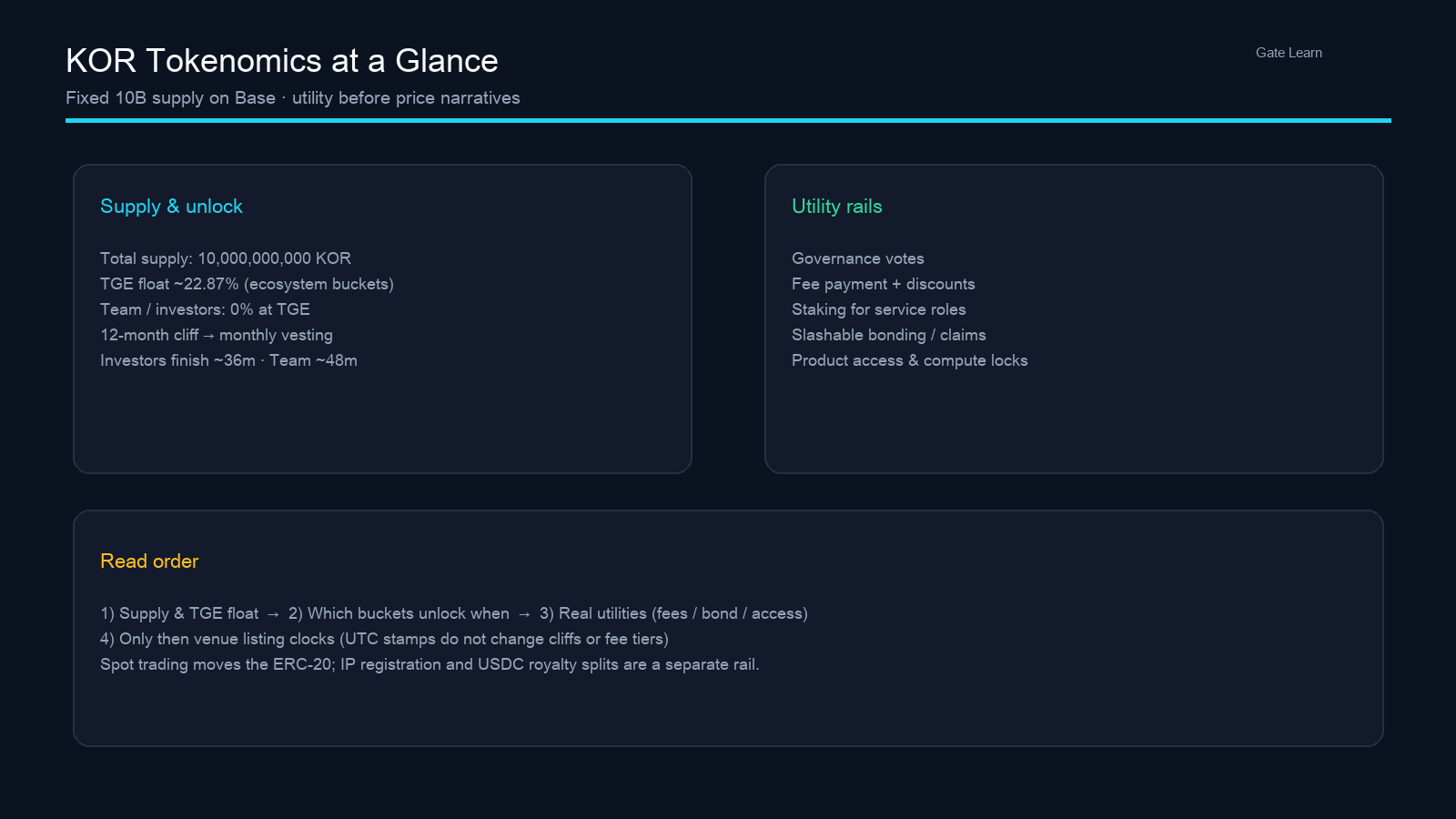 Figure 1. KOR tokenomics separates TGE float and cliffs from utility rails such as fees, staking, bonding, and product access.
At TGE. Circulating unlocks are described as coming from ecosystem development, foundation operations, community access, liquidity, and marketing. That structure funds growth and market-making style needs while delaying team and investor free float. Community and ecosystem allocation buckets are what open first; insider allocation remains closed through the cliff.
After TGE. Team and investor allocations both face a twelve-month cliff with no unlocks. At cliff end, 10% of each allocation releases, then the remainder unlocks in equal monthly amounts. Investor schedules finish 36 months after TGE; team schedules finish 48 months after TGE. Early investors therefore do not receive an immediate free allocation dump at listing time under the published schedule.
Cliff + monthly vesting reduces single-event insider dumps relative to an immediate unlock, but it does not eliminate future circulating supply growth. Readers modeling float should treat vesting calendars as supply mechanics, not as bullish or bearish signals about price. When an exchange listing is confirmed on a trading platform, the educational question remains the same: which allocation is unlocked, and which remains locked for investors and the team?
What Utility Does KOR Actually Have?
KOR Protocol describes several overlapping token uses. Exact parameters can change via governance or product rules. The Base deployment matters because fee rails, USDC settlement for IP clearing, and the ERC-20 listing share one L2 environment—but token transfers on a trading platform are still separate from IP registration inside the protocol system.
Governance
Token holders may vote on protocol parameters. Early phases can still be foundation-stewarded; progressive decentralization language in Foundation posts should be read as a roadmap posture, not a completed handoff. Community proposals, if and when they open, still need confirmed quorum and parameter rules before they change fee tables.
Fee payment and discounts
Licensing, settlement, and agent-initiated transactions may accept KOR at a discount versus other payment assets. Separately, the white paper describes depositing KOR into lock-up tiers of 30, 90, 180, and 365 days for compute-cost discounts in the 10%–50% range on AI-workflow usage. Discounts reduce stated fees; they do not create yield by themselves, and they do not set a market price.
Premium intelligence and product access
Staking or holding KOR can unlock deeper audience intelligence and priority matching features across live apps (Korus, VRSNS, Pacer, Streamline, KOR Hubs), subject to product rules and regional availability. Access gating is a product-platform rule, not a claim that holders outperform other investors.
Staking for service roles
Labels, agencies, verification providers, and third-party agent operators may need to stake KOR as performance collateral. Qualified operators can earn protocol-defined fees for services; passive holders may delegate to eligible operators where rules allow. Delegation and operator rewards are service-economy mechanics, not guaranteed APY products. The staking system is closer to service bonding than to open-ended yield farming.
Bonding / slashable claims
The white paper emphasizes bonding KOR as slashable collateral for claims the protocol cannot verify mechanically—authorship, sample clearance, AI provenance inside Verify; talent calls and matches inside Route; high-value settlements inside Settle. Bonding raises the cost of false claims; slashing is a risk for incorrect or malicious attestations. That allocation of risk sits with the bonded party, not with every community holder by default.
Creator rewards and airdrops
Creators may receive token-denominated rewards. Airdrop eligibility narratives have referenced onchain campaigns, KOR ID, and ecosystem interaction before a pre-TGE snapshot—always verify current rules on KOR Foundation notices. Community distribution campaigns, when confirmed, should be read from those primary notices rather than from secondary listing roundups.
How Should Readers Separate Token Utility From Protocol Clearing?
KOR the token coordinates incentives around KOR the clearinghouse. Spot trading KOR/USDT on Gate moves the ERC-20 on a centralized platform; it does not register an IP Asset or settle a license. Conversely, Verify/Settle activity can occur in USDC while KOR is used for fees, discounts, or bonding. Conflating “paid in USDC royalties” with “must buy KOR first” misstates the dual-rail design.
Exchange listing pages answer “where can the ERC-20 trade?” Tokenomics pages answer “what allocation unlocks, and what can the token do inside the system?” Keeping those questions separate prevents listing headlines from being mistaken for utility documentation. A confirmed listing on Base-bridged spot markets also does not open protocol governance by itself.
Venue listing posts often lead with a calendar month and a clock printed in UTC for deposits, trading open, and withdrawals. Those UTC stamps are operational logistics for a listing event; they do not change total supply, cliff length, or fee-discount tiers. When a dated announcement and a UTC schedule disagree with Foundation tokenomics, treat the allocation and vesting tables as the mechanism source of truth. Secondary listing roundups are especially noisy: they mix UTC open times with speculation and should not replace the white paper’s utility definitions. Readers comparing a TGE headline, a spot listing blurb, and an airdrop rumor should still return to the same checklist—supply, cliff, utility—rather than chaining press titles into a price narrative.
What Risks and Misreadings Are Common?
- Unlock calendar ≠ price floor — Scheduled releases increase potential float; they do not confirm support for any price level.
- Discount ≠ yield — Paying fees in KOR or locking for compute discounts is a cost reduction, not an interest product.
- Bonding risk — Slashable collateral can be lost if backed claims fail protocol checks.
- Parameter drift — Governance and foundation stewardship can change fee tiers, staking requirements, and product gating.
- Jurisdiction and transfer restrictions — White-paper entities and exchange listing rules can impose eligibility limits; educational pages are not offers.
- Investors vs community float — Early investors follow cliff schedules; community and ecosystem allocation can open earlier. Mixing those buckets misreads supply.
- Contract and network mix-ups — Base ERC-20 transfers require the confirmed contract address from KOR Protocol and the listing venue; copying a ticker from an unrelated chain or a spoofed listing page is an operational failure mode, not a tokenomics feature.
- Airdrop and snapshot myths — Snapshot timing, KOR ID requirements, and campaign tasks change; unfinished checklists do not create a claim on locked team or investor allocation.
A practical diligence order for tokenomics readers is: (1) total supply and TGE float share, (2) which buckets unlock at TGE versus after the cliff, (3) documented utilities that actually touch fees, bonding, or product access, (4) only then venue listing logistics. Skipping to chart headlines or “node sale” rumors before those four items usually recreates SERP noise inside an education page. Sinks and faucets language—fees paid in KOR, rewards paid out, slash events—describes flows inside the coordination system; it is not a promise that burns or emissions will dominate market price.
Summary
KOR tokenomics combine a fixed 10 billion supply on Base, a TGE float skewed to ecosystem and community buckets, long cliffs for team and investors, and multi-role utility across fees, staking, bonding, governance, and compute discounts. Treat each utility as a coordination rule tied to the KOR Protocol clearinghouse—not as a prediction about market price after any platform listing. When Foundation posts, white-paper tables, and exchange notices disagree, prefer the supply and utility definitions over timed listing copy.
FAQ
What is KOR’s total supply?
KOR Foundation states a total supply of 10,000,000,000 KOR on Base.
How much KOR circulates at TGE?
About 2,286,666,667 KOR, or 22.87% of total supply, circulates at TGE from non–team/investor buckets.
Do team and investor tokens unlock at launch?
No. Those allocations stay locked through a twelve-month cliff before monthly vesting.
What is KOR used for?
Documented uses include governance, discounted fee payment, staking for service roles, slashable bonding, product access, creator rewards, and lock-tier compute discounts.
Does locking KOR generate guaranteed yield?
No. Lock tiers are framed around fee or compute discounts and participation rules, not as a promised return product.