The project focuses on making collaborative computing possible even when participants do not fully trust one another. For example, competing companies could use Interfold to calculate insights from their combined data without directly exposing proprietary information to each other. FOLD is the native token associated with the Interfold ecosystem and is deployed on Ethereum.
Key Takeaways
-
Interfold is a privacy-preserving computing project designed to let multiple parties collaborate on computations without exposing their individual inputs.
-
The protocol aims to allow participants, including organizations that may not fully trust one another, to contribute private data while verifying whether the final computation is correct.
-
FOLD is the native token associated with the Interfold ecosystem.
-
FOLD is an Ethereum-based token with the contract address.
-
FOLD is available for spot trading on Gate, providing a USDT-denominated market for users who want to trade the token.
-
As with other newly listed crypto assets, FOLD can be subject to significant price volatility, liquidity changes, and market risks.
What Is Interfold?
Interfold is a privacy-focused computing project built around the idea that different parties should be able to collaborate on computations without revealing their private inputs to one another.
This model can be useful in situations where multiple organizations need to derive insights from combined data but cannot simply share their underlying information. For example, competing companies may want to calculate a common statistic or verify a shared result without giving each other direct access to their proprietary datasets.
Interfold's core concept separates using data for computation from revealing the underlying data. Participants contribute inputs privately, while the resulting computation can still be checked for correctness.
How Does Interfold Work?
Interfold is designed around collaborative computation in which different parties contribute data without necessarily exposing their individual inputs.
Instead of requiring every participant to hand over raw data to a central party, the system aims to process the combined inputs while preserving the privacy of each contributor. The resulting output can then be verified, allowing participants to check whether the computation was performed correctly.
This type of architecture addresses a fundamental challenge in collaborative data processing: organizations often have valuable data but cannot freely share it because of competitive concerns, confidentiality requirements, or data governance restrictions.
Privacy-Preserving Computation
Privacy-preserving computation allows multiple parties to derive a result from private inputs without requiring those inputs to be openly disclosed.
Consider two competing companies that want to determine the combined size of a particular market. Sharing their complete customer or sales data could reveal commercially sensitive information. A privacy-preserving system could instead allow them to contribute relevant inputs to a computation while keeping those inputs hidden from one another.
Interfold's approach is designed around this type of interaction. The participants can collaborate on the computation while maintaining control over their own inputs.
Verifiable Results
Privacy alone is not enough for collaborative computation. Participants also need confidence that the output is accurate.
Interfold therefore emphasizes verifiability. The system is designed so that participants can verify whether a computation produced the correct result without necessarily gaining access to the private inputs contributed by other parties.
This creates two properties that are important for collaborative computing: input privacy and result verifiability.
Why Is Private Collaborative Computing Important?
Modern organizations increasingly depend on data, but valuable datasets are often distributed across companies, institutions, or individuals that cannot simply combine their raw information.
Privacy-preserving computation offers a potential way to unlock some of this value. Instead of choosing between keeping data completely isolated and exposing it to other parties, organizations can potentially perform specific computations while limiting the information that is revealed.
This concept has applications across areas such as finance, healthcare, machine learning, advertising, fraud detection, and business analytics. The practical usefulness of any particular implementation, however, depends on its security model, performance, supported computations, and real-world adoption.
What Is the FOLD Token?
FOLD is the native token associated with the Interfold ecosystem.
The token is deployed on Ethereum, with the contract address:
0xE172e9B6cfBeeB5593bDcE3f077356FDb33af904
Users should verify the contract address before interacting with the token, particularly around a newly listed asset where similarly named tokens may exist across different networks.
The specific role and utility of FOLD should be considered in the context of Interfold's evolving ecosystem. As the project develops, token-related functions may depend on how its computing infrastructure, applications, and network participants are implemented.
| Metric |
Details |
| Project |
Interfold |
| Token |
FOLD |
| Blockchain |
Ethereum |
| Contract Address |
0xE172e9B6cfBeeB5593bDcE3f077356FDb33af904 |
| Token Type |
ERC-20 |
| Spot Pair on Gate |
FOLD/USDT |
What Makes Interfold Different?
Interfold focuses on a specific problem within data collaboration: how can multiple parties calculate something together without revealing their private inputs?
Traditional centralized data processing often requires participants to transfer their data to a shared system or trusted intermediary. This can create concerns around data ownership, confidentiality, and trust.
Interfold instead focuses on a model in which each participant can keep its input private while still participating in a shared computation. The ability to verify the resulting computation adds another layer of transparency to the process.
The concept is particularly relevant where the participants may have conflicting interests. The project's own description highlights scenarios in which even competitors or previously unrelated parties can collaborate without exposing their individual inputs.
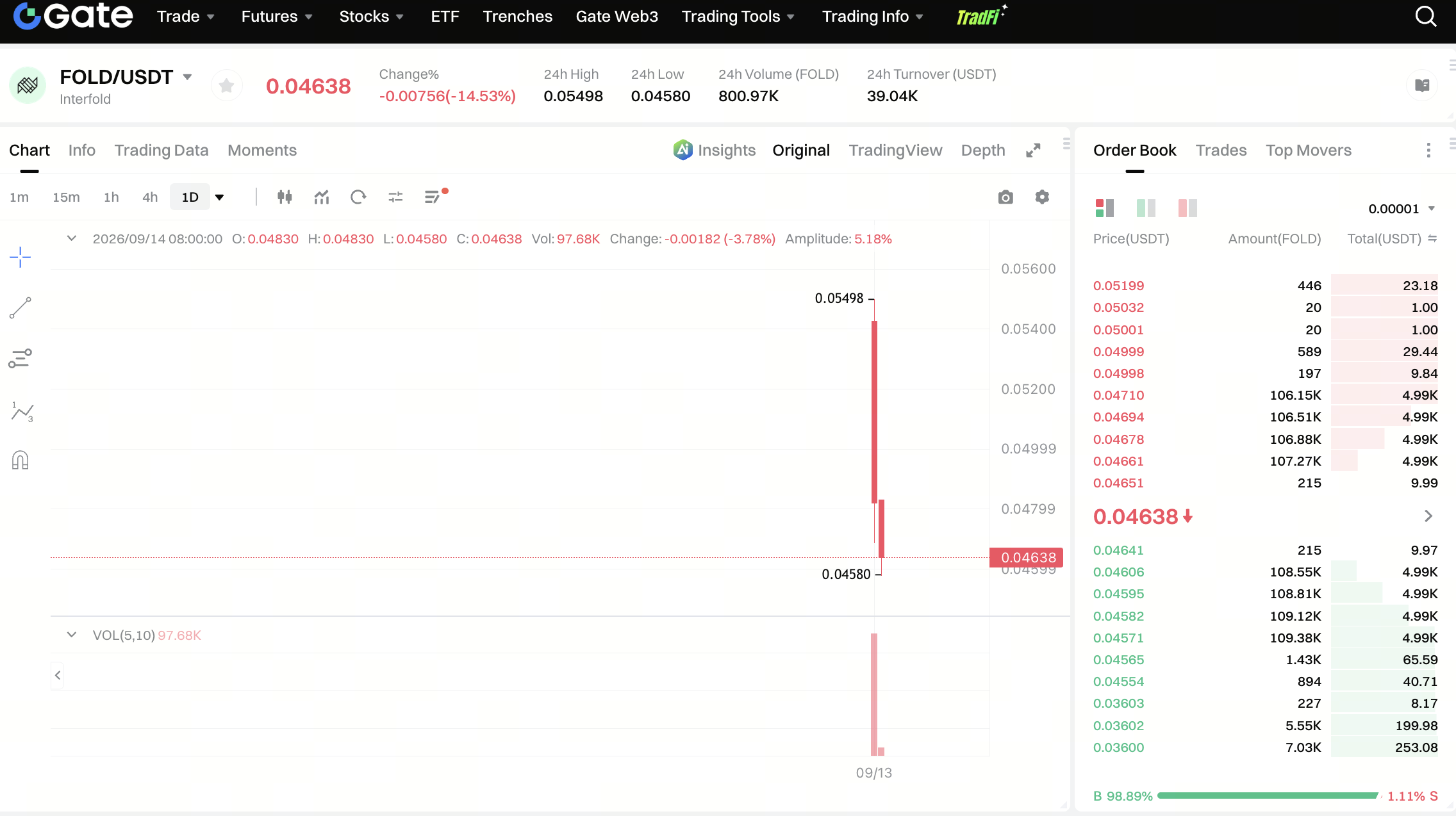
FOLD Trading on Gate
FOLD is available for spot trading on Gate, giving users access to the FOLD/USDT market.
Users can visit the FOLD/USDT spot market to view the current price, trading activity, and market information. This provides a direct way to access the FOLD spot market through Gate after the token's listing.
Users who already hold supported assets on Gate can also check whether Flash Swap is available for FOLD. Flash Swap is designed to provide a simpler way to exchange supported crypto assets without going through the conventional spot trading interface.
Before trading FOLD, users should check the current market status, applicable fees, liquidity, and trading conditions. Newly listed assets may experience substantial price movements, particularly during the initial period following listing.
How to Trade FOLD on Gate?
Trading FOLD on Gate generally involves accessing the FOLD/USDT spot market and placing an order based on the available market conditions.
A simplified flow is:
-
Open Gate and log in to your account.
-
Search for FOLD/USDT in the spot trading section.
-
Review the market, including the current price, order book, and available liquidity.
-
Choose an order type and enter the amount of FOLD you want to trade.
-
Review and confirm the order.
For users who prefer a direct asset conversion rather than placing a conventional spot order, the Flash Swap function may provide an alternative where FOLD is supported.
What Are the Potential Use Cases for Interfold?
The underlying concept of Interfold can be applied to situations where different parties need to cooperate without sharing their complete datasets.
Potential applications include collaborative analytics, where organizations want to calculate statistics across multiple private datasets; financial applications, where institutions may need to compare or combine information without exposing sensitive customer or transaction data; and AI or machine learning, where different data owners may want to contribute information while maintaining greater control over their underlying datasets.
These are potential application areas rather than guarantees of current product functionality. The practical scope of Interfold will depend on the project's technical development and adoption.
What Are the Risks of FOLD and Interfold?
Interfold operates in the broader field of privacy-preserving and decentralized computing, where technical complexity can create additional risks. The security and reliability of such systems depend on their cryptographic design, implementation, infrastructure, and ability to operate correctly under different conditions.
FOLD is also a newly listed crypto asset and may experience high volatility. Trading volume and liquidity can change quickly, which can increase execution risks and price fluctuations.
The project's long-term prospects also depend on whether its technology can attract developers, organizations, and other users. A technically interesting concept does not necessarily guarantee widespread adoption or token value appreciation.
Users should conduct their own research and consider their risk tolerance before trading FOLD.
Frequently Asked Questions About Interfold (FOLD)
What is Interfold?
Interfold is a privacy-preserving computing project designed to allow multiple parties to collaborate on computations while keeping their individual inputs private and making the resulting computation verifiable.
What is the FOLD token?
FOLD is the native token associated with the Interfold ecosystem. It is deployed on Ethereum as an ERC-20 token.
What is the FOLD contract address?
The stated Ethereum contract address for FOLD is 0xE172e9B6cfBeeB5593bDcE3f077356FDb33af904. Users should verify the contract before interacting with the token.
What problem does Interfold solve?
Interfold focuses on collaborative computation between parties that may not want to disclose their underlying data. Its approach aims to keep individual inputs private while allowing participants to verify the correctness of the resulting computation.
Where can I trade FOLD?
FOLD is available for spot trading on Gate through the FOLD/USDT market. Users can also check whether FOLD is currently supported through Gate's Flash Swap feature.
Is FOLD a good investment?
FOLD is a cryptocurrency asset and can be highly volatile, especially around a new listing. Its future value depends on factors including project development, adoption, liquidity, market conditions, and broader crypto-market sentiment. Users should conduct independent research before trading.