The stablecoin market has long suffered from a structural imbalance: issuers exclusively capture reserve yields, while the platforms that drive adoption struggle to share in those returns. Issuing prudentially regulated stablecoins is a high-barrier endeavor, leaving few eligible assets. GDN solves this through networked collaboration, letting enterprise-level participants share ecosystem value within a compliant framework.
From a blockchain perspective, USDG is an on-chain stablecoin pegged 1:1 to the U.S. dollar, circulating on ERC-20 and multiple approved chains, offering a composable base asset for DeFi protocols, payment gateways, and institutional treasuries. To assess USDG's role in the stablecoin ecosystem, it's essential to understand GDN's role framework and USDG's issuance mechanism.
What Is the Global Dollar Network (GDN)? How Does It Relate to USDG?
The Global Dollar Network (GDN) is a stablecoin ecosystem that coordinates issuers, platform partners, and end-use cases. Its core asset is Global Dollar (USDG). GDN defines network rules, partner roles, and revenue distribution; USDG serves as the unified value token for on-chain circulation and settlement.
GDN officially launched in November 2024 with founding partners Anchorage Digital, Bullish, Galaxy Digital, Kraken, Nuvei, Paxos, and Robinhood. The network is open to expansion—enterprises can join as Hold, Mint, or Accept participants. USDG minting, redemption, and on-chain transfers operate under both Paxos's issuance framework and GDN's network rules.
| Concept |
Role |
Core Function |
| GDN |
Stablecoin network ecosystem |
Defines partner roles, revenue distribution, and expansion rules |
| USDG |
Core network stablecoin |
1:1 USD peg, on-chain circulation and settlement |
| Paxos |
Issuance and compliance entity |
Licensed issuer of USDG, manages reserves |
| Network Partners |
Ecosystem participants |
Hold/Mint/Accept drive adoption and earn revenue |
GDN is not an on-chain token; it's a commercial network built around USDG. Users hold and transfer USDG, while network rules determine how partners participate and earn reserve-linked rewards.
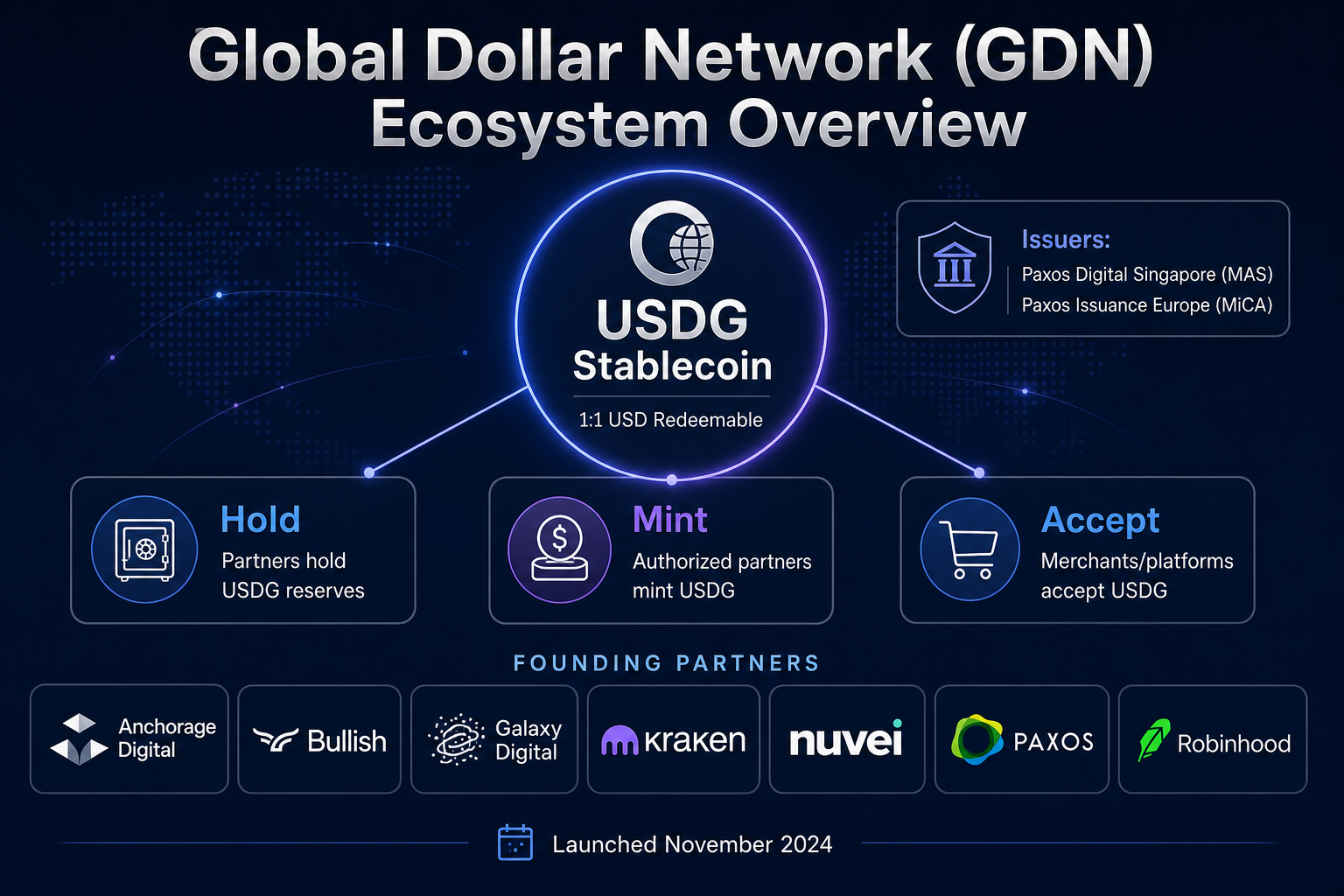 Figure 1: Global Dollar Network ecosystem overview: USDG at the center, linking three partner roles—Hold, Mint, and Accept.
What Is USDG? How Does Global Dollar Maintain Its 1:1 USD Peg?
Global Dollar (USDG) is a single-currency stablecoin denominated in U.S. dollars, redeemable 1:1 for USD with Paxos. Issuers are Paxos Digital Singapore Pte. Ltd. (holder of a Singapore MAS Major Payment Institution license) and Paxos Issuance Europe (issued under the MiCA framework for the European region), each managing compliance and reserves in their respective jurisdictions.
Reserve assets are cash and cash equivalents held in segregated accounts. Paxos handles minting verification, reserve custody, and on-chain burning. Per the whitepaper, ordinary token holders do not directly earn interest from reserves—that revenue primarily flows to GDN network partners.
Why Is GDN Unique? How Are Stablecoin Reserve Returns Distributed?
GDN's key differentiator is its revenue distribution model: under traditional structures, issuers keep most reserve yield, while adoption-driving platforms receive little. GDN shifts the distributable portion of reserve revenue toward network partners—up to 100%.
This allocation targets GDN-approved network partners based on their contributions via Hold, Mint, and Accept roles, not direct payouts to ordinary on-chain holders. Hold means platforms maintain USDG balances; Mint means contributing to circulation growth; Accept means accepting USDG for payments or deposits. This design lowers the barrier for individual platforms to obtain a stablecoin license independently, enabling rapid deployment through Paxos's existing compliance infrastructure.
How Do GDN Partners Participate? What Do Hold, Mint, and Accept Mean?
The Hold role is for institutions holding USDG balances on their platform, earning a share of reserve revenue proportional to their holdings. The Mint role targets authorized partners who mint USDG: converting USD reserves into on-chain USDG to increase circulation, earning revenue based on incremental minting. The Accept role is for platforms that accept USDG as payment or deposit, earning incentives based on inbound volume.
These roles can be adopted individually or in combination. For example, an exchange can simultaneously act as Hold, Mint, and Accept, generating network revenue from multiple angles. Specific eligibility and revenue splits are defined by the GDN network agreement and partner contracts.
Who Are GDN's Founding Partners? How Does the Network Expand?
GDN's seven founding partners cover key stablecoin ecosystem segments: Anchorage Digital (institutional custody), Bullish (trading and liquidity), Galaxy Digital (digital asset finance), Kraken (exchange), Nuvei (global payments), Paxos (issuer), and Robinhood (retail brokerage).
Founding partners provide initial liquidity, adoption use cases, and compliance infrastructure for USDG. GDN is open to expansion: qualified enterprises can apply to join the Network Directory, participate as Hold, Mint, or Accept, share reserve revenue, and access Paxos's MAS and MiCA compliant issuance systems.
How Does USDG Work On-Chain? ERC-20, Minting, and Redemption Explained
USDG follows the ERC-20 standard, deployed on Ethereum and other blockchains approved by Paxos, directly connecting to DeFi protocols, wallets, and cross-chain bridges. Paxos developer documentation provides APIs for mint, redeem, and convert for authorized partners.
Minting process: Partners deposit equivalent USD into Paxos accounts; after reserve verification, USDG is minted on-chain. Redemption reverses the process: submit on-chain USDG, Paxos burns the tokens and returns the equivalent USD. This burn mechanism ensures a 1:1 correspondence between circulating supply and reserves at all times. USDG also serves as a composable building block for smart contracts, supporting on-chain applications like payment routing and treasury management.
Are USDG Reserve Assets Safe? How Is Transparency Verified?
USDG reserves are cash and cash equivalents held in segregated accounts. DBS Bank serves as the primary banking partner, handling reserve custody and transfers. Paxos publishes monthly reserve reports and independent third-party attestations, allowing the public to verify the match between circulating supply and reserve balances.
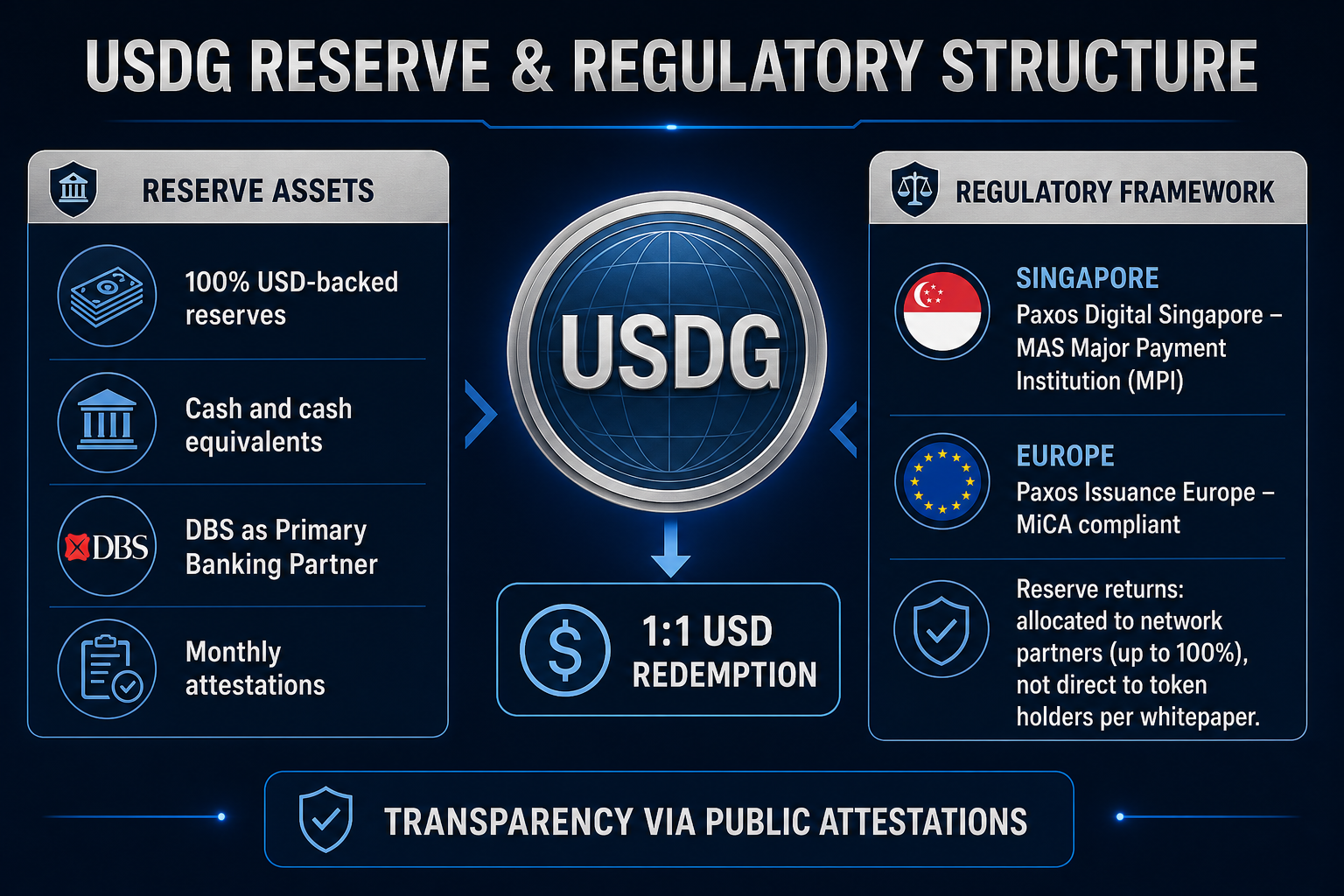 Figure 2: USDG reserve and regulatory structure: segregated reserves, DBS banking partner, and MAS/MiCA compliance frameworks.
| Transparency Element |
Description |
| Reserve Type |
100% cash and cash equivalents |
| Custodian Bank |
DBS (primary banking partner) |
| Account Segregation |
Segregated accounts protect user assets |
| Periodic Disclosure |
Monthly reserve report + independent attestation |
Reserve reports and attestations form the verifiability foundation for circulating supply. Partners and users can independently check whether on-chain total supply matches off-chain reserves.
What Regulations Apply to USDG? MAS and MiCA Compliance Structure Explained
USDG uses a dual-entity, dual-license compliance structure. Paxos Digital Singapore holds an MAS MPI license, issuing USDG under Singapore's framework, subject to prudential standards including capital adequacy, reserve segregation, and AML. Paxos Issuance Europe issues USDG under the MiCA framework in Europe, supervised by the Finnish FIN-FSA.
This dual-entity structure allows USDG to circulate across jurisdictions with localized compliance. It reflects Paxos's expertise in stablecoin regulation; USDG shares some compliance infrastructure with Paxos's other stablecoins, but differs in GDN network rules and revenue distribution.
| Issuing Entity |
Regulatory Framework |
Supervisory Authority |
| Paxos Digital Singapore |
MAS MPI |
Monetary Authority of Singapore |
| Paxos Issuance Europe |
MiCA |
Finnish FIN-FSA |
The table above summarizes USDG's compliance structure across its two issuing jurisdictions. Partners and users can choose the relevant entity for minting and redemption based on region.
What Are the Advantages and Risks of Using or Holding USDG?
Advantages: GDN directs reserve revenue toward adoption-driving network partners—up to 100%—reshaping traditional stablecoin economics. USDG is issued by dual-licensed entities under MAS MPI and MiCA, with reserves custodied by DBS and regular attestations. ERC-20 and multi-chain support provide DeFi composability.
Limitations: Reserve revenue goes to GDN partners; ordinary token holders do not directly earn reserve interest. Partner onboarding requires compliance review, not all platforms can join. USDG ecosystem breadth depends on continued partner network expansion.
Risks: Stablecoin value depends on reserve sufficiency and the 1:1 redemption promise. Changes in banking partners or reserve structure may affect redemption liquidity. Smart contracts and cross-chain bridges introduce on-chain security risks; counterfeit contracts may circulate on unofficial chains. Evolving regulations in MAS, MiCA, and U.S. jurisdictions may affect issuance conditions or cross-border circulation rules.
These factors are structural descriptions—not investment advice.
Summary
The Global Dollar Network (GDN) launched in November 2024, with USDG as its core stablecoin, redistributing revenue through three roles: Hold, Mint, and Accept. USDG is issued by Paxos Digital Singapore (MAS MPI) and Paxos Issuance Europe (MiCA), redeemable 1:1 for USD, with reserves custodied by DBS and regular attestations.
FAQ
What is the Global Dollar Network (GDN)?
GDN is a USD stablecoin network ecosystem initiated by Paxos with multiple institutions, launched in November 2024. It defines partner roles and revenue distribution, with USDG as its core token. Founding partners include Anchorage Digital, Bullish, Galaxy Digital, Kraken, Nuvei, Paxos, and Robinhood.
How is USDG different from USDC and USDT?
USDG is issued by Paxos licensed entities under MAS MPI and MiCA, with reserve revenue primarily allocated to GDN network partners. USDC is issued by Circle, USDT by Tether. Key differences between USDG and USDC/USDT center on issuer, regulatory framework, reserve disclosure, and revenue distribution.
Can ordinary users earn reserve interest by holding USDG?
Per the USDG whitepaper, ordinary on-chain token holders do not directly receive interest from reserves. Reserve revenue is distributed to GDN network partners in Hold, Mint, and Accept roles. Token holders retain the 1:1 USD redemption right but do not share in reserve returns.
On which chains does USDG circulate?
USDG is deployed as an ERC-20 token on Ethereum and can circulate on other blockchains approved by Paxos. For the full list of supported chains and contract addresses, refer to the Paxos developer documentation. Always verify that the contract on your target chain is the official deployment.
How to become a GDN network partner?
Qualified enterprises can apply to join GDN. After review, they participate as Hold (holding USDG balances), Mint (authorized minting), or Accept (accepting USDG payments). Specific conditions are set by the GDN network agreement.
How can USDG reserve assets be verified?
Paxos publishes monthly reserve transparency reports, including reserve composition and independent third-party attestations. Reserves are 100% cash and cash equivalents held in segregated accounts, with DBS as the primary banking partner. Historical reports are available on the Paxos website.