Traditional Initial Public Offerings (IPOs) have long served as a key mechanism for companies to access public capital markets and an important channel for investors to participate in corporate growth. However, traditional IPO subscriptions typically rely on securities accounts, regional eligibility requirements, and complex intermediary systems, making it difficult for many retail investors to directly access IPO opportunities worldwide.
As the digital asset industry continues to evolve, an increasing number of platforms are exploring ways to connect traditional capital markets with global users through digital infrastructure. Gate IPOs was launched in this context as an IPO Access service that integrates project discovery, subscription applications, and allocation procedures, providing users with a digital gateway to participate in IPO and Pre-IPO opportunities. It has become one of the key initiatives through which digital asset platforms expand into Real-World Assets (RWA) and traditional financial services.
What Is Gate IPOs?
As Gate’s IPO Access service, Gate IPOs is designed to provide users with a digital channel for participating in IPOs (Initial Public Offerings) and selected Pre-IPO opportunities. Through this service, users can review project information, submit subscription applications, and participate in subsequent allocation processes within a unified platform.
Unlike traditional IPO subscriptions in securities markets, Gate IPOs does not rely solely on brokerage accounts as the entry point. Instead, it streamlines project access, eligibility verification, and subscription procedures through digital services, improving participation efficiency and reducing operational complexity.
As the inaugural project of Gate IPO Access, SpaceX demonstrated how users who receive allocations after the IPO process can directly access Gate’s U.S. stock trading products and trade real shares.

How Does Gate IPO Access Work?
The core mechanism of Gate IPO Access revolves around three stages: project onboarding, user subscriptions, and allocation settlement.
First, the platform showcases eligible IPO and Pre-IPO opportunities and discloses relevant information, including project background, offering details, and subscription rules. Users can evaluate projects based on publicly available information.
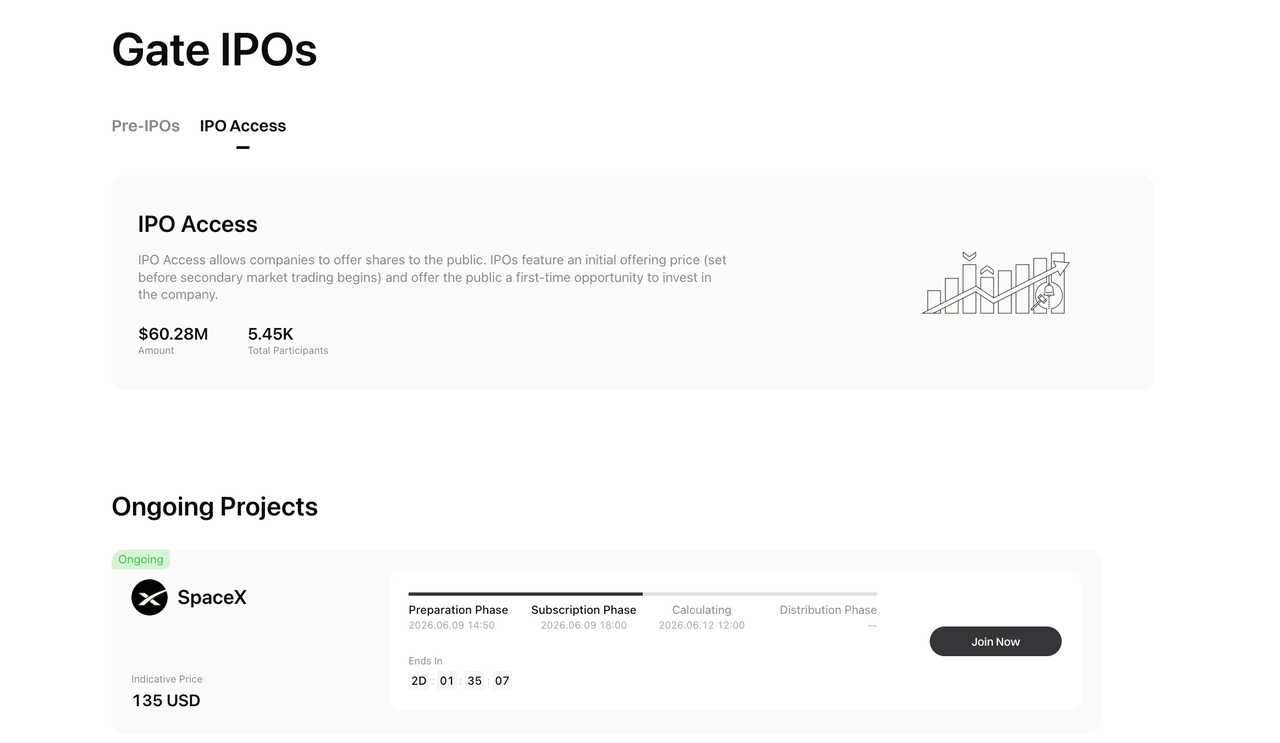
Next, eligible users may submit subscription applications during the designated participation period. The process typically includes eligibility verification, fund locking, and subscription quota management.
After the subscription period ends, the project enters the allocation phase. If demand exceeds the available allocation, shares or interests may be distributed proportionally or according to other predefined allocation rules. Once allocation is completed, users receive the corresponding asset entitlements or settlement arrangements.
Throughout the process, the platform primarily facilitates information disclosure, workflow coordination, and subscription management, while the issuance itself remains subject to applicable market regulations and compliance requirements.
The Complete Gate IPOs Participation Process
First, users browse the IPO Access page and review project materials, including company background, offering size, schedule, and participation requirements.
Next, users complete the necessary eligibility verification and submit subscription applications during the subscription period.
After subscriptions close, the project moves into the allocation stage. If demand exceeds available capacity, allocations are distributed according to predefined rules.
Once allocation is completed, users can view the final results and proceed to settlement or asset management according to the project's arrangements.
This process consolidates multiple steps traditionally spread across different institutions and platforms into a single interface, improving overall participation efficiency.
What Is the Difference Between Gate IPOs and Launchpad?
Both Gate IPOs and Launchpad provide opportunities to participate in new projects, which is why they are often compared. However, the underlying asset types and market logic differ significantly.
Launchpad primarily focuses on blockchain token offerings. Participants receive digital tokens whose value is typically linked to ecosystem development, tokenomics, and market demand.
Gate IPOs, on the other hand, focuses on IPO and Pre-IPO opportunities, where the underlying assets are generally associated with corporate equity, public listings, or real-world assets.
From an asset perspective, Launchpad belongs to the crypto asset issuance market, whereas IPO Access represents a digital extension of participation in traditional capital markets.
Although both involve subscriptions and allocations, their underlying assets, regulatory environments, market structures, and risk factors are fundamentally different.
| Comparison Category |
Gate IPOs |
Launchpad |
| Core Asset |
IPO / Pre-IPO Opportunities |
Crypto Tokens |
| Market Type |
Traditional Capital Markets |
Digital Asset Markets |
| Participation Objective |
Corporate Financing Participation |
Token Offering Participation |
| Primary Risk Source |
Corporate Operations and Market Performance |
Project Development and Tokenomics |
| Allocation Logic |
IPO Allocation Rules |
Token Distribution Rules |
What Are the Main Use Cases of Gate IPOs?
The primary use cases of Gate IPOs lie at the intersection of traditional capital markets and digital finance.
For users seeking exposure to global IPO markets, IPO Access provides a centralized channel for discovering and evaluating opportunities.
For investors interested in high-growth companies, Pre-IPO opportunities offer insights into businesses before they enter public markets.
For those researching Real-World Assets (RWA) and financial digitalization trends, Gate IPOs demonstrates how digital platforms can bridge traditional finance and blockchain ecosystems.
Advantages and Potential Limitations of Gate IPOs
One of the key advantages of Gate IPOs is improved efficiency in accessing IPO information and participating through a streamlined platform.
Compared with traditional approaches, users do not need to navigate multiple institutions or market channels separately to learn about opportunities and complete application procedures.
Digital infrastructure also enhances information transparency, making it easier for users to compare and research different projects.
However, it is important to note that participation through Gate IPOs does not guarantee allocation. IPO opportunities often attract demand that exceeds available supply, making final allocations inherently uncertain.
In addition, local regulations, market requirements, and project-specific conditions may affect eligibility and final participation outcomes.
Conclusion
As Gate’s IPO Access service, Gate IPOs connects traditional capital markets with the digital asset ecosystem through a digital framework, providing users with access to IPO and Pre-IPO opportunities. Its core value lies in integrating project discovery, subscription applications, allocation management, and settlement procedures into a unified experience, improving efficiency while reducing operational complexity.
As Real-World Assets (RWA), digital securities, and financial digitalization continue to evolve, Gate IPOs is gradually becoming an important infrastructure layer connecting traditional finance with the digital asset ecosystem.
FAQs
How Is Gate IPO Access Different from Traditional IPO Subscriptions?
Traditional IPO subscriptions are typically conducted through brokerage firms, while Gate IPO Access centralizes information discovery, application submission, and allocation management within a unified platform. Both focus on IPO opportunities, but their participation pathways and operational processes differ.
Is Gate IPOs the Same as Stock Trading?
No. Gate IPOs focuses on participation in IPO and Pre-IPO opportunities during the issuance stage. Secondary market stock trading occurs after a company has gone public, making them distinct stages of the investment lifecycle.
What Is the Difference Between Gate IPOs and Launchpad?
Launchpad is designed for blockchain token offerings, whereas Gate IPOs focuses on IPO and Pre-IPO opportunities. The two differ significantly in terms of underlying assets, market structure, participation mechanisms, and risk profiles.
What Is a Pre-IPO?
A Pre-IPO refers to a financing stage that occurs before a company officially goes public. Pre-IPO opportunities generally take place before a company enters the public market and represent an important stage in the IPO preparation process.
Are There Risks Associated With Gate IPOs?
Yes. Like any IPO or Pre-IPO opportunity, Gate IPOs involves market risk, allocation risk, and compliance-related risks. Project performance, market conditions, and allocation outcomes may all affect the overall participation experience, making it important for users to understand the relevant rules and risk factors before participating.