For a long time, IPOs (Initial Public Offerings) have been regarded as a critical gateway for companies to access public capital markets. However, for many retail investors, participating in globally popular IPOs often requires relying on specific broker channels, meeting account balance thresholds, and navigating complex subscription processes.
As digital financial infrastructure evolves, an increasing number of platforms are exploring digital upgrades to IPO participation models. Gate's IPO Access service was born out of this trend, with its debut project selecting SpaceX, providing users with a seamless, end-to-end experience from IPO intent subscription to stock distribution.
Why SpaceX as Gate IPOs' Debut Project?
Founded by Elon Musk in 2002, SpaceX is one of the world's most influential commercial aerospace companies, spanning areas such as reusable rockets, satellite internet via Starlink, and future space computing.
From the IPO Access product positioning standpoint, SpaceX combines global recognition, technological innovation, and market buzz. It perfectly illustrates the core value of IPO Access: bridging digital asset users with global capital markets.
For Gate, the SpaceX project is not merely an IPO subscription case; it also demonstrates the complete product lifecycle of IPO Access, from subscription to stock trading.
The First Step of SpaceX IPO Access: Expression of Interest
The SpaceX project employs an "Expression of Interest" mechanism.
An Expression of Interest does not guarantee share allocation. It simply indicates a user's desire to participate in the IPO allocation process. Whether shares are ultimately received and how many depends on the actual offering results and the allocation quota available to the platform.
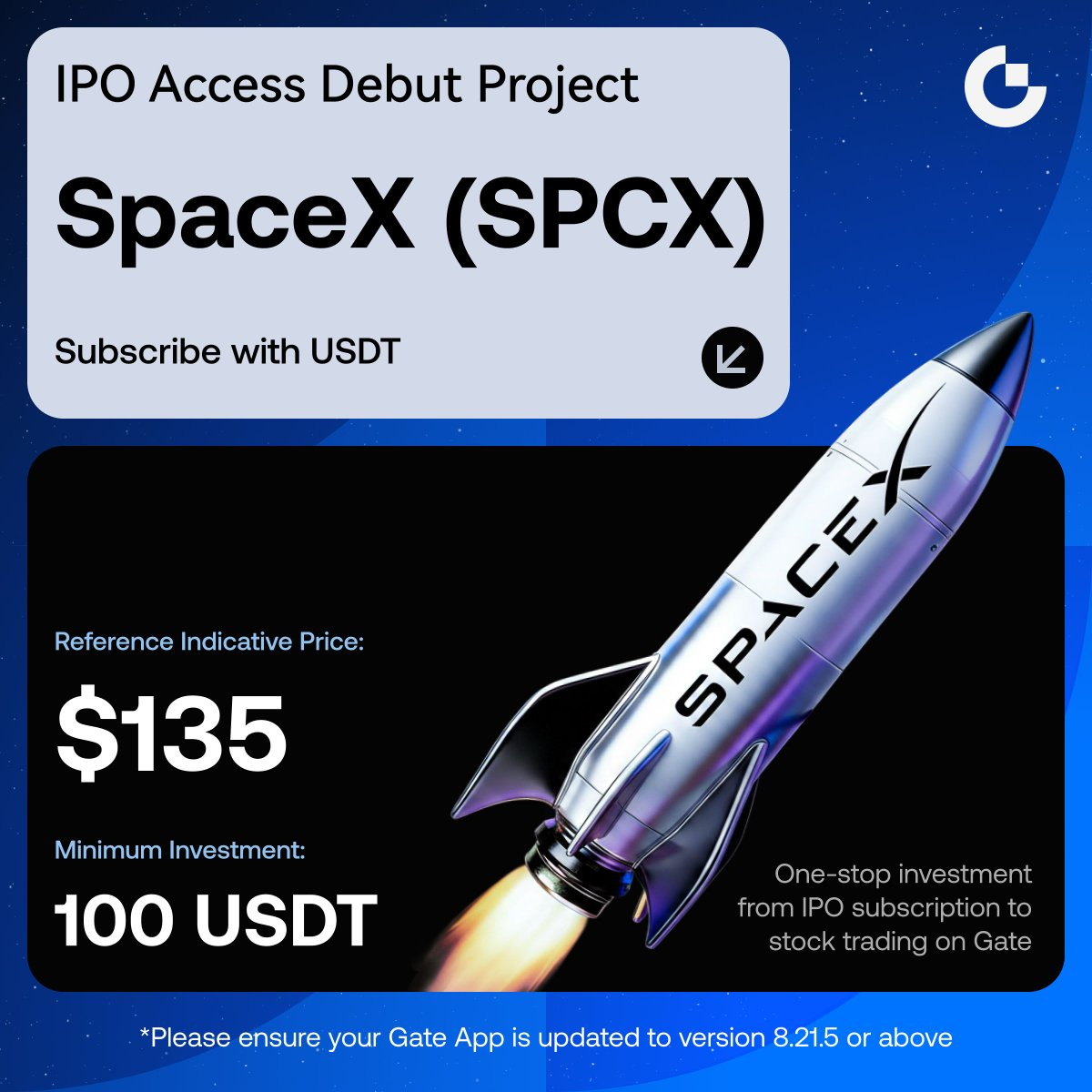
For the SpaceX project, users subscribe using USDT, with a minimum investment of 100 USDT and a maximum of 500,000 USDT. The reference subscription price is $135 per share, with the final price determined by the actual IPO pricing.
This mechanism mirrors the IOI (Indication of Interest) logic in traditional IPO markets, where investors submit a subscription intent and wait for the final allocation.
What Happens During the Fund Lock-Up Phase?
Once users complete their Expression of Interest, the corresponding funds enter a lock-up state.
During lock-up, the assets cannot be traded, withdrawn, or transferred. The platform continuously records the user's locked-up amount, using this data as a key input for subsequent allocation weight calculations.
The core purpose of the lock-up mechanism is to ensure genuine subscription demand while providing a quantitative basis for allocation.
From a system perspective, lock-up is not merely freezing funds but a vital component of the IPO Access allocation model.
How Is the Allocation Weight Calculated?
A standout feature of the SpaceX project is the use of an average locked-up amount mechanism.
The system calculates each user's allocation weight based on the ratio of their hourly average locked-up amount during the entire subscription period to the total average locked-up amount of all participants. The earlier the subscription is completed, the higher the average locked-up amount, and thus the higher the allocation weight.
For example, in a 66-hour subscription cycle:
- Users locking up in the first hour have their funds included in the calculation for the longest period.
- Users joining later see a lower average locked-up amount.
- Users joining at the very end have the lowest calculated weight.
This mechanism incentivizes early subscription while preventing allocation imbalances caused by a last-minute surge of participants.
How Is the Final Stock Allocation Executed?
After the subscription period ends, the system enters the final allocation phase.
First, the actual IPO pricing must be determined. The $135 reference price for SpaceX is indicative; the final issuance price depends on market demand, valuation, and book-building results.
If the final issuance price deviates no more than 20% from the reference price, the system automatically executes the allocation. If the deviation exceeds 20%, a secondary confirmation process is triggered.
The platform then distributes shares based on the actual allocation received and users' allocation weights. Possible outcomes include:
- Full allocation
- Partial allocation
- No allocation
Therefore, the Expression of Interest amount does not directly translate into the final number of shares received.
What Happens After Shares Are Credited?
Users who receive an allocation will have the corresponding shares credited after the IPO is completed.
According to Gate's announcement, shares will be transferred to users' dedicated stock accounts upon listing and will enter the Gate stock trading section. Users can then trade real stocks.
For the SpaceX project, stock distribution is expected to occur within hours of the IPO, with no additional lock-up period. Once received, shares are immediately available for trading.
This means IPO Access not only covers the subscription phase but also connects to post-listing stock trading, forming a complete investment lifecycle.
How Is Gate IPO Access Different from Traditional IPO Subscriptions?
Although both revolve around IPOs, the participation methods differ significantly.
| Comparison Dimension |
Gate IPO Access |
Traditional IPO Subscription |
| Participation Entry |
Unified platform interface |
Brokerage account |
| Subscription Method |
Expression of Interest |
Broker subscription |
| Fund Form |
Digital assets (e.g., USDT) |
Fiat currency |
| Allocation Basis |
Average lock-up weight + allocation quota |
Broker rules & underwriting mechanism |
| Stock Crediting |
Gate stock account |
Brokerage securities account |
| Subsequent Trading |
Gate stock section |
Stock exchange |
While the participation paths differ, both involve allocation uncertainty — submitting an application does not guarantee shares.
Summary
The SpaceX debut project showcases the full operational framework of Gate IPOs. From Expression of Interest, fund lock-up, and weight calculation to final allocation and stock distribution, IPO Access consolidates multiple steps of traditional IPOs into a unified platform.
For users, submitting a subscription application is just the beginning. The final number of shares received depends on the actual project offering, the allocation quota obtained by the platform, and the individual's allocation weight based on their average locked-up amount.
FAQs
What does Expression of Interest mean for Gate IPO Access?
An Expression of Interest is a way for users to signal their desire to participate in the IPO allocation process. Submitting an EOI enters the user into the allocation calculation, but it does not guarantee share allocation.
Why does the SpaceX project use a lock-up mechanism?
The lock-up mechanism records users' actual participation amounts and serves as the basis for allocation weight calculation. During lock-up, funds cannot be traded, withdrawn, or transferred.
Is it advantageous to participate in SpaceX IPO Access earlier?
Yes. The SpaceX project uses an average locked-up amount mechanism. The earlier you subscribe, the longer your funds are included in the calculation, resulting in a higher allocation weight.
Will I definitely receive shares after submitting an Expression of Interest?
No. The final outcome may be full allocation, partial allocation, or no allocation. Results depend on the actual IPO issuance and the allocation quota received by the platform.
Where will the shares be distributed?
Successfully allocated shares will be credited to your Gate stock account and can be traded in the Gate stock section.