Unlike staking products that require users to deposit assets into a yield pool, HODLer Airdrop is built around three core elements: holding GT, registering for the campaign, and holding snapshots. Gate takes multiple random snapshots of GT balances throughout the campaign and calculates average holdings, meaning that rewards depend on eligible average holdings over the full campaign period rather than only the amount of GT held at the moment of registration.
HODLer Airdrop campaigns are often associated with new projects entering the Gate ecosystem. The total token allocation, campaign duration, GT participation limits, VIP-related limits, and token distribution rules can vary from project to project. Users should therefore review the specific campaign page and current rules before participating.
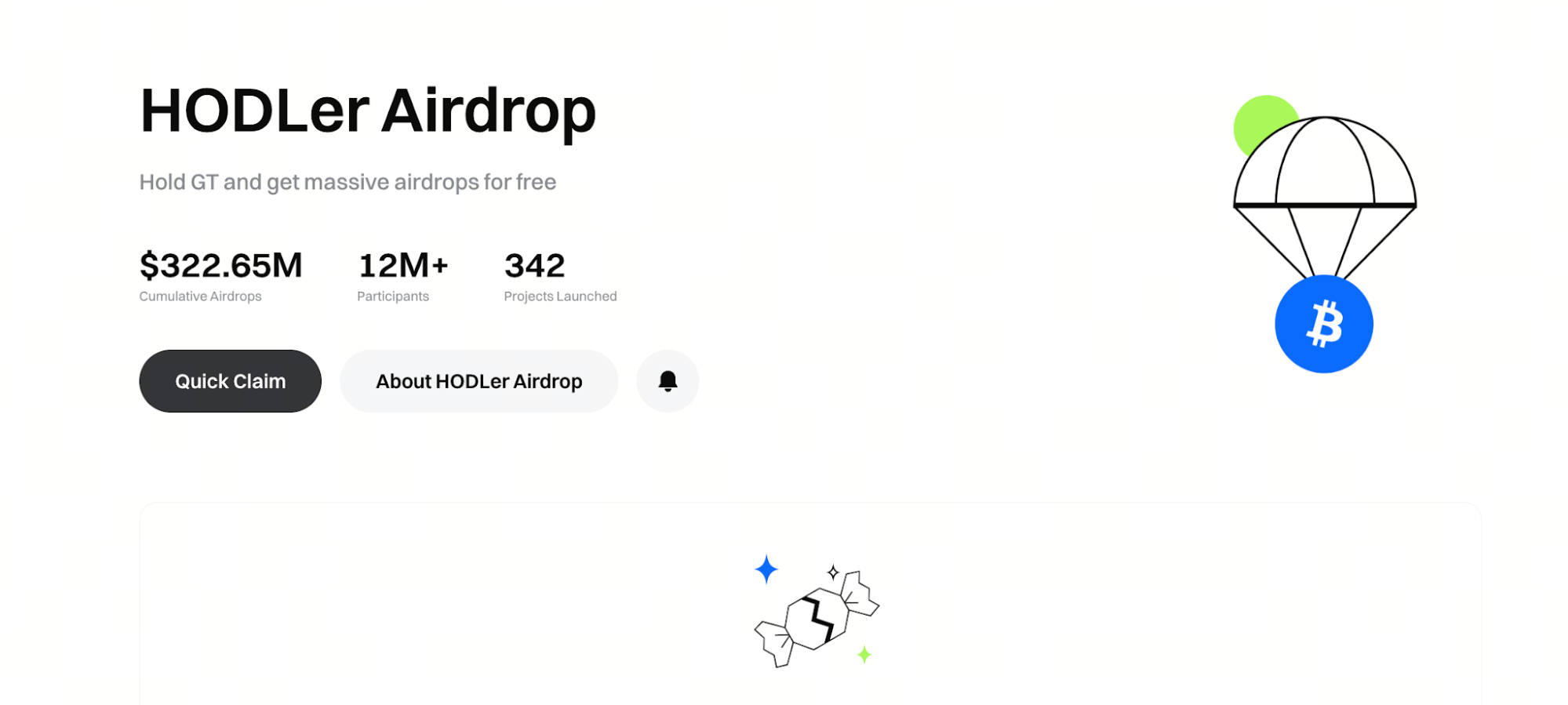
Key Takeaways
-
Gate HODLer Airdrop is a new token airdrop program for GT holders, with a current basic participation threshold of at least 1 GT.
-
Users need to complete identity verification and register for eligible campaigns.
-
Airdrop rewards are primarily calculated according to the user’s average GT holdings during the campaign relative to the average holdings of all participating users.
-
Gate takes multiple random snapshots each hour and calculates an hourly average balance, reducing the impact of temporarily increasing GT holdings around a single snapshot.
-
Registering after a campaign begins does not necessarily mean earlier holdings are completely excluded, as the current mechanism can retroactively account for relevant holdings after the campaign starts.
-
Different campaigns may set different GT participation limits, while some campaigns provide higher limits based on VIP level.
-
Participating in HODLer Airdrop does not deduct the GT used to qualify for the airdrop.
-
Airdropped tokens are subject to price volatility and project-specific risks, and receiving tokens does not guarantee future value.
What Is Gate HODLer Airdrop?
Gate HODLer Airdrop is a token distribution mechanism designed for GT holders. A project provides a certain amount of new tokens as an airdrop reward pool, and eligible Gate users can register for the campaign and share the rewards based on their qualifying GT holdings.
The core mechanism does not require users to purchase the airdropped token. Instead, GT holdings serve as an important factor in determining both participation eligibility and reward allocation. Under the current basic requirements, users need to complete identity verification and hold at least 1 GT. If the calculated average GT balance during the campaign is below 1 GT, the user will not qualify for the corresponding reward.
HODLer Airdrop is frequently used to distribute tokens from new projects. Gate has previously used HODLer Airdrop campaigns to distribute tokens from projects such as IDOS, ST, and RAIN, with Spot trading for certain tokens opening after the corresponding campaigns.
HODLer Airdrop can therefore be understood as a mechanism connecting GT holders with new project token distributions within the Gate ecosystem. Instead of directly purchasing the new token, eligible users can receive an allocation based on their qualifying GT holdings.
How Does Gate HODLer Airdrop Work?
A typical HODLer Airdrop campaign includes several key elements: the airdrop project, campaign period, GT holding calculation, total token allocation, and individual participation limit.
Once a campaign begins, users can enter the corresponding HODLer Airdrop page and register. The system does not simply record how much GT a user holds at the exact moment of registration. Instead, it tracks qualifying GT holdings throughout the campaign period.
Gate currently uses a multiple random snapshot mechanism. During each hour, the system records GT holdings multiple times and calculates the average balance for that hour. It then combines the hourly data across the campaign to determine the user’s final average holdings used for reward calculations.
This mechanism is designed to reduce the impact of users temporarily increasing their GT holdings around a specific snapshot time and selling immediately afterward. Compared with a single-point snapshot, average holdings across the campaign provide a better representation of sustained GT ownership.
After the campaign ends, the system allocates the airdropped tokens according to each participant’s qualifying average holdings. The final reward may also be affected by individual participation limits, VIP level, and other project-specific rules.
How Are Gate HODLer Airdrop Rewards Calculated?
The core reward formula can be expressed as:
Final token reward = (User’s average hourly GT holdings during the campaign ÷ Average hourly GT holdings of all participating users during the campaign) × Total airdrop allocation
For example, suppose a project allocates 1,000,000 tokens to a HODLer Airdrop campaign, and a user’s qualifying average GT holdings represent 0.1% of the total qualifying average holdings of all participants. Without considering individual caps or other special rules, the user could theoretically receive approximately 1,000 tokens.
The key concept here is average holdings, rather than the amount of GT visible at a single point in time. If a user holds 1,000 GT at the beginning of a campaign but transfers most of it out during the second half, the final average holding will decrease, potentially reducing the airdrop allocation.
Conversely, buying or transferring a large amount of GT shortly before the campaign ends does not mean that the entire campaign will be calculated using that higher balance. Users trying to understand their final reward should therefore consider their holdings throughout the full campaign rather than looking only at the ending balance.
How Does the Gate HODLer Airdrop Snapshot Mechanism Work?
Gate upgraded the HODLer Airdrop holding snapshot mechanism in 2025, moving toward multiple random snapshots across the entire airdrop campaign.
The system randomly takes multiple snapshots of a user’s GT holdings during each hour and then calculates the average balance for that hour. After the campaign ends, the hourly holding data is used to calculate the user’s average holdings over the full campaign period.
One notable feature of the current mechanism is that users who register after the campaign has already started may still have relevant GT holdings from earlier in the campaign counted retroactively. In Gate’s example, when a user registered several hours after the campaign began, the system could still retrieve qualifying holding data from the earlier part of the campaign.
This means HODLer Airdrop should not simply be understood as “GT holdings only start counting after registration.” Users still need to register within the specified campaign period, however, and the final eligibility and snapshot rules should always follow the terms of the specific project.
What Are the Requirements for Gate HODLer Airdrop?
Under the current basic HODLer Airdrop requirements, users need to complete identity verification and hold at least 1 GT.
Individual projects may also set their own maximum eligible GT holdings. This means that even if a user holds more GT than the campaign limit, the amount above that limit may not be included when calculating the user’s airdrop allocation.
Some campaigns also increase participation limits based on Gate VIP level. In certain 2026 HODLer Airdrop campaigns, users at lower VIP levels had lower eligible GT limits, while higher VIP levels received larger limits. Some campaigns provided uncapped participation for eligible users at VIP 10 or above. The exact thresholds are determined separately for each campaign.
Therefore, it is not accurate to assume that holding more GT will always increase rewards without limit. Once a user exceeds the applicable participation cap, additional GT may no longer increase the allocation for that particular campaign.
How to Participate in Gate HODLer Airdrop
Users first need to log in to their Gate personal account, complete identity verification, and make sure they hold at least 1 GT.
On Gate, users can navigate to Earn → HODLer Airdrop through the web or app interface and view currently available campaigns. After selecting an ongoing project, users should review the total airdrop allocation, campaign end time, eligible GT limit, and other project-specific requirements before registering for the campaign.
After registration, users do not need to manually check in every hour. The system automatically records qualifying GT holding snapshots according to the campaign rules and calculates rewards based on the user’s eligible average holdings after the campaign ends.
Users can review their participation results and distributed tokens through the relevant airdrop records or project page. Distribution timing and trading availability can differ by project, so receiving an airdrop does not necessarily mean that Spot trading or withdrawals will become available immediately.
Does Participating in HODLer Airdrop Deduct GT?
Participating in HODLer Airdrop does not mean using GT to purchase the new token. As a result, the GT used to qualify for the campaign is not deducted simply because the user receives an airdrop.
In HODLer Airdrop campaigns, GT holdings primarily determine eligibility and the user’s weighting within the airdrop reward pool. Users continue to hold their GT rather than exchanging it directly for the new project token.
This is one of the important differences between HODLer Airdrop and mechanisms such as token subscriptions or directly buying newly listed tokens. Users are receiving additional project tokens based on qualifying GT holdings rather than exchanging GT for those tokens.
However, “GT is not deducted” does not mean participation is completely free of economic risk. GT itself can rise or fall in market value. Users who purchase a large amount of GT solely to participate in a particular airdrop may therefore be exposed to GT price volatility during the holding period.
Does VIP Level Affect HODLer Airdrop?
VIP level may affect the maximum eligible GT holdings for some HODLer Airdrop campaigns, although not every campaign follows exactly the same VIP rules.
In some Gate campaigns, different VIP levels correspond to different maximum eligible GT amounts. Higher VIP levels may receive higher participation limits, allowing more of a user’s GT holdings to be included in the airdrop calculation if they hold enough GT.
For example, if a campaign limits eligible participation for a particular VIP tier to 2,000 GT, a user holding 5,000 GT may still have only up to 2,000 GT counted under that campaign’s rules. A higher VIP tier with a larger limit may allow more of the user’s holdings to be included.
VIP-based limits are project-specific rather than permanent parameters of HODLer Airdrop. Users should therefore review the applicable limits each time they participate in a new campaign.
What Is the Difference Between Gate HODLer Airdrop and Launchpool?
HODLer Airdrop and Gate Launchpool can both provide access to new project token rewards, but their participation mechanisms are different.
HODLer Airdrop is primarily based on GT holdings. Users hold a qualifying amount of GT, register for a campaign, and receive rewards based on their average eligible GT holdings over the campaign period.
Launchpool is closer to an asset staking model. Different projects may open pools for GT, USDT, BTC, ETH, or other designated assets. Users actively stake assets into the corresponding pool and receive hourly rewards based on their effective share of the pool.
| Category |
HODLer Airdrop |
Gate Launchpool |
| Core Participation Method |
Hold GT and register |
Stake designated assets into a pool |
| Common Participation Assets |
GT |
GT, USDT, BTC, ETH, and others depending on the project |
| Reward Calculation |
Share of average GT holdings during the campaign |
Effective stake as a share of total pool stake |
| Reward Frequency |
Distributed according to project completion and allocation rules |
Usually calculated and distributed hourly |
| Assets Need to Be Staked Into a Pool |
Generally no |
Yes |
| Individual Limits |
Determined by project and, in some cases, VIP rules |
Determined by project staking limits and other requirements |
Although both products are associated with new token rewards, HODLer Airdrop is better understood as an extension of GT holding benefits, while Launchpool involves actively allocating assets to a staking pool.
What Are the Risks of Gate HODLer Airdrop?
The first risk is GT price volatility. Although HODLer Airdrop does not directly deduct GT for participation, users still hold GT throughout the process. If the market price of GT moves significantly, gains or losses on the GT position may be larger than the value of the airdrop received.
The second risk is the price volatility of the airdropped token. The number of tokens distributed may be calculated according to the campaign rules, but their actual market value depends on supply, demand, liquidity, and broader market conditions. Newly listed tokens can experience substantial price movements.
The third risk is project-specific uncertainty. Projects featured through HODLer Airdrop may still be at relatively early stages, and their product development, token economics, liquidity, adoption, and market demand can change over time.
Campaign rules can also vary. Total token allocations, eligible GT limits, VIP-related limits, campaign periods, and token distribution or unlocking arrangements may differ between projects. Users should rely on the current campaign rules rather than assuming that parameters from a previous HODLer Airdrop will apply to a new one.
Summary
Gate HODLer Airdrop is a new token airdrop mechanism designed around GT holders. After completing identity verification, holding at least 1 GT, and registering for an eligible campaign, users can participate in token distributions based on their average qualifying GT holdings over the campaign period.
The key mechanism is not “using GT to buy new tokens.” Instead, Gate takes multiple random snapshots of GT holdings and calculates an average balance, which is then used to determine each participant’s share of the airdrop. The GT used for participation is generally not deducted simply because a user receives an airdrop.
However, an airdrop should not be treated as risk-free income. GT itself can fluctuate in value, newly distributed project tokens can experience significant volatility, and participation limits, VIP rules, and token distribution arrangements may differ from one campaign to another.
When evaluating a Gate HODLer Airdrop campaign, users should therefore look beyond the number of tokens available and understand the average holding calculation, their individual eligible GT limit, and the risks associated with the underlying project.
FAQ
What is Gate HODLer Airdrop?
Gate HODLer Airdrop is a new token airdrop program for GT holders, allowing eligible users to share project token rewards based on their average qualifying GT holdings during a campaign.
How much GT do I need for Gate HODLer Airdrop?
The current basic participation threshold is at least 1 GT, and users also need to complete identity verification. Individual campaigns may introduce additional eligibility requirements or participation limits.
Does participating in HODLer Airdrop deduct my GT?
No. Under the standard HODLer Airdrop mechanism, GT is used to determine eligibility and reward allocation rather than being exchanged for the airdropped token.
How are HODLer Airdrop rewards calculated?
Rewards are primarily calculated based on the user’s average hourly GT holdings during the campaign relative to the average hourly holdings of all participating users, subject to individual participation limits and other project-specific rules.
Do I need to lock GT after registering for HODLer Airdrop?
HODLer Airdrop is based on GT holding snapshots rather than staking GT into a Launchpool-style pool. However, reducing GT holdings during the campaign can lower the user’s average eligible balance and may reduce the final airdrop allocation.
Is Gate HODLer Airdrop the same as Launchpool?
No. HODLer Airdrop primarily distributes rewards based on GT holding snapshots, while Launchpool requires users to stake designated assets into a pool and distributes rewards based on their effective share of that staking pool.