The intersection of AI and crypto has expanded rapidly over the past two years, and FastX Network bets on combining physical GPU data centers with on-chain token incentives: miners deploy GPUs in data centers worldwide to form a compute network, while FXNW and node NFTs measure contributions and distribute rewards. As of September 22, 2026, FXNW's circulating supply stands at roughly 130 million tokens, or 13% of total supply (Source: Gate price page), placing it in an early distribution phase. Three threads frame the project — how the four layers coordinate, what node NFTs and Mining Power entitle holders to, and how the token allocation unlocks — the same lens used to evaluate any decentralized AI infrastructure claim.
Key Takeaways
- FastX Network positions itself as decentralized AI infrastructure, converting GPU compute into AI agents and decision tools for Web3 through four layers: L1 vector database, L2 AI, L3 routing, and L4 application.
- FXNW is an ERC-20 token on Arbitrum One with a 1 billion supply; 40% is reserved for mining and node rewards released over 10 years, with revenue-funded buyback and burn planned.
- FastX nodes are ERC-721 NFTs in three tiers — L1, L2, and L3 — with Mining Power of roughly 2,000G, 100G, and 10,000G respectively; each holder can create one AI agent free of charge.
- Core claims such as physical GPU data centers and proprietary AI algorithms lack independent third-party verification, and a same-name counterfeit token exists on Base — verify the network, contract, and decimals before engaging.
What Is FastX Network (FXNW)?
FastX Network positions itself as a decentralized AI infrastructure serving Web3, claiming to have built AI compute data centers worldwide and to schedule distributed compute through a unified platform. Unlike software-only AI crypto projects, FastX Network emphasizes physical infrastructure: miners deploy real GPUs in data centers across the globe, and that compute is scheduled upward through the stack.

This differentiated positioning rests on four pillars: physical GPU infrastructure, Web3-native AI agents, cross-platform AI integration routing, and ecosystem incentives built around FXNW. The FXNW contract is 0xd3eA09206d4a76361e369e16b4Ff37A89838623d, an ERC-20 token with 18 decimals and a total supply of 1 billion.
How Does FastX Network's Four-Layer Architecture Work?
FastX Network's technology stack is divided into four layers from the bottom up; user requests travel downward through the stack and return with results. Consider a user asking an AI agent to generate a market signal report:
- The L4 application layer receives the request. The user submits a need through an information dashboard, control panel, or AI agent interface, and the application layer converts natural language into a task.
- The L3 routing layer assigns a path. The routing layer optimizes AI token usage costs, chooses among multiple AI platforms and compute sources, and decides which data center handles the request.
- The L2 AI layer executes the computation. Physical GPU data centers run proprietary AI algorithms to complete inference — the layer where compute is actually consumed.
- The L1 vector database layer supplies the knowledge base. Information inside FastX data centers is converted into vector data for the AI layer to retrieve and cite.
- Results travel back up the stack. Output returns along L2 → L3 → L4 to the application layer, presented as reports, signals, or agent actions.
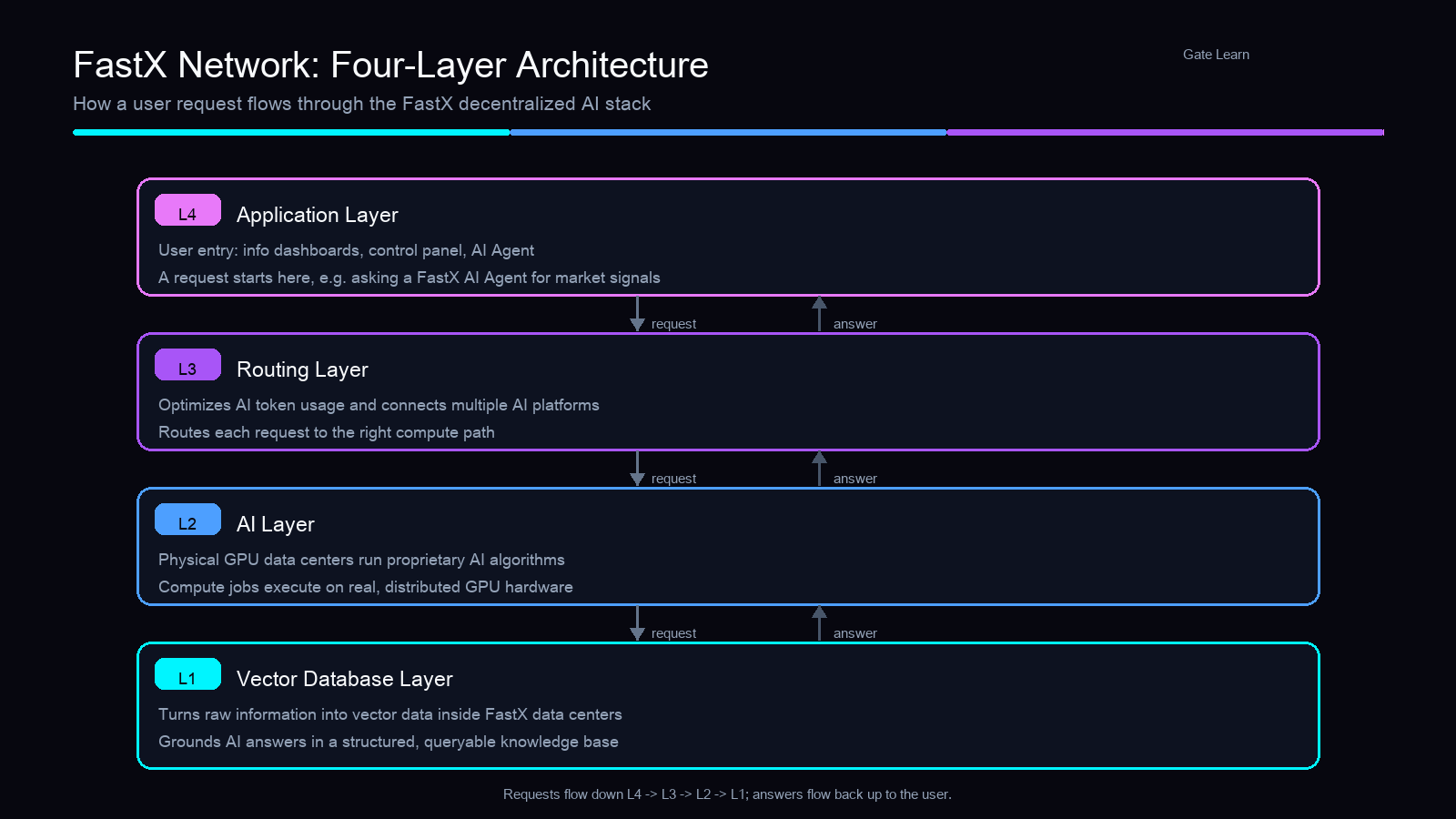
Figure 1. FastX Network's four-layer data flow: user requests pass down from the L4 application layer through routing, AI, and vector database layers, then results return layer by layer.
This layered design decouples compute supply, model execution, cost routing, and the interface: the routing layer can switch providers across AI platforms, while the vector database layer anchors outputs in FastX's own data.
What Are FastX Nodes? L1/L2/L3 and Mining Power Explained
A FastX node is fundamentally an ERC-721 NFT on Arbitrum One, implemented on the OpenZeppelin ERC721 standard; purchasing a node mints the NFT to the paying wallet, and on-chain state is the final proof of ownership. One clarification matters: a node NFT is an entitlement certificate for compute contribution, not a physical GPU — the NFT represents a share of the compute network, while GPUs are deployed and maintained by miners.
The three node tiers differ by Mining Power, where higher Mining Power means greater measured compute contribution and reward weight:
| Node Tier |
Mining Power |
Current Status |
| L1 Node |
~2,000G |
Open in presale |
| L2 Node |
~100G |
Opens in a future phase |
| L3 Node |
~10,000G |
Opens in a future phase |
On the Mining Power gradient, L3 ranks above L1 and L1 above L2; the presale opens only L1, with L2 and L3 reserved for later phases. Purchasing involves two on-chain confirmations (first Approve USDT, then confirm the purchase), and once minted, the NFT appears under My Nodes after backend indexing. Node holders can create one AI agent free of charge in the FastX Agent Beta, locked to a "1 account, 1 agent; 1 wallet drives 1 agent" rule. Buying a node and self-operating GPU mining are two distinct paths, and L1/L2/L3 nodes and Mining Power covers the reward mechanics against GPU mining in finer detail.
What Is FXNW Used For? Tokenomics and Allocation
FXNW serves three core functions: paying AI service fees (AI agents, intelligent search, and decision tools, with discounts for token payments), staking and governance (voting on AI model updates, fee structures, and ecosystem expansion), and mining incentives (40% reserved for mining and node rewards released over 10 years, with liquidity mining and buyback-and-burn also planned).
The FXNW token allocation, per officially published figures, breaks down as follows:
| Allocation Category |
Share |
Unlock Schedule |
| Mining & Node Rewards |
40% |
Released over 10 years |
| Ecosystem Development |
15% |
Locked 2 years, then vested as needed |
| Investors |
10% |
1-year cliff, then 12-month linear unlock |
| Strategic & Listings |
10% |
Locked until needed |
| Team |
10% |
2-year cliff, then 12-month linear unlock |
| Liquidity & Market Making |
10% |
For trading pair liquidity |
| Airdrop |
10% |
For the early community |
Shares above follow officially published figures, and the advisor allocation is included within the breakdown.
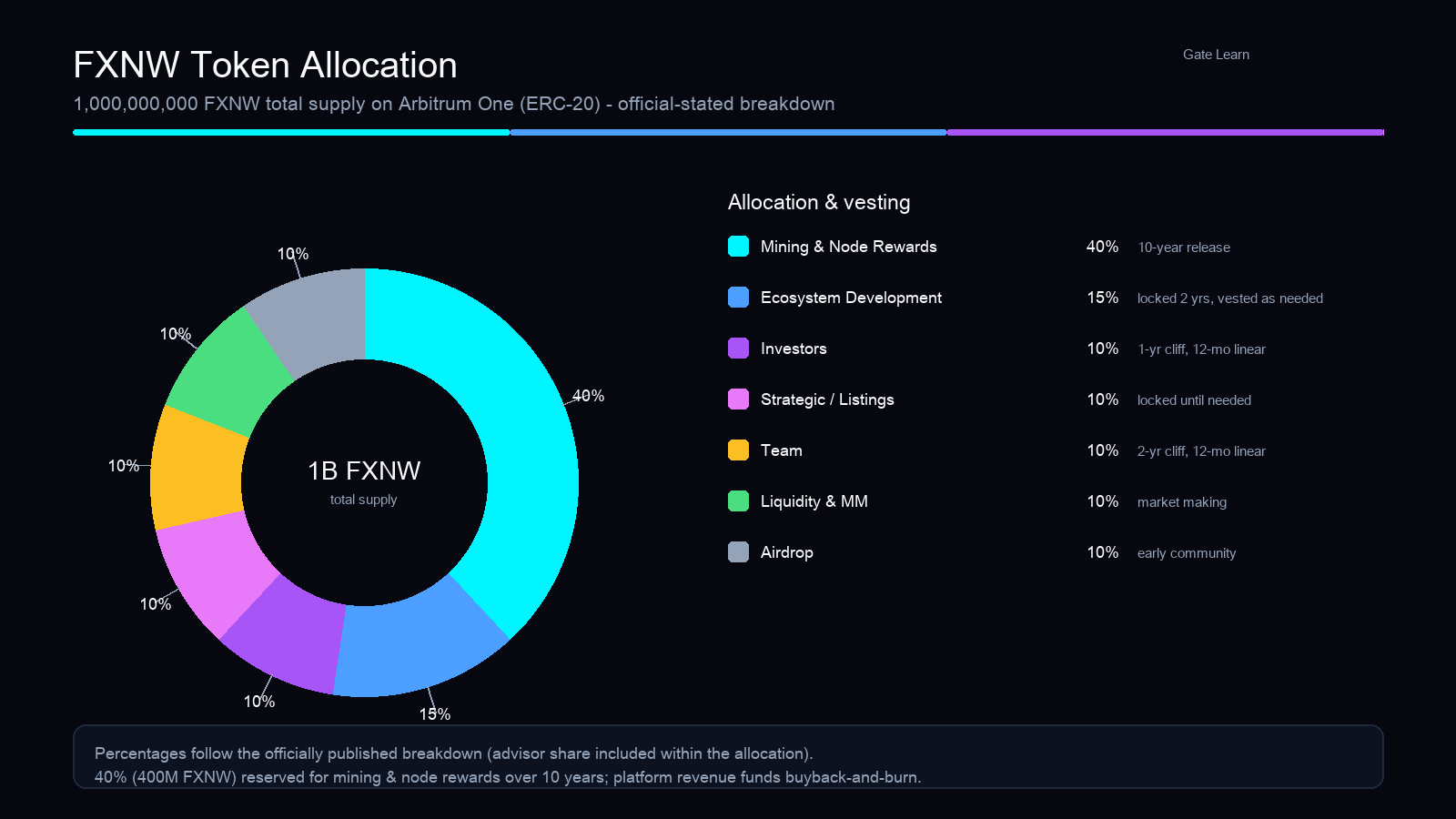
Figure 2. FXNW token allocation: 40% goes to mining and node rewards released over 10 years, with the remainder spread across ecosystem, investors, team, liquidity, and airdrop categories.
Reading the allocation table together with the vesting timeline, FXNW's sell pressure runs light first and heavy later: investor shares unlock linearly after a 1-year cliff, team and ecosystem shares lock for 2 years, so circulating growth in the first two years comes mainly from mining, airdrop, and liquidity allocations; mining takes 40% but spreads across 10 years, averaging about 4% of total supply per year. On the offsetting side, the platform plans to direct revenue shares into buyback and burn to create deflation — its effect depends on revenue scale, which currently lacks verifiable data as well.
What Can FastX Agent and the Ecosystem Do?
FastX Network plans five categories of AI application scenarios for Web3 users, all carried by FastX Agent:
- Trading: AI market signals and on-chain intelligence.
- Reporting: Automated market reports and portfolio analysis.
- AI Team Member: An AI employee online 24/7.
- Workflow Automation: Multi-step Web3 workflow orchestration and automatic execution.
- Advisory: Strategy advisory combining on-chain and off-chain data.
These five scenarios share the same underlying stack: the agent interface at the application layer, cost optimization at the routing layer, and compute at the AI layer resting on the vector database foundation. The rule granting node holders one free agent ties node NFTs to usage rights, closing the loop of "hold a node → receive an allowance → consume FXNW."
Who Backs FastX Network? Investors and Partners
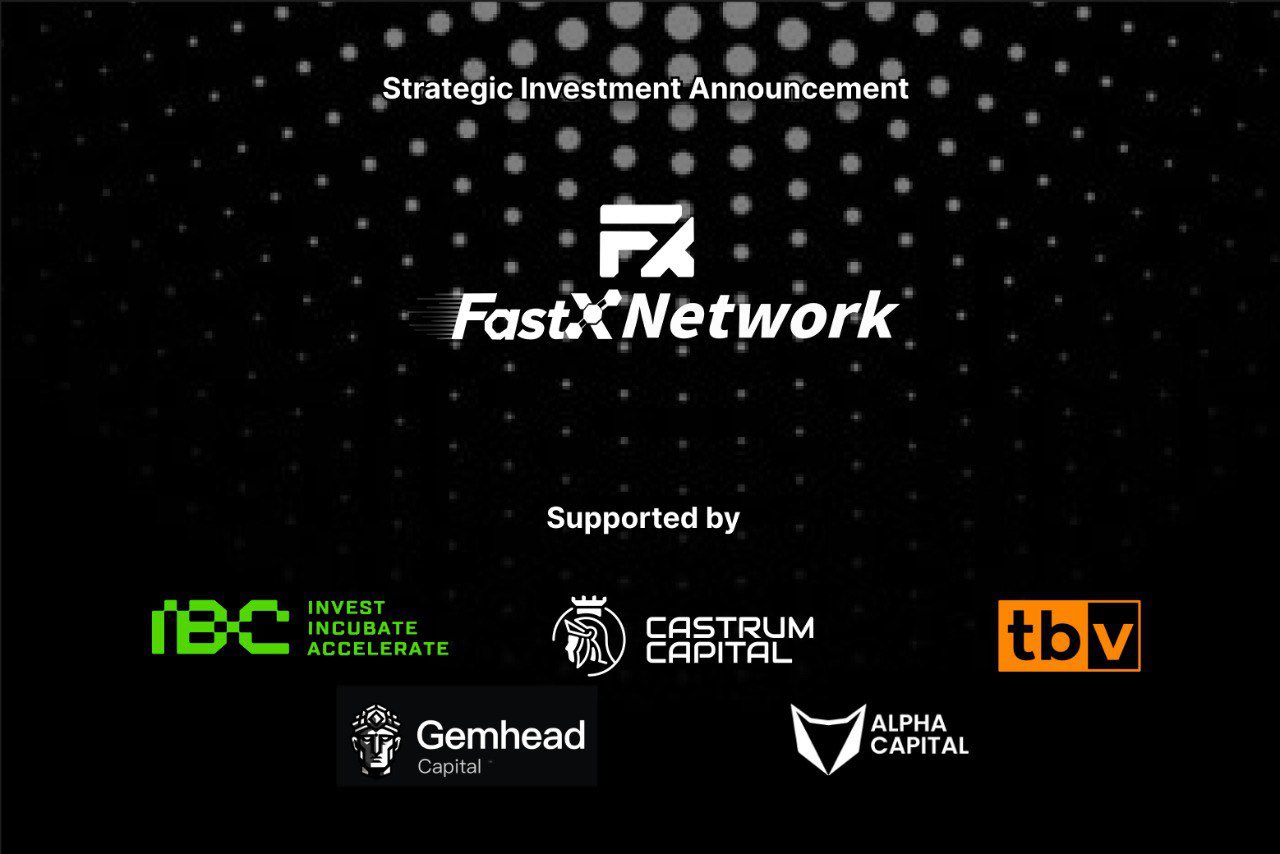
FastX Network closed a $3 million investment round in November 2025, led by IBC Group and Roundtable Space, with participation from Castrum Capital, TBV, Gemhead Capital, and Alpha Capital (Source: official X pinned post, November 13, 2025).
On the ecosystem side, FastX Network announced a partnership with decentralized compute project Nebulai on September 14, 2026; Nebulai organizes idle GPUs and CPUs into a permissionless compute network that complements FastX's scheduling layer. For listings, Gate debuted FXNW/USDT spot trading on September 22, 2026, with LBank listing the same day.
What Are the Risks of Holding FXNW?
FastX Network's core claims — physical GPU data centers and proprietary AI algorithms — currently lack independent third-party verification, and Arbiscan shows very few holder addresses for the official token, consistent with an early-stage project but also meaning on-chain network effects have yet to form. The node presale relies on backend authorization and an off-chain indexer, placing off-chain components between minting, Mining Power accounting, and reward distribution that require trusting the platform's backend bookkeeping. Another directly verifiable risk is same-name counterfeits: a token called "FastX Network (FXNW)" exists on Base with contract 0x6fAe8623B769CA5e57254b7fd0f69f777e31bcC3, 9 decimals, and a 1 trillion supply — not the same asset as the official FXNW. Verifying authenticity takes three steps: confirm the network is Arbitrum One, compare the contract, and check that decimals equal 18. Beyond that, FXNW has only just listed on spot markets; newly listed assets typically carry thin liquidity and sharp volatility, and the execution of unlocks and buyback-and-burn also requires ongoing tracking.
How to Trade FXNW on Gate
Gate debuted the FXNW/USDT spot trading pair at 12:00 UTC on September 22, 2026, with zero-fee Flash Swap starting at 13:00 UTC the same day alongside a CandyDrop campaign. The trading path: register and complete verification, deposit USDT, then search FXNW/USDT on the spot market to place an order. For on-chain deposits and withdrawals, always confirm the network is Arbitrum One to avoid confusion with the counterfeit token. Before trading, the Gate FXNW price page provides quotes, circulating supply, and market cap. Newly listed tokens are highly volatile, and any trading decision should rest on your own risk tolerance.
Summary
FastX Network (FXNW) grounds the decentralized AI infrastructure narrative in a dissectible structure: a four-layer architecture organizes the data flow from user request to GPU computation, ERC-721 node NFTs measure compute entitlements via Mining Power, and the ERC-20 FXNW handles payments, staking governance, and mining incentives — with 40% released over 10 years and buyback-and-burn on top. The project has raised $3 million from institutions including IBC Group and Roundtable Space and formed a compute partnership with Nebulai. At the same time, core claims such as physical compute capacity and proprietary algorithms still lack independent verification, holder addresses remain very few, and a same-name counterfeit token exists on Base — checking the network, contract, and decimals is a necessary step before touching FXNW.
FAQ
What is FXNW?
FXNW is the native token of FastX Network, issued on Arbitrum One as an ERC-20 token with 18 decimals and a total supply of 1 billion. FastX Network is a decentralized AI infrastructure that provides AI agents, intelligent search, and decision tools for Web3 applications through global GPU data centers; FXNW pays for service fees, staking governance, and mining rewards.
How does FastX Network work?
FastX Network operates through a four-layer architecture: the L1 vector database layer converts information into vector data, the L2 AI layer runs proprietary algorithms on physical GPU data centers, the L3 routing layer optimizes AI token usage and connects multiple platforms, and the L4 application layer provides dashboards and AI agent interfaces. User requests pass down from L4 through each layer for computation, and results return layer by layer.
How to buy FXNW?
One way to buy FXNW is trading the FXNW/USDT pair on Gate's spot market: after registering and completing verification, deposit USDT and search FXNW to place an order; Gate first listed the pair on September 22, 2026. When transferring on-chain, verify that the network is Arbitrum One and the contract is 0xd3eA09206d4a76361e369e16b4Ff37A89838623d to avoid buying the counterfeit token.
What is FXNW's total and circulating supply?
FXNW's total supply is fixed at 1 billion tokens. As of September 22, 2026, circulating supply is approximately 130 million tokens, or 13% of the total (Source: Gate price page). 40% is reserved for mining and node rewards, released over 10 years.
What is the FXNW token used for?
FXNW has three core uses: paying AI service fees on the FastX platform (AI agents, intelligent search, and decision tools, with discounts for token payments); staking and governance, where holders vote on AI model updates, fee structures, and ecosystem expansion and earn staking rewards; and mining incentives, where node holders receive rewards based on uptime and compute contribution, with liquidity mining and buyback-and-burn also planned.