There are two structurally different ways to participate in the FastX compute ecosystem: buying a node NFT onchain, where your stake is measured in Mining Power, or purchasing your own GPU hardware and contributing real compute to the network. Before comparing the two, it helps to ground yourself in the full picture: FastX Network (FXNW) is a decentralized AI infrastructure project on Arbitrum One that organizes global GPU compute through a four-layer architecture. FXNW is an ERC-20 token with a 1 billion total supply, and its mining and node reward pool holds 40% of supply, released over 10 years.
Key Takeaways
- A FastX node is an ERC-721 NFT on Arbitrum One, issued in L1, L2, and L3 tiers with Mining Power of roughly 2,000G, 100G, and 10,000G respectively; the GPU mining path requires owning physical GPUs and covering electricity and maintenance.
- The node path is a one-time USDT purchase with clearly bounded costs; GPU mining returns depend on hardware cost, power, uptime, and total network compute, and cannot be guaranteed.
- Both paths are rewarded from the same 40% FXNW mining and node reward pool (400 million tokens released over 10 years), measured by uptime and share of compute contribution.
- There is no public contract-level evidence that simply holding a node NFT automatically yields FXNW; the reward formula and claim process are unpublished and must be treated as known unknowns before participating.
What Is a FastX Node (NFT)?
A FastX node is fundamentally an ERC-721 NFT on Arbitrum One, implemented on the OpenZeppelin ERC721 standard; purchasing a node mints the NFT to the paying wallet, and the onchain state is the final proof of ownership. The node NFT is a claim on network compute rights rather than a physical GPU: it maps to a compute share and a Mining Power weight, while the physical GPUs are deployed and maintained by miners in data centers.
The purchase happens on the official node presale page, paid in USDT, with node prices subject to the live presale listing. Buying involves two onchain confirmations: first an Approve for USDT, then the purchase confirmation; after minting, the NFT is processed through backend authorization and an offchain indexer before appearing on the My Nodes page. Holdings accumulate as Mining Power, and during the FastX Agent Beta each holder can create one AI Agent for free, subject to the lock rules of one Agent per account at a time and one Agent per wallet at a time.
What Is the GPU Mining Path?
The FastX GPU mining path means contributing real compute to the network: miners deploy GPU hardware in data centers around the world — the FastX guide cites RTX 4080-class or enterprise-grade GPUs as examples — run mining software, supply compute to the FastX AI layer, and earn FXNW based on uptime and their share of compute contribution.
The fundamental difference from node NFTs is that miners hold physical hardware rather than an onchain NFT, and rewards are tied directly to the device's actual online status and compute output. Hardware procurement, electricity, and maintenance all fall on the miner, making this a capital-intensive, operations-heavy way to participate; FastX's claimed physical data-center footprint currently lacks independent third-party verification.
Node Ownership vs Physical GPU Deployment: How Do Barriers, Costs, and Rewards Differ?
The one-line conclusion: a node NFT is a buy-once, low-maintenance onchain claim, while GPU mining is a continuously funded, operations-heavy hardware business — the two have entirely different cost curves and risk exposures. Six dimensions capture the contrast:
| Dimension |
FastX Node (NFT) |
Physical GPU Mining |
| How to join |
Buy with USDT on the official node presale page |
Deploy GPU hardware in a data center and run mining software |
| Asset form |
ERC-721 NFT on Arbitrum One (ERC-721 non-fungible token standard) |
Physical GPU hardware (e.g., RTX 4080+ or enterprise-grade GPUs) |
| Cost structure |
Node NFT presale price (per live USDT listing on the presale page) |
Hardware purchase + electricity + data-center hosting and maintenance |
| Technical demands |
Wallet operations and two onchain confirmations (Approve USDT → confirm purchase) |
Hardware deployment, network configuration, continuous uptime maintenance |
| Reward source |
40% FXNW mining and node reward pool, measured by Mining Power and related rules |
The same 40% reward pool, allocated by uptime and compute contribution share |
| Liquidity and exit |
NFT is transferable; exit depends on secondary-market liquidity |
Hardware is resellable; residual value depreciates with each chip generation |
Both paths share the same 40% reward pool (400 million FXNW released over 10 years), but the measurement basis and exit mechanics differ. Node NFT liquidity depends on secondary-market depth, and no mature trading venue exists yet; GPU hardware residual value depreciates as chip generations advance. The backend authorization and offchain indexer in the presale flow are offchain components, so there are trust assumptions in the platform's backend between minting, Mining Power accounting, and reward distribution.
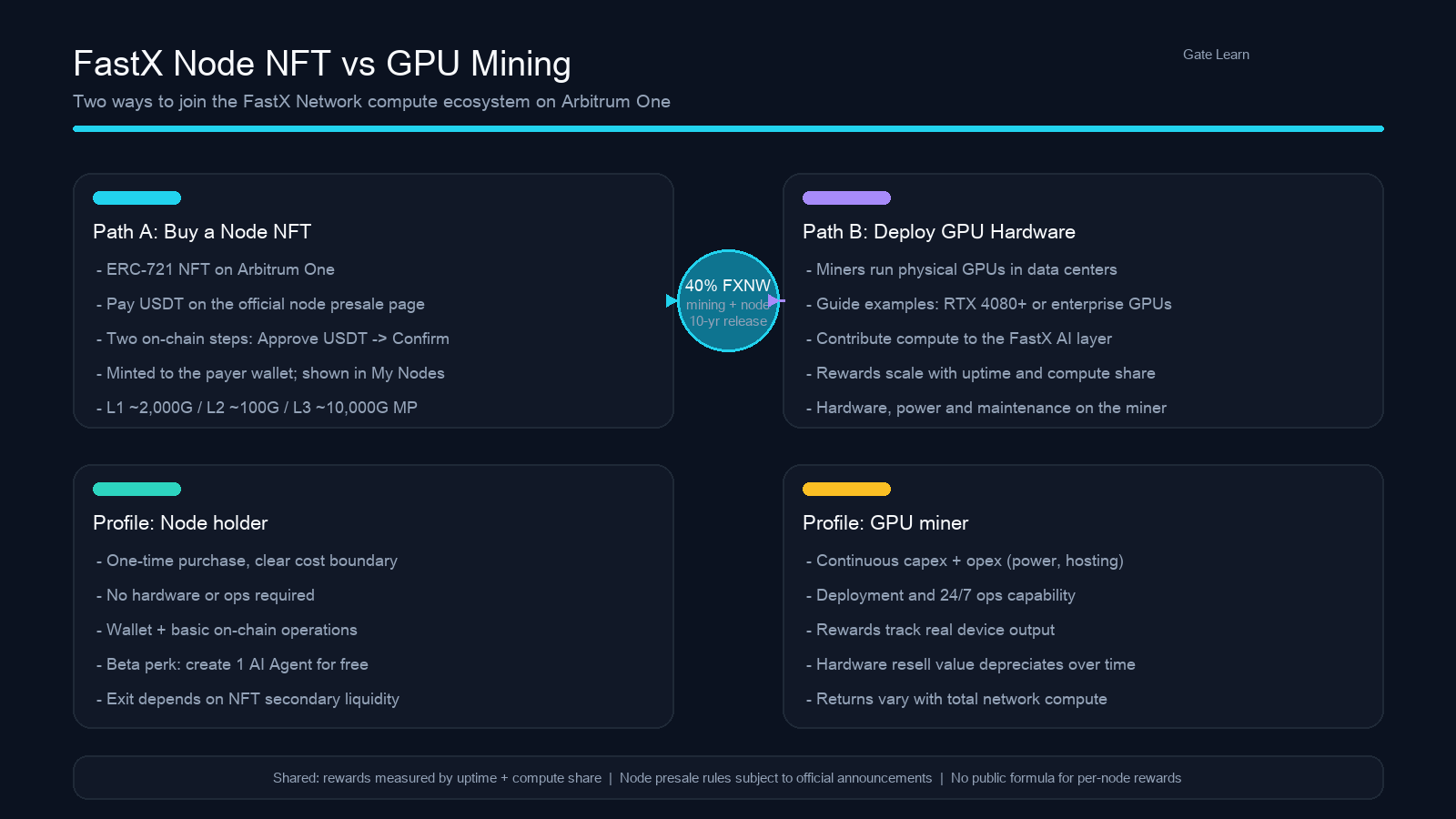
Figure 1. The FastX node NFT path versus the physical GPU mining path: the left side shows the onchain flow of buying an ERC-721 node NFT, the right side shows the operational flow of deploying GPU hardware, and both paths share the 40% FXNW mining and node reward pool.
L1 vs L2 vs L3: How Does Mining Power Differ?
The L1, L2, and L3 node tiers differ by Mining Power — a compute weighting — where higher Mining Power means a larger measured compute contribution and reward weight. The parameters and availability of the three tiers are:
| Node Tier |
Mining Power |
Current Status |
| L1 node |
~2,000G |
Open in the presale phase |
| L2 node |
~100G |
Opens in a future phase |
| L3 node |
~10,000G |
Opens in a future phase |
The gradient forms a clear pyramid: L3 Mining Power is about 5x L1 and about 100x L2. Only L1 is open in the current presale, with L2 and L3 reserved for later phases; presale rules and node reward specifics are subject to the backend and official announcements and may change.
On reward measurement, the FXNW mining and node reward pool accounts for 40% of total supply (400 million tokens), released over 10 years — roughly 4% of total supply per year on average — and rewards are allocated by node uptime and compute contribution share. Elsewhere in the allocation, 10% goes to liquidity and market making; staking FXNW grants governance voting rights and staking rewards, with liquidity mining and a platform-revenue buyback-and-burn also on the roadmap.
How Are FXNW Mining Rewards Generated and Claimed? What's Known and Unknown?
The FXNW mining reward mechanism can be split into two halves — confirmed facts and unpublished pieces — and the two should be weighed separately before participating.
Confirmed mechanism elements:
- Reward pool size: 40% of the 1 billion FXNW total supply (400 million tokens) is reserved for mining and node rewards, released over 10 years; the contract 0xd3eA09206d4a76361e369e16b4Ff37A89838623d is an ERC-20 token with 18 decimals, verifiable on Arbiscan.
- Measurement basis: nodes and miners earn rewards by uptime and compute contribution share, with Mining Power expressing the weight on the node side.
- Additional benefit: node holders can create one AI Agent for free during the FastX Agent Beta.
Unpublished or unverifiable elements:
- There is no public contract-level evidence that holding a node NFT automatically yields FXNW, and the reward claim method and calculation formula are unpublished.
- The node presale relies on backend authorization and an offchain indexer, so offchain accounting sits between Mining Power measurement and reward distribution.
- Actual returns on the physical GPU path depend on hardware cost, electricity, uptime, and total network compute, and cannot be calculated in advance.
Seen separately, the picture is clear: the 40% pool's size, release schedule, and measurement basis are verifiable tokenomics facts, while the exact reward amount per node or per GPU, the claiming contract, and the distribution cadence can currently only be taken from the backend and official announcements.
Which Path Suits Whom?
Neither path is inherently better — they simply match different situations: buying a node NFT means purchasing an onchain claim, while GPU mining means running a hardware compute business.
Choose a FastX node (NFT) if you:
- Want to join the FastX Network ecosystem with a low technical barrier and lack the means to deploy and maintain hardware;
- Prefer a one-time purchase with clearly bounded costs and can handle wallet and onchain confirmation steps;
- Value the added benefit of creating one AI Agent for free during the FastX Agent Beta;
- Can accept the uncertainty of adjustable reward rules and thin NFT secondary-market liquidity.
Choose physical GPU mining if you:
- Already own GPU hardware or have data-center hosting access, with the ability to keep machines online continuously;
- Can absorb ongoing hardware, electricity, and depreciation costs and run your own payback math;
- Prefer rewards tied directly to real device compute output;
- Can accept the business-like volatility of earnings as network-wide compute competition and hardware generations shift.
Whichever path you take, first verify that the FXNW contract is 0xd3eA09206d4a76361e369e16b4Ff37A89838623d, the network is Arbitrum One, and the decimals are 18, so you don't confuse it with same-name counterfeit tokens on Base; Gate listed the FXNW/USDT spot pair first on September 22, 2026, and the same verification steps apply to onchain deposits and withdrawals.
Summary
The core differences in FastX node vs GPU mining come down to asset form and cost structure: a FastX node is an ERC-721 NFT on Arbitrum One in L1/L2/L3 tiers with Mining Power of roughly 2,000G/100G/10,000G, suited to participants who want low barriers and light maintenance; physical GPU mining requires owning hardware and covering electricity and upkeep, suited to miners with hardware and operational capacity. Both paths share the 40% FXNW mining and node reward pool (400 million tokens over 10 years), measured by uptime and compute contribution. At the same time, contract-level evidence for automatic node rewards, the calculation formula, and the claim process remain unpublished, and the presale depends on an offchain indexer — uncertainties that belong on your checklist before participating.
FAQ
What is a FastX node NFT?
A FastX node NFT is an ERC-721 token issued on Arbitrum One, implemented on the OpenZeppelin ERC721 standard. It is purchased with USDT on the official node presale page and minted to the paying wallet, with the onchain state serving as the final proof of ownership. The node NFT represents a claim on FastX Network compute, weighted by Mining Power, and holders can create one AI Agent for free during the FastX Agent Beta.
What's the difference between buying a node and deploying your own GPU?
Buying a FastX node gives you an onchain ERC-721 NFT with Mining Power rights — a one-time USDT cost with no maintenance; deploying your own GPU means purchasing physical hardware (such as RTX 4080+ or enterprise-grade GPUs) and running it in a data center, continuously covering hardware, power, and maintenance costs, with rewards tied directly to device uptime and compute output. Both draw from the same 40% FXNW mining and node reward pool, but the asset form, cost structure, and exit routes are entirely different.
What's the difference between L1, L2, and L3 nodes?
The three tiers differ by Mining Power: L1 is about 2,000G, L2 about 100G, and L3 about 10,000G, with higher Mining Power carrying greater compute contribution weight and reward weight. Only L1 nodes are open in the current presale; L2 and L3 belong to future phases, and presale rules and node reward specifics follow the backend and official announcements.
How are FXNW mining rewards calculated and claimed?
The published basis: rewards come from the 40% FXNW mining and node reward pool (400 million tokens released over 10 years), allocated by uptime and compute contribution share, with Mining Power expressing node-side weight. However, the specific reward formula, the claiming contract, and contract-level evidence that holding a node NFT automatically yields FXNW have not been published, so the claim method should be taken from the backend and official announcements.
Is FastX node mining profitable?
FastX node rewards come from the 40% FXNW reward pool and are measured by uptime and compute share, but there is no public formula for how much FXNW a single node receives, so returns cannot be calculated in advance. FXNW has been volatile in its early trading period, node NFT presale prices follow the live presale listing, and reward rules may be adjusted; actual outcomes depend on multiple uncertain factors including reward distribution, token price, and secondary-market liquidity.