xBubble matters because the DAPPOS thesis depends on whether a conversational interface can do more than answer questions. If xBubble can reliably interpret prompts and return useful outputs, it becomes the clearest product proof for DAPPOS as an AI operating system rather than as a narrative label.
xBubble is also useful as a separate topic because many readers want to distinguish the ecosystem from the product. DAPPOS refers to the broader platform and token context, while xBubble is the product layer most users are likely to encounter directly.
Key takeaways
- xBubble is the flagship AI product within the DAPPOS ecosystem and serves as a user-facing prompt interface.
- xBubble is designed to convert plain-language requests into structured Web3 outputs or application-ready results.
- xBubble should be evaluated through workflow, output quality, and user fit rather than through AI branding alone.
- xBubble lowers interface friction, but it does not eliminate the need to assess accuracy, scope, and operational risk.
What is xBubble?
xBubble is a product interface that lets users describe what they want in natural language and receive a result intended to be useful in a Web3 context. The main promise is convenience: users express goals through prompts instead of assembling tool chains manually.
That means xBubble is not best understood as a generic question-answering chatbot. xBubble is better understood as an AI product built around translating intent into outputs that have a clearer path to action, deployment, or execution.
xBubble is the flagship product within DAPPOS, while DAPPOS is the broader ecosystem and operating-system narrative. Readers who need the higher-level definition can return to What is DAPPOS (DOS)?, but the practical way to understand the ecosystem is often to start with xBubble itself.
This distinction matters because many crypto-AI projects combine brand, protocol, token, and application layers under one name. Separating xBubble from DAPPOS helps clarify which claims belong to the product workflow and which belong to the larger ecosystem story.
How does xBubble turn prompts into Web3 app outcomes?
xBubble is built around a prompt-to-output workflow. A user states a desired task, tool, or application outcome, and the system interprets the request before producing a result that is meant to be more directly usable than a plain text answer.
The value of this model lies in reducing the translation burden on the user. Instead of converting goals into technical steps alone, the user provides intent first, while xBubble attempts to bridge that intent into structure, logic, and delivery.
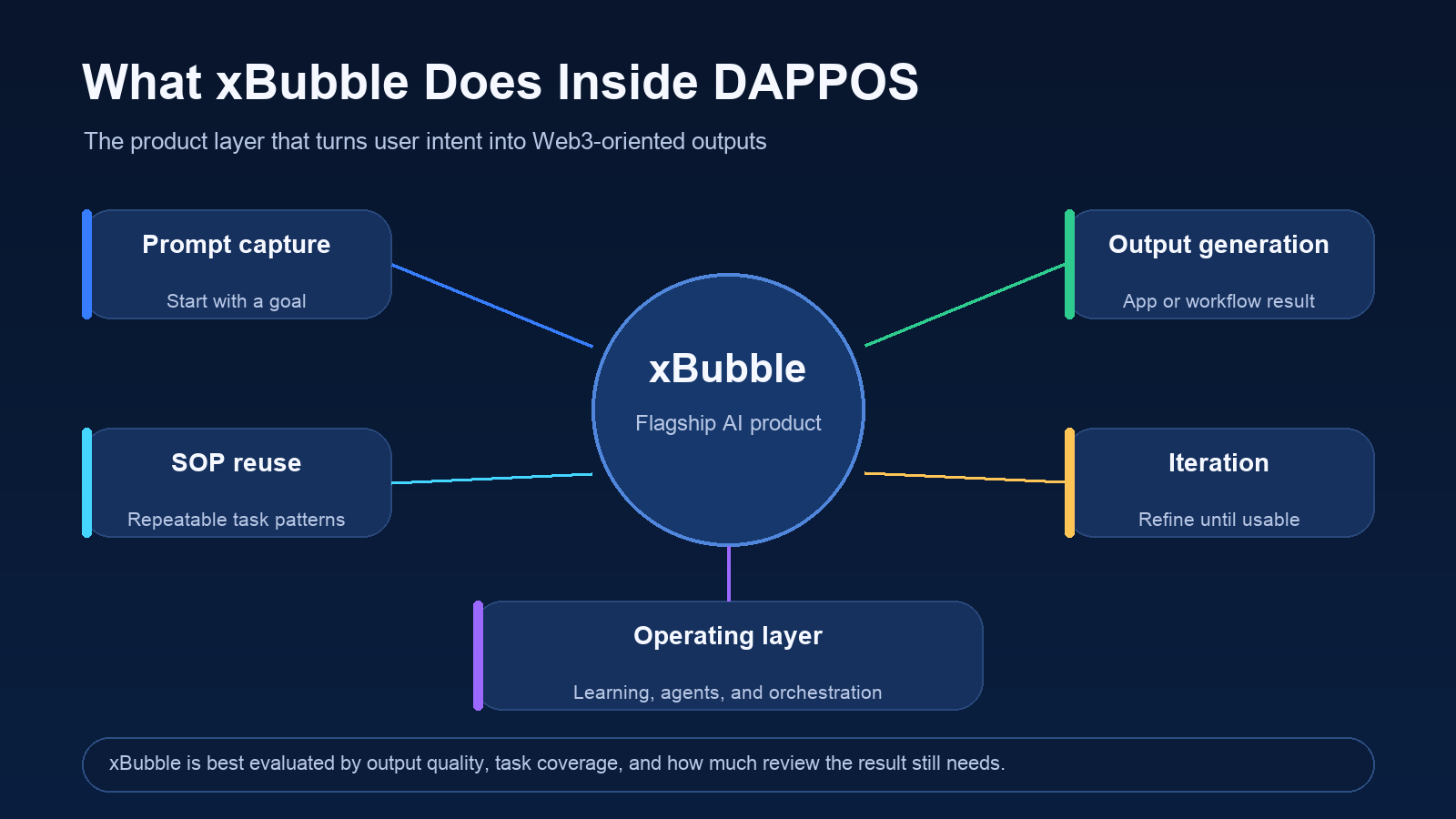
In practical terms, that can include research-oriented requests, testing flows, content or app drafting, and multi-step tasks that would otherwise require the user to move between separate tools. DAPPOS describes xBubble as part of a broader effort to make AI more learnable and more operated through reusable SOP-style paths, which is important because many Web3 tasks are repetitive, conditional, and difficult to express through one-off prompts alone.
If xBubble relies on agents, SOP orchestration, and a persistent learning layer, the product is trying to do more than answer questions. The goal is to let the system learn how a task should be handled, reuse that operating pattern, and then produce a solution that is closer to a ready-to-use result. That framing helps explain why DAPPOS presents xBubble as a Web3 AI product rather than as a general AI assistant.
| Step |
What xBubble does |
Why it matters |
| Intent capture |
Reads a plain-language request from the user |
Lets the user start with goals rather than configuration |
| Interpretation |
Maps the request into a structured task path |
Connects conversation to execution logic |
| Output generation |
Produces a usable Web3-oriented result |
Makes the system operational rather than purely descriptive |
| Iteration |
Allows the user to refine the request |
Improves alignment between intent and outcome |
What kinds of users and use cases fit xBubble?
xBubble may fit users who want a shorter path from idea to result in Web3. That can include builders who want faster prototyping, operators who want a more guided workflow, and users who are interested in outcome-oriented automation without learning every underlying tool first.
The product may be especially relevant where the task is clear but the tool path is fragmented. In those situations, a conversational interface can be more useful than a dashboard-heavy environment, provided the output remains reliable enough to act on.
Examples can include on-chain research, workflow drafting, app-building support, and repeated operational tasks where a team wants the same solution pattern to be used each time. In those settings, the value of xBubble depends not only on response quality but also on whether the system can retain learning, coordinate agents, and keep the operated process understandable enough for users to review.
xBubble differs from a general AI chat tool by focusing on actionable Web3 outcomes rather than on broad conversational assistance alone. A general AI tool can explain concepts, generate text, or answer open-ended questions, but xBubble is framed around moving from request to practical result inside a narrower domain.
This difference is important because domain focus changes user expectations. If xBubble is treated only as a chatbot, its product value can be underestimated. If xBubble is treated only as a magic automation layer, its limitations can be ignored. A balanced view evaluates both the interface and the output discipline.
What should users watch before relying on xBubble?
Users should look at output consistency, supported task range, and the amount of review required before acting on a result. A smooth chat interface can reduce friction, but it can also make people overlook edge cases, unsupported tasks, or gaps between a generated result and a production-ready result.
Users should also separate convenience from certainty. xBubble may reduce the effort needed to get started, but it cannot automatically remove the need for judgment, verification, or awareness of operational risk in Web3 environments.
A practical way to read the xBubble roadmap is to focus on how bubble workflows, learning loops, and SOP reuse may help users move from research to testing and then toward a more usable solution. In that framing, xBubble is built to support repeated tasks, operated processes, and agent-assisted execution rather than one-time prompts alone.
DAPPOS materials also connect xBubble with Bubble Engine, a deeper operating layer intended to make the system more adaptive as users repeat the same kinds of tasks. That idea matters because many Web3 users do not need infinite flexibility; they need a built solution path that can be learned, reused, and improved.
For builders, this is also why xBubble is sometimes compared with a blockchain app builder. A blockchain app builder helps users shape applications with fewer manual steps, while xBubble extends that idea by combining research, testing, agents, and SOP-style orchestration into one prompt-led flow.
Summary
xBubble is the flagship AI product in the DAPPOS ecosystem and is designed to translate simple prompts into usable Web3-oriented outputs. The clearest way to assess xBubble is to look at whether it narrows the gap between user intent and practical delivery more effectively than a general AI chat tool or a traditional Web3 dashboard workflow.
FAQ
What is xBubble in DAPPOS?
xBubble is the flagship AI product inside the DAPPOS ecosystem. xBubble is designed to turn simple prompts into structured Web3 outputs or application-ready results.
Is xBubble the same as DAPPOS?
xBubble is not the same as DAPPOS. xBubble is the product layer, while DAPPOS refers to the broader platform and ecosystem context.
How does xBubble work?
xBubble works by taking a user's natural-language request, interpreting the intent, and generating a more usable Web3-oriented output than a normal text-only answer. The product focuses on reducing the operational steps between idea and result.
Is xBubble just a chatbot?
xBubble is better described as a Web3-focused AI product than as a general chatbot. The product aim is to produce practical outcomes, not only conversational responses.
What should users check before using xBubble?
Users should check what tasks xBubble supports, how reliable the outputs are, and how much manual review is still needed before acting on a result. Users should also confirm whether a generated output is only a draft or is ready for real use.