As AI generated content, AIGC, and automation tools become increasingly common, the question of “who is a real user” on the internet is becoming more complex. Traditional verification methods, such as phone numbers, email addresses, or CAPTCHAs, are no longer enough to effectively prevent mass bot registrations and manipulation. In this environment, building a mechanism that can verify “real humans” has become an important issue in Web3 and digital identity.
World ID was introduced against this backdrop as an identity protocol. As a core part of the Worldcoin ecosystem, it combines biometrics with encryption technology to achieve Proof of Personhood. This mechanism is not only used to prevent Sybil Attacks, but also offers a new implementation path for decentralized identity systems, DID.
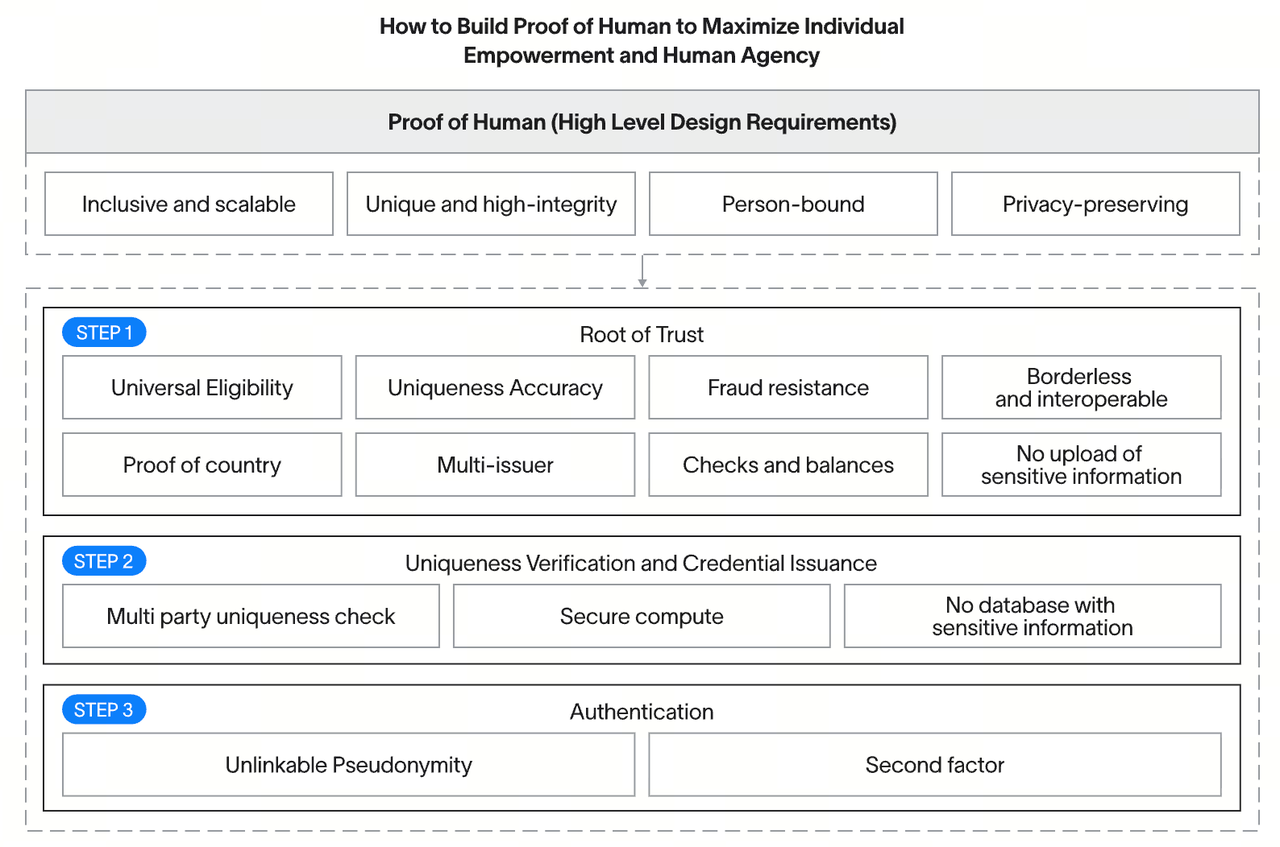
Source: Worldcoin White Paper
What Is World ID?
As a blockchain based digital identity system, World ID is used to prove that a user is a “unique and real human individual.” It does not rely on traditional identity information. Instead, it generates encrypted credentials from biometric traits, allowing users to complete identity verification across different applications.
Unlike common account based systems, World ID does not directly store users’ personal data. It generates a verifiable but irreversible identity marker, achieving uniqueness while protecting privacy.
What Is the Core Principle Behind World ID?
The core of World ID is Proof of Personhood, which ensures that each identity corresponds to only one real human. This goal is achieved through biometric technology and cryptographic algorithms.
The system first obtains unique biometric traits through iris scanning, then converts them into digital codes and further generates encrypted hash values. Because the iris is highly unique, this approach can effectively prevent duplicate registrations and forged identities.
At the same time, the system uses Zero Knowledge Proofs, allowing users to complete identity verification without exposing specific biometric information. This creates a balance between “uniqueness” and “privacy protection.”
How Does Iris Verification, Orb, Work?
World ID’s identity verification relies on a dedicated device called the Orb. This device collects a user’s iris information and performs the initial processing.
In practice, users complete a one time iris scan through the Orb. The device captures the iris image and converts it into a digital feature code. This code is then processed into an IrisHash, which is used for later identity generation.
The key point in this process is that the system does not need to store the original image over the long term. Instead, it keeps only the encrypted result, reducing the risk of sensitive data exposure.
What Is the Complete World ID Verification Process?
From the user’s perspective, generating a World ID can be understood as a continuous process made up of several steps. First, users download World App and create an account. They then go to a location that supports Orb verification.
After the iris scan is completed, the system generates the corresponding IrisHash and uses cryptographic algorithms to create a unique World ID. This identity can then be linked to the user’s wallet for on chain interactions.
During later use, when users need to prove their identity, they can complete verification through Zero Knowledge Proofs without going through biometric verification again. This design makes the identity reusable while avoiding repeated data exposure.
How Does World ID Protect User Privacy?
Privacy protection is a key part of World ID’s design. The system uses multiple technical layers to reduce reliance on sensitive data.
First, iris data is converted into a hash value after collection, rather than being stored directly as an image. Second, Zero Knowledge Proofs allow users to complete verification without disclosing identity details. In addition, the identity credential itself does not contain information that can directly identify an individual.
This design allows World ID to provide identity uniqueness while reducing the risk of privacy leakage as much as possible. However, its real world security still depends on technical implementation and operational practices.
How Is World ID Different from Traditional KYC or DID?
World ID differs clearly from traditional KYC, or real name verification, and decentralized identity, DID, in its design philosophy.
KYC usually relies on government issued documents and centralized databases, while DID places more emphasis on users’ control over their own data and the ability to combine credentials. By contrast, World ID focuses on verifying “whether someone is a real and unique human,” rather than “who this person is.”
This difference makes World ID more suitable for scenarios that need to prevent duplicate identities, such as airdrop distribution, DAO voting, and anti bot systems. DID, meanwhile, is better suited to identity presentation and data management.
Limitations and Challenges of World ID
Although World ID offers an innovative approach to identity verification, it still faces certain challenges. Biometric technology is highly sensitive by nature, and users’ level of trust in data security will directly affect adoption.
In addition, the deployment of Orb devices creates physical limitations, meaning global expansion will take time. Regulatory differences across regions on biometric data collection may also affect adoption.
Together, these factors create uncertainty around World ID’s real world application.
Conclusion
World ID combines biometrics with encryption technology to achieve Proof of Personhood, meaning that one real human corresponds to one identity in a decentralized environment. This mechanism provides important identity infrastructure for Web3, helping prevent bot attacks and support fair participation.
As AI technology continues to develop, the importance of identity verification keeps rising. The technical path represented by World ID offers a new way to think about digital identity systems, but its long term development still needs to strike a balance among privacy, security, and regulation.
FAQs
What Is World ID?
World ID is a digital identity protocol used to verify that a user is a unique and real human individual.
How Does World ID Work?
It scans the iris through the Orb to generate an IrisHash, then creates an encrypted identity and completes verification through Zero Knowledge Proofs.
Does World ID Store Iris Data?
The system does not directly store original iris images. Instead, it uses encrypted hashes to represent identity.
What Is Proof of Personhood?
Proof of Personhood is a mechanism used to ensure that each identity corresponds to only one real human.
What Is the Difference Between World ID and KYC?
KYC verifies “who you are,” while World ID verifies “whether you are a unique human.”
Is World ID Safe?
Its security depends on encryption technology and privacy design, but factors such as devices, data, and regulation still need to be considered.