Suitable for readers new to self-custody, or already using browser extensions and hardware wallets but still mixing up account security with key security. Crypto wallet security relates to securing crypto assets: the former focuses on signing power and attack surface, while the latter leans toward asset storage and platform-side defenses. Day-to-day steps start with seed phrase backup and continue with wallet phishing checks before signing.
Key Takeaways
- Wallet security is about controlling signing authority; exchange account security mainly protects login and withdrawal channels—the two are not interchangeable.
- Once a seed phrase or private key leaks, there is no website-style “password reset”; assets must move to addresses derived from a brand-new seed.
- Hot, cold, and custodial wallets expose different surfaces; online, offline, and counterparty risk should be assessed separately.
- Common attack paths include phishing sites, malicious token approvals, lookalike address poisoning, and blind-sign prompts.
- Parking an entire balance in a hot wallet maximizes loss if one vector succeeds; layered storage separates daily spend from long-term holdings.
What Is Crypto Wallet Security—and What Does It Protect?
Crypto wallet security protects who can sign on-chain transactions, not an app login session. A cryptocurrency wallet manages public and private keys rather than storing coins directly. On-chain assets belong to addresses; a public address derived from a public key is what others use to send funds, while the private key is used to authorize transactions or spend from that address. Wallet software is only a custody and signing interface for key pairs—what decides where assets go is whether signing authority remains solely with the holder.
Draw a hard line with exchange account security: exchange defenses usually cover passwords, two-factor authentication, withdrawal whitelists, and device management to cut account-takeover and rogue-withdrawal risk. On the self-custody side, once an attacker has a seed phrase or private key—or tricks the holder into a high-privilege signature—assets can often move on-chain with no support desk able to freeze or reverse the transfer. So crypto wallet security equals control of signing authority, not exchange account security. Wallet form factors and key basics align with how a crypto wallet separates custodial and non-custodial designs.
What Risks Do Hot, Cold, and Custodial Wallets Each Expose?
The three form factors carry different risks and should not share one vague sense of “feeling safe.”
| Form factor |
Where keys roughly live |
Main exposure |
Typical use |
| Hot wallet |
Online phone/PC, browser extension, or other software wallets connected to the internet |
Malware, phishing pages, malicious approvals, clipboard hijacks |
Small daily interaction and frequent signing |
| Cold wallet |
Offline hardware wallet or other offline key medium; a physical device used for secure storage of private keys |
Physical loss, supply-chain fakes, backup mistakes, social engineering for the seed |
Medium- to long-term holding, large rarely moved balances |
| Custodial wallet |
Provider-managed key storage rather than users who own keys |
Platform counterparty, account takeover, withdrawal and compliance freezes |
Trading matching and deposits/withdrawals |
Hot wallets are convenient because they can sign anytime—and that means the signing environment stays on the network attack surface. Bitcoin.org’s wallet security guidance stresses backups and offline custody: large long-term balances should not sit in always-online signing setups. Cold wallets reduce live infection and instant phishing-sign risk, but do not erase peeping at the seed, cloud-photo backups, or swapped devices. Custodial setups trade platform risk controls for higher counterparty and account-layer exposure.
A more durable pattern is a mix: a small hot wallet for interaction, a cold endpoint with an independent seed for holdings, and trading float managed under platform account-security rules—rather than stacking every exposure on one form factor.
Why Can’t You “Reset a Password” After a Seed or Private Key Leak?
Chains do not “remember” website accounts; they only check whether a cryptographic signature matches an address. BIP-39 maps a human-readable mnemonic to a seed, then derives private keys and address trees; the seed is root key material. There is no centralized switch to void an old password and force a new one.
That produces outcomes unlike a bank account: after a seed or private key leak, an attacker can restore the same address control in any compatible wallet; app lock screens and PINs only gate the device entrance and cannot make an “old seed” invalid on-chain. The correct response is to move assets—while still controllable—to addresses from a newly generated seed and retire every old seed backup. “Change the password and you are safe” is a centralized-account habit—and a seed leak cannot be fixed by a password reset, only by migrating to a new seed.
What Are Common Wallet Attacks—Phishing, Malicious Approvals, Address Poisoning?
Common threats do not always steal the private key outright; more often they elicit one valid signature or steer a transfer to an attacker address.
Phishing: Fake official sites, support chats, airdrop pages, or “sync wallet” prompts push seed entry or a fake client download. Seed phrases belong only in offline backup contexts; any webpage or support agent asking for a seed is abnormal.
Malicious approval: Under ERC-20-style models, users can authorize a contract to spend a token allowance. Attackers dress up mint/claim UIs to solicit unlimited allowances or suspicious spenders, then move tokens later without stealing the private key again. Before signing, check the contract, allowance, domain, and chain ID.
Address poisoning: Tiny inbound transfers or lookalike addresses planted in history encourage copying the wrong address from “recent transfers.” Receive addresses should come from a trusted address book or a second check of prefix and suffix.
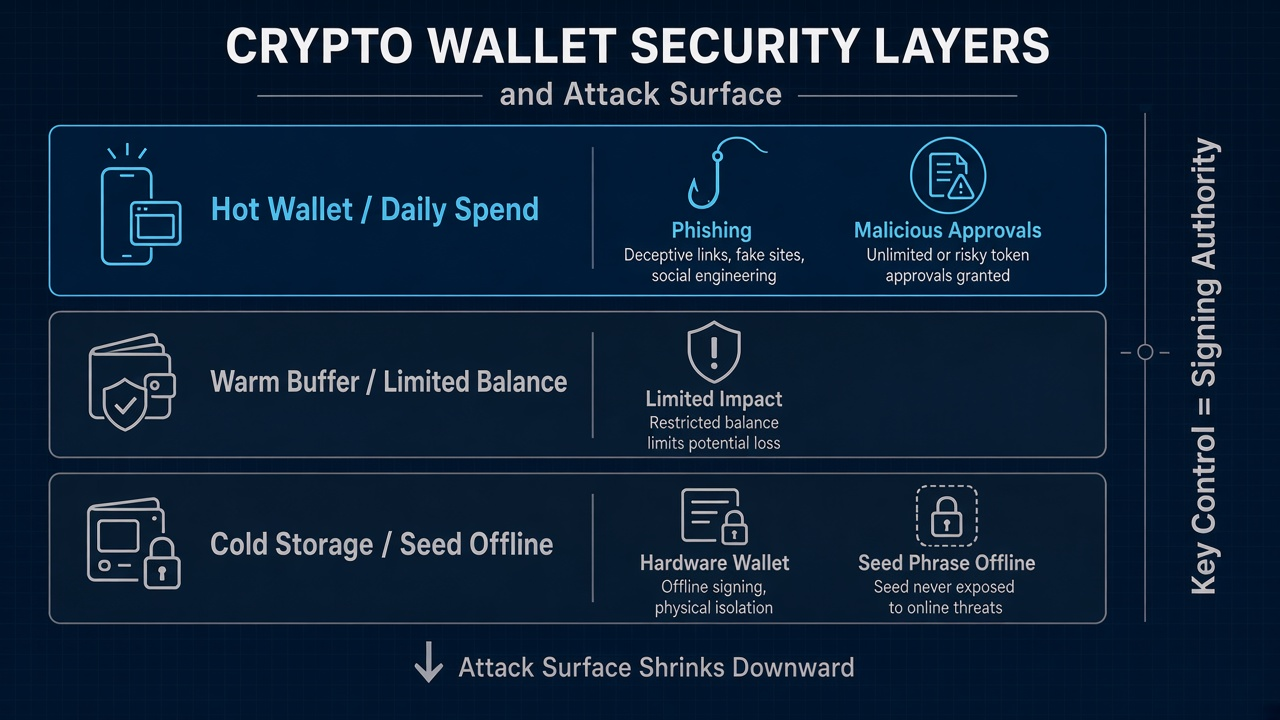 Figure 1. Wallet attack surface and key-control layers: hot wallets sit highest on the exposure scale; cold storage and offline seeds isolate signing authority.
Blind signing is equally dangerous: when a prompt shows only “unknown data” or a long hex string, the holder is handing over signing power with unknown consequences. Ledger Academy’s wallet security checklist treats software updates, fake-app recognition, and offline seed custody as baseline defenses.
How Do Layered Storage and Daily Habits Shrink Loss Surface?
Layered storage does not erase every risk; it caps how much a single breach can cost.
-
Hot daily layer: Keep only small balances needed for interaction and gas; assume the device may be phished.
-
Buffer layer: Medium balances on addresses that sign less often; isolate from the hot-wallet mnemonic so one seed does not cover the full stack.
-
Cold holding layer: Large long-term holdings on an independent seed, preferably generated and backed up offline; use BIP-39 to understand the wordlist and checksum, and keep seed photos out of cloud albums and chat history.
Daily habits also decide whether one hit goes through: do not leave the entire stack in a hot wallet for convenience—“all funds in a hot wallet” maximizes phishing, malware, and malicious-approval loss; treat unfamiliar dApps as high risk by default; hardware wallets still require reading what is being signed; verify backups before funds move in.
What Are the Advantages and Limits of Self-Custody Wallets?
Self-custody means users hold their keys directly rather than relying on a provider, so they control and protect digital assets themselves: exposure need not bind entirely to one custodial counterparty, and it is the default entry to DeFi, NFTs, and multi-chain apps. For groups or organizations, multi signature wallets can cut single-point-of-failure risk because multiple parties use separate approvals to sign transactions before funds move. Limits are equally clear: wrong transfers, wrong approvals, and seed leaks usually cannot be reversed by support; backup and approval hygiene demand a minimum security process; losing the only backup means losing control.
Custody fits trading float and simpler operations, but it is not “advanced self-custody.” Split by purpose: trading float under platform account-security systems, long-term self-holding under key-control systems.
Summary
Crypto wallet security’s core claim is that assets follow signing authority. Hot, cold, and custodial setups expose different attack surfaces; once a seed phrase or private key is compromised there is no password reset—only migration to a new seed; phishing, malicious approvals, and address poisoning usually buy one valid signature or a mistyped transfer. Layered storage and pre-sign checks shrink the loss surface.
FAQ
What is crypto wallet security?
Crypto wallet security means controlling and defending private keys, seed phrases, and the on-chain signing authority they produce. A wallet manages private and public keys, not the assets themselves, which remain on the blockchain; whoever can sign a transaction can move assets from the matching address, while the public and private keypair includes the public address used to receive crypto. It protects key material and approval boundaries—not exchange login passwords themselves.
How do you protect a crypto wallet?
Keep seed phrases and private keys offline and isolated, use a strong password for wallet apps or related online services, and rely on various methods to protect access; split balances by purpose so the full stack never sits in a hot wallet; before signing, verify domain, chain, allowance size, and receive address; install and update clients only from sources that can be independently checked, and on a supported mobile phone, biometric authentication methods such as facial recognition can add an extra layer through biometric authentication.
Can you reset a password after a seed phrase leak?
No. A seed phrase maps to root material that can derive every related private key; chains have no centralized “void the old seed and force a new one” reset. If the seed is exposed, move assets as soon as possible to addresses from a newly generated seed, and retire every backup and wallet instance tied to the old seed.
Should assets sit on an exchange or in a self-custody wallet?
It depends on use: frequent trading and deposits/withdrawals often rely on exchange account systems, while online wallets or digital wallets are convenient and self-custody offers stronger control over keys; decentralized finance use cases usually require self-custody rather than exchange-only access. If you are holding crypto for the long term, many users prefer a hardware device such as a ledger nano for offline protection against online threats. Account takeover and key leakage are different event types—split by amount and how often funds must move.
What should be checked before signing?
Before signing, verify the transaction details shown by the wallet: confirm the site or client is the intended one, the chain ID is correct, the receive-address prefix and suffix match, the token spender and allowance are necessary, and the prompt does not show unexplained blind-sign data. If the request cannot be explained, refuse the signature and restart from a trusted entry point, since valid cryptocurrency transactions depend on the wallet using the private key to sign the exact details presented.