In August 2026, Cloudflare announced Cloudflare Wallets and cloudflare.pay, proposing the use of account wallets, virtual wallets, and stablecoin payment mechanisms to enable AI Agents to autonomously purchase services within user-defined permission limits, without waiting for manual confirmation for every small transaction.
As AI Agents move from information retrieval and content generation into real-world task execution, payments are becoming an important part of agent infrastructure. An AI Agent capable of autonomously calling tools, comparing services, and completing workflows would face limitations if it still had to rely on users to register accounts, enter bank card information, and purchase API credits. Stablecoins and payment protocols such as x402 offer new ways for machines to exchange value, while programmable wallets serve as an important link between AI services and on-chain financial infrastructure.
However, Cloudflare Wallets' product plans must be clearly distinguished from its actually available features. As of November 17, 2026, its developer documentation still lists wallet identifier reservation as the primary feature currently available. Full stablecoin payment capabilities, account wallets, and virtual wallets are not yet listed as generally available in the documentation. Accordingly, this article explains, based on the announced product architecture, how Cloudflare Wallets is planned to support automatic payments by AI Agents, asset permission management, and x402 transactions, while analyzing the potential value and risks of this model.
Cloudflare Wallets docs+1
Key Points
- Cloudflare Wallets is programmable wallet infrastructure for AI Agents, focused on agent identity, fund usage permissions, and automatic payments.
- The product plan includes two structures: Account Wallet and Virtual Wallet. They serve fund owners and task-executing agents, respectively.
- Account owners can set spending limits, merchant allowlists, and per-transaction limits for agents, reducing the risk of uncontrolled automated payments.
- Cloudflare Wallets is planned to use stablecoins for sending and receiving funds, while integrating with the x402 protocol to support machine-native payments for APIs, data, and digital content.
- x402 can embed payment requests into HTTP interactions, allowing an AI Agent to continue accessing a required service after meeting the payment conditions.
- Cloudflare Wallets focuses more on agent payments and controlled fund usage. It should not be directly equated with a wallet that provides full DeFi trading, cross-chain bridging, or portfolio management capabilities.
- Wallet username reservation is currently the primary available feature. Full payment capabilities remain subject to the actual product release status.
What Are Cloudflare Wallets, and Why Do AI Agents Need Dedicated Wallets?
Cloudflare Wallets is a programmable wallet solution for automated software. Its core goal is not to make AI Agents operate crypto wallets manually like ordinary users, but to enable agents to complete payments through programmatic interfaces within clearly defined permission and budget constraints. Compared with traditional digital asset wallets designed for individuals, it places greater emphasis on machine identity, service purchases, delegated funds, and automated execution.
Traditional internet payments are generally designed around human users. Users must register accounts, link payment methods, purchase plans, or add funds before calling services through API Keys. This process may be acceptable for ordinary software performing a single task, but for AI Agents that need to dynamically select among multiple tools, repeated registration, payment, and authorization increase execution costs.
For example, an AI Agent conducting market research may need to call a financial data API, a search service, an AI reasoning model, and a specialized database at the same time. If each new service requires the user to register and pay manually, the agent will have difficulty selecting the right tools independently based on the task requirements.
Cloudflare Wallets attempts to convert these operations into processes that machines can understand and execute. Users configure funds and spending rules in advance. When the agent needs a paid resource, it initiates a payment request, and the wallet determines whether the expense is permitted based on the established permissions. Once payment is completed, the agent continues calling the service.
This design shifts the wallet from being solely an asset custody tool toward becoming a payment execution component for automated applications. However, the ability to make automatic payments does not mean that an AI Agent can manage assets without restrictions. The key questions are which operations the agent can perform, who controls the funds, and how those permissions are constrained.
What Is the Difference Between Cloudflare Wallets' Account Wallet and Virtual Wallet?
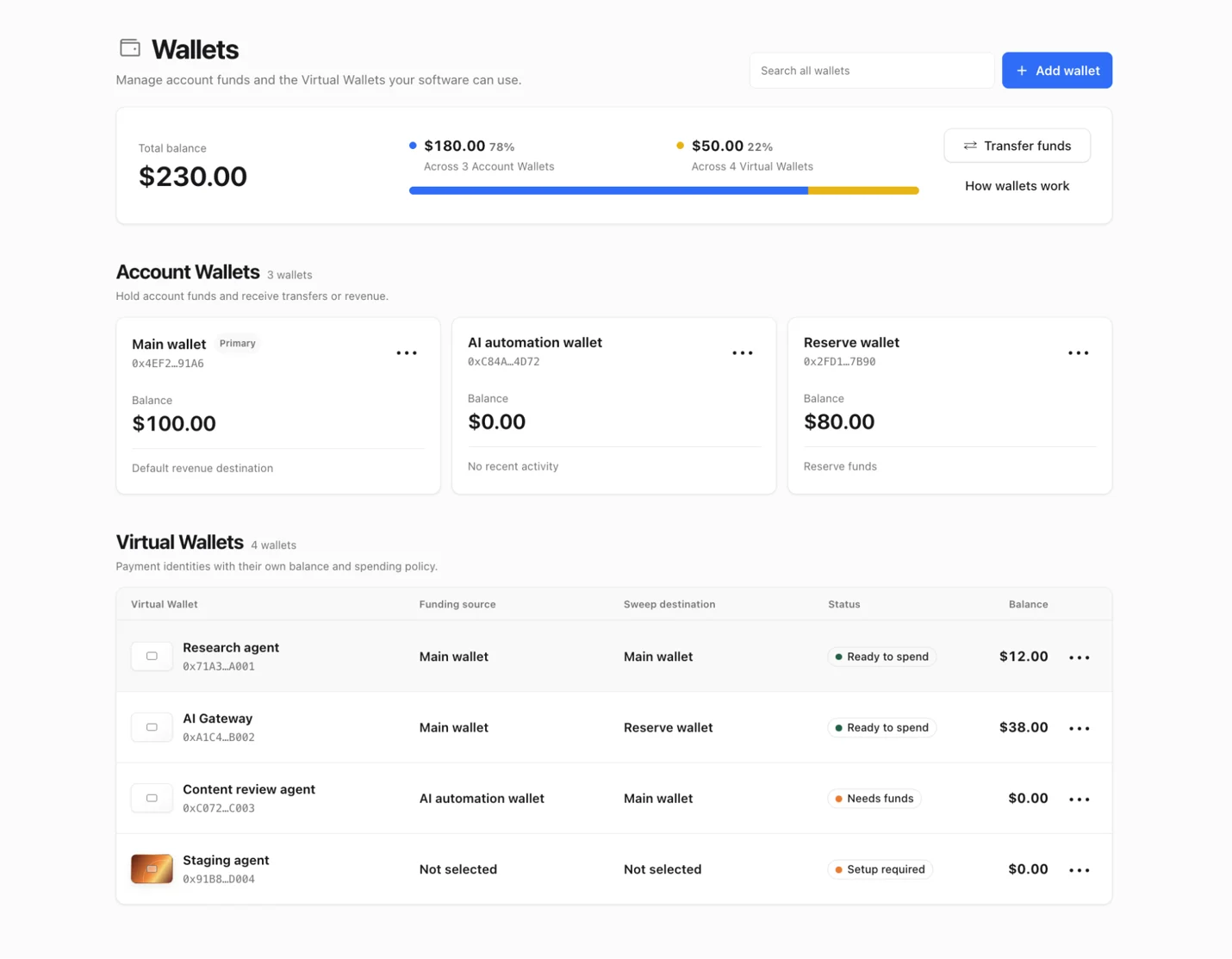
Cloudflare Wallets uses a two-layer wallet structure: Account Wallet and Virtual Wallet. They have different responsibilities. The Account Wallet is intended for fund owners, while the Virtual Wallet is intended for the AI Agent that actually performs tasks. This design aims to separate fund management from automated spending permissions and prevent agents from gaining unrestricted control over all funds.
The Account Wallet is the primary entry point for users or businesses to manage funds. According to the announced product plan, account owners can add funds to the wallet, manage stablecoin balances, delegate certain spending permissions to Virtual Wallets, and withdraw funds as needed. The Account Wallet can also be associated with a cloudflare.pay identity, helping external services identify the transaction entity.
The Virtual Wallet is designed for AI Agents and is used programmatically through methods such as API Keys. An agent can purchase APIs, MCP tools, or digital content within predefined rules, but its spending limit is restricted by the account owner's settings. The Virtual Wallet is intended to provide limited access to funds rather than give the agent ownership of all assets in the Account Wallet.
| Comparison |
Account Wallet |
Virtual Wallet |
| User |
User, business, or account owner |
AI Agent |
| Primary responsibility |
Fund management and permission configuration |
Automated payment execution |
| Source of funds |
Funds added by the user to the Account Wallet |
Spending delegated by the Account Wallet |
| Method of operation |
Account management and configuration interface |
Programmatic interfaces such as APIs |
| Permission scope |
Manage balances and spending rules |
Use funds within the authorized scope |
| Risk controls |
Set budgets, allowlists, and other rules |
Operate within established permissions |
For example, a company that wants an AI Agent to purchase data services automatically can have an administrator manage the Account Wallet and create separate Virtual Wallets for different agents. The market research Agent could receive a weekly data purchasing budget of $20, while the customer service Agent could receive a weekly AI reasoning budget of $50. Even if both agents operate simultaneously, their spending can be controlled through separate limits.
The significance of this structure is that automation does not require users to relinquish control of their funds. Users can specify in advance how much an agent may spend and which service providers it may pay. However, the specific custody, key management, and transaction signing mechanisms of Virtual Wallets remain subject to the technical documentation released with the official launch. Their adoption of any particular on-chain account standard or smart contract architecture should not be assumed.
How Do Cloudflare Wallets Use x402 to Enable Automatic Payments?
x402 is an internet payment protocol built around the HTTP 402 Payment Required status code. Its goal is to enable software accessing paid resources to complete payments through standardized request and response flows. For AI Agents, this means that payment can become part of an API call rather than always depending on a manually operated checkout page.
Traditional APIs generally require developers to create accounts, link payment methods, and purchase usage credits in advance. x402 allows a service provider to return machine-readable payment requirements when it receives a request. Based on information such as the price, payment asset, and network, the client determines whether to pay. After payment is completed, the client submits the relevant payment credential or transaction information, and the server provides the resource after verifying that the payment conditions have been met.
Cloudflare Wallets is planned to work with infrastructure such as Cloudflare Monetization Gateway. Monetization Gateway is intended for service providers that want to generate revenue through APIs, content, and other digital resources, while Wallets is intended for users and AI Agents that need to purchase those resources. Together, they form buyer-side and seller-side infrastructure for automated service transactions.
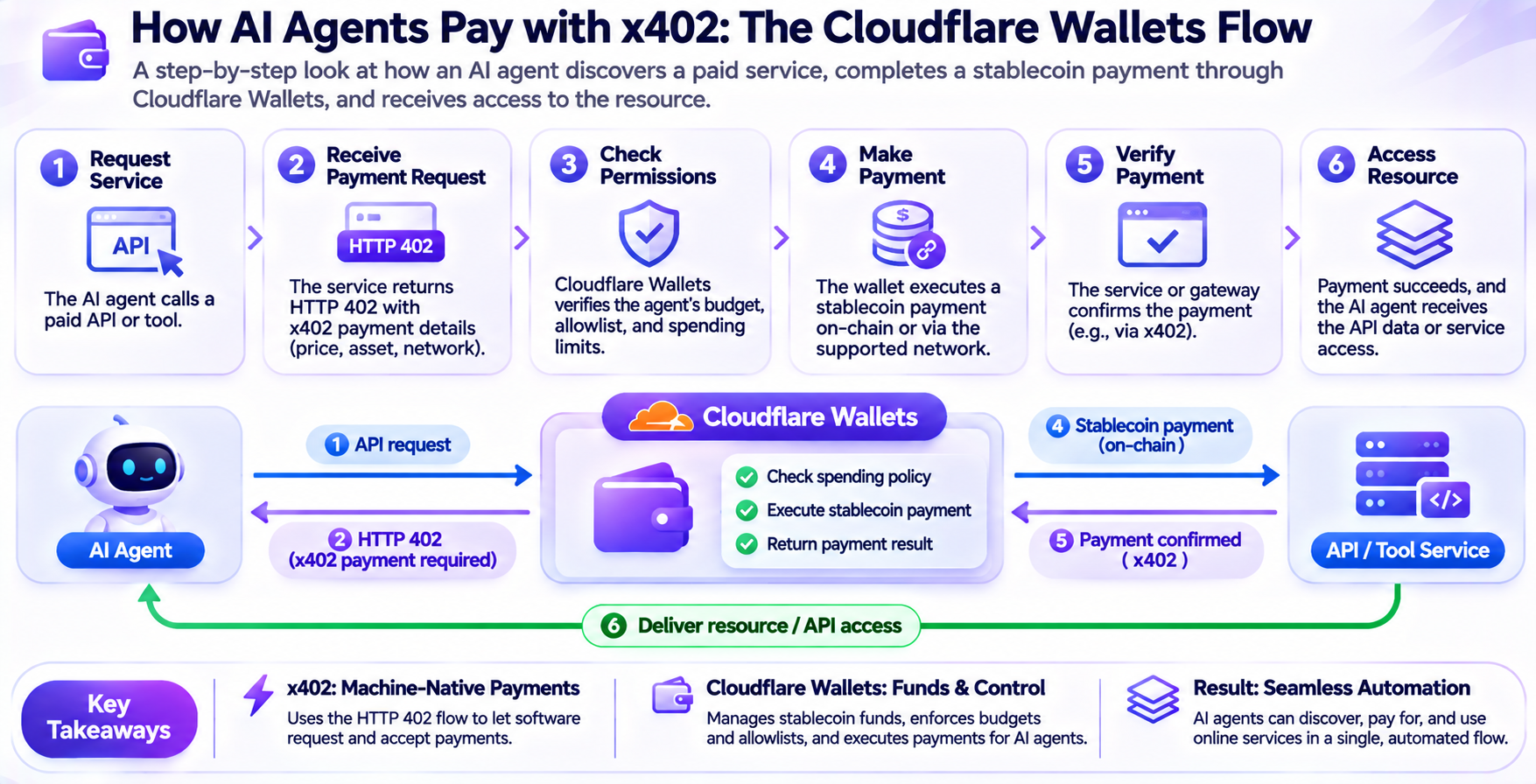
For example, when an AI Agent purchases a paid financial data API, the planned interaction could consist of six steps:
- Initiate the service request: The AI Agent calls a financial data API based on the task requirements.
- Receive the payment requirement: The API returns an HTTP 402 response stating the price and payment conditions required to access the resource.
- Check wallet permissions: The agent uses the Virtual Wallet to check the available budget, permitted merchants, and per-transaction limit.
- Execute the stablecoin payment: If the transaction complies with the authorization rules, the wallet completes payment using a supported payment method.
- Verify the payment result: The server or payment infrastructure verifies that the payment requirements have been met.
- Continue the task: After payment succeeds, the AI Agent receives the data or service and continues the subsequent workflow.
The core value of this process is that it converts service purchases into programmable operations. For example, an agent that needs to compare the data quality of three providers could pay small amounts to obtain samples from each provider before selecting the most suitable service. As long as total spending remains within the user's budget, the entire process could theoretically reduce the need for human intervention.
However, x402 itself is not a wallet and does not manage all of an AI Agent's funds. x402 primarily defines how payment requirements interact with network requests, while the wallet manages fund usage, payment authorization, and related operations. The two must work together to create a complete automated payment process. Cloudflare Wallets' specific x402 integration capabilities will still depend on the scope of the subsequent product release.
How Can AI Agents Manage On-Chain Assets Through Cloudflare Wallets?
In the Cloudflare Wallets design, on-chain asset management is initially reflected in the receipt, custody, allocation, and use of stablecoin funds, rather than in traditional crypto portfolio management. The product plan treats stablecoins as an initially supported funding type, allowing users to configure payment balances for purchasing digital services through automated applications.
This model can be understood as dividing fund management into three layers:
- The first layer is asset ownership. The account owner manages the source of funds and the overall balance.
- The second layer is spending authorization. The user defines the scope of funds that the agent may use.
- The third layer is task execution. The AI Agent completes specific payments when they comply with the permissions.
For example, an automated research system may need to purchase market data, call AI models, and access paid reports each week. An administrator can first fund the Account Wallet and then allocate budgets to Virtual Wallets responsible for different tasks. The market data Agent is responsible only for purchasing data, while the content analysis Agent is responsible only for paying model inference fees. The remaining funds continue to be managed centrally by the account owner.
Compared with giving an AI Agent direct access to a complete wallet private key, a controlled spending model can reduce risks through permission design. Even if an agent can initiate payments, it should not automatically gain the ability to modify budgets, expand the merchant scope, or withdraw all funds. Effective permission isolation also depends on the wallet service reliably enforcing identity authentication, access controls, and payment rules.
It is important to note that the core capabilities currently announced for Cloudflare Wallets do not amount to a complete on-chain DeFi asset management system. Its product positioning primarily concerns stablecoin payments, wallet identity, and delegated funds. Existing product descriptions do not explicitly list token swaps, yield aggregation, staking, cross-chain transfers, or automated portfolio rebalancing as generally available capabilities.
From the broader perspective of AI Agent wallet technology, future systems may use smart contract wallets, session keys, transaction simulation, and strategy engines to support more sophisticated on-chain asset management. These are technology directions the industry may explore and should not be treated as features already implemented by Cloudflare Wallets.
How Does Cloudflare Wallets Restrict AI Agent Payment Permissions?
One of the main challenges facing automatic payments by AI Agents is ensuring that agents do not make unnecessary expenditures because of misinterpreted tasks, manipulated external information, or software errors. One of the key design goals of Cloudflare Wallets is to allow fund owners to configure clear payment boundaries before agents begin executing tasks.
The announced permission design primarily includes spending limits, merchant allowlists, and per-transaction limits. These rules constrain overall spending, limit the entities with which the agent may transact, and prevent a single abnormal transaction from causing excessive losses.
For example, a user could set a total budget of $20 for an AI Agent, allow it to pay only a designated data service provider, and set a per-transaction limit of $1. Even if the agent attempts to call another paid service or a service suddenly requests a payment of $50, the wallet should restrict the transaction under the predefined rules.
These mechanisms are especially important for AI Agents because agents may receive external information from webpages, documents, API responses, and MCP tools. If an attacker uses malicious content to induce an agent to change its objective, the agent may attempt to access unauthorized services or make abnormal payments.
When payment restrictions are enforced by infrastructure independent of the model's decisions, a malicious prompt should not directly change the wallet's established spending limit even if it affects the model's judgment. However, this does not mean that all payment risks have been eliminated. Attackers may still induce agents to make unnecessary transactions within the permitted budget and merchant scope, or exploit account configuration errors, leaked API Keys, or server vulnerabilities to cause losses.
Wallet security therefore needs to cover identity authentication, permission isolation, key protection, payment rules, and transaction records. For higher-value or higher-risk operations, organizations may also consider human approval, anomaly detection, and emergency deactivation mechanisms. Cloudflare Wallets' announced spending limits provide an important design foundation, but complete security protections must still be evaluated based on the official product implementation.
How Do Cloudflare Wallets Differ From Traditional Crypto Wallets?
Traditional crypto wallets are primarily designed for individual users. They are generally used to manage blockchain accounts, sign transactions, transfer tokens, and interact with decentralized applications. Users control assets through private keys or other signing mechanisms and confirm transactions when they need to be executed.
Cloudflare Wallets, by contrast, focuses on the automated payment needs of AI Agents. It does not require an agent to wait for a user to click a confirmation button for every payment. Instead, it uses a layered structure of Account Wallets and Virtual Wallets to let users define fund usage limits in advance and have agents execute operations that comply with the rules.
The main differences between the two types of wallets involve user roles and permission design, not merely whether they support stablecoins.
| Comparison |
Traditional Crypto Wallet |
Cloudflare Wallets Planned Solution |
| Primary users |
Individuals or organizations |
Account owners and AI Agents |
| Primary use |
Asset custody, transfers, and DApp interaction |
Automatic payments for APIs, tools, and content |
| Method of operation |
User confirmation or predefined automation strategies |
AI Agent execution through programmatic interfaces |
| Permission management |
Depends on the specific wallet and authorization mechanism |
Layered Account Wallet and Virtual Wallet |
| Payment controls |
Depends on the wallet product and on-chain rules |
Budget, merchant, and per-transaction limits |
| Identity |
Usually based on a blockchain address |
Planned integration with cloudflare.pay identity |
| Product status |
Many mature products are available |
Primarily identifier reservation currently available |
This distinction does not mean that traditional wallets cannot support automatic payments. Technologies such as smart contract wallets, account abstraction, and session keys can also allow applications to execute transactions within limited permissions. Cloudflare Wallets' distinguishing feature is its attempt to place these requirements within a broader internet service purchasing environment, allowing AI Agents to build payment workflows around APIs and digital content.
Cloudflare Wallets' identity design is also notable. Although blockchain addresses can be used to verify transactions, they are generally difficult for humans to identify. The cloudflare.pay plan is intended to provide a more stable and readable identity, allowing service providers to identify the transaction account or the identity claimed by an agent.
However, a human-readable identifier is not equivalent to complete identity authentication. Merchants must still determine whether a transaction entity is trustworthy and whether its payment behavior meets their security and compliance requirements. The relationship between wallet identity, on-chain addresses, and the actual identity of users also requires further clarification in subsequent technical and product implementations.
How Can Cloudflare Wallets Integrate With MCP and the AI Agent Tool Ecosystem?
The Model Context Protocol (MCP) is an open protocol for connecting AI applications with external tools, data sources, and services. Through MCP, AI Agents can access databases, search tools, enterprise systems, and other software capabilities without requiring a separate complex integration for each service.
However, being able to call a tool does not mean being able to purchase it automatically. Some APIs or MCP services require paid subscriptions, prepaid balances, or per-call fees. If an AI Agent discovers during a task that a paid tool would better meet its needs but cannot complete the payment independently, it must wait for the user to intervene.
Cloudflare Wallets is planned to address the payment component of this problem. An agent can discover services through tool interfaces, obtain pricing information, and complete a payment when the payment complies with the wallet permissions before continuing the task. For paid endpoints that support x402, payment requirements can also be integrated directly into the network request flow.
For example, an AI Agent responsible for preparing a corporate market analysis may need to call a news search service, a financial database, and an AI reasoning service. It can first use free tools to obtain basic information and then select paid data sources based on the required quality. If the wallet budget allows, the agent may automatically pay a small fee to obtain the required data and continue the analysis.
This model combines an AI Agent's tool-use capabilities with its ability to use funds. Previously, an agent was mainly responsible for determining which tool to call. With programmable payment capabilities, it can also determine within the authorized scope whether a service is worth paying for.
However, this automation requires clear cost and security boundaries. Information supplied by MCP tools may be inaccurate, and external services may return malicious instructions. If an agent makes payments without sufficient verification, it may incur unnecessary expenses. A more reliable design should handle tool discovery, service trust assessment, payment authorization, and result verification separately.
Accordingly, integrating Cloudflare Wallets with MCP does not mean that all MCP tools can charge users directly, nor does it mean that the wallet can automatically determine service quality. It provides payment infrastructure that can be explored. Actual applications will still depend on whether tool providers support the relevant protocols and how developers configure permissions and workflows.
What AI Agent Use Cases Could Cloudflare Wallets Support?
The potential applications of Cloudflare Wallets are concentrated in digital services that require small, frequent, and automated payments. Unlike traditional e-commerce purchases of physical goods, these products are generally data, computing resources, or digital content delivered directly through APIs. Once payment is completed, the task can continue.
- AI inference services are a typical use case. An agent may need to call different models for text generation, code analysis, or complex reasoning. If a service provider supports per-call pricing, the agent can select a model based on the task requirements and pay for the call within its budget. This may reduce developers' need to purchase multiple service plans in advance.
- Data and information services are another potential application. A financial research Agent may need to purchase real-time market data, historical data, or specialized research materials. A business analysis Agent may need industry databases and market research data. For data services priced per call, automatic payment allows an agent to obtain resources when needed instead of relying on a long-term subscription.
- MCP tools and software services further expand the potential scope. An AI Agent handling a complex task may discover new tools dynamically during execution. If those tools support machine-readable pricing and payment mechanisms, the agent can try different services within the permissions set by the user.
Access to digital content is another potential direction. For example, a website could charge a small access fee for a specific article, report, or data interface, and an AI Agent could pay as needed after receiving authorization. This mechanism could enable more granular pricing for digital content, but adoption will still be affected by payment costs, service quality, user demand, and content licensing rules.
These use cases share several characteristics: the service can be delivered through a programmatic interface, the transaction amount is relatively small, and the transaction is suitable for automated execution by software. Cloudflare Wallets' product plan is designed around these requirements. However, whether specific use cases can be implemented will depend on the official release of payment capabilities and the integration of the relevant infrastructure by service providers.
What Security and Commercialization Challenges Does Cloudflare Wallets Face?
Cloudflare Wallets offers a new technical direction for AI Agent payments. However, moving from wallet architecture to large-scale real-world adoption still requires addressing issues involving fund security, identity verification, payment settlement, and business models.
- Automated payment boundaries. AI Agents can act autonomously based on external information, but model outputs are uncertain and may be affected by prompt injection attacks. Even when a wallet has budget limits, an agent may still make unreasonable purchases within the authorized scope. Limiting maximum losses and ensuring that each payment serves a reasonable business purpose are two different challenges.
- Fund custody and key management. Programmable wallets must handle payment authorization, transaction signing, and access to funds. Account owners need to understand clearly who controls the funds, which operations require signatures, and what could happen if agent credentials are exposed. For enterprise users, audit logs, permission revocation, and abnormal transaction handling are also important.
- Stablecoin settlement and compliance. Stablecoins can support programmatic fund transfers, but transaction fees, confirmation times, and asset support differ across blockchain networks. Cross-border payments may also involve anti-money laundering requirements, sanctions screening, and other regulatory obligations. The fact that a transaction can be initiated automatically by software does not eliminate the related compliance responsibilities.
- Payment disputes and refunds. Traditional bank cards and some online payment systems have relatively mature dispute processes, while blockchain transactions generally cannot be reversed directly after confirmation. If an AI Agent purchases the wrong data, a service is not delivered properly, or a merchant's results do not meet requirements, users still need reliable refund and dispute resolution mechanisms.
- Commercial scale. Machine-native payments reduce the operational barrier to purchasing individual services, but actual demand will depend on whether service providers are willing to charge per use, whether users accept recurring small payments, and whether agents can correctly evaluate service value. For low-priced API calls, payment processing costs and network fees must also be proportionate to the transaction amount.
The long-term value of Cloudflare Wallets depends not only on whether the wallet can send stablecoins, but also on whether it can establish a reliable connection among identity, authorization, payment, and service delivery. Only when these components operate reliably can automatic AI Agent payments develop from a technical demonstration into a common internet service model.
What Does Cloudflare Wallets Mean for the AI Agent and Web3 Ecosystems?
Cloudflare Wallets reflects the expansion of AI Agent infrastructure from computing and tool calls into identity and payments. In the past, AI Agents primarily relied on model inference, external APIs, and task orchestration systems to perform work. As agents begin handling more real-world tasks, the secure use of funds is gradually becoming part of infrastructure design.
Stablecoins offer certain technical advantages in this process. They can transfer value through programmatic interfaces and combine with blockchain transaction verification mechanisms to provide a new approach to automated payments. For AI Agents that need to call services across platforms, stablecoin payments may reduce some traditional account registration and prepayment procedures, but settlement costs, compliance, and user protection issues must still be addressed.
x402 attempts to connect payment capabilities with internet requests, allowing paid resources to communicate prices and payment requirements directly to software. Cloudflare Wallets adds Account Wallets, Virtual Wallets, and permission controls to explore how agents can complete these payments with limited authorization.
From a Web3 perspective, this direction could expand the use cases for stablecoins and programmable wallets. Digital assets would no longer be used only for trading, transfers, or interaction with DeFi protocols. They could also become payment tools that AI Agents use to obtain computing resources, data, and software services.
However, Cloudflare Wallets' current positioning remains centered on internet service purchases rather than serving as a general asset management platform for all on-chain financial activities. Its future impact will depend on the pace at which wallet features are released, developer adoption, the x402 service ecosystem, and actual payment demand.
Conclusion
Cloudflare Wallets is programmable wallet infrastructure introduced by Cloudflare for AI Agents. It aims to use stable identity, Account Wallets, Virtual Wallets, and stablecoin payments to allow agents to purchase APIs, MCP tools, and digital content autonomously within user-defined permissions. Its core approach is to separate fund management from automated execution permissions, allowing AI Agents to complete routine small payments without gaining unrestricted control over all assets.
Compared with traditional crypto wallets, Cloudflare Wallets places greater emphasis on machine-native payments, spending budgets, and service invocation workflows. When combined with the x402 protocol, AI Agents may be able to obtain payment requirements directly when accessing paid resources, complete the payment, and continue executing tasks. However, wallet automation does not eliminate the risks of prompt injection, permission abuse, transaction errors, or fund security issues. Developers still need to establish independent authorization and risk control mechanisms.
As of November 17, 2026, Cloudflare Wallets' public developer documentation still lists wallet identifier reservation as the primary currently available feature. Full stablecoin payment capabilities and Virtual Wallets remain pending official release. Its long-term value will depend on actual product capabilities, developer adoption, and its ability to establish a reliable balance between payment efficiency and fund security. For the AI Agent and Web3 ecosystems, the significance of this direction is that wallets are gradually evolving from asset tools operated actively by humans into payment infrastructure that software can access under clearly defined authorization.
FAQ
What Are Cloudflare Wallets?
Cloudflare Wallets is a programmable wallet solution introduced by Cloudflare for AI Agents and automated internet applications. It is planned to provide stablecoin payments, Account Wallets, Virtual Wallets, and controlled spending permissions.
Are Cloudflare Wallets Available Yet?
As of November 17, 2026, the public developer documentation confirms that wallet usernames can be reserved. However, full stablecoin payment capabilities, Account Wallets, and Virtual Wallets are not yet listed as generally available.
Which Digital Assets Do Cloudflare Wallets Support?
Cloudflare's initial plan focuses on sending, receiving, and holding stablecoins. The specific stablecoins and blockchain networks supported will be subject to the product documentation released with the official launch.
What Is the Difference Between an Account Wallet and a Virtual Wallet?
The Account Wallet is intended for account owners and is responsible for fund management and permission configuration. The Virtual Wallet is intended for AI Agents and is used to execute payments within authorized limits and rules.