As AI agents evolve from conversational assistants into automated systems capable of calling tools, executing tasks, and coordinating multiple services, payment capabilities are becoming an important factor affecting their practical scope of use. An agent may independently search for information, select models, and call MCP tools, but if users must manually complete checkout every time a paid service is used, end-to-end task automation remains difficult. The combination of stablecoins and programmable wallets provides a new technical path for small-value payments between machines.
x402 does not directly give AI agents the ability to manage funds. Instead, it defines how clients and servers express, submit, and verify payments. Fully automated payments also require wallet signatures, fund authorization, settlement networks, and server-side verification mechanisms. This article explains how AI agents can use stablecoin payments to access services through x402, how wallet permissions can restrict fund usage, and how this model applies to the MCP tool ecosystem and its security boundaries.
Key Takeaways
-
x402 uses the HTTP 402 status code to enable paid services to return machine-readable payment requirements to AI agents.
-
Within their authorized scope, AI agents can decide whether to make payments based on service pricing, payment assets, and network information.
-
Stablecoins can serve as settlement assets for machine payments, but actual transaction costs and confirmation speeds depend on the network used.
-
x402 handles the payment interaction flow, while wallets control funds and authorize transactions. They are not the same technology.
-
MCP connects AI agents with external tools, while x402 can add per-use payment capabilities to certain paid tools.
-
Spending limits, merchant allowlists, per-transaction limits, and permission revocation mechanisms can help reduce the risks of agent-initiated payments.
-
Automated payments do not eliminate the need for human oversight. Additional controls are still needed for large amounts, sensitive data, and unusual transactions.
What Is x402, and Why Do AI Agents Need a Machine-Native Payment Protocol?
The core goal of x402 is to enable programs to process payments automatically, much like ordinary HTTP requests. In traditional internet architecture, HTTP primarily handles resource requests, data transmission, and status feedback. Although the HTTP 402 Payment Required status code has existed for a long time, it has lacked a widely adopted standardized payment flow. x402 builds payment requirement, authorization submission, and settlement confirmation mechanisms around this status code, allowing paid resources to directly communicate transaction terms to clients.
For AI agents, this mechanism has clear practical value. Agents can retrieve data through APIs, call models, or perform software operations. However, if a service requires users to register an account, link a bank card, or purchase a plan first, the automated workflow may be interrupted. x402 enables servers to directly provide pricing and payment methods during a request, allowing clients to decide whether to proceed with the purchase.
For example, an AI agent responsible for generating industry reports may need access to paid data. The server can return payment requirements through HTTP 402. The agent determines whether the price fits its budget, and the wallet then generates payment authorization. Once verification and settlement are complete, the server returns the required data and the agent can continue preparing the report.
It is important to note that x402 is not limited to AI agents. Standard applications, automation scripts, and other software clients can also use the protocol. AI agents are an important use case because their tasks are dynamic: an agent may discover new services during execution and need to decide independently whether to purchase them.
x402 also does not require every service to abandon account-based systems. It provides a technical option for payment per request, while service providers can still retain subscriptions, API Keys, or other access control mechanisms.
How Can an AI Agent Complete an Automated Payment Through x402?
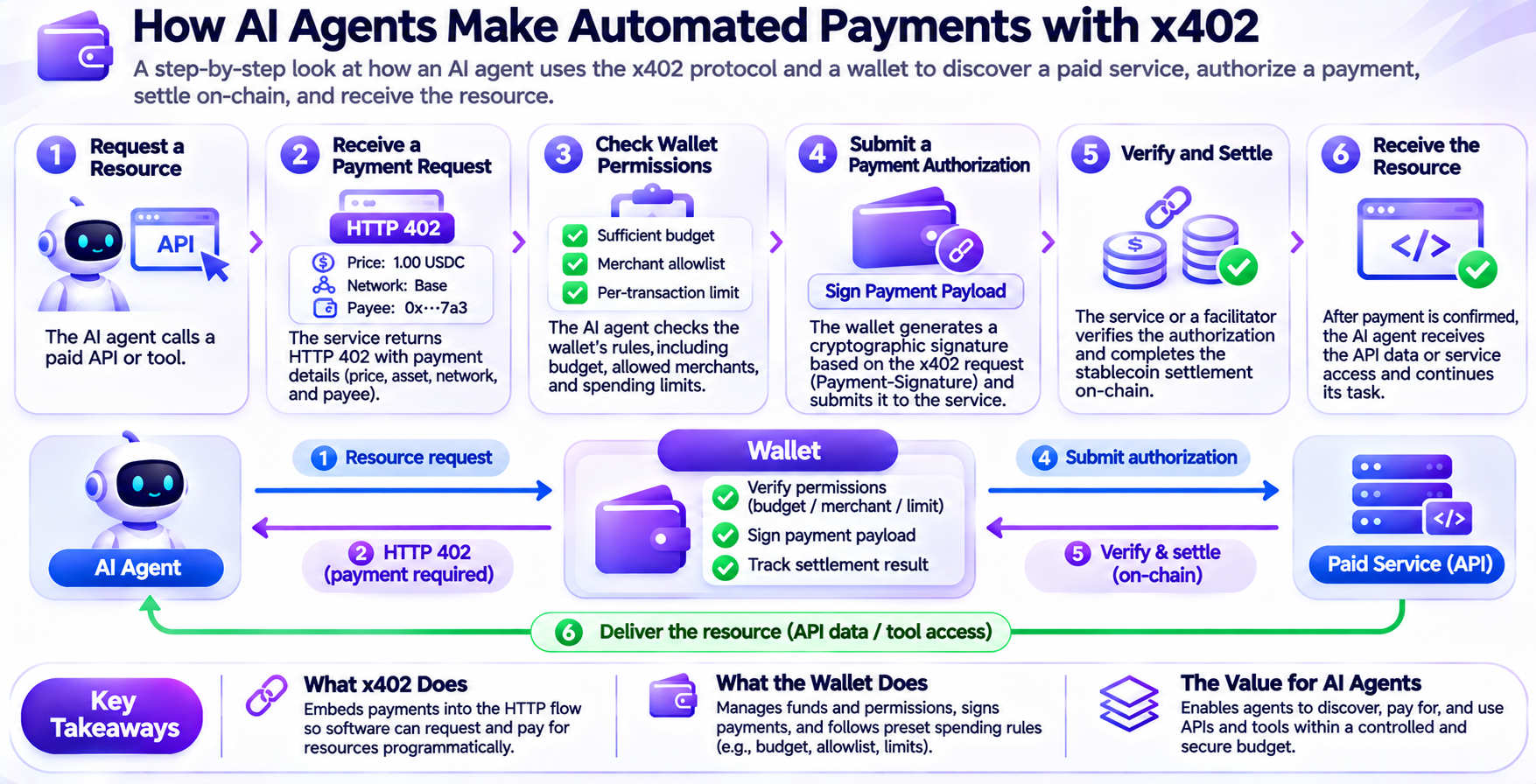
x402 connects service requests with payment verification, allowing clients to purchase resources within the same business flow. Its primary participants include the client, resource server, wallet, and an optional Facilitator, which provides payment verification and settlement services.
In a typical flow, an AI agent first sends an HTTP request to a paid API. If the server requires payment, it returns an HTTP 402 status code and provides information such as pricing, accepted assets, settlement networks, and recipient addresses through protocol fields such as PAYMENT-REQUIRED.
The agent then checks whether the payment requirements comply with the user's authorization, including whether the payment amount exceeds the budget, whether the asset and network are supported, and whether the recipient is trusted. If the conditions are met, the wallet generates a signed payment payload, and the client uses PAYMENT-SIGNATURE to submit the authorization information with a new request to the server.
After receiving the payment authorization, the server can verify it independently or delegate verification to a Facilitator. After verification succeeds, the payment enters the settlement stage. The server or Facilitator submits the transaction according to the payment mechanism of the relevant network. Once payment completion is confirmed, the resource server returns the requested content to the client.
This process can be summarized in six stages:
-
Request a resource: The AI agent calls a paid API or digital service.
-
Receive a quote: The server returns HTTP 402 and payment requirements.
-
Check authorization: The client confirms that the budget, asset, network, and merchant comply with the rules.
-
Submit payment credentials: The wallet signs the payment authorization, and the client resends the request.
-
Verify and settle: The server or Facilitator verifies the payment payload and completes settlement.
-
Deliver the resource: The server returns API data or the tool execution result.
It is important to distinguish payment authorization from actual settlement. Submitting a signed payment payload does not mean that funds have already been transferred on-chain. Payment verification confirms that the authorization is valid, while settlement performs the actual transfer of funds. For applications that require strict control over service delivery risk, these two stages should not be treated as the same process.
The technical significance of x402 lies in consolidating actions that were previously spread across account registration, payment pages, and service calls into a request flow that software can process. It reduces the interaction costs of automated payments, but successful payment still depends on wallets, settlement networks, and server-side implementation.
Why Are Stablecoins Suitable for Automated AI Agent Payments?
Stablecoins are digital assets designed to maintain relatively stable value, with dollar-pegged stablecoins being a common type. For AI agents that frequently purchase APIs, data, and computing services, stablecoins can provide a programmable method of value transfer, enabling payments to be initiated and verified through software interfaces.
Traditional payment systems are primarily built around human consumers and merchants, often involving account registration, payment credentials, risk-control reviews, and clearing processes. These mechanisms have mature consumer protection and commercial infrastructure, but may not be suitable for every machine transaction charged on a per-use basis. In particular, when the amount for a single API call is low, fixed payment costs may affect the business model.
Stablecoins can enable programmatic transfers on supported blockchain networks. For AI agents that already have wallet and payment authorization capabilities, payment flows can be directly embedded into task execution systems instead of requiring users to enter a manual checkout page for every service purchase.
However, stablecoins do not inherently mean zero cost or instant settlement. Actual costs depend on the blockchain network, transaction congestion, payment service design, and other infrastructure costs. Confirmation times, transaction finality, and stablecoin support also vary across networks.
In addition, stablecoins still involve issuer, reserve asset, redemption, contract, and regulatory risks. For enterprise AI agents that need to operate continuously, selecting a settlement asset requires consideration not only of transaction costs, but also of stablecoin liquidity, available networks, and fund security mechanisms.
From a technical perspective, x402 is not permanently tied to a particular stablecoin or blockchain. Its payment schemes can be extended for different networks and assets. Some implementations use exact payment schemes with fixed amounts, while others use upto schemes in which amounts are determined based on actual resource consumption. Developers should select an appropriate mechanism based on the billing model of the specific service, rather than treating all AI agent payments as fixed-amount USDC transfers.
How Does Wallet Authorization Control an AI Agent's Fund Usage Permissions?
Automated payments can reduce manual intervention, but they also introduce new risks. If an agent makes an incorrect decision, calls a malicious service, or is affected by a prompt injection attack, funds may be used without the user confirming each transaction. Therefore, AI agent wallets need not only signing and payment capabilities, but also independent fund authorization rules.
One common design separates the fund owner from the task executor. Users or businesses retain control over primary funds while allocating limited spending permissions to AI agents. Agents can make payments within their authorized scope, but cannot independently increase budgets, modify approved merchants, or withdraw all assets.
The architecture announced by Cloudflare Wallets reflects this approach. Its plan includes an Account Wallet for account owners and a Virtual Wallet for AI agents. Account owners can set spending limits, approved merchants, and per-transaction limits for virtual wallets. Agents can use limited funds through programmatic interfaces to purchase APIs, MCP tools, and digital content. It is important to distinguish the full fund and payment capabilities of Cloudflare Wallets from the wallet identifier reservation functionality that is already available.
For example, a user can set a weekly budget of $20 for a market research agent, allow it to purchase only specified financial data services, and limit each transaction to no more than $1. If an API suddenly increases its price or the agent attempts to access an unauthorized merchant, an independent payment policy can block actions that do not meet the conditions.
In addition to budget and merchant restrictions, developers can add expiration periods, usage limits, transaction frequency limits, and manual approval conditions based on application requirements. For agents that need to access multiple services, independently configured permissions are generally more appropriate than directly providing a wallet with full control over all funds.
However, wallet authorization also has limits. Even if every transaction complies with the budget, an agent may still repeatedly purchase useless data or be induced by malicious content to make unnecessary requests to services on an allowlist. Therefore, payment permission controls should be used together with task validation, service trustworthiness checks, and abnormal behavior monitoring.
How Can x402 and MCP Work Together to Enable Paid Tool Calls?
Model Context Protocol (MCP) is an open protocol for connecting AI applications with external tools, data sources, and services. Through MCP, AI agents can discover and call tools provided by different systems without requiring a separate complex integration approach for every tool.
MCP addresses tool connectivity and invocation, while x402 addresses payment interactions for paid resources. When combined, tool providers can set per-use pricing rules for certain services, and agents can process payment requirements when calling tools.
For example, an AI agent connects to a specialized data service through MCP. When the agent calls a paid query tool, the service can return payment requirements. An x402-enabled client checks wallet permissions based on the quote, completes payment authorization and settlement, and then receives the data returned by the tool.
This mechanism can allow developers to explore more granular billing models. Previously, service providers may have required users to purchase monthly subscriptions or prepay a certain amount. Under a pay-per-use model, users can pay based on the actual number of calls. This model provides some flexibility for AI agents that only occasionally use specialized tools.
However, not all MCP tools inherently support x402. Tool providers need to implement billing logic, and clients also need the corresponding payment processing capabilities. Cloudflare's developer tools already provide MCP tool billing and client payment integration solutions built around x402, but actual use still depends on the specific SDK, network, and payment configuration.
From a business model perspective, the combination of MCP and x402 may support the development of a tool marketplace charged by invocation. Data providers, AI model service providers, and specialized software developers can price specific capabilities, while agents can select services based on task requirements.
However, pay-per-use billing can also create cost uncertainty. If an agent continuously calls many tools during a complex task, total spending may increase quickly. Therefore, developers need to manage tool call volume, per-call pricing, and total task budgets at the same time, rather than relying only on wallet balance limits.
What Role Does a Facilitator Play in x402?
A Facilitator is an optional infrastructure component in the x402 payment flow. It primarily helps servers verify payment authorizations and execute settlement. For API service providers that do not want to maintain complex blockchain interaction logic themselves, a Facilitator can simplify payment integration.
In a typical implementation, after a server receives a payment payload submitted by a client, it can send the relevant information to a Facilitator's verification interface. The Facilitator checks whether the signature, payment scheme, network, and other requirements are met, then returns the verification result.
After verification succeeds, the server can request that the Facilitator submit the payment transaction to the relevant blockchain network through a settlement interface. The Facilitator waits for the settlement result and returns the transaction execution status to the server. The server then decides whether to deliver the resource based on the payment result.
It is important to emphasize that a Facilitator typically does not need to directly custody user funds. Its role is mainly to process authorized payment transactions, verify relevant information, and assist with transaction broadcasting and settlement. The wallet remains responsible for generating payment authorization, while the resource server remains responsible for deciding when to provide the service.
This division of responsibilities helps lower the technical barrier for developers to integrate payments. An API provider offering paid data does not need to develop all blockchain signature verification and transaction submission functions from scratch, and can instead integrate payment capabilities through supported SDKs and Facilitators.
However, using a Facilitator also means that service availability and correctness depend on external infrastructure. If a verification service fails, settlement is delayed, or a network experiences an issue, the response of a paid API may be affected. For systems with high availability requirements, developers need to consider retry handling, duplicate payment protection, transaction status queries, and service degradation mechanisms.
Therefore, a Facilitator is a technical support component for payment execution, not a complete solution that replaces wallet permission controls or server-side risk management.
What Security Risks Can AI Agent Automated Payments Face?
The main risks of AI agent automated payments arise from the gap between the uncertainty of model decisions and the real-world consequences of fund operations. A model may determine whether to call a tool based on context, but that determination can be affected by incorrect information, malicious inputs, or misunderstandings of a task. Once combined with payment capabilities, erroneous actions can result in actual financial losses.
Prompt injection is one important risk. An attacker may add malicious instructions to a webpage, API response, or content returned by an MCP tool, inducing an agent to access a paid service or repeatedly execute payments. If an agent mistakenly treats external content as a high-priority task instruction, it may deviate from the user's original objective.
Another type of risk comes from wallet credential leakage. If an attacker obtains an API Key, signing permission, or other sensitive credential that can initiate payments, they may attempt to spend funds within the authorized scope. Even with spending limits in place, losses may still occur. Therefore, key storage, access isolation, and permission revocation mechanisms are very important.
Payment replay and duplicate charges also require attention. Network requests may be automatically retried because of timeouts. If clients and servers do not properly handle payment status, the same service may be purchased multiple times. Developers should design transaction uniqueness checks, idempotent processing, and reliable settlement status records based on the payment scheme.
In addition, automated payments face service delivery risks. Successful payment does not guarantee accurate data, usable tools, or service quality that meets expectations. For high-value data and important business operations, agents need to verify service results rather than treating payment success as task success.
A more reasonable approach to these risks is to separate model decisions from payment authorization. AI agents can submit purchase requests, but an independent policy system determines whether the amount, merchant, asset, and network comply with the rules. Manual approval can also be introduced for unusual or high-risk transactions.
This model cannot eliminate risk completely, but it can reduce the likelihood that model errors are directly converted into unrestricted fund operations.
How Does x402 Differ From Traditional API Subscription and Prepayment Models?
Traditional API business models typically use subscriptions, prepaid balances, or usage-based billing. Users first register an account and configure a payment method, then call services through an API Key. This model is suitable for developers who continuously use the same service and also makes it easier for businesses to centrally manage billing and usage permissions.
x402, by contrast, allows servers to request payment for specific resource requests, enabling clients to complete authorization and payment during the request process. For AI agents that need to temporarily call many different services, this approach can reduce some upfront registration and prepayment steps.
The two models are not necessarily substitutes. For enterprise applications with stable call volumes and fixed service providers, traditional subscriptions or prepayment may be simpler and may offer better commercial pricing. For occasionally accessed specialized data, temporary computing tasks, or low-value digital content, x402 payment per request may offer greater flexibility.
In addition, x402 does not mean that all services can only charge fixed amounts. Different payment schemes can support different billing logic, but developers still need to resolve consistency issues among quotes, authorization, actual fees, and settlement results.
Future API business models may retain subscriptions, prepayment, and machine-native payment per use at the same time. For AI agents, what matters is not that one billing method completely replaces another, but that agents can select services that meet task requirements within clearly defined budgets and permissions.
How Will AI Agent Automated Payments Affect Stablecoin and Web3 Applications?
The combination of x402 and AI agent wallets provides stablecoins with a new use case beyond traditional trading and asset transfers. Stablecoins can become payment tools for software to purchase data, computing resources, and digital content, directly connecting on-chain value transfers with internet service calls.
This change may shift the product positioning of wallets. Traditional wallets are mainly designed around asset custody, transfers, and DApp interactions for human users. AI agent wallets need to place greater emphasis on programmatic authorization, budget management, transaction auditing, and permission revocation. Wallets must not only be able to sign transactions, but also determine whether a payment complies with rules set by users in advance.
For service providers, machine-native payments may also change how digital resources are monetized. Specialized data interfaces, AI model inference, software tools, and certain digital content can explore per-use billing without always requiring users to purchase long-term subscriptions. Infrastructure such as Cloudflare Monetization Gateway is attempting to combine billing rules with internet resource access control, providing more convenient integration for these models.
However, the actual scale of machine payments still depends on developer adoption, user demand, payment costs, and security and reliability. Not every AI agent needs an independent wallet, and not every tool call is suitable for on-chain settlement. For high-frequency, low-value transactions in particular, developers need to consider whether network fees and settlement efficiency are economically viable.
From a longer-term perspective, the significance of AI agent automated payments lies in enabling software to use funds under limited authorization. This may expand the real-world payment use cases of stablecoins, but it will not automatically eliminate issues such as asset custody, payment compliance, and service quality.
x402 provides a standardized path for internet payment interactions, wallets provide fund controls, and blockchain networks provide the corresponding settlement capabilities. Only when these components collectively meet requirements for cost, security, and availability can machine-native payments become a common part of AI agent infrastructure.
Summary
Through the HTTP 402 Payment Required status code, x402 introduces payment requirements, signature authorization, and settlement verification into the internet resource access flow. This enables AI agents to automatically purchase APIs, MCP tools, data, and other digital services after receiving user authorization. Compared with traditional payment models that require manual registration and prepayment, this mechanism provides a more direct technical path for per-use transactions between software systems.
Stablecoins and programmable wallets are important components of this process, but they have different responsibilities. Stablecoins are used for value transfer, wallets handle fund management and payment authorization, and x402 defines how clients and servers exchange payment information. Facilitators can further simplify transaction verification and on-chain settlement, so service providers do not need to maintain complete payment processing infrastructure themselves.
For AI agents, the real challenge is not only whether payments can be completed, but how to maintain reliable fund controls while independently performing tasks. Budget limits, merchant allowlists, transaction limits, key protection, and anomaly monitoring are all essential components of automated payment systems. As x402, MCP, and AI agent wallet infrastructure continue to develop, stablecoins may see broader use in digital service procurement and machine-to-machine payments. However, their long-term value will still depend on actual demand, security mechanisms, and settlement efficiency.
FAQ
What Is x402?
x402 is an open payment protocol based on the HTTP 402 Payment Required status code. It enables clients to receive payment requirements, submit payment authorization, and complete verification and settlement when accessing paid resources.
How Can an AI Agent Make Automated Payments Through x402?
After an AI agent requests a paid resource, the server returns payment requirements. The client checks wallet permissions and submits a signed payment payload, and the server delivers the resource after completing verification and settlement.
Must x402 Use USDC?
No. x402 supports different payment schemes, assets, and networks. The specific available options depend on the client, server, and protocol implementation they use.
What Is the Difference Between x402 and MCP?
MCP is primarily used to connect AI applications with external tools, while x402 is primarily used to handle payment interactions for paid resources. They can be combined to enable per-use billing for certain MCP tools.