Stage 2: Native Excellence & Cultural Adaptation
Bitcoin has long been considered one of the most secure blockchain networks, but its design prioritizes value storage and transfer over executing complex applications. As new use cases like DeFi, blockchain gaming, NFTs, and AI Agents emerge, the market is actively exploring ways to expand Bitcoin’s functionality while preserving its security. This has made Bitcoin Layer2 a critical focus for the industry.
BSquared Network is an infrastructure project built specifically for this context. Unlike traditional sidechains or standalone blockchains, BSquared leverages Rollup technology to inherit Bitcoin’s security, while using a modular network architecture to create a comprehensive application ecosystem. Its core components—B² Rollup, B² Hub, Mining², and AI Signal—span multiple layers including execution, data, yield, and AI economy.
The Origin of BSquared Network
Bitcoin offers a highly decentralized and mature security model, but it has limitations in transaction throughput, smart contract functionality, and application development.
As smart contract platforms like Ethereum accelerate on-chain application growth, the demand for scaling the Bitcoin ecosystem has steadily increased. Developers want to tap into Bitcoin’s massive asset base and security advantages while enjoying a development experience comparable to smart contract platforms.
This has made Bitcoin Layer2 a key industry trend. BSquared Network adopted the ZK Rollup approach, aiming to scale through off-chain execution and on-chain verification without altering Bitcoin’s core protocol.
How BSquared Network’s Technical Architecture Works
BSquared Network uses a modular design that separates execution, proof generation, data availability, and final settlement.
When a user submits a transaction, it first enters the B² Rollup execution environment. The network’s Sequencer orders the transactions and creates new blocks, after which the zkEVM updates the state.
Once execution is complete, a Prover node generates a zero-knowledge proof. This proof validates the correctness of all transaction computations without requiring the full computation to be re-run.
Finally, the proof and state data are anchored to the Bitcoin network, leveraging Bitcoin’s security model for final settlement and confirmation.
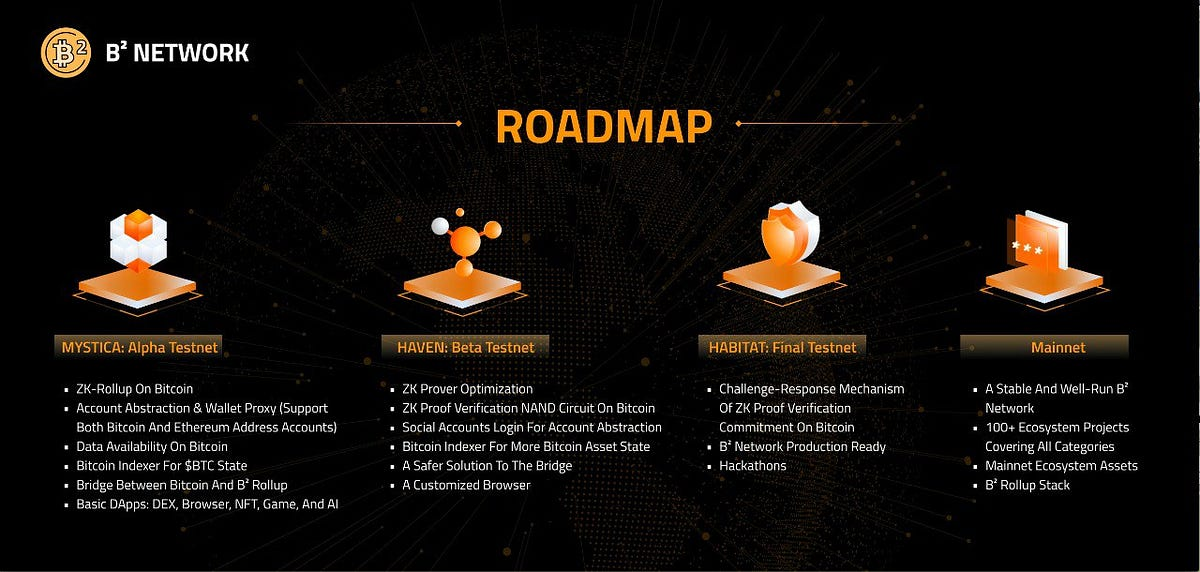 BSquared Network Roadmap
What Is B² Rollup?
B² Rollup is the core execution layer of BSquared Network.
The core idea of a rollup is to process a high volume of transaction computations off-chain, submitting only the verification results to the main chain. This reduces the main chain’s workload while boosting network throughput.
B² Rollup provides a zkEVM-compatible environment, allowing developers to use familiar EVM tools and smart contract frameworks.
Compared to executing complex logic directly on the Bitcoin main chain, B² Rollup significantly reduces execution costs and improves application deployment speed.
What Is B² Hub?
B² Hub is a Layer 1.5 infrastructure layer introduced by BSquared Network.
Traditional blockchains typically have only execution and settlement layers, while modular blockchains further separate the data availability layer. B² Hub’s primary role is to handle data availability and ecosystem coordination.
With an independent data layer, the network can store and verify rollup-generated data while reducing the load on the main chain.
B² Hub also introduces the Proof of Signal (PoSg) mechanism, designed to create a new incentive system based on network behavior, ecosystem contributions, and data value.
The Role of the B2 Token in the Network
B2 is the core utility token of the BSquared Network ecosystem.
During network operation, B2 is used for transaction fees, node staking, and network governance.
For Sequencers, validator nodes, and ecosystem participants, B2 is also a key part of the incentive framework. The network uses token rewards to encourage node operation and ecosystem development.
As the ecosystem grows, B2 may also be used in application access, governance voting, and resource allocation.
Core Ecosystem Components of BSquared Network
BSquared Network is more than just a rollup network—it is an ecosystem built from multiple infrastructure modules.
B² Rollup
B² Rollup handles transaction execution and smart contract operations, serving as the core application-layer infrastructure.
B² Hub
B² Hub provides data availability and modular coordination, connecting various ecosystem components.
Mining²
Mining² connects Bitcoin mining resources to the on-chain economy, providing new infrastructure for BTC yield generation and asset liquidity.
AI Signal
AI Signal focuses on the collaboration between AI Agents and the on-chain economy, aiming to build a verifiable network of AI data and actions.
B² Buzz
B² Buzz drives ecosystem interaction, community collaboration, and signal propagation to support overall ecosystem growth.
What Application Scenarios Does BSquared Network Support?
One of BSquared Network’s design goals is to expand Bitcoin’s application boundaries.
In finance, developers can build BTC DeFi, lending protocols, stablecoin systems, and yield markets.
In digital assets, the network supports NFTs, blockchain gaming, and digital identity solutions.
As AI Agents become an important trend in blockchain, BSquared also provides payment, settlement, and data verification infrastructure for AI Agents.
Together, these scenarios drive Bitcoin’s evolution from a pure store of value into a versatile application platform.
How Is BSquared Network Different from Other Bitcoin Layer2 Solutions?
There is no single technical standard for Bitcoin Layer2; different projects have adopted various scaling approaches.
Stacks uses an independent chain with a PoX consensus mechanism. Lightning Network focuses primarily on payment scaling. Rootstock emphasizes EVM compatibility. Some newer projects use Optimistic Rollup or modular designs.
BSquared Network stands out by combining ZK Rollup, Bitcoin final settlement, and an independent data availability layer.
This design balances smart contract compatibility, scalability, and security, while offering the potential to support complex application ecosystems.
| Comparison Dimension |
BSquared Network |
Stacks |
Lightning Network |
| Core Positioning |
ZK Rollup |
Smart Contract Chain |
Payment Network |
| Smart Contracts |
Supported |
Supported |
Not Supported |
| EVM Compatible |
Supported |
Not Supported |
Not Supported |
| Scaling Method |
Rollup |
Independent Chain |
State Channels |
| Primary Use Case |
Application Ecosystem |
Application Development |
BTC Payments |
BSquared Network Advantages and Challenges
BSquared Network’s main strengths come from inheriting Bitcoin’s security and its modular architecture.
ZK Rollup improves transaction efficiency while reducing the main chain’s burden. EVM compatibility lowers the barrier for developer migration. The modular design also facilitates future ecosystem expansion.
However, BSquared Network still faces challenges such as competition in the Bitcoin Layer2 market, the need for further network decentralization, and overall ecosystem maturity.
Conclusion
BSquared Network is a modular ZK Rollup network built for the Bitcoin ecosystem. Through components like B² Rollup, B² Hub, Mining², and AI Signal, it creates an infrastructure system covering the execution layer, data layer, and application layer.
Compared to traditional scaling solutions, BSquared Network aims to provide stronger scalability for smart contracts, BTC DeFi, AI Agents, and on-chain applications while preserving Bitcoin’s core security.
FAQs
What is the difference between B² Rollup and traditional sidechains?
B² Rollup submits verification results to the Bitcoin network using zero-knowledge proofs, while traditional sidechains typically rely on an independent set of validators for security. The two differ significantly in their security models and data verification methods.
What is the role of B² Hub?
B² Hub is the data availability and coordination layer of the BSquared Network. It stores, verifies, and manages network data while enabling collaboration between ecosystem modules.
What are the uses of the B2 token?
The B2 token is primarily used for network transaction fees, node staking, ecosystem incentives, and governance. It is an essential component of the BSquared Network’s operation.
Does BSquared Network support migration for Ethereum developers?
Yes. BSquared Network uses a zkEVM architecture, allowing developers to deploy applications using Solidity, EVM toolchains, and existing development frameworks.
What application scenarios is BSquared Network suitable for?
BSquared Network supports a wide range of use cases, including BTC DeFi, stablecoins, NFTs, blockchain gaming, digital identities, AI Agent payments, and on-chain data verification.