Because public blockchains record transactions in transparent ledgers, analysts can examine how digital assets move between addresses, interact with smart contracts, and pass through different services. However, understanding who controls an address or why a transaction occurred often requires information beyond the blockchain itself.
Blockchain intelligence connects on-chain transaction data with sources such as public records, known service addresses, sanctions information, and other legally obtained evidence.
This guide explains how blockchain intelligence works, how it differs from blockchain analytics, the tools involved, and its applications across the cryptocurrency industry.
Key Takeaways
-
Blockchain analytics and blockchain intelligence overlap, but intelligence generally emphasizes interpreting data within a broader context.
-
Cryptocurrency exchanges and financial institutions may use blockchain intelligence to support anti-money laundering and sanctions compliance.
-
Law enforcement agencies use blockchain analysis to investigate fraud, ransomware, theft, and other financial crimes.
-
Traders can use on-chain intelligence to monitor wallet activity, exchange flows, and market trends.
-
Blockchain intelligence has limitations, including incomplete attribution, false positives, privacy constraints, and differences in blockchain coverage.
What Is Blockchain Intelligence?
Blockchain intelligence refers to the collection, analysis, and interpretation of blockchain data to produce insights about cryptocurrency transactions, entities, and activities.
Public blockchains such as Bitcoin and Ethereum record transaction information that can be examined independently.
Depending on the blockchain, this information may include transaction amounts, timestamps, wallet addresses, token transfers, and smart contract interactions.
However, most public blockchain addresses do not directly reveal the real-world identities of their users, so analysts work to link activity to real world entities.
Blockchain intelligence attempts to provide additional context by combining transaction records with other information, including off chain information.
For example, an analyst investigating a suspicious cryptocurrency transfer may examine:
-
The originating on chain addresses
-
Previous transactions involving that address
-
Connections to known cryptocurrency services
-
Transfers through decentralized exchanges or bridges
-
Exposure to addresses associated with reported illicit activity
-
Relevant public records or legally obtained customer information
The objective is to understand the transaction’s context rather than simply observe its movement. That is broader than tracing funds from a single source alone.
Why Is Blockchain Intelligence Important?
Blockchain transparency creates opportunities for financial analysis and investigations.
However, public transaction records alone do not explain the intent behind a transfer.
A large cryptocurrency transaction could represent an investment, an internal exchange transfer, a payment, or potentially suspicious activity.
Blockchain intelligence helps analysts investigate these possibilities by examining transaction patterns and available supporting information.
This broader context is essential for financial crime investigations, regulatory compliance, market monitoring, and higher-stakes institutional due diligence.
Blockchain Intelligence vs. Blockchain Analytics
Blockchain analytics and blockchain intelligence are closely related, and the terms are sometimes used interchangeably.
Both involve examining blockchain data to understand cryptocurrency activity.
Blockchain analytics focuses on collecting, processing, measuring, and visualizing blockchain information, often starting from raw blockchain data. Whereas blockchain intelligence emphasizes interpreting that information in context to support decisions.
| Feature |
Blockchain Analytics |
Blockchain Intelligence |
| Primary focus |
Analyzing blockchain activity |
Interpreting blockchain activity in context |
| Typical questions |
What happened on-chain? |
What might the activity mean? |
| Common data |
Transactions, balances, token flows |
On-chain data plus relevant external information, off-chain information, and open source data |
| Techniques |
Metrics, clustering, tracing, visualization |
Analytics, attribution, contextual investigation, risk assessment |
| Common applications |
Market research, network monitoring |
Compliance, investigations, risk management |
| Main output |
Analytical findings |
Contextual assessments and actionable insights |
These categories are not mutually exclusive.
Modern blockchain analytics platforms may already include entity attribution, sanctions screening, and investigative tools.
Blockchain intelligence can therefore be understood as an application of blockchain analytics rather than an entirely separate technology.
Blockchain Intelligence vs. Blockchain Forensics
Blockchain forensics focuses specifically on examining blockchain transactions for investigative or evidentiary purposes, particularly following cryptocurrency theft, fraud, or security breaches.
Recent exchange hacks demonstrate its practical applications. In September 2026, approximately $387.5 million was stolen from Bitget. Blockchain forensics like Chainalysis traced the stolen assets across multiple networks, identifying suspicious wallet addresses and tracking transfers through cross-chain protocols. Similarly, following Binance’s approximately $6.3 billion security breach in October 2026, investigators analyzed on-chain transactions to trace stolen funds and support asset-freezing efforts.
Blockchain intelligence encompasses these forensic investigations but extends further into ongoing transaction monitoring, regulatory compliance, fraud prevention, and risk assessment. While blockchain forensics primarily reconstructs past activities, blockchain intelligence also helps exchanges and financial institutions identify suspicious transactions and respond to emerging threats.
How Does Blockchain Intelligence Work?
Blockchain intelligence typically involves several stages, beginning with blockchain data collection and progressing toward contextual analysis.
1. Blockchain Data Collection
The first step is collecting relevant blockchain information.
This may include:
Blockchain nodes, explorers, and data-indexing services provide access to this information.
Different blockchains have different transaction structures, which affects how data is collected and interpreted.
2. Address Clustering
Address clustering attempts to identify blockchain addresses that may be controlled by the same entity.
On Bitcoin, analysts may use transaction patterns such as common-input ownership heuristics.
However, these heuristics are not universally reliable.
Certain transaction structures, including collaborative transactions, can invalidate assumptions about shared ownership.
Account-based blockchains such as Ethereum require different analytical approaches.
Repeated interactions with the same smart contract do not, by themselves, establish that multiple addresses share a common owner.
Clustering results should therefore be interpreted according to the method used and its limitations.
3. Entity Attribution
Entity attribution associates blockchain addresses with known services, organizations, or other entities.
For example, an intelligence platform may identify addresses associated with:
-
Centralized cryptocurrency exchanges
-
Decentralized finance protocols
-
Cryptocurrency payment services
-
Mining pools
-
Reported scam operations
-
Sanctioned entities
Attribution may rely on public disclosures, transaction patterns, verified service information, or other evidence.
However, associating an address with an exchange does not necessarily identify the exchange customer responsible for a transaction.
Similarly, a probable attribution should not be treated as a confirmed identity without sufficient supporting evidence.
4. Transaction Graph Analysis
Graph analysis represents blockchain activity as a network of connected addresses and transactions.
Addresses or entities may appear as nodes, while transfers represent connections between them.
This approach helps analysts identify transaction pathways, recurring relationships, and potential intermediaries, making complex crypto transactions more easily understandable.
For example, a graph may reveal that funds moved through several wallets before reaching a cryptocurrency exchange. In more complex cases, graphing can also help investigators spot possible criminal networks.
However, a connection between two addresses does not necessarily establish a direct relationship between their owners.
5. Cross-Chain Transaction Analysis
Cryptocurrency transactions increasingly involve multiple blockchains.
Users may move assets through bridges, wrapped tokens, decentralized exchanges, or Layer 2 networks.
Cross-chain analysis attempts to connect related transactions across these environments.
For example, an analyst may examine a bridge transaction on Ethereum and identify the corresponding asset movement on another supported network.
However, cross-chain tracing is not always straightforward. This is because transaction structures, privacy features, intermediary services, and incomplete data can limit visibility.
6. Risk Assessment
Blockchain intelligence platforms may assign risk indicators to addresses, transactions, or entities.
These assessments can consider factors such as:
-
Known sanctions exposure
-
Connections to reported illicit services
-
Transaction patterns associated with financial crime
-
Exposure to compromised funds
-
Behavioral anomalies
-
Relevant jurisdictional or counterparty information
A risk score is an analytical assessment rather than proof that a transaction is illegal.
Its reliability depends on the underlying data, methodology, and context.
What Are the Main Types of Blockchain Intelligence Tools?
Different tools serve different analytical needs.
Some focus on transaction visibility, while others provide specialized compliance or investigative capabilities.
Blockchain Explorers
Blockchain explorers allow users to search public blockchain records.
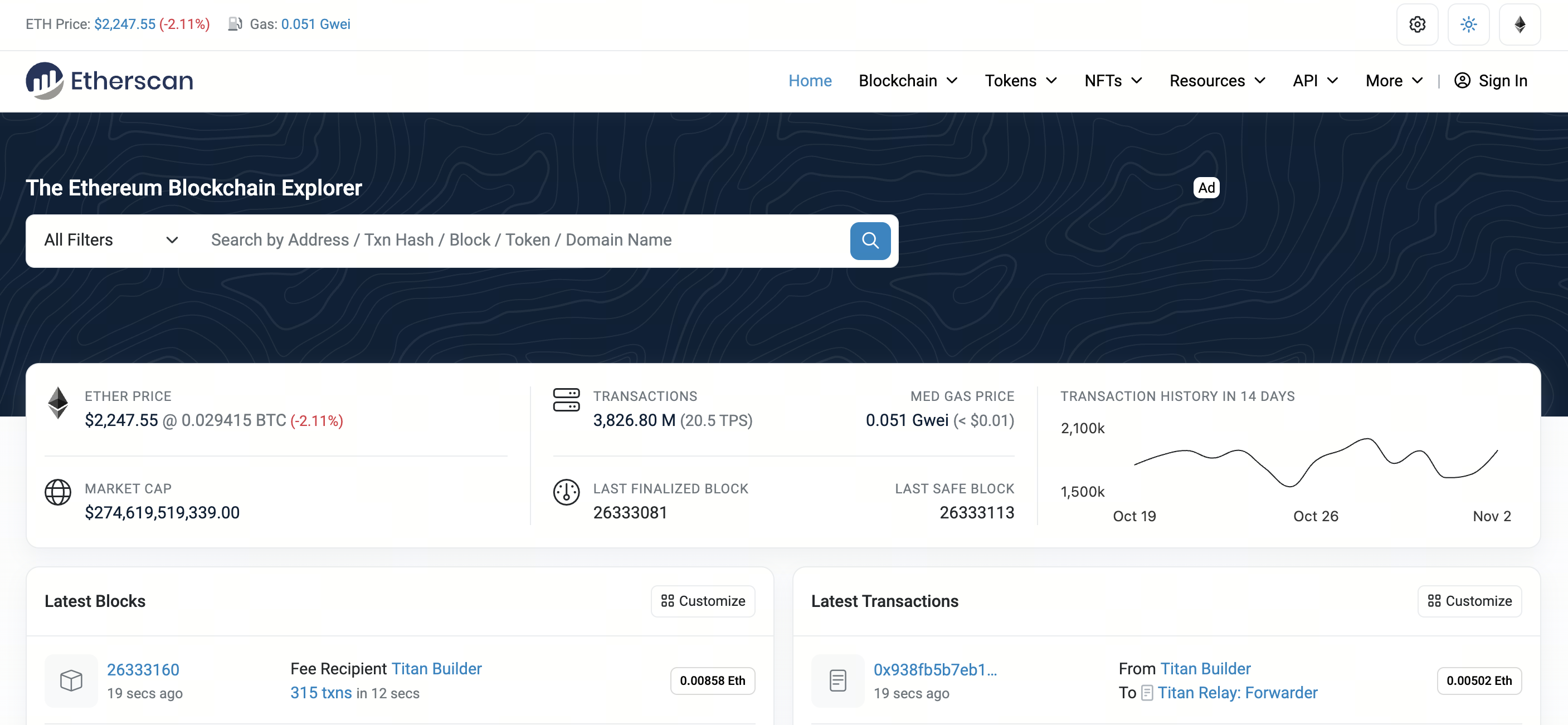
Examples include Etherscan and Solscan.
Users can examine wallet addresses, transaction histories, token transfers, and smart contract activity.
Explorers are useful starting points for blockchain research, but they generally do not provide the full investigative context available through specialized intelligence platforms.
On-chain analytics platforms aggregate blockchain data into dashboards, queries, and visualizations.
For example, Dune enables users to explore blockchain datasets and create analytical dashboards.
These tools can help researchers examine exchange activity, DeFi usage, token movements, and other network trends.
However, a dashboard showing transaction activity does not necessarily establish the identity or intent of the participants.
Specialized investigation platforms support transaction tracing, entity analysis, and case management.
Examples include:
Their capabilities may include transaction visualization, entity attribution, cross-chain analysis, and investigative reporting, and in suitable cases they can help connect cyber incidents to related on-chain activity to support faster enforcement actions.
Specific features, supported networks, and data coverage vary by provider and product.
Compliance-focused blockchain intelligence tools help financial institutions and other covered businesses support crypto compliance, assess cryptocurrency transaction risks, and improve transparency.
They may support:
They can also assist compliance professionals during customer due diligence and ongoing reviews.
These tools support compliance programs and may also aid regulatory reporting, but do not replace legal analysis or human review.
How Is Blockchain Intelligence Used?
Blockchain intelligence supports several activities across the cryptocurrency ecosystem.
1. Cryptocurrency Compliance
Cryptocurrency exchanges and other virtual asset service providers may use blockchain intelligence to support anti-money laundering and counter-terrorist financing controls.
For example, a compliance team may review a deposit associated with an address previously linked to reported illicit activity.
The team can examine the transaction history, assess the reliability of the attribution, and determine whether further investigation is necessary.
Blockchain intelligence may also support sanctions screening and suspicious activity monitoring.
However, legal obligations differ by jurisdiction.
A blockchain risk score alone does not determine whether a transaction must be blocked or reported.
2. Law Enforcement Investigations
Law enforcement agencies use blockchain analysis to investigate crypto crimes.
Common investigation areas include:
-
Cryptocurrency theft
-
Investment scams
-
Ransomware payments
-
Fraudulent fundraising
-
Money laundering
-
Sanctions evasion
Investigators may trace funds from a reported incident through subsequent transactions and identify potential destinations. These cases may cross borders and involve multiple services or jurisdictions.
Where funds reach a regulated intermediary, investigators may seek relevant customer information through appropriate legal procedures.
Blockchain analysis can support an investigation, but identifying a wallet’s real-world controller often requires additional evidence. When reporting incidents to local law enforcement, preserve transaction hashes, wallet addresses, timestamps, and relevant communications.
3. Regulatory Supervision
Regulators may use blockchain intelligence to better understand cryptocurrency activity and identify potential financial risks.
For example, blockchain data can provide insights into transaction volumes, stablecoin movements, or interactions with certain services.
However, blockchain data does not necessarily reveal the jurisdiction or identity of every participant.
Regulatory assessments therefore require information beyond on-chain activity.
4. Trading and Market Research
Traders and analysts may use blockchain intelligence to monitor activity that could influence cryptocurrency markets.
Common metrics include:
Exchange inflows and outflows: Transfers involving addresses attributed to exchanges may provide context about potential market activity.
Large wallet movements: Significant transfers may attract attention because of their potential relationship to liquidity or market sentiment.
Stablecoin flows: Changes in stablecoin supply and transfers may provide information about activity across cryptocurrency markets.
DeFi activity: Smart contract deposits, withdrawals, and liquidity movements can help analysts understand protocol usage.
However, these indicators are not reliable trading signals on their own.
For example, a large transfer to an exchange does not necessarily mean the assets will be sold.
It could represent internal custody movements, collateral transfers, or other activities.
5. Institutional Due Diligence
Institutions may use blockchain intelligence to assess transaction histories and potential counterparty risks.
For example, a business considering a cryptocurrency transaction may review the provenance of relevant assets and any known exposure to illicit activity.
Such analysis should be combined with contractual, legal, financial, and operational due diligence.
How Blockchain Intelligence Helps Investigate Financial Crime
Public blockchain records can allow investigators to follow transaction histories even when funds move through multiple addresses. However, tracing the movement of assets is not the same as proving criminal responsibility.
Example: Investigating Stolen Cryptocurrency
Consider a hypothetical cryptocurrency theft.
An attacker transfers assets from a compromised wallet to another address.
The funds subsequently move through several intermediary wallets and a cross-chain bridge.
An investigator may examine:
-
The original unauthorized transaction
-
Subsequent transfers from the receiving address
-
Interactions with identifiable services
-
Relevant cross-chain transactions
-
Potential destinations of the transferred assets
The investigator may then compare these findings with additional evidence.
This could include incident reports, service records, and information obtained through lawful investigative procedures.
If the funds reach a cryptocurrency exchange, identifying the account holder may require cooperation from the exchange and an appropriate legal basis for obtaining records.
Why Transaction Patterns Require Context
Certain transaction patterns can appear in financial crime investigations.
Examples include:
-
Transfers through multiple intermediary addresses
-
Rapid movements across different blockchains
-
Interactions with mixing services
-
Transfers involving addresses associated with reported scams
-
Unusual transaction sequences
However, these activities are not automatically illegal.
For example, bridging assets between networks and interacting with decentralized exchanges are common legitimate activities.
The significance of a transaction pattern depends on the surrounding evidence.
Blockchain Intelligence and Cryptocurrency Regulation
Blockchain intelligence can support compliance with financial crime regulations.
However, regulations generally establish obligations for covered businesses rather than requiring a particular commercial blockchain intelligence product.
FATF and Virtual Asset Service Providers
The Financial Action Task Force, or FATF, establishes international standards for combating money laundering, terrorist financing, and proliferation financing.
Its guidance addresses virtual assets and virtual asset service providers.
Under the FATF framework, covered service providers are expected to implement risk-based measures appropriate to their activities and applicable national requirements.
Blockchain intelligence may help support these measures.
However, FATF recommendations are implemented through domestic legal and regulatory frameworks, so specific obligations differ across jurisdictions.
The FATF Travel Rule
The FATF Travel Rule addresses the collection, transmission, and availability of specified originator and beneficiary information for qualifying virtual asset transfers.
The requirements depend on the applicable jurisdiction and transaction circumstances.
Blockchain intelligence can help identify potential counterparties and assess transaction risks.
However, blockchain analysis alone does not necessarily provide all information required for Travel Rule compliance.
European Union Requirements
The European Union has established regulatory frameworks addressing crypto-assets and financial crime.
MiCA primarily regulates areas such as crypto-asset services, issuers, and market conduct.
AML obligations arise through related European and national legal frameworks.
The EU’s rules on information accompanying transfers of funds and certain crypto-assets are also relevant to Travel Rule compliance.
These frameworks should not be described as imposing a universal obligation to use a specific blockchain intelligence platform.
United States Requirements
In the United States, applicable financial crime obligations may arise under the Bank Secrecy Act and related regulations administered by FinCEN.
Certain cryptocurrency businesses may be subject to requirements involving registration, AML programs, recordkeeping, and suspicious activity reporting.
The applicable requirements depend on the business model and regulatory classification.
Why Human Review Matters
Automated blockchain risk assessments can produce false positives.
For example, an address may receive a high-risk classification because of indirect exposure to a suspicious service.
That does not automatically establish that its owner engaged in wrongdoing.
Compliance teams should consider the quality of the evidence, the nature of the exposure, and applicable legal requirements before making consequential decisions.
Limitations and Risks of Blockchain Intelligence
Blockchain intelligence provides valuable analytical capabilities, but its findings are subject to limitations.
Incomplete Wallet Attribution
Most public blockchain addresses do not directly reveal their owners.
Attribution may rely on incomplete or probabilistic information.
An incorrect label can affect subsequent analysis.
False Positives
Risk-scoring systems may flag legitimate transactions because of indirect connections, shared services, or unusual but lawful activity.
This can create unnecessary investigations or restrictions if findings are not reviewed carefully.
Cross-Chain Visibility Gaps
Not every blockchain or protocol provides the same level of transparency.
Cross-chain transactions can be difficult to interpret when assets move through multiple services or transaction structures.
Privacy Technologies
Privacy-enhancing technologies can limit the information available to blockchain analysts.
This creates additional challenges for transaction tracing and attribution.
However, the use of privacy technology does not itself establish criminal intent.
Data Freshness
Blockchain intelligence depends on current information.
New addresses, recently reported scams, and emerging transaction patterns may not immediately appear in existing datasets.
Methodological Differences
Different intelligence providers may reach different conclusions about the same wallet or transaction.
Their results can vary because of differences in data coverage, attribution methods, and risk-scoring models.
For this reason, blockchain intelligence should be treated as evidence-informed analysis rather than an infallible source of truth.
Conclusion
Blockchain intelligence helps transform public blockchain transaction data into information that can support compliance, investigations, risk management, and market research.
By combining on-chain activity with relevant external evidence, analysts can better understand cryptocurrency flows and identify potential risks.
The value of blockchain intelligence lies not simply in tracing transactions, but in interpreting them accurately, responsibly, and within the appropriate context.
FAQ
Can Blockchain Intelligence Identify Wallet Owners?
Sometimes, but not always. Analysts may associate addresses with known services or entities, but identifying an individual wallet controller often requires additional evidence.
Is Blockchain Intelligence Used for AML Compliance?
Yes. Blockchain intelligence can support AML programs by helping organizations identify and investigate potentially suspicious cryptocurrency transactions.
However, it does not replace other compliance obligations or human review.
Can Blockchain Intelligence Track Stolen Cryptocurrency?
It can help investigators trace stolen cryptocurrency across supported blockchain networks.
However, successful tracing does not guarantee identification of the responsible party or recovery of the assets.
Can Traders Use Blockchain Intelligence?
Yes. Traders may analyze exchange flows, large wallet transfers, stablecoin activity, and DeFi transactions to better understand market conditions.
These indicators should not be treated as reliable standalone predictions of future prices.
Is Blockchain Intelligence Always Accurate?
No. Its accuracy depends on data quality, attribution methods, blockchain coverage, and supporting evidence. Incorrect conclusions are possible.