Arbitrage trading is an investment strategy that involves taking advantage of price differences of similar currencies or commodities in different markets, and it is common across stocks, bonds, commodities, and crypto.
Arbitrage exploits market inefficiencies and price variations — an approach long used by sophisticated hedge fund investors in traditional markets. Unlike regular trading, it bets on temporary mismatches between quotes rather than on market direction, which is why it is often called a market-neutral strategy.
Today the same idea has made inroads into the crypto industry, where high volatility and inconsistent prices across platforms create frequent arbitrage opportunities.
Key Takeaways
Arbitrage trading profits from temporary price differences of the same asset across different markets or exchanges, not from predicting whether the price will rise or fall.
Crypto arbitrage exists because the market is fragmented across centralized exchanges, decentralized exchanges, and separate liquidity pools, each with its own fees, rules, and supply and demand.
Gross spread is not profit: trading fees, withdrawal and network fees, slippage, and conversion costs can shrink a 0.4% gap to a fraction of that amount.
Most arbitrage today is executed by bots and high-frequency trading firms because price windows often close within seconds; beginners should start small and calculate all costs first.
What Is Arbitrage Trading?
Arbitrage trading is an alternative investment strategy that involves the buying and selling of stocks, commodities, and currencies in different markets or crypto exchanges, quickly taking advantage of the slight price differences to generate profits.
Crypto arbitrage is a product of supply and demand where arbitrageurs (those involved in arbitrage) take advantage of price differences of similar assets across exchanges. Though sophisticated technology now monitors prices constantly and narrows these gaps, it has not eliminated arbitrage, nor stopped some investors from making quick cash from it.
Unlike regular trading, arbitrage does not require guessing the market's direction: an arbitrageur bets on a temporary mismatch between quotes and locks in the difference. This is why arbitrage is often described as market-neutral — the profit comes from convergence, not a correct price prediction.
How Does Arbitrage Trading Work?
Arbitrage trading is simply an exploitation of price differences in the financial market, using highly sophisticated software to receive signals of price variations from different markets.
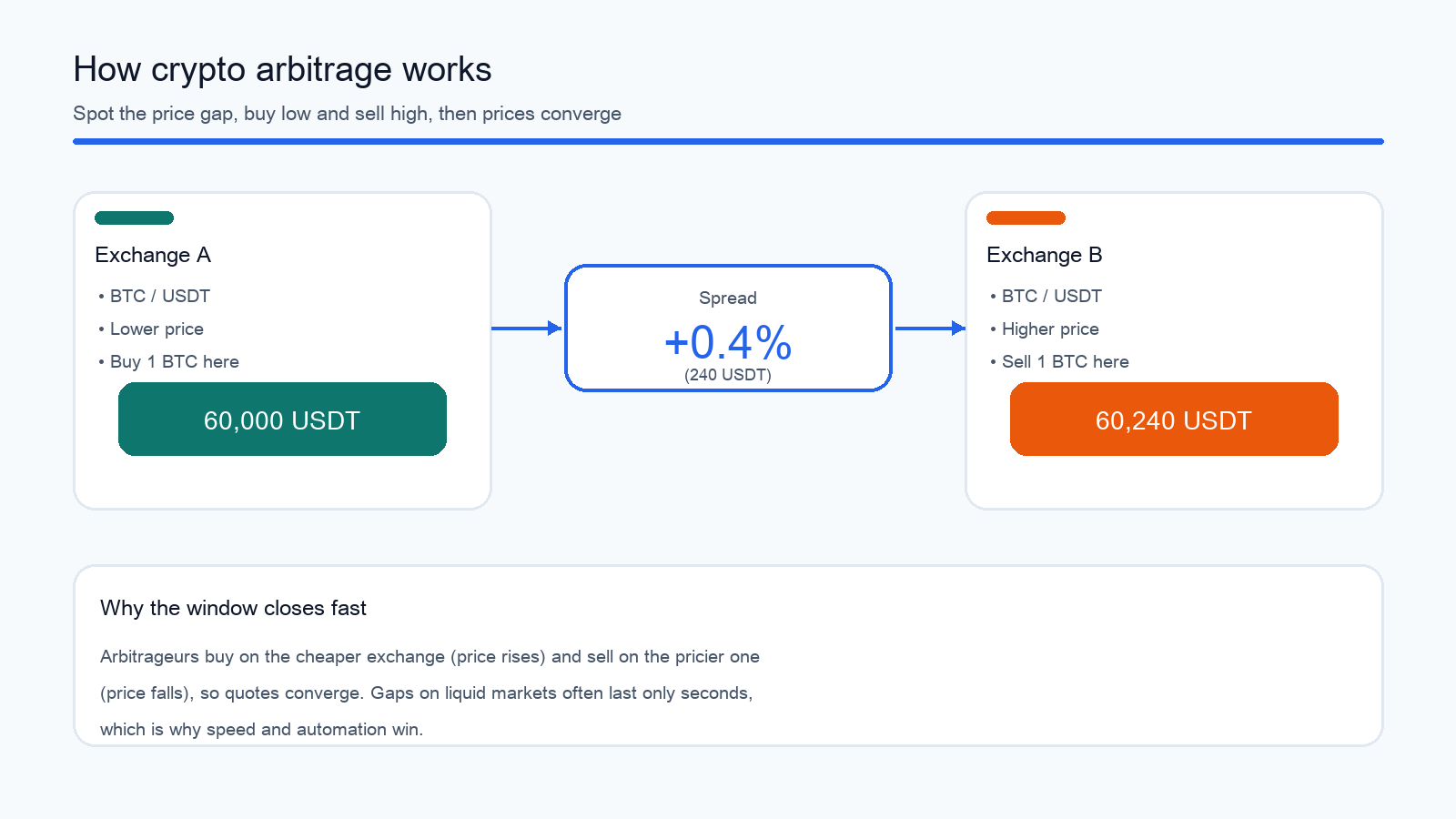
Suppose Bitcoin (BTC) trades at 60,000 USDT on Exchange A and 60,240 USDT on Exchange B — a spread of 240 USDT, or 0.4%. Buying 1 BTC on the cheaper venue and almost simultaneously selling it on the more expensive one yields a gross profit of 240 USDT before costs.
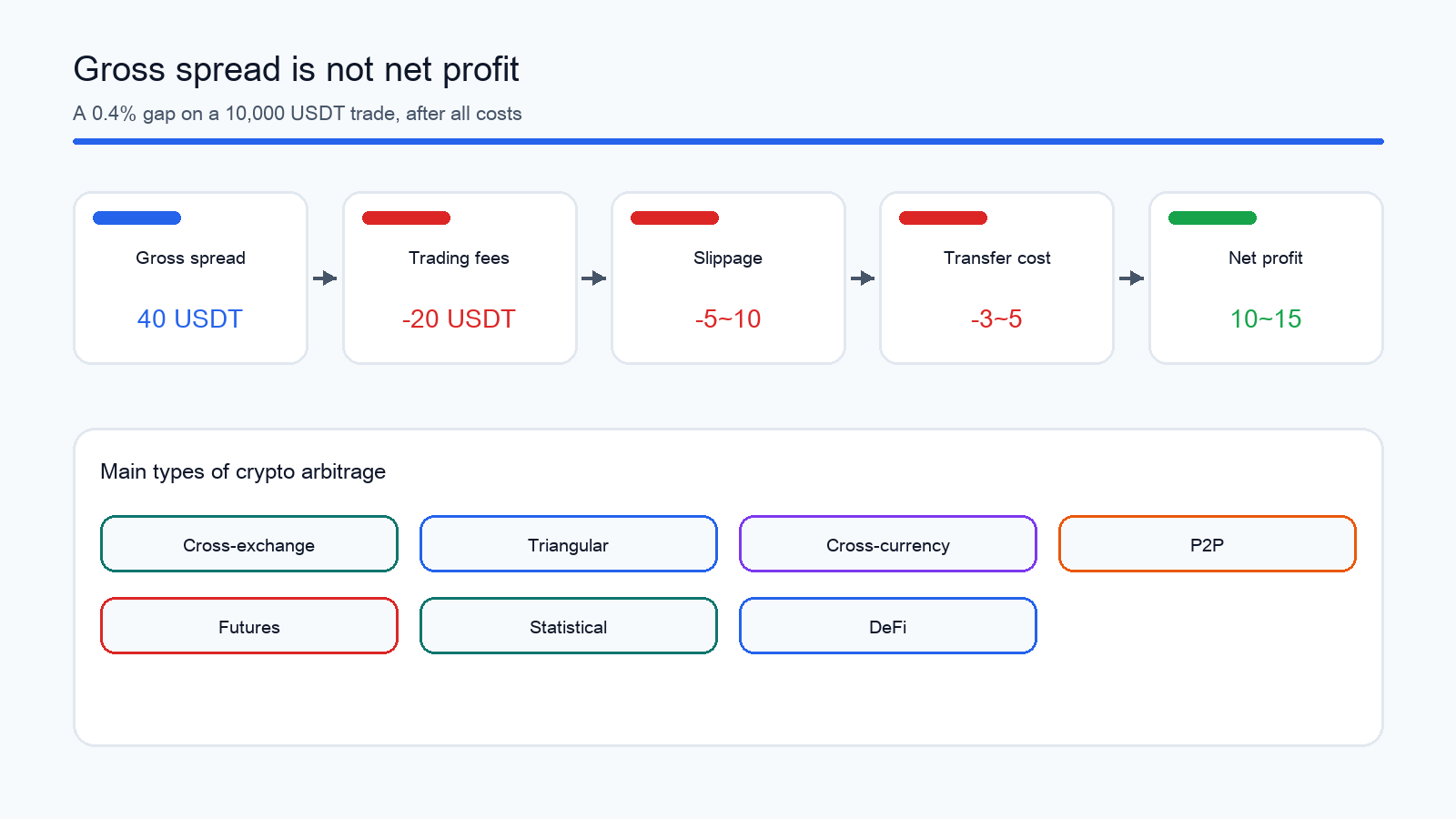
Gross spread, however, is not net profit. On a 10,000 USDT trade with that 0.4% spread, the gross difference is 40 USDT; a 0.1% taker fee on each leg already costs about 20 USDT, and even minimal slippage of 0.05–0.1% removes another 5–10 USDT. Moving funds between exchanges adds conversion and transfer costs, so the net result can shrink to 10–15 USDT — or disappear entirely.
Convergence is also what keeps prices aligned. When arbitrageurs heavily buy on the cheaper exchange the price there rises, and when they heavily sell on the more expensive one it falls, so quotes across venues converge. This is why discrepancies on large, liquid markets exist only for seconds and why instant execution matters so much in arbitrage.
Fig. 1. The basic crypto-arbitrage loop: spot a price gap between venues, buy low and sell high, then prices converge.
Why Do Price Differences Exist in Crypto?
Cryptocurrency trades simultaneously on centralized and decentralized exchanges and in separate liquidity pools, each with its own conditions, fees, and deposit or withdrawal rules, and this fragmentation creates the preconditions for price gaps. Regulatory differences add to the effect, since capital controls or licensing rules prevent local supply-demand imbalances from being arbitraged away instantly.
For the largest assets, gaps between venues are usually small because of high liquidity. But during volatility, when deposits or withdrawals are temporarily limited, or right after new tokens are listed, noticeable discrepancies tend to appear — and those are the moments arbitrageurs watch for.
Types of Arbitrage Trading
There are several types of arbitrage trading that touch on different financial investments. Let us focus on the most common types:
Fig. 2. Gross spread is not net profit — fees, slippage, and conversion costs shrink the gap; the main types of crypto arbitrage are listed below.
Cross-Exchange (Crypto Exchange) Arbitrage
This simply involves buying coins on one exchange at a low cost and selling them on another at a high cost and then keeping the profit from the slight price difference between the two. For instance, the price of Ethereum (ETH) on Gate could be $1,780 and cost slightly higher than $1,800 on another exchange. Investors can earn a profit of $20 for every ETH sold. Profits are generally very small in arbitrage trading, hence, the volume per trade and the speed of transaction is very important, the reason most arbitrage trading is executed by algorithms created by high-frequency trading (HFT) firms.
More noticeable margins tend to appear in newly listed tokens, in altcoins with modest trading volumes, or in pairs quoted against less common stablecoins. Beginners sometimes assume it is enough to buy a coin on one exchange and transfer it to another, but constant withdrawals raise costs through fees, and by the time a transaction confirms the quote may have moved. Experienced participants therefore spread capital across venues in advance and use automation tools rather than moving funds for each trade.
Intra-Exchange (Triangular) Arbitrage
Intra-exchange arbitrage happens within a single platform. Its main advantage is that funds do not need to be withdrawn to a blockchain, which means fewer delays and no extra network fees.
The best-known format is triangular arbitrage, also called three-point arbitrage or cross-currency arbitrage. In this case a trader sequentially executes three trades across different pairs and returns to the original currency. If the balance after the full cycle is larger, a temporary price inconsistency existed.
For example, suppose an exchange quotes BTC/USDT at 60,000 and ETH/USDT at 3,000. These values imply a "fair" BTC/ETH rate of about 20. But if the order book momentarily shows BTC/ETH at 19.98, a cycle becomes possible: use 60,000 USDT to buy 20 ETH, use 19.98 ETH to buy 1 BTC, sell that BTC back for 60,000 USDT, and keep the leftover 0.02 ETH. Gross profit in this example is about 60 USDT, or roughly 0.1%, but fees and slippage can erase it, which is why traders rely on bots that analyze quotes and place orders within fractions of a second.
Cross-Currency Arbitrage
Cross-currency arbitrage means earning on the difference in an asset's price across different quote currencies. For example, Bitcoin trades against both USDT and USDC; ideally its price in the two pairs should be nearly identical. But if BTC/USDT sits at 60,000 while the converted BTC/USDC rate implies 60,200, a gap appears.
The principle is simple: buy the asset in the currency where it is temporarily cheaper and sell it where it is temporarily more expensive. Discrepancies are usually most visible during rising volatility, but the risk also rises — if the intermediary stablecoin briefly loses its dollar peg, the expected profit can shrink.
P2P Arbitrage
P2P arbitrage is earning on the difference between the price at which people buy and sell crypto directly with each other and the exchange price. It can look like buying USDT from one participant at a discount and selling it at the market rate on the spot market or to another participant, or the reverse. Margins in P2P are often higher than in classic cross-exchange arbitrage because the price reflects fiat transfer costs, counterparty risk, and local restrictions.
The main risk is that you are dealing with a specific person rather than an exchange mechanism, so mistakes and dishonest behavior are possible — a counterparty might send a fake payment confirmation or try to dispute a transfer after receiving the crypto. Bank compliance checks are another risk: automated monitoring may flag transfers whose references contain crypto terms, which can freeze a payment or even temporarily block an account. This is why P2P platforms use escrow. When a seller posts an offer, their crypto is locked by the platform until payment is confirmed, and disputes can be appealed with evidence such as chat history and payment documents.
Futures (Spot-Futures and Funding Rate) Arbitrage
Futures arbitrage is based on the difference between an asset's spot price and its futures price. Sometimes the futures trades above spot, sometimes below, and that gap creates an opportunity.
When the futures trades above spot — a situation called contango — a trader can buy the asset on the spot market and simultaneously open a short futures position. The difference between the two prices is locked in at entry, and when the futures price converges back toward spot the trader closes both legs and keeps the initial gap. If the futures is cheaper than spot, the scheme works in reverse.
A separate variant involves perpetual futures. Because these contracts have no expiry, a funding rate keeps their price close to spot through regular payments between participants. When the rate is positive, longs pay shorts; when negative, shorts pay longs. Traders sometimes combine a spot position with an offsetting perpetual position to collect funding while staying market-neutral.
Statistical Arbitrage
Statistical arbitrage uses quantitative models to identify short-term price inconsistencies. A trading algorithm — a constructed mathematical model — scores assets on relative performance and trades them against each other, aiming to profit when temporarily diverged prices move back toward their statistical relationship. These strategies require analyzing large volumes of data quickly, so they are difficult to run manually and are typically automated.
Decentralized Finance (DeFi) Arbitrage
DeFi is a non-custodial financial protocol that exchanges with zero human interference. Their coding architecture makes them ideal for arbitrage; "DeFi degens" who want to try arbitrage can use this platform. They use smart contracts for trading.
The various returns provided by DeFi lending methods are one of the best ways for arbitrage. A trader might switch their low-yield stablecoin to a high-yield one to earn that extra 1% if one platform provides a 10% yield from one stablecoin while another platform offers an 11% yield from a different stablecoin. Yield gaps between lending protocols, liquidity pools, and stablecoin pairs are the raw material of DeFi arbitrage.
Tools and Technology for Crypto Arbitrage
An edge in arbitrage usually comes from tools rather than intuition. On liquid assets discrepancies are minimal, so profit depends on the speed of market data, the accuracy of cost calculation, and the synchronicity of execution — none of which is realistic without automation.
The most convenient market-data apps — many of them free — include CoinGecko, CoinDesk, and CoinMarketCap, which let you track price changes across exchange listings. Arbitrage calculators and portfolio trackers such as CoinStats let you monitor pair prices across many exchanges.
For finding and acting on gaps, traders generally pick one of three automation setups:
Ready-made platforms. Services that connect to exchanges and let you run algorithms without programming, such as Cryptohopper, 3Commas, and HaasOnline. These suit beginners or those without a technical background.
Custom bots. Ready libraries for exchange APIs — for example CCXT, which provides access to many venues — let you write your own bot with custom spread logic and order-book depth checks.
Hybrid models. Traders detect opportunities with their own scripts or external services, while execution runs through established infrastructure.
Before any trade you need to find the discrepancy, and that is the job of scanners: data aggregators provide cross-exchange prices for initial monitoring, while dedicated arbitrage scanners compare venues in real time and estimate profit after fees.
How to Start Crypto Arbitrage: First Steps
To begin with crypto arbitrage, a beginner should:
Register on one to three exchanges (depending on the type of arbitrage) and complete verification.
Enable two-factor authentication on every account.
Understand the deposit and withdrawal terms of each venue.
Study the fee schedules in detail.
Then run a test cycle on a small amount: study prices and order-book depth, find a gap, calculate the potential profit after all costs, and only then execute. This shows you where slippage appears and how long transfers take. The main beginner mistake is counting only the price difference — always subtract every cost: trading fees on both sides, deposit or withdrawal fees, network fees, slippage, and any conversion cost.
Advantages of Using Automated Crypto Arbitrage
Automated crypto-arbitrage algorithms can scan many exchanges at once while tracking hundreds of cryptocurrencies. A massive number of trades are scanned simultaneously with speed and efficiency that no human can match.
It does not involve financial expertise, no time-consuming research into price discrepancies or trading activity on exchanges with large and low trading volumes, or hours spent in front of a computer screen placing transactions.
Risks Involved in Crypto Arbitrage Trading
Crypto arbitrage is less risky than its traditional counterparts — commodities, bonds, and stocks — because it exploits price discrepancies across exchanges rather than predicting prices. But it still carries risks worth knowing:
Slippage: On order-book exchanges an order can "slip" and cost more than expected when the purchase exceeds the cheapest offer. Because arbitrage margins are so low, slippage can wipe out the prospective earnings.
Price fluctuations: Volatility creates the opportunity, but a delayed transaction can let prices normalize before both legs fill. Traders must act quickly, keeping funds on the exchanges and using fast blockchains.
High transaction fee: Withdrawal, deposit, and trading fees can eat the entire profit. High-volume hedge fund traders are less affected because their relative fees are lower.
Delayed transactions: Arbitrage windows open briefly and close faster as more traders join, so profit depends heavily on how fast you move funds between exchanges.
Hacking or exchange closure: Hot wallets are vulnerable to breaches, and exchanges have shut down taking customers' funds. Store the bulk of assets in cold wallets and trade on well-established exchanges like Gate.
Execution and platform risk: The price can move faster than the arbitrageur opens both legs, so one side fills as planned while the other does not. Cross-exchange arbitrage also depends on the reliability of each venue, where withdrawal delays or technical limits can trap funds.
Counterparty and regulatory risk: In P2P deals you interact directly with another person, which raises the chance of fraud or payment disputes. And because crypto regulation is still forming in many countries, the rules applied to platforms and transactions can change.
Most of these risks can be reduced through automation, precise margin calculation, and using reputable platforms.
Is Crypto Arbitrage Still Profitable?
Supply and demand of similar assets create price gaps across markets, and in the first crypto boom (2017–2018) arbitrage was easier because price normalization took days or weeks. Today the market has evolved and profit is harder, though skilled investors and hedge fund traders still earn strong returns through arbitrage.
There is no single answer to how much one can earn. Returns depend on many factors, such as the size of the capital committed and the speed of execution. On liquid markets, price gaps amount to tenths or hundredths of a percent, and the margin per operation is most often in the 0.05–0.3% range after basic fees. In certain segments, or when using derivatives, some estimates reach 10–20% of the deposit per month, but such results are only possible with large trading capital, automated execution, and constant cost control.
Summary
Arbitrage trading has profited both investors and traders, and the technology deployed to monitor and close price gaps keeps markets efficient. An arbitrageur's income is built on systematically working these discrepancies: finding opportunities, opening multiple positions at once, and calculating costs, since even a small miscalculation can wipe out the profit. To automate execution, traders use bots, scanners, and the built-in tools of exchanges.
Crypto arbitrage suits those willing to work with precise calculations over the long run rather than chase quick gains. Per-trade profit rarely exceeds a fraction of a percent, so consistently monitoring prices and acting in time matters more than any single trade.
FAQ
What is arbitrage trading in simple terms?
Arbitrage trading is earning on the price difference of the same asset: if a coin is cheaper on one venue than another, an arbitrageur buys low and almost immediately sells higher, keeping the difference. Unlike normal trading, there is no need to predict the market direction.
Is crypto arbitrage legal?
Arbitrage as a trading strategy is not prohibited by itself — it is simply buying and selling crypto assets on different markets. General rules for digital-asset transactions in each country apply. For example, buying and selling crypto is allowed across the European Union under the MiCA framework, provided exchanges are licensed and follow verification requirements. Always check the rules in your own jurisdiction.
What are the main risks of arbitrage trading?
The main risks are execution risk (price moves before both legs are filled), slippage, high transaction and withdrawal fees, transfer delays, platform reliability, counterparty fraud in P2P deals, and changing regulation. Most can be reduced with automation, accurate cost calculation, and using reputable exchanges.
Is crypto arbitrage good for beginners?
It can be, if approached carefully. Start with simple cross-exchange or P2P strategies on a small amount, calculate net profit after every fee, enable two-factor authentication, and learn each platform's deposit and withdrawal rules before scaling up.
Do you need a bot for arbitrage trading?
Not strictly, but in practice yes beyond occasional trades. Price windows often close within seconds, hard to catch manually, so traders use ready-made platforms, custom bots on exchange APIs, or hybrid setups.
Author: Paul
Translator: binyu
Reviewer(s): Edward、Jayne
Disclaimer
* The information is not intended to be and does not constitute financial advice or any other recommendation of any sort offered or endorsed by Gate.
* This article may not be reproduced, transmitted or copied without referencing Gate. Contravention is an infringement of Copyright Act and may be subject to legal action.
DEX aggregators integrate order data, price information, and liquidity pools from multiple decentralized exchanges, helping users find the optimal trading path in the shortest time. This article delves into 8 commonly used DEX aggregators, highlighting their unique features and routing algorithms.
In the Web3 ecosystem of 2026, Non-Fungible Tokens (NFTs) have evolved far beyond basic digital art into multi-chain dynamic assets, tokenized Real-World Assets (RWAs), cross-chain gaming items, and Bitcoin Ordinals. Navigating today’s hyper-connected market requires real-time data precision, algorithmic anti-wash trading filtering, and sophisticated cross-chain intelligence.
The report shows that in Q1 2026, the crypto market will reach a stage of structural maturity, with Derivative trading making up more than 90% of total trading volume, exceeding $20 trillion. As Spot demand weakens, liquidity will become even more concentrated in top exchanges, reflecting a more cautious market sentiment and a shift toward leveraged and institutional trading.