Unlike most public blockchain tokens that primarily handle gas fees or serve as a medium of exchange, AMP is designed for a different purpose—it acts as credit collateral during payment transactions. When consumers pay with digital assets, AMP instantly guarantees the transaction, allowing merchants to safely receive funds before the blockchain reaches final confirmation.
AMP’s value isn’t generated from token circulation alone; it comes from the ongoing payment demand on the Flexa network. As payment volume grows, collateral needs increase, and more participants stake their tokens, AMP’s role in the payment ecosystem expands in tandem.
What Role Does AMP Play in the Flexa Network?
AMP is vital infrastructure for the Flexa payment network. Every transaction relies on AMP to provide temporary collateral, positioning it more as a credit assurance layer than a conventional payment currency.
According to the official whitepaper, AMP follows the “Extensible Collateral” concept. This means it can serve not only Flexa but also other applications requiring on-chain collateral through a unified smart contract framework, earning it the official label of a general-purpose collateral asset.
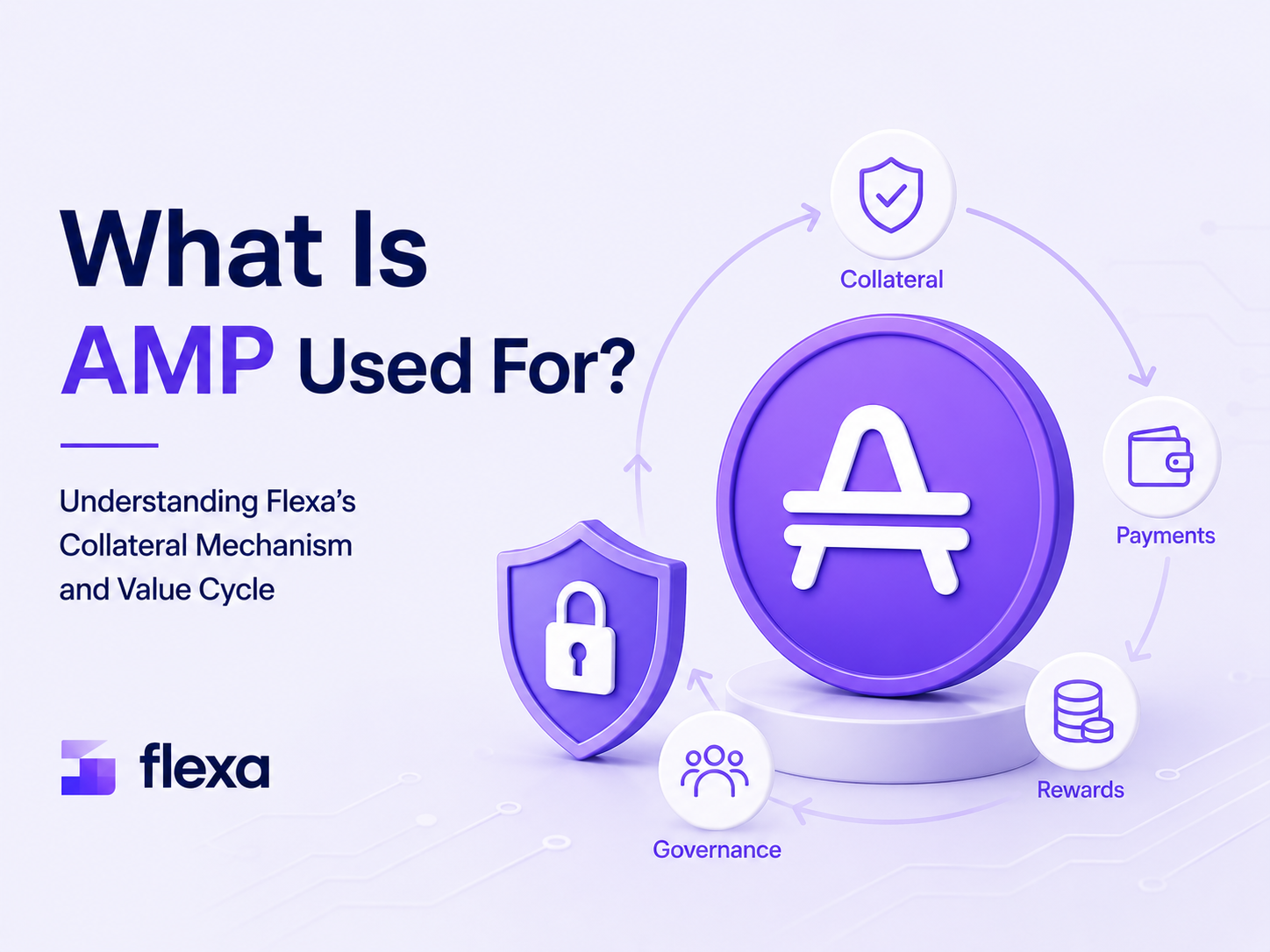
Beyond payment collateral, AMP also handles network governance, staking incentives, and ecosystem expansion, aligning token value with the payment network’s growth.
The officially confirmed core uses of AMP are as follows:
| Function |
Role |
| Payment Collateral |
Provide instant guarantees for payment transactions |
| Network Staking |
Increase payment network collateral capacity and earn rewards |
| Governance |
Participate in protocol governance and ecosystem decisions |
| Extensible Collateral |
Support other on-chain applications in building collateral mechanisms |
Flexa did not design AMP as a payment medium; instead, its collateral capability underpins the entire payment network’s credit system. This is the key distinction between AMP and most payment tokens.
Why Does Flexa Need a Collateral Token?
Blockchain transactions require network confirmations before final settlement, which takes too long for real-world commerce. If merchants had to wait for blockchain confirmation before delivering goods, they would struggle to match the speed of card payments.
Flexa’s solution introduces a collateral mechanism during payment confirmation. When a consumer initiates a payment, the system immediately locks an equivalent amount of AMP to guarantee that transaction. Merchants can then confirm receipt and wait for the blockchain to finalize settlement later.
If the transaction succeeds, the locked AMP is automatically released from collateral. If it fails due to an anomaly, the collateral compensates the merchant according to protocol rules. This shifts payment risk from the merchant to the collateral system, allowing digital asset payments to balance efficiency and security.
Therefore, AMP does not accelerate the blockchain itself—it resolves the tension between payment confirmation and fund security through collateral. This is the foundation of Flexa’s instant payment experience.
How Does AMP Ensure Payment Security?
AMP’s security mechanism is built on an automated smart contract collateral process. When the Flexa network receives a payment request, it automatically locks a corresponding amount of AMP as a transaction guarantee, requiring no manual intervention.
The entire collateral process is managed by on-chain smart contracts. Only after the underlying blockchain confirms the transaction are the collateral assets automatically released. If the payment fails or cannot be confirmed according to protocol, the system invokes collateral assets for compensation, reducing the risk merchants bear from failed transactions.
Unlike traditional payments that rely on bank credit, AMP provides a fully on-chain credit assurance mechanism. Payment security comes from pre-locked collateral assets, not from a third-party institution. As a result, the process is more transparent and easier to verify on-chain.
AMP’s payment assurance process can be summarized as follows:
-
User initiates a digital asset payment
-
System locks AMP of corresponding value
-
Merchant receives instant payment confirmation
-
Blockchain completes final settlement
-
AMP is unlocked or used for compensation
This mechanism keeps payment confirmation and on-chain settlement in sync. It is also the core reason AMP is defined as a “collateral token” rather than a “payment token.”
How to Stake AMP for Rewards
AMP’s staking mechanism provides collateral capacity for the Flexa payment network. When users stake AMP into a designated Collateral Manager, they make collateral assets available for the network. As the network processes payments, this capacity secures each transaction.
Staking is not only about earning rewards—it enhances the network’s overall payment capability. The more AMP staked, the larger the payment volume Flexa can support and the more pending transactions it can handle simultaneously. Collateral capacity directly correlates with network payment ability.
Rewards come from transaction fees generated by the Flexa network, not from newly issued AMP. The more active the network’s payment activity, the richer the fee pool available to incentivize stakers. Thus, rewards are directly tied to actual network usage.
Official materials indicate that AMP holders can choose from different collateral pools based on their needs. Different Collateral Managers may offer varying reward levels, but all follow the network’s established rules.
| Staking Step |
Role |
| Stake AMP |
Provide payment collateral capacity |
| Support payment network |
Guarantee pending transactions |
| Earn rewards |
Share network payment fees |
| Increase network capacity |
Support more merchants and transactions |
Therefore, AMP staking is more akin to building payment network infrastructure than a traditional high-yield farming mechanism.
How Does AMP Participate in Governance?
Beyond payment collateral, AMP is also an important governance token for the Flexa network. Holders can participate in protocol governance, voting on the network’s future direction and key parameters, thereby shaping ecosystem development.
According to official materials, governance topics include ecosystem fund usage, partner onboarding, cross-chain integration, and other protocol upgrades. This mechanism enables AMP holders to participate in network operations, not just as collateral providers.
Governance rights are typically tied to the amount of AMP held or staked, but governance does not interfere with the payment process. The payment network executes automatically according to protocol, while governance focuses on how the network evolves.
AMP governance content mainly includes:
-
Community governance proposal voting
-
Partner ecosystem building
-
Network fund allocation
-
Cross-chain and DeFi integration decisions
This dual role—payment network infrastructure and governance token—enables AMP to serve both functions simultaneously.
AMP’s value cycle is built on the continuous operation of the Flexa payment network, not on token trading alone. Every new payment demand requires corresponding AMP collateral, so network expansion directly increases collateral demand.
As more AMP is staked into the network, payment capacity increases, allowing Flexa to support more merchants and digital asset payments. The transaction fees generated by network payments are returned to stakers, forming a “payment → collateral → reward” cycle.
The entire value cycle can be summarized as follows:
Digital asset payments increase
        ↓
AMP collateral demand rises
        ↓
More users participate in staking
        ↓
Payment capacity expands
        ↓
More merchants join Flexa
        ↓
Payment transactions continue to grow
Notably, AMP’s value cycle is based on actual network usage, not automatic yield generation. Payment volume, merchant count, and ecosystem adoption all affect collateral demand, so AMP’s long-term role is closely tied to the growth of the Flexa payment network.
Summary
AMP is critical infrastructure for the Flexa payment network. Its core purpose is to secure digital asset payments through on-chain collateral, connecting payment network, staking, and protocol governance. Rather than acting as a payment medium, AMP emphasizes credit assurance and network security, providing merchants with instant payment guarantees.
As more payment scenarios integrate with Flexa, AMP’s collateral capability, governance function, and staking incentives form a complete value cycle, making it an indispensable core component of the Flexa payment ecosystem.
FAQ
What is the main role of AMP?
AMP’s core role is to provide on-chain collateral for digital asset payments on the Flexa network, while also supporting network staking, protocol governance, and other extensible collateral applications.
Why doesn’t Flexa directly use the payment asset as collateral?
Because payment assets require blockchain confirmation. As an independent collateral asset, AMP can provide an immediate guarantee the moment a payment is initiated, allowing merchants to complete receipt without waiting for on-chain final confirmation.
Where do AMP’s staking rewards come from?
Official materials indicate that AMP staking rewards primarily come from transaction fees generated by the Flexa network, not from continuous token issuance.
What scenarios can AMP be used for?
Besides the Flexa payment network, AMP also supports building other on-chain collateral applications through Collateral Managers, positioning it as an extensible, general-purpose collateral asset.
Will AMP be continuously issued?
According to the official whitepaper, AMP adopts a fixed supply model with a total supply of 99,444,125,026 tokens. No continuous issuance mechanism has been announced.
What is the difference between AMP and ordinary payment tokens?
Ordinary payment tokens are mainly used for value transfer, while AMP focuses on providing on-chain collateral and credit assurance. Its value derives from the collateral demand of the payment network, rather than directly serving as a payment medium.