Agentic Wallets are a type of wallet architecture designed to enable AI Agents to execute tasks autonomously. Within user-defined authorization limits, they allow AI systems to complete on-chain payments, token swaps, asset transfers, and other blockchain operations. Unlike traditional wallets, which primarily rely on users to manually confirm transactions, Agentic Wallets place greater emphasis on the coordination of programmable permissions, automated signing, and task execution.
As AI Agents expand from information retrieval and content generation into payments, trading, and cross-application operations, wallets are evolving from simple asset storage tools into infrastructure that supports automated economic activity. However, an AI model's ability to understand transaction intent does not mean it should have direct access to a user's complete private key. How to improve execution efficiency while ensuring that asset transfers remain subject to clear controls is a core question in Agentic Wallet design.
This article starts with the basic principles of Agentic Wallets and explains how AI Agents complete on-chain transactions, how Session Keys control authorization scopes, and how smart contract accounts, account abstraction, and related protocols work together to support agentic economic activity. It also discusses the main security risks faced by automated wallets.
Key Points
-
Agentic Wallets are wallet architectures that enable AI Agents to manage on-chain assets, initiate transactions, and execute tasks within predefined permissions. Their core function is to combine automated execution capabilities with asset control permissions.
-
Autonomous trading by an AI Agent does not mean that the Agent has unrestricted control over funds. Wallets can limit Agent behavior through transaction amounts, contract allowlists, operation types, and authorization validity periods.
-
Smart contract accounts, account abstraction, Session Keys, and delegated authorization mechanisms provide AI Agents with more flexible ways to execute on-chain operations and manage permissions.
-
Technologies such as ERC-4337 and ERC-7579 can provide a foundation for smart accounts and modular permission management, but not every Agentic Wallet must adopt the same standards.
-
MCP, A2A, ERC-8004, and x402 relate to tool connectivity, Agent collaboration, on-chain identity, and payment flows, respectively. They should not be confused with wallet signing permissions.
-
The main risks associated with Agentic Wallets include prompt injection, malicious tool calls, excessive authorization, transaction slippage, and loss of control over automated strategies. These risks require mitigation through permission isolation, transaction simulation, and continuous monitoring.
What Is an Agentic Wallet? How Does It Differ From a Traditional Crypto Wallet?
An Agentic Wallet, also commonly referred to as a wallet for AI Agents, is a wallet system that allows an AI Agent to execute on-chain operations based on task objectives and predefined authorizations. It is not a single, unified blockchain wallet standard. Instead, it is a combination of components such as smart accounts, key management, transaction tools, and automated strategies.
Traditional crypto wallets are primarily designed around active user operations. Users need to connect to an application, review transaction details, and complete the signing process. Even when some wallets support automated features, their core interactions remain user-centric. Agentic Wallets allow users to define task objectives and execution boundaries in advance, after which AI Agents can complete certain operations within the authorized scope.
For example, a user may want an AI Agent to regularly check the yield of a DeFi protocol and adjust asset allocations when certain conditions are met. Under a traditional workflow, the user would generally need to check the data and confirm the transaction manually. An Agentic Wallet, however, can connect to market data tools, evaluate predefined conditions, and use the wallet to execute authorized operations.
However, this autonomy has clear boundaries. An AI Agent can analyze and propose a transaction, but whether assets can be transferred ultimately depends on the wallet's signing permissions, smart contract validation logic, and other independent execution controls.
| Comparison |
Traditional Crypto Wallet |
Agentic Wallet |
| Primary user |
Human user |
AI Agent authorized by a human user |
| Transaction trigger |
Initiated by the user |
Triggered by the Agent based on tasks and strategies |
| Authorization method |
Per-transaction signing or prior authorization |
Per-transaction approval, delegated permissions, or automated strategies |
| Execution frequency |
Primarily manual |
Continuous monitoring and automated execution |
| Permission management |
Account keys and contract approvals |
Amount limits, validity periods, destination addresses, and operation restrictions |
| Main risks |
Phishing, private key exposure, and malicious approvals |
Traditional wallet risks combined with model and automated execution risks |
Therefore, the core value of an Agentic Wallet is not to eliminate user control, but to convert user authorization requirements into verifiable and executable technical rules.
How Can an AI Agent Complete On-Chain Transactions Autonomously Through an Agentic Wallet?
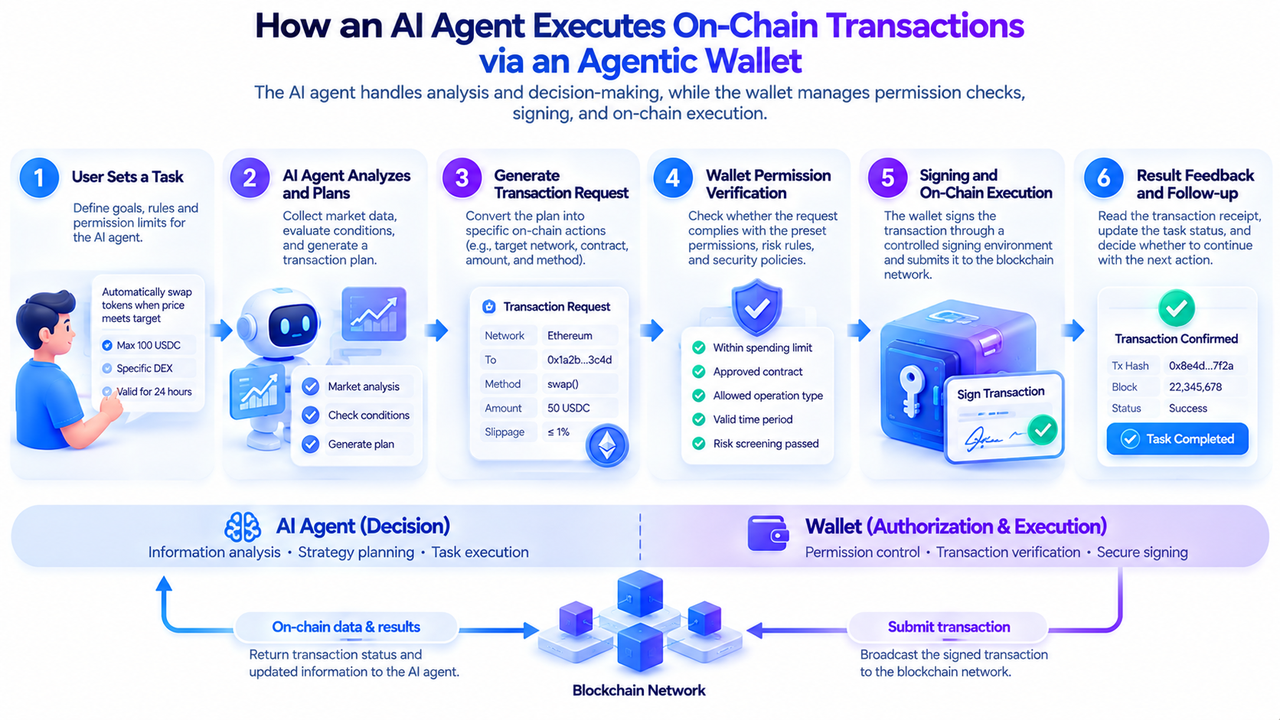
Autonomous transactions by an AI Agent typically involve multiple stages, including task interpretation, data retrieval, transaction planning, permission verification, signing and execution, and result reporting. The wallet manages assets and authorizations, while the AI Agent primarily handles decision-making and workflow orchestration. The two must work together through clearly defined interfaces.
The user provides the AI Agent with an objective, such as monitoring the price of a specific asset or using stablecoins to pay for a service when predefined conditions are met. The Agent obtains information through market data interfaces, blockchain nodes, or other tools, and forms an execution plan based on the task requirements.
The Agent converts the plan into specific on-chain operations, including the target network, contract address, token amount, call method, and transaction parameters. At this stage, the wallet system should independently verify the transaction rather than automatically approving it simply because the AI model considers the operation reasonable.
After the transaction passes the permission checks, a wallet component with the appropriate signing capability authorizes it and submits it to the blockchain network. Once execution succeeds, the Agent can read the transaction receipt, update the task status, and continue to the next step when necessary.
Using an automated swap as an example, the complete process may include:
-
The user authorizes the Agent to use no more than 100 USDC on a specified network.
-
The Agent obtains a quote and checks the predefined price and slippage conditions.
-
The wallet verifies the target contract, token, amount limit, and authorization validity period.
-
After the transaction passes the checks, a controlled signing component signs and submits it.
-
The Agent reads the on-chain result and reports the execution status to the user.
The 100 USDC amount here is a hypothetical example used to illustrate the permission mechanism. It is not a default configuration for any product.
It is important to note that generating a transaction request and having the blockchain confirm the transaction are two separate stages. Network congestion, changes in Gas fees, transaction slippage, or contract execution failures may cause the final result to differ from the Agent's initial plan.
In addition, a transaction intent generated by a model cannot replace independent strategy checks. For high-risk transactions, the wallet may require the user to confirm again or directly reject operations that exceed the authorized scope.
How Do Session Keys Limit an AI Agent's Wallet Permissions?
A Session Key is a representative authorization mechanism in Agentic Wallets. It allows users to temporarily delegate certain operation permissions to another key under specified conditions without exposing the primary wallet's private key to the AI Agent.
In traditional wallet interactions, users may need to sign each transaction repeatedly. For an AI Agent that needs to execute multiple tasks continuously, this approach reduces automation efficiency. A Session Key allows users to authorize a clearly defined set of operations in advance, enabling the Agent to complete transactions that comply with the rules during the validity period.
For example, a user can set the following permissions for an AI Agent:
| Permission Type |
Example Setting |
Primary Purpose |
| Validity period |
Authorization remains valid for 24 hours |
Prevents permissions from remaining open long term |
| Per-transaction limit |
No more than 20 USDC per transaction |
Limits the risk of each individual transaction |
| Cumulative limit |
Total spending cannot exceed 100 USDC |
Controls fund usage for the entire task |
| Destination address |
Only specified contracts are allowed |
Reduces the risk of transfers to unknown addresses |
| Operation type |
Only specified token swaps are allowed |
Prevents unrelated operations |
| Revocation mechanism |
The user can revoke the authorization manually |
Enables subsequent operations to be stopped |
These restrictions must be enforced in practice by the wallet contract, permission module, or an independent policy execution system. They cannot merely be written into the AI Agent's prompt.
The security of a Session Key also depends on its specific implementation. Different smart wallets currently support Session Keys and delegated authorization in different ways. ERC-4337 provides infrastructure for smart account transaction validation, but the specific permission rules for Session Keys are generally implemented by the wallet itself or by related modules.
At the same time, revoking permissions does not mean that completed on-chain transactions can be reversed. For operations that have already been executed, users still need to manage the assets or contract approvals based on the actual circumstances.
Therefore, a Session Key is better understood as a limited authorization tool rather than a mechanism that grants an AI Agent full control over a wallet.
How Do Smart Contract Accounts and ERC-4337 Support Agentic Wallets?
Account Abstraction is an important technology direction for supporting Agentic Wallets. Traditional Ethereum externally owned accounts (EOAs) primarily rely on private key signatures to control transactions, while smart contract accounts can use programmable logic to define more complex authorization rules.
ERC-4337 provides an Account Abstraction framework for the Ethereum ecosystem without requiring changes to the underlying consensus rules. A user or Agent can construct a UserOperation, which a Bundler submits to the EntryPoint contract. The smart account then performs validation and execution.
This architecture gives Agentic Wallets more flexible transaction control options. For example, a wallet can combine different signature validation modules, batch operations, and Gas sponsorship mechanisms to enable an AI Agent to complete a series of tasks when the authorization conditions are met.
A Paymaster can pay Gas for eligible operations based on specific rules, reducing the need for an Agent to manage native Gas tokens itself. However, Gas sponsorship is not automatically free. The associated costs must still be covered by the user, application, or service provider.
ERC-7579 provides an interface standard for modular smart accounts, allowing validation, execution, and other functional modules to be combined in a relatively standardized manner. Developers can use it to design permission management modules and assign different authorization rules to different Agents.
It is important to distinguish that ERC-4337 and ERC-7579 primarily provide account and modular infrastructure. They do not directly determine how an AI Agent should trade. The Agent's decision logic, risk strategy, and wallet authorization still need to be designed independently.
In addition, an Agentic Wallet does not necessarily use ERC-4337. Wallet APIs based on custodial services, MPC signing services, and other blockchain account models can also support automated operations by AI Agents to some extent.
How Do MPC, TEE, and Smart Accounts Protect an AI Agent's Private Key Together?
Agentic Wallets face a specific challenge: an AI Agent needs to execute transactions but should not directly obtain a user's complete private key. Large language models need to process external text, web content, and tool outputs, and these inputs may contain malicious instructions.
If the complete private key is given directly to the Agent's runtime environment, assets may face the risk of unauthorized transfer if the system is affected by prompt injection, malicious tool calls, or a server intrusion.
To reduce this risk, developers can separate the AI Agent's decision-making environment from the wallet's signing environment.
Multiparty computation (MPC) distributes signing capabilities among multiple participants or devices, so that no single component needs to independently hold complete signing capabilities. A trusted execution environment (TEE) attempts to protect sensitive code and data through hardware isolation, reducing the ability of ordinary applications to directly access key materials.
Smart contract accounts can further check authorization conditions during transaction execution, such as the target contract, per-transaction amount, and cumulative spending. Even if an Agent generates a transaction request that does not comply with the rules, on-chain validation logic can prevent it from being executed.
These technologies address different aspects of security:
| Technology |
Primary Protection Target |
Typical Function |
| MPC |
Key control and signing process |
Reduces the risk of a single point of private key exposure |
| TEE |
Sensitive execution environment |
Isolates certain signing and security operations |
| Smart contract account |
On-chain transaction permissions |
Enforces programmable authorization rules |
| Session Key |
Temporary operation permissions |
Limits authorization periods and operation scopes |
| Transaction simulation |
Transaction execution results |
Identifies certain abnormal behaviors in advance |
However, no single technology can eliminate risk on its own. For example, TEEs may still be affected by implementation defects or side-channel attacks. MPC cannot automatically determine whether a transaction intent is reasonable. Permission modules in smart contracts may also contain vulnerabilities.
Therefore, a secure Agentic Wallet should combine key protection, permission checks, transaction simulation, and human approval.
How Do x402, MCP, and ERC-8004 Expand Agentic Wallet Use Cases?
Agentic Wallets are used not only for token trading, but also to provide funding execution for payments between AI Agents, service purchases, and task collaboration. As related protocols develop, wallets are increasingly being integrated with tool calls, identity discovery, and automated payment mechanisms.
x402 is primarily designed for automated payments for internet services. A service provider can issue a payment request through an HTTP 402 response, after which the client resubmits the request once the required payment process is complete. For an AI Agent, this means it can pay for data interfaces, computing resources, or other digital services within its authorized limit.
MCP (Model Context Protocol) is primarily used to connect AI models with external tools and data sources. An Agent can use MCP to obtain market data, call trading tools, or access other services, but MCP itself does not ensure the security of on-chain funds.
A2A (Agent-to-Agent) focuses on capability discovery, communication, and task collaboration between different AI Agents. When one Agent needs to call a service provided by another Agent, the wallet can execute the corresponding payment.
ERC-8004 focuses on Agent identity, reputation, and verification in open environments. It provides infrastructure related to identity registration, feedback, and verification, but does not directly define transaction payment methods or automatically grant wallet signing permissions.
The relationship between these technologies can be summarized as follows:
| Technology or Protocol |
Core Function |
Relationship to Agentic Wallets |
| x402 |
Automated service payments |
Provides the payment interaction flow |
| MCP |
Connecting models with external tools |
Connects transaction and data tools |
| A2A |
Collaboration between Agents |
Supports cross-Agent task workflows |
| ERC-8004 |
Agent identity, reputation, and verification |
Helps identify and assess interaction counterparties |
| ERC-4337 |
Smart account transaction infrastructure |
Supports programmable wallet execution |
For example, a research Agent can use MCP to call a data service, use x402 to make a small payment, and then provide the result to another Agent. Throughout the process, the Agentic Wallet executes authorized fund operations, while identity verification, task communication, and payment protocols perform separate roles.
It is important to note that the ability to combine protocols does not mean that every wallet or Agent product fully supports these functions. Actual availability still depends on the network, SDK, wallet implementation, and service provider.
What Practical Applications Will Agentic Wallets Have in 2026?
In 2026, Agentic Wallets began moving from conceptual exploration into more specific developer tools and application scenarios. Crypto platforms such as Coinbase and Gate have progressively opened wallet management, on-chain trading, and automated payment capabilities to AI Agents, enabling them to execute actual fund operations within predefined authorization limits.
Gate: Gate for AI Agent and Automated Wallet Operations
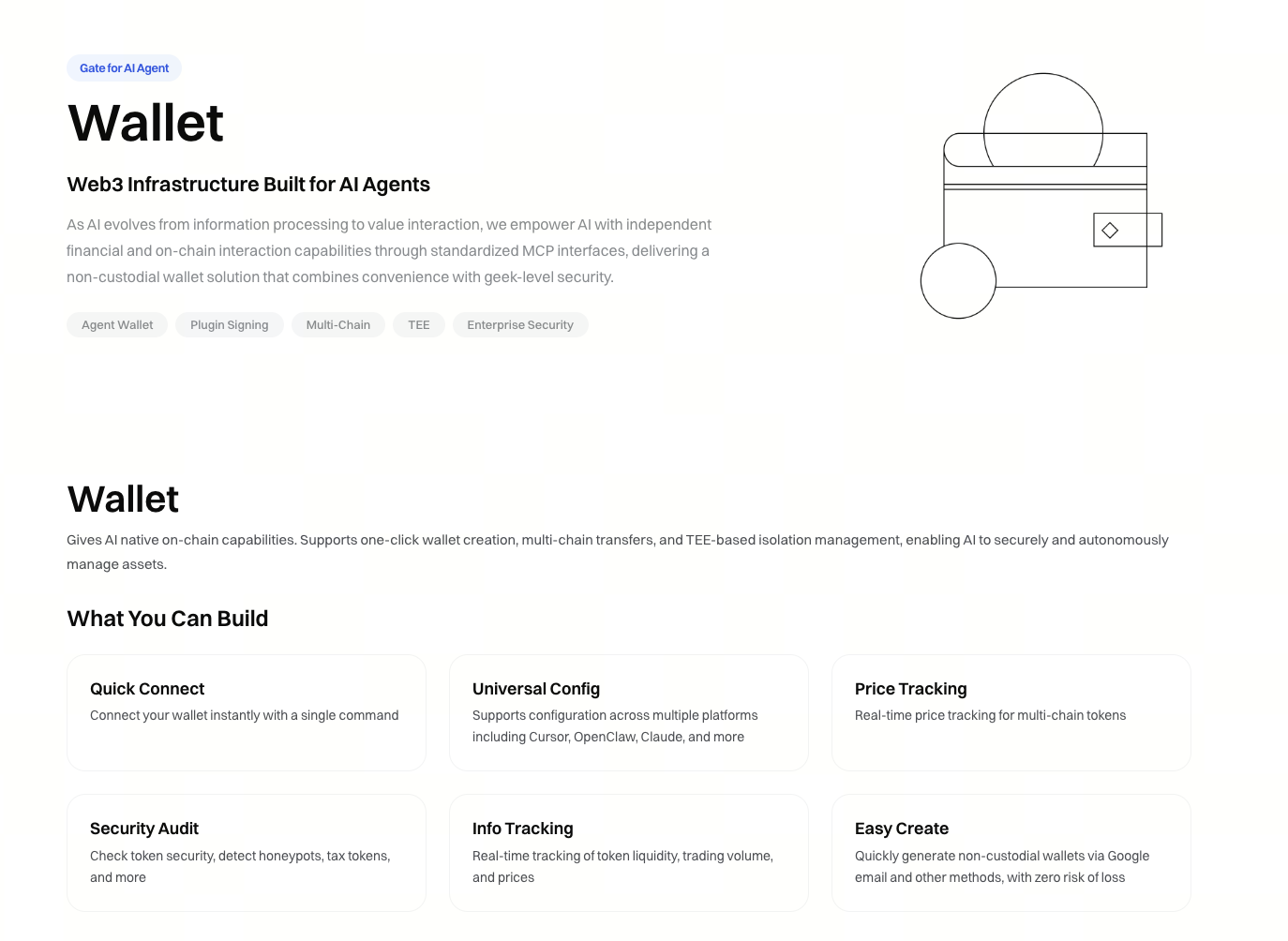
Gate for AI Agent, launched by Gate, is crypto financial infrastructure for AI Agents. Through tools such as Gate Skills, CLI, MCP, and API, it integrates trading, market data, asset management, Web3 wallets, and on-chain payment capabilities into a service ecosystem that Agents can access.
In trading scenarios, an AI Agent can use Gate Skills to obtain market data, check account assets, and generate trading operations based on user instructions. For sensitive operations such as placing orders and transferring funds, the platform provides secondary confirmation and API permission controls. It also recommends using independent subaccounts to isolate the AI Agent's funds and operational scope, reducing the potential impact of automated execution on assets in other accounts.
In Web3 scenarios, Gate Wallet Skills support wallet identity authentication, multichain asset queries, token transfers, transaction signing, and DApp interactions. They can also be combined with other Gate DEX tools to complete operations such as token swaps. In addition, Gate supports automated payments by AI Agents for paid APIs and digital services through x402, providing an execution entry point for on-chain economic activity between Agents.
This architecture reflects an important direction in the development of Agentic Wallets: an AI Agent does not need to directly control a user's complete private key. Instead, it can complete specific tasks through wallet tools, authorization mechanisms, and a controlled execution environment. Authorization requirements for different operations depend on the tools and wallet configuration used in practice, and automation capabilities do not mean that all transactions can bypass user confirmation.
Coinbase: Agentic Wallets and AgentKit
In February 2026, Coinbase Developer Platform launched Agentic Wallets, providing AI Agents with payment, trading, and on-chain operation capabilities. The product combines Agent wallet operations with controlled signing infrastructure and provides security measures such as transaction amount limits and session-level spending controls. According to its product description, private keys are not directly exposed to the AI model's prompt environment. Developers can also use x402 to build automated payment flows.
Coinbase AgentKit provides development tools for connecting AI Agents with wallets and on-chain operations. Developers can use the relevant interfaces to build asset queries, token transfers, and other automated functions. However, the tool framework itself may not provide a complete security policy. Developers still need to configure appropriate safeguards against prompt injection, malicious tool calls, and abnormal transactions.
Application Directions for Agentic Wallets
The examples above show that Agentic Wallet applications are expanding into automated service payments, on-chain swaps based on predefined strategies, DeFi position management, and small-value settlement between Agents.
These scenarios generally require clearly defined authorization boundaries, including the assets that may be used, transaction limits, destination addresses, operation types, and authorization validity periods. Actual product capabilities, supported networks, and security mechanisms still vary. Autonomous trading also does not mean that a strategy is profitable or that market risks can be eliminated.
What Security Risks Do Agentic Wallets Face? How Can Automated Trading Permissions Be Controlled?
Agentic Wallets connect AI decision-making with asset execution, bringing traditional wallet security issues into contact with AI system risks. One of the most important concerns is that transaction requests generated by a model may be affected by untrusted information.
For example, when an Agent reads web pages, social media content, or external API responses, it may receive malicious instructions that attempt to change the transaction destination. If a wallet relies solely on the model's own judgment to determine whether an operation should be executed, an attacker may be able to use prompt injection to influence the flow of funds.
Automated trading may also face risks such as delayed market data, incorrect quotes, excessive slippage, malicious contracts, and repeated transactions. Even when an Agent follows its task precisely, changes in the external environment may still produce unexpected results.
Therefore, Agentic Wallets should use permission enforcement mechanisms that are as independent of the AI model as possible, with a focus on controlling the following risks:
-
Principle of least privilege: Grant only the asset, contract, and operation permissions required to complete the current task.
-
Amount and validity limits: Set per-transaction amounts, cumulative spending, transaction frequency, and authorization expiration times.
-
Independent transaction verification: Check the destination address, call method, token approvals, and expected asset changes before signing.
-
Transaction simulation and anomaly detection: Identify certain abnormal asset transfers, excessive slippage, and suspicious contract interactions.
-
Human approval and emergency pauses: Require human confirmation for large, high-risk, or out-of-scope transactions, while retaining the ability to stop subsequent operations.
For Agents that need to run for extended periods, transaction logs, permission audits, and anomaly alerts should also be established to track behavior and adjust strategies promptly.
It is particularly important to note that on-chain transactions are generally irreversible. Revoking a Session Key or stopping an Agent can limit subsequent operations, but cannot automatically restore asset transfers that have already been completed.
The security objective of an Agentic Wallet should not be to give an AI Agent the greatest possible operational authority. Instead, it should enable the Agent to complete tasks within authorization boundaries that are clear, verifiable, and revocable.
Conclusion
Agentic Wallets are an important technology direction that combines AI Agents with blockchain asset management. Through smart accounts, key management, delegated authorization, and automated execution tools, they enable AI Agents to complete payments, token swaps, and other on-chain operations under specific conditions.
Compared with traditional wallets, the primary change introduced by Agentic Wallets is not the complete transfer of asset control to AI. Rather, users can convert part of their transaction permissions into programmable rules. Session Keys, ERC-4337, MPC, and transaction strategy controls provide support at the levels of authorization, account execution, and key protection, respectively.
As protocols such as x402, MCP, A2A, and ERC-8004 continue to develop, Agentic Wallets may play a greater role in automated payments, digital service procurement, and Agent collaboration. However, their long-term adoption will still depend on whether permission management, signing security, risk monitoring, and actual user needs can be combined into a reliable overall solution.
FAQ
How Does an Agentic Wallet Differ From a Regular Crypto Wallet?
An Agentic Wallet allows an AI Agent to automatically execute certain on-chain operations based on predefined tasks and authorization rules, while a regular wallet generally relies on the user to initiate and confirm transactions manually. Both require reliable key management and transaction verification.
Can an AI Agent Directly Control a User's Private Key?
It is technically possible to design a solution in which the Agent's runtime environment directly accesses the private key, but this increases the risk of key exposure and malicious operations. A more secure architecture generally separates the AI decision-making environment from the signing environment and uses permission policies to limit fund operations.
What Is the Difference Between a Session Key and a Wallet's Primary Private Key?
A primary private key generally provides a high level of account control, while a Session Key is mainly used to execute delegated tasks within a specific validity period, amount limit, and operation scope. The actual permission boundaries depend on the wallet implementation.
Must an Agentic Wallet Use ERC-4337?
No. ERC-4337 is an important approach for implementing programmable smart accounts, but an Agentic Wallet can also use MPC wallets, custodial signing services, or other blockchain account architectures.
Can an Agentic Wallet Guarantee Profits From Automated AI Trading?
No. An Agentic Wallet primarily provides transaction execution and permission control capabilities. It does not guarantee that a trading strategy is correct. Market volatility, insufficient liquidity, slippage, and incorrect model judgments may all result in losses.