Hardware Wallet Supply Chain Attack is a type of security threat targeting the circulation of cryptocurrency asset storage devices. Attackers may compromise the security of hardware wallets before they reach the end user by tampering with device components, implanting malicious modules, or modifying initialization processes, turning devices originally designed to protect private keys into entry points for asset leakage. Unlike traditional network attacks, supply chain attacks can occur before the user first uses the device, making them particularly stealthy.
On October 9, 2026, hardware wallet manufacturer Ledger announced an investigation into reports of abnormal asset losses from some Southeast Asian users. These users had purchased Ledger devices through the distributor CryptoBilis. Ledger subsequently requested the distributor to suspend sales and shipments and issued security recommendations to users who had recently purchased devices. Follow-up reports on October 10 indicated that Ledger had confirmed at least one affected device contained unauthorized hardware implants, but the full scope of the attack and the final extent of losses were still under investigation.
This incident has brought the issue of supply chain security for hardware wallets back into the spotlight. Cold wallets are typically viewed as essential tools for protecting the private keys of cryptocurrency assets, but their security relies not only on cryptographic algorithms and secure chips but also on a complete and trustworthy chain from production to delivery. This article will explain the working principles of hardware wallet supply chain attacks, the potential security risks they pose, and how ordinary users can mitigate related threats, using the Ledger incident as a case study.
Key Points
-
Hardware wallet supply chain attacks refer to malicious tampering by attackers during the manufacturing, transportation, storage, or sales processes, leading users to unknowingly use devices with security vulnerabilities.
-
In October 2026, Ledger investigated asset loss incidents reported by users who purchased devices through the Southeast Asian distributor CryptoBilis, with on-chain researchers estimating suspected losses exceeding $86 million, though this amount has not been officially confirmed.
-
Supply chain attacks do not necessarily require direct compromise of secure chips; attackers may also obtain sensitive information through additional hardware implants, preset recovery phrases, or malware.
-
Authenticity verification of hardware wallets does not equate to a complete physical security audit; even if a device passes official verification, it does not guarantee the absence of additional malicious hardware components.
-
Users should prioritize purchasing channels, device initialization, recovery phrase backups, and transaction signature verification, establishing a security protection mechanism that covers the entire lifecycle of the hardware wallet.
What is a Hardware Wallet Supply Chain Attack?
A hardware wallet supply chain attack occurs when attackers exploit weak points in the production and delivery process of hardware wallets to maliciously modify devices or related software, thereby gaining opportunities to steal sensitive information, interfere with transaction signatures, or control wallet assets. The targets of the attack may include not only the hardware wallet itself but also device packaging, initialization instructions, accompanying software, and distribution channels.
Under normal circumstances, hardware wallets store private keys using secure chips or other isolated key management mechanisms, with transaction signatures typically completed internally to avoid direct exposure of private keys to connected computers or mobile devices. However, this security design relies on a crucial premise: the device used by the user and its key interaction processes must be trustworthy. If the device has been maliciously modified before delivery, attackers may bypass the user's trust in the device's origin, using initialization, screen displays, or transaction confirmations to obtain sensitive information.
The distinction between supply chain attacks and ordinary phishing attacks lies in the location of the attack. Phishing attacks typically induce users to disclose information through fake websites, malicious emails, or social engineering, while supply chain attacks may directly alter the devices received by users. Even if users do not visit suspicious websites, they may still face risks from using tampered hardware wallets.
What Happened in the Ledger Incident? Why Did It Raise Supply Chain Security Concerns?
On October 9, 2026, Ledger announced it was investigating asset loss incidents reported by some Southeast Asian users. These users had purchased Ledger hardware wallets through CryptoBilis, which had previously been listed as an authorized sales channel for Ledger in markets such as Indonesia, Malaysia, and the Philippines. Ledger subsequently requested CryptoBilis to suspend device sales and shipments and advised users who had purchased devices from that channel within the past 90 days and had not yet initialized them to refrain from using them. For users who had already completed initialization, Ledger recommended considering migrating assets to devices using entirely new recovery phrases.
According to reports from The Block, on-chain researchers tracked the related abnormal fund transfers, with some estimates indicating suspected losses exceeding $86 million, involving blockchains such as Bitcoin, Ethereum, and Tron. However, this data comes from third-party on-chain analysis and has not been confirmed as the final loss amount by Ledger; the actual number of affected users and the scale of funds still require further verification.
On October 10, new developments emerged in the investigation. The Verge reported that Ledger had confirmed at least one affected device contained unauthorized hardware implants. Public images showed what appeared to be an additional circuit board beneath the device's screen, and researchers suspected that this module might intercept sensitive information displayed during the device's initialization process and transmit it externally through communication components. However, public information is insufficient to prove that all affected devices employed the same attack method, nor can it confirm that all financial losses were caused by this hardware implant.
The key concern raised by this incident is that the affected devices may not be counterfeit products in the traditional sense but rather genuine hardware wallets that have been physically modified. If attackers can retain the original secure chip while adding hardware components to steal information, relying solely on chip authenticity verification may not be sufficient to identify all risks.
How Do Hardware Wallet Supply Chain Attacks Operate?
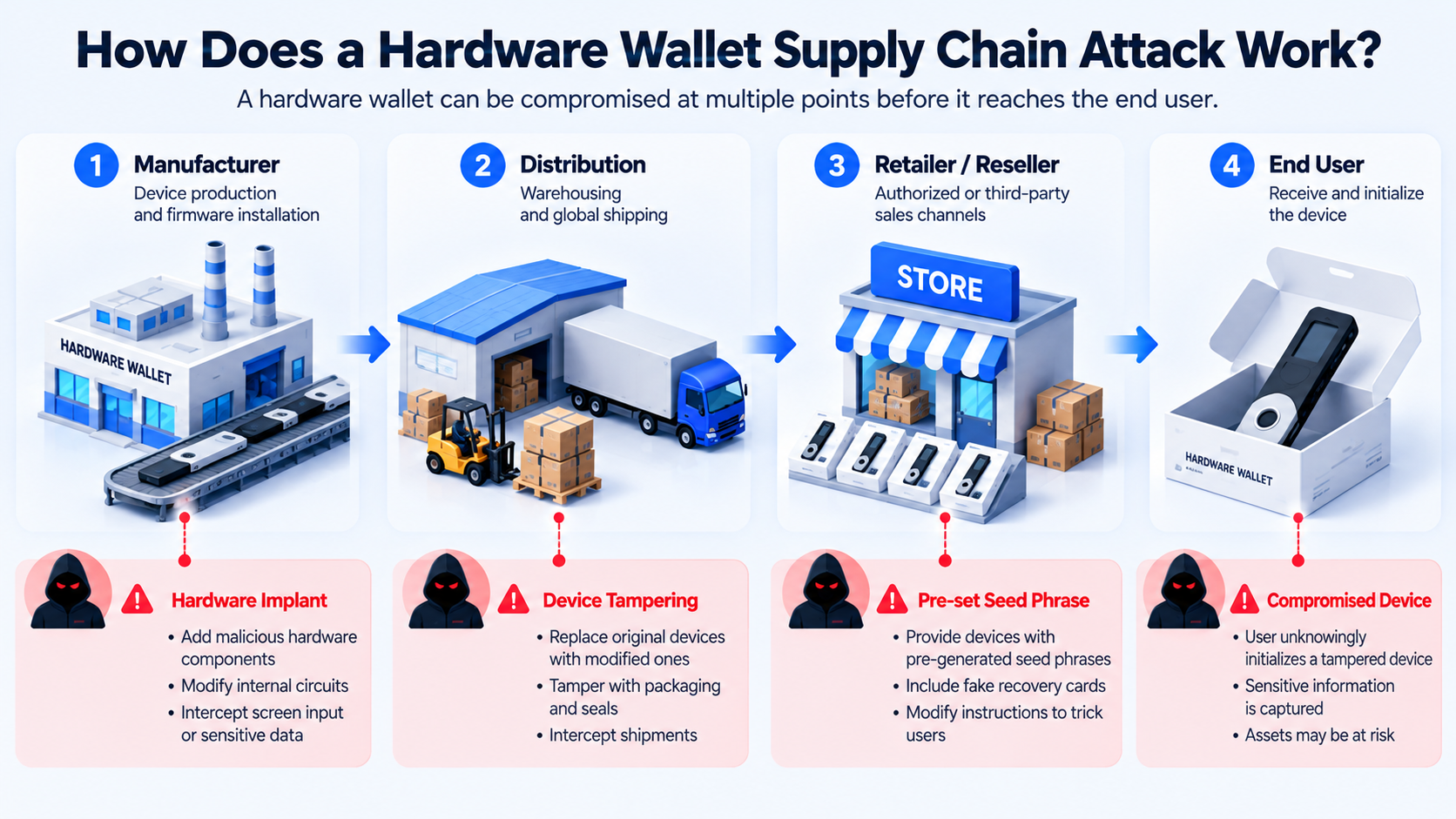
Hardware wallet supply chain attacks typically require attackers to gain some level of access or control before the device is officially put into use. Depending on the attackers' technical capabilities and objectives, attacks may occur at various stages, including manufacturing, storage, logistics, distribution, and device initialization.
One common attack method is physical tampering of the device. Attackers may open genuine hardware wallets, add unauthorized electronic components inside, and then repackage the device for delivery to users. These components may be designed to observe screen information, monitor input operations, or interfere with communication between the device and the external environment. Compared to directly compromising secure chips, this type of attack may exploit security weaknesses in peripheral components of the device.
Another method is preset recovery phrase attacks. Normally, users should generate new random recovery phrases using trusted devices rather than using recovery phrases provided in advance by sellers. If attackers generate and save recovery phrases before the device is delivered and then induce users to use this set of recovery phrases to create wallets, the attackers may effectively have the ability to recover the wallet from the start. Once users transfer assets to the relevant address, attackers could potentially recover the wallet on other devices using the recovery phrases.
Additionally, attackers may utilize counterfeit management software, forge firmware upgrade prompts, or modify initialization instructions to carry out attacks. For example, device packaging may include QR codes that prompt users to visit unofficial websites and enter recovery phrases. Although this method may not involve internal hardware modifications, it similarly exploits users' trust in the product delivery process.
It is important to emphasize that the aforementioned methods represent typical technical paths for supply chain attacks and do not imply that they have all been confirmed in the 2026 Ledger incident. The technical thresholds, implementation conditions, and potential impacts of different attack methods vary significantly.
Why Might Hardware Wallets Still Have Security Risks Despite Authenticity Verification?
Hardware wallet manufacturers typically protect private keys through secure chips (Secure Element), firmware signatures, and device authentication mechanisms. For example, Ledger's Genuine Check authenticity verification mechanism uses an encrypted challenge-response process to verify whether the internal secure chip of the device has legitimate credentials, helping to identify counterfeit devices or unauthorized firmware.
However, device authenticity and physical integrity are two distinct security concepts. Authenticity verification primarily confirms whether the key security components within the device are trustworthy but does not necessarily identify additional malicious electronic components that may have been added inside the device. For instance, if attackers retain the original secure chip while implanting listening modules near the screen or other peripheral components, the device may still pass secure chip authentication, but users' sensitive information could be intercepted at other stages.
Ledger explicitly states in its official security documentation that Genuine Check cannot detect all unauthorized physical modifications, especially when the original secure chip remains intact. This indicates that the security of hardware wallets relies not only on cryptographic verification but also on the physical integrity of the device, supply chain management, and the user operating environment.
The 2026 Ledger incident further highlights this security boundary. According to follow-up reports on October 12, Ledger indicated that the confirmed related cases were still concentrated on devices sold by CryptoBilis, and the number of affected devices appears limited, with no current evidence suggesting that Ledger's internal systems or direct sales channels were compromised. However, the investigation is ongoing, and the specific implantation stages and responsible parties have yet to be determined.
How Do Hardware Wallet Supply Chain Attacks Differ from Traditional Wallet Attacks?
The core difference between hardware wallet supply chain attacks and traditional cryptocurrency wallet attacks lies in the trust elements that attackers seek to undermine. Traditional wallet attacks typically focus on the user experience, such as stealing recovery phrases through phishing websites, using malware to modify transaction addresses, or inducing users to sign dangerous smart contract authorizations. In contrast, supply chain attacks may occur before the device's first initialization, placing users in an untrustworthy hardware environment from the outset.
Moreover, the detection difficulty of supply chain attacks may be higher. Traditional phishing attacks can sometimes be identified by checking website domain names, transaction content, or unusual authorization requests, but physically tampered hardware wallets may not exhibit obvious differences in appearance or basic functionality compared to normal devices. Even if a device can successfully create accounts, display balances, and complete transactions, this does not eliminate potential risks.
| Comparison Dimension |
Supply Chain Attack |
Traditional Wallet Attack |
| Attack Stage |
Before device delivery or during circulation |
During device usage |
| Main Attack Target |
Hardware, firmware, delivery process |
Recovery phrases, transaction authorizations, user accounts |
| Common Methods |
Hardware implants, device replacements, preset recovery phrases |
Phishing, malware, dangerous signatures |
| User Detection Difficulty |
May require professional hardware inspection |
Some can be detected through software and transaction checks |
| Main Preventive Measures |
Trusted procurement, authenticity and integrity checks |
Recovery phrase protection, transaction verification, authorization management |
It is important to note that these two types of attacks are not entirely independent. Attackers may also implant malware through supply chain channels and then use phishing or social engineering techniques to complete asset theft. Therefore, wallet security protection needs to cover risks both before device delivery and during actual usage.
How Can Users Identify If a Hardware Wallet Has Been Subject to Supply Chain Tampering?
For ordinary users, identifying supply chain tampering is not easy, as some attacks may be carefully disguised and difficult to detect through visual inspection. Therefore, security checks should be conducted from multiple aspects, including device source, initialization status, official verification, and abnormal behavior, rather than relying on a single detection method.
First, users should confirm the purchasing channel and transaction records of the hardware wallet. Purchasing devices through the brand's official website typically reduces intermediary circulation links but does not eliminate all risks. If the device comes from a third-party distributor, its authorization status should be verified, and the packaging should be checked for signs of abnormal opening, repackaging, or inconsistent accessories. It is important to emphasize that intact packaging does not guarantee that the device has not been tampered with internally.
Second, users should confirm whether the device generates a brand new recovery phrase during initialization. Normally, recovery phrases should be generated by trusted devices during the initialization process, rather than being pre-written on cards or sent via email by sellers. If the device prompts users to use preset recovery phrases or requires them to enter recovery phrases on computers, mobile devices, or websites, users should immediately cease operations.
Finally, users can use the official authenticity verification features provided by manufacturers to check the device. For example, Ledger users can perform a Genuine Check using the official Ledger Wallet application. However, since this mechanism cannot rule out all risks of additional hardware implants, successful certification does not mean the device has passed a complete physical security audit. For devices with significant doubts about their source, stopping use is usually more prudent than attempting to disassemble and inspect them.
What Should Users Do to Protect Assets If They Suspect Their Ledger Device Is Affected?
If users suspect that their Ledger device may have been subject to a supply chain attack, they should first assess the purchasing channel, purchase time, and current usage status of the device. For the CryptoBilis incident in October 2026, Ledger has clearly advised users who purchased devices from that distributor recently and have not yet initialized them to refrain from using them to avoid generating new recovery phrases on potentially untrustworthy devices.
For users who have already used suspicious devices, merely resetting the device or updating firmware may not be sufficient to eliminate risks. If attackers have already obtained the original recovery phrase, even resetting the device to factory settings may not prevent them from recovering the wallet using the previously obtained recovery phrase. Therefore, a more prudent approach is to generate a brand new recovery phrase using a trusted new device and transfer the assets from the original wallet to the new address.
During the asset migration process, users should also pay attention to the accuracy of the transaction network, receiving address, and signature content. For assets involving multiple blockchains, the corresponding network's balances, tokens, and smart contract authorizations should be checked separately. If the original wallet has participated in DeFi transactions, users should also consider whether there are any dangerous authorizations that have not been revoked. After completing the asset migration, users should not continue to use the recovery phrase that has been suspected of being compromised as a long-term storage credential.
Additionally, users should stay informed about the progress of the incident through official customer service channels and avoid trusting third-party services on social media that claim to help recover assets. Attackers may exploit security incidents to create panic, further inducing victims to submit recovery phrases or connect to malicious websites, resulting in secondary losses.
Are Cold Wallets Still Safe? How Should We Understand the Security Boundaries of Hardware Wallets?
The Ledger incident does not imply that the security mechanisms of cold wallets have entirely failed. The core value of hardware wallets lies in their ability to isolate private keys from everyday connected environments, reducing the likelihood of computer viruses, remote malware, and certain network attacks directly obtaining private keys. This design remains an important component of the self-custody security system for cryptocurrency assets.
However, hardware wallets cannot solve all security issues. They can protect the keys stored within the device but cannot automatically ensure that the device delivery process is entirely trustworthy; they can require users to confirm transactions on the device screen but cannot prevent users from voluntarily approving malicious transactions; they can provide recovery phrase mechanisms but cannot avoid users losing access to assets due to backup errors.
Therefore, the security of cold wallets should be understood as a layered protective capability rather than an absolute security guarantee. For users holding cryptocurrency assets long-term, trusted procurement channels, secure initialization, offline recovery phrase backups, and device-side transaction confirmations are all essential protective measures. For individuals or institutions managing large amounts of assets, further evaluations of multi-signature (Multisig) and independent device management solutions can reduce the risks associated with the loss of a single device or key.
From a broader industry perspective, supply chain attacks also indicate that cryptocurrency asset security is evolving from merely protecting private keys to encompassing multiple aspects such as device manufacturing, logistics management, distribution channels, hardware certification, and user education. In the future, improving the verifiability of physical integrity of devices may become an important direction for hardware wallet manufacturers' continuous improvement.
Conclusion
Hardware wallet supply chain attacks represent a security threat that exploits malicious tampering during the manufacturing, circulation, or delivery stages of devices. Unlike traditional wallet phishing attacks, these attacks may occur before users first use the device and can affect private key security through hardware implants, device replacements, or preset recovery phrases.
The 2026 Ledger incident provides a real-world case for this risk. Ledger has confirmed that at least one affected device contained unauthorized hardware implants, but the specific attack chain, the scope of affected devices, and the final extent of losses are still under investigation. This incident illustrates that even hardware wallets equipped with secure chips and authenticity verification mechanisms cannot completely eliminate physical security risks at the supply chain level.
For ordinary users, the key to reducing risk lies in establishing a comprehensive security management process, including selecting trusted purchasing channels, correctly initializing devices, offline saving recovery phrases, verifying transaction content, and promptly taking asset protection measures when device anomalies are detected. Hardware wallets remain important tools for the secure storage of cryptocurrency assets, but their security effectiveness ultimately depends on the combined effects of technical protections, supply chain trustworthiness, and user operational habits.
FAQ
What is a Hardware Wallet Supply Chain Attack?
A hardware wallet supply chain attack refers to malicious tampering by attackers during the manufacturing, transportation, storage, or sales processes, leading users to receive hardware wallets with security vulnerabilities. Attackers may steal sensitive information through methods such as implanting malicious hardware, replacing devices, or presetting recovery phrases, thereby threatening the security of cryptocurrency assets.
Does the Ledger incident mean that Ledger's secure chip has been compromised?
Currently, there is no evidence to suggest that this incident involves a widespread compromise of Ledger's secure chip. The confirmed finding is that at least one affected device contained unauthorized hardware implants. Attackers may have obtained information through peripheral components of the device without needing to directly compromise the secure chip.
Can Ledger's Genuine Check detect all supply chain attacks?
No. Genuine Check primarily verifies the authenticity of the device's secure chip through cryptographic authentication, but if attackers retain the original secure chip and add additional hardware components, the device may still pass certification. Therefore, authenticity verification cannot replace security checks for the physical integrity of the device.
If a hardware wallet is purchased through official channels, is it absolutely safe?
No. Official channels typically reduce unnecessary intermediary circulation links and lower some supply chain risks, but they cannot guarantee that the device is entirely free from manufacturing defects, logistics anomalies, or other security issues. Users still need to correctly initialize the device, protect recovery phrases, and verify transaction content.
Is resetting the device sufficient if a hardware wallet is suspected of being tampered with?
Not necessarily. If attackers have obtained the original recovery phrase, resetting the device will not revoke their ability to recover the wallet. For wallets with credible leak risks, a safer approach is usually to generate a brand new recovery phrase using a trusted new device and transfer assets to a new address.