Key Takeaways:
-
Understand the crucial difference between base currency and quote currency, and why the order of assets in a trading pair matters.
-
Recognize the importance of liquidity, bid-ask spread, and slippage in choosing the right trading pairs for spot trading.
-
Learn how arbitrage opportunities arise from price differences across pairs and exchanges, and how pairs trading strategies exploit relative value between correlated assets.
-
Familiarize yourself with the types of crypto trading pairs: fiat-to-crypto, stablecoin pairs, and crypto-to-crypto pairs, each with their own benefits and risks.
-
Know how to select appropriate trading pairs based on your trading goals, risk tolerance, and market conditions to optimize execution costs and capital efficiency.
What Are Crypto Trading Pairs? Core Concepts and Real Examples
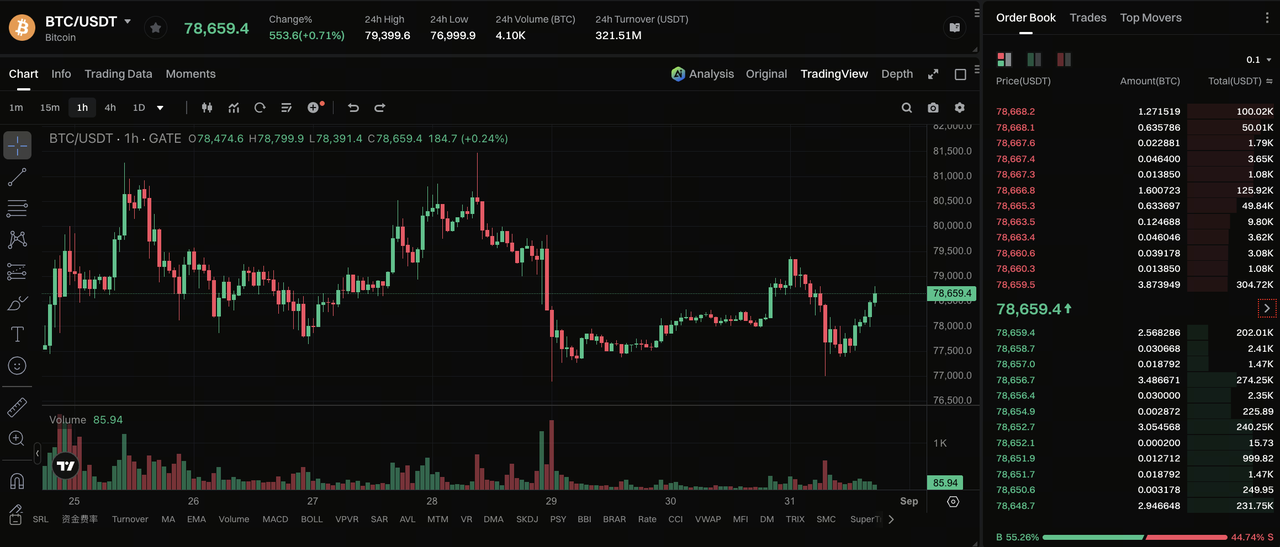
A crypto trading pair is two digital assets quoted against each other, forming a separate market with its own order book, volume, and fee schedule. Even when two pairs share one asset, they are distinct markets with independent liquidity and pricing.
-
Two assets, one price (BTCUSDT) = 77,958 means 1 BTC costs 77,958 USDT, not 77,958 USD in cash. The numerical value of a pair represents exchange ratios between base and quote currencies.
-
Separate order books. BTC/USDT, BTC/EUR, and ETH/BTC each have their own bids, asks, depth, and spread. On Gate.com, BTC/USDT carries roughly $210 million in 24-hour trading volume; ETH/USDT roughly $112 million; SOL/USDT roughly $108 million
-
Different types of pairings. BTC/USDT pairs Bitcoin against a stablecoin. ETH/BTC pairs Ethereum against Bitcoin, letting you track relative performance without converting to dollars. Common examples include fiat-to-crypto, stablecoin, and crypto-to-crypto pairs.
Base Currency vs Quote Currency: The Most Important Rule in Crypto Pairs
In every cryptocurrency pair, the first asset is the base currency and the second asset is the quote currency. The price tells you how many units of quote you pay for one unit of base.
In every cryptocurrency pair, the first asset is the base currency and the second asset is the quote currency. The price tells you how many units of quote you pay for one unit of base.
In every cryptocurrency pair, the first asset is the base currency and the second asset is the quote currency. The price tells you how many units of quote you pay for one unit of base.
-
Order matters. ETH/BTC is not BTC/ETH. If ETH/BTC = 0.055, one ETH costs 0.055 BTC. Flipping the pair inverts your price relationship and your P&L direction.
-
On Gate Spot, order sizes are entered in base currency units, while prices are entered in quote currency units. Submitting a buy order for 0.1 on BTC/USDT means you want to buy 0.1 BTC, not 0.1 USDT.
Base Currency: The Asset You Are Actually Buying or Selling
-
The first asset listed in a pair is called the base currency. In BTC/USDT, BTC is the base. In SOL/ETH, SOL is the base.
-
When you place a limit order on BTC_USDT for 0.1 BTC at a price of 77,958, "0.1" is the base asset amount. Your account's display currency does not change this.
-
Popular base assets on Gate.com: BTC, ETH, SOL, XRP. Stablecoins can also be the base when they appear first (e.g., USDT/TRY).
-
Cost formula: Cost = Base quantity × Price in quote asset. For 0.1 BTC at 77,958 USDT, you spend 7,795.8 USDT.
Quote Currency: The Asset Used to Price the Base
-
The second asset listed in a pair is called the quote currency. In BTC/USDT, USDT is the quote. In ETH/EUR, EUR is the quote.
-
If BTC/USDT = 77,958, the number "77,958" is denominated in USDT and tells you how many USDT you need for one unit of BTC.
-
To find how much base you get for 1 unit of quote, compute 1 ÷ price. For BTC/USDT at 77,958: 1 USDT buys approximately 0.00001283 BTC.
-
Common quote currencies on Gate.com: USDT, USDC, BTC, ETH, and fiat currencies like USD and EUR for fiat pairs.
How Trading Pair Symbols Work Across Crypto Exchanges
Different exchanges format symbols differently. Binance uses "BTCUSDT" (no separator). Coinbase uses "BTC-USD." Gate uses the slash format: BTC/USDT, ETH/USDT, SOL/BTC on Gate Spot. This format appears in the UI, the API, and all documentation.
-
API precision matters. Traders using bots must pass the exact string ETH/USDT to Gate's Spot currency pairs, {currency/pair} endpoint. Sending ETHUSD or ETH-USDT returns an error or hits a different market entirely.
-
One asset, many symbols. BTC appears in BTC/USDT, BTC/EUR, BTC/ETH, and BTC/TRY. Each symbol routes to a different order book with different quote currency exposure.
-
Symbol examples across platforms:
-
Gate: BTC/USDT
-
Binance: BTCUSDT
-
Coinbase: BTC-USD
BTC/USDT vs BTC/USD: Same Bitcoin, Different Market
-
BTC/USDT is a stablecoin pair (Bitcoin vs Tether); BTC/USD is a fiat pair (Bitcoin vs US dollar). They trade in separate order books with separate liquidity pools.
-
USDT aims to track $1.00 but can deviate. During stress events, BTC/USDT might quote 77,960 while BTC/USD quotes 77,900 because of differing demand, banking rails, and exchange rates.
-
On Gate Spot, stablecoin pairs like BTC/USDT tend to have deeper ±2% order book depth (roughly $19.8 million on bids, $28 million on asks) than most direct fiat pairs, which affects execution quality for larger orders.
Main Types of Crypto Trading Pairs: Fiat, Stablecoin, and Crypto to Crypto
Cryptocurrency pairs split into three categories by quote asset: fiat pairs, stablecoin pairs, and crypto-to-crypto pairs. Each category carries different trade-offs in regulation, market volatility, convenience, and portfolio tracking. Gate.com supports all three, letting users move between traditional money and digital assets through whichever route fits their needs.
Fiat Pairs: Connecting Crypto Trading to Traditional Currencies
-
Crypto-to-fiat pairs involve a digital asset paired with a traditional government-backed currency (e.g., BTC/USD, ETH/EUR, BTC/TRY). They serve as on-ramps and off-ramps between fiat currency and crypto.
-
Fiat pairs let you see asset prices in your local currency and buy directly from bank deposits or card payments.
-
Trade-offs: stricter KYC requirements, possible banking-hour restrictions, and often thinner order books. On a given day, BTC/USDT volume on Gate.com can exceed BTC/EUR volume by a factor of 10 or more, which widens the spread and increases slippage on fiat pairs for larger orders.
Stablecoin Pairs: Crypto-Native "Dollar" Markets
-
Stablecoin pairs use crypto-backed assets like USDT or USDC as the quote currency. BTC/USDT and ETH/USDT are among the most liquid markets on any centralized exchange, making them the default for most traders.
-
Benefits: 24/7 settlement, familiar dollar-denominated pricing, lower banking friction, and easy transfers between exchanges and DeFi protocols.
-
Risks: depeg events, issuer risk, and regulatory changes. In March 2023, USDC fell to roughly $0.88-$0.90 after Circle disclosed $3.3 billion in reserves at Silicon Valley Bank. USDC's market cap dropped about 15% in 24 hours (S&P Global). Pairs quoted in USDC saw pricing anomalies and widened spreads until the peg recovered. Counterparty risk in stablecoin pairs is real, even when the quote asset appears stable.
Crypto-to-Crypto Pairs: Measuring Relative Value Between Digital Assets
-
Crypto to crypto pairs have both base and quote as cryptocurrencies (e.g., ETH/BTC, SOL/ETH). Trading pairs allow direct asset exchanges without fiat currency.
-
These pairs let traders focus on relative performance. If ETH/BTC rises from 0.050 to 0.060, ETH outperformed BTC by 20% in BTC terms, regardless of absolute price movements in USD.
-
Pairs show relative strength and help traders gauge performance against major cryptocurrencies. Portfolio managers use ETH/BTC as a dominance indicator; rotation traders use pairs like SOL/AVAX to express views on which L1 ecosystem will gain market share.
-
Some altcoins on Gate are listed only against BTC or USDT, requiring you to route trades through those core crypto pairs.
How Crypto Trading Pairs Work on a Centralized Exchange Like Gate
Each pair on a centralized exchange like Gate has its own order book. Bids are sorted from highest to lowest; asks from lowest to highest. When you submit an order on BTC/USDT, it interacts only with liquidity in that specific pair's market, not a global BTC pool.
-
The matching engine pairs your buy order with the lowest available sell order (or vice versa) at the moment of execution. The resulting fill creates the latest trade price for that pair.
-
Gate.com lists hundreds of cryptocurrency pairs, including altcoin/BTC and altcoin/USDT markets, allowing more direct routes and fewer intermediate conversions.
Order Types and Pair-Specific Rules on Gate.com
-
Each pair enforces specific rules: minimum order size (in base units), minimum notional value (price × quantity in quote), tick size (smallest price increment), and quantity step size.
-
Concrete example from Gate.com's API: ETH_USDT has min_base_amount = 0.001 ETH, min_quote_amount = 1.0 USDT, amount_precision = 3 decimal places, and precision = 6 for price. An order for 0.0001 ETH would be rejected.
-
Compare fee structures to minimize costs during frequent trades. Maker vs taker fees differ by pair, and Gate.com's VIP tiers reduce fees at higher volume levels.
-
Derivatives pairs (e.g., BTC_USDT perpetual futures) use similar symbols but carry separate margin requirements, funding rates, and position limits compared with spot pairs.
Check pair rules before trading. Query Gate.com's pair details page or the /spot/currency_pairs/ API endpoint for current minimums, precision, and fee rates on your target pair.
Price Differences, Arbitrage Opportunities, and Crypto Pairs Trading
Crypto trading pairs can have different prices across exchanges because each platform runs its own order book. BTC/USDT on Gate.com, Binance, and Coinbase will show slightly different numbers at any given second due to independent supply, demand, and fee structures.
-
Arbitrage opportunities arise when price discrepancies exist for the same asset across different exchanges. A trader could buy BTC/USDT at 77,950 on one venue and sell at 78,000 on another, capturing the $50 difference minus fees and transfer time.
-
Triangular arbitrage works within a single exchange. On Gate.com, if ETH/USDT = 2,448, BTC/USDT = 77,958, and ETH/BTC = 0.0314, you can check whether buying ETH with USDT, selling ETH for BTC, then selling BTC for USDT nets a profit after trading fees. (It rarely does on high-liquidity pairs because market makers close gaps in milliseconds.)
-
During high volatility, spreads widen on illiquid altcoin pairs, creating brief windows. Evaluate fees and slippage to protect trading capital before pursuing any arbitrage route.
From Correlation to Crypto Pairs Trading Strategies
Pairs trading exploits price inefficiencies between correlated assets. Instead of betting on absolute price movements, crypto pairs trading focuses on the spread between two cryptocurrencies, aiming for market neutrality. Pairs trading can be market-neutral, reducing directional risk; this means the strategy generates returns from the relative worth of two assets rather than from the direction of the entire crypto market.
The distinction between correlation and cointegration matters here. Correlation ranges from -1 to +1, indicating how closely asset prices move together. But high correlation does not guarantee a stable price ratio over time. Cointegration indicates a stable long-term relationship between two assets; their linear combination produces a stationary spread that reverts to a mean. Cointegration tests ensure stable long-term relationships between assets, and they typically use the Augmented Dickey-Fuller test for validation. If two cryptocurrencies are non stationary individually but cointegrated as a pair, that's the statistical basis for setting trade entry points.
Here is how pairs trading works in practice:
-
Select cointegrated pairs (e.g., ETH/BTC or two related digital assets like SOL/AVAX) using historical data.
-
Compute the spread and its z scores. A z-score above ±2 indicates potential trading opportunities.
-
When the spread deviates from its mean, go long the underperformer and short the outperformer.
-
Close both positions when the spread reverts.
Stop-loss orders help manage risk in pairs trading strategies; stop-loss orders prevent catastrophic losses in pairs trading. Diversifying across 5-10 pairs reduces the impact of failed trades. Regularly validate statistical relationships to manage risk, because correlation measures and cointegration can break down as market conditions shift. Pairs trading offers opportunities in both a bull market and a downturn, but past performance of a spread relationship does not guarantee future results.
Professional traders implement automated strategies through Gate.com's APIs and tools like Python's statsmodels for linear regression on spread data. Statistical arbitrage at scale requires real-time data feeds; Gate.com's WebSocket channels provide order book depth updates as fast as 20ms on select contracts.
Liquidity, Volume, Spread, and Slippage in Crypto Trading Pairs
Liquidity measures how easily assets can be traded without affecting their price. A pair with deep liquidity means large orders fill close to the quoted price. Liquid trading pairs can quickly fill large orders with minimal slippage. A low liquidity pair forces you to pay more (or receive less) as your order eats through thin price levels.
-
Trading volume: BTC/USDT on Gate.com: ~$210 million in 24h. A thin altcoin pair might do $50,000. High-market-cap trading pairs usually feature higher liquidity and tighter bid-ask spreads.
-
Spread: The gap between best bid and best ask. BTC/USDT spread on Gate.com hovers around 0.01%. Thin altcoin pairs can show 0.5% or wider.
-
Slippage: The difference between your expected execution price and the actual fill. A 10 BTC market sell on BTC/USDT (with $19.8M in bid depth within 2%) would barely move the price. The same dollar amount on a thin pair could move the price 2-5%.
Choose exchanges with high liquidity for better trade execution. Verify trading volume authenticity using independent analytics platforms like CoinGecko or CoinMarketCap before relying solely on an exchange's reported numbers.
Choosing the Right Crypto Trading Pair for Your Goal
Trading pairs often determine trading strategies and liquidity risks. The choice of trading pair impacts execution costs and capital efficiency. Before placing any order, decide what exposure you want after the trade.
-
Entering the cryptocurrency market: Start with fiat pairs (BTC/EUR, ETH/USD) or stablecoin pairs (BTC/USDT) to convert your local fiat currency into crypto.
-
Active crypto trading: Most traders use high liquidity pairs like BTC/USDT or ETH/USDT for tight spreads and fast fills. The choice of pair affects perceived gains and risk exposure; tracking P&L in USDT vs BTC yields different performance numbers.
-
Expressing relative views: Use crypto-to-crypto pairs. If you believe SOL will outperform AVAX, trade SOL/AVAX directly (if listed) or route through USDT. This isolates relative value from USD moves.
-
Risk tolerance check: A highly volatile altcoin pair carries more downside risk than a major pair. Match pair selection to your risk tolerance and position sizing. Position sizing should limit risk to 1-2% of capital per trade.
Practical Trading Routes and Multi-Step Conversions
Not every combination of assets has a direct crypto trading pair. Some swaps require multi-step routes using liquid intermediates.
-
Example 1: You hold a niche altcoin (ALT) listed only against BTC. To convert to USDT: sell ALT/BTC, then sell BTC/USDT. Two trades, two sets of fees.
-
Example 2: You want to move from DOGE to MATIC. Neither DOGE/MATIC nor MATIC/DOGE exists. Route: DOGE → USDT → MATIC through DOGE/USDT and MATIC/USDT.
-
Trade-off: More steps mean extra trading fees and possible slippage at each hop, but using deep intermediary pairs (BTC/USDT, ETH/USDT) often produces a better final rate than a thin direct pair.
-
Traders using bots should simulate total route cost (fees + spread + slippage across all legs) before choosing a path. Gate.com's API returns fee rates and order book depth per pair, making this calculation straightforward.
How Beginners Can Safely Start Trading Crypto Pairs on Gate.com
-
Create an account. Sign up on Gate and complete KYC if you plan to use fiat pairs.
-
Deposit funds. Transfer fiat via bank or card, or deposit stablecoins (USDT, USDC) from another wallet.
-
Pick a liquid pair. Start with BTC/USDT or ETH/USDT. These pairs have deep order books and tight spreads.
-
Place a small order. Use a limit order for 0.001 ETH or equivalent to learn how base quantity, quote price, and fees interact.
-
Verify before confirming. Double-check that the base currency is what you intend to buy and the quote currency is what you intend to spend.
Select platforms offering both USD(T) and crypto-to-crypto pairs so you can progress from simple fiat on-ramps to more advanced different pairs as your own research and experience grow. Avoid relying solely on market orders in thin pairs; use limit orders and check price charts and depth before executing.
Risk, Security, and Regulatory Considerations When Trading Crypto Pairs
Trading cryptocurrency pairs involves market risk (the cryptocurrency market is highly volatile and asset prices can move against you), counterparty risk (exchange reliability and stablecoin issuer solvency), and asset-specific risk (token failures, depeg events). Managing risk across all three dimensions protects your capital.
-
Platform security. Use exchanges with proven security records and insurance coverage. Gate.com maintains a 100% reserve policy, publishes proof-of-reserves, operates a SAFU fund, and holds regulatory licenses including U.S. money transmitter licenses and Dubai VARA authorization.
-
Leverage caution. Margin, futures, and perpetual pairs magnify both profits and losses. Master spot crypto trading pairs before using leverage. Financial decisions involving leverage require clear risk management and appropriate position sizing.
-
Regulatory awareness. Jurisdiction-specific rules affect which fiat pairs, stablecoins, and digital assets are available. Consult a qualified professional for tax and legal guidance.
-
Stablecoin risk. As the March 2023 USDC depeg showed, even "safe" quote currencies carry issuer and banking risk. Diversifying quote exposure across different stablecoins and fiat pairs reduces concentration.
Conclusion
Understanding how trading pairs work; base vs quote, pair types, liquidity depth, and routing; is the foundation of effective crypto trading on Gate.com or any exchange. Two practical takeaways apply to every trade: always confirm which asset you are buying (the first asset) and which asset you are spending (the second asset), and always check whether the pair has enough liquidity for your intended order size.
From here, you can explore more advanced topics: crypto pairs trading strategies using technical analysis and cointegrated pairs, arbitrage opportunities across exchanges, and automated strategies through Gate.com's API. Each builds on the core mechanics covered in this article.
FAQ
Is BTC/USDT the same as BTC/USD?
No. BTC/USDT uses Tether as the quote asset, while BTC/USD uses fiat U.S. dollars. Their prices are usually similar but can differ because the markets and liquidity are separate.
Which crypto trading pair is best for beginners?
Highly liquid major pairs such as BTC/USDT and ETH/USDT are generally easier to understand because they tend to have deeper liquidity and tighter spreads than small altcoin markets.
Why do crypto prices differ between trading pairs?
Each pair has its own order book. Differences in liquidity, demand, stablecoin pricing, exchange conditions, and regional activity can create slightly different prices.
What happens if there is no direct trading pair?
You may need to use an intermediary asset such as USDT or BTC. For example, DOGE → USDT → another asset requires two separate trades.