For readers who already trade spot markets, the useful question is how to read a robotics token rather than how to compile a ticker list. The label is unusually loose. CoinGecko's robotics category carried roughly 849 million USD of market capitalization on 22 October 2026, but that figure merges assets that bill per task, per device, and per unit of net asset value, so a single metric cannot cover all of them. Mechanics, verification, valuation, supply checks, risk, and tradability follow in that order.
Key Takeaways
-
Robotics tokens coordinate physical work and machine data; they are not a claim on robot hardware or on a robotics company's equity.
-
The category splits into four layers with different revenue models, so market cap and FDV comparisons across layers mislead more than they inform.
-
An onchain record proves that a contribution was logged, not that a robot performed a physical task, which makes verification design the central risk.
-
A four-question test on product independence, fee capture, and unlock schedule separates an infrastructure token from a narrative token.
What Are Robotics Tokens? How Do They Differ From Decentralized Physical Infrastructure Networks (DePIN) and AI Agent Tokens?
Robotics tokens are issued by networks that treat machines as economic participants. A robot, a robot operator, or a person generating training data holds a wallet, submits work, gets scored, and receives payment through a smart contract. The token either pays for that work, secures access to the network, or represents a claim on a pool of assets, depending on the network’s specific application.
The boundary with neighbouring categories is where most confusion starts. DePIN covers physical infrastructure such as storage, wireless coverage, and compute supply. Robotics tokens borrow the same task-verify-reward loop but apply it to machines that move, sense, or generate manipulation data, including autonomous vehicles. A robotics project can therefore be a DePIN project, while most DePIN networks have nothing to do with robots, and most robotics companies never touch a blockchain.
Software-side autonomy is a separate question again. AI agents are programs that plan and execute digital actions, so their verification problem is whether the agent did what it claimed in a log or a transaction, with more direct ability to verify those digital actions than physical ones. A robot has to prove something happened in a physical space, which no ledger observes directly.
| Dimension |
Robotics tokens |
DePIN tokens |
AI agent tokens |
| Unit being coordinated |
Robots, robot operators, physical data contributors |
Hardware that supplies storage, bandwidth, or compute |
Software agents that plan and act |
| Token's main job |
Pay for verified physical work, stake for access, fund data programs |
Pay for resource supply and usage |
Payment for inference, identity, or agent services |
| Verification object |
A physical task or a manipulation trajectory |
Uptime, bandwidth, or capacity served |
A digital action or a model output |
| Failure mode that matters most |
Claimed work never happened in the real world |
Hardware offline or fake capacity reporting |
Agent misreports or exceeds its mandate |
The table matters because the three groups get compared in the same conversations and priced with the same shorthand. A robotics token's value proposition sits closer to a labour and data marketplace than to a bandwidth network, and it inherits the verification difficulty of the physical world.
How Do Robotics Tokens Work in Physical AI? From Task Posting to Settlement
A robotics token network runs on a four-step loop: task posting, contribution, validation and scoring, and settlement with provenance. Each step leaves a different kind of evidence, and only the last step touches a chain.
-
Task posting. A sponsor publishes a task with a specification: which robot arm, which object, which motion, how many successful demonstrations, and what quality threshold counts as accepted. Budget is committed before work begins.
-
Contribution. Contributors submit work. On data networks this is often remote operation of a simulated robot arm in a browser, or first-person video captured through a phone. On hardware networks it is a device reporting uptime, position, or sensor data.
-
Verification and scoring. The submission is replayed, scored, cleaned, and filtered. Networks commonly combine automated checks with random human review, and some checks still require humans to inspect submissions, while some require a bond that can be slashed if the submission fails.
-
Settlement and provenance. Accepted work is paid, and the identifiers behind it are written to a chain. Axis Robotics, for example, records a Data ID, a task ID, and a contributor ID on Base for each accepted trajectory, which makes the contribution auditable after the fact.
The step that gets overstated in marketing is step three. A blockchain is good at recording that a signed submission existed at a point in time and that a payment cleared against it. It cannot confirm that a physical arm moved the way the submission claims. When a network runs entirely in simulation, the verification problem is a software problem and can be solved with replay and scoring. When a network claims real-world work, everything depends on the attestation layer between the sensor and the chain, ensuring the record matches real-world activity. The crypto x AI stack treats data provenance as a middleware problem for exactly this reason.
What Are the Four Layers of the Robotics Token Market?
The robotics token market is easier to read as four layers than as one sector. Each layer sells a different thing to a different buyer across different markets, and each produces a different kind of onchain evidence.
| Layer |
What the token does |
Representative projects |
Evidence the layer can produce |
| Training data and physical AI data |
Pays contributors for verified manipulation or activity data; lets sponsors fund data programs |
Axis Robotics (AXIS), Fabric / OpenMind (ROBO) |
Task IDs, accepted-trajectory scores, contributor records |
| Machine identity and payments |
Gives a machine an identity and a payment rail; meters machine-to-machine transactions |
peaq (PEAQ), IoTeX (IOTX) |
Registered device IDs, payment volume between machines |
| Positioning and perception |
Sells location, mapping, or visual coverage that robots need to move |
GEODNET (GEOD), Auki (AUKI), NATIX (NATIX) |
Device density, coverage cells, correction-service usage |
| Investment exposure |
Packages exposure to robotics companies into one transferable token |
Reserve Robotics DTF (ROBOTS), XMAQUINA (DEUS) |
Basket composition, net asset value, redemption terms |
The first layer is a labour market with a quality filter. Axis Robotics illustrates the shape: contributors operate a simulated robot arm in a browser or record real-world actions through an app, submissions are scored, and the platform reports more than 5.5 million trajectories from over 200,000 contributors since launching on Base in March 2026. The second layer is infrastructure for machine commerce, where a device needs an identifier to enable it to receive or send payment. The third layer sells a physical input that autonomous machines genuinely consume to support real-world performance, such as centimetre-level GNSS corrections from GEODNET or device identity services from peaq. These networks matter when robots and other systems interact in the physical world. The fourth layer is not an operating business at all: Reserve's ROBOTS token is redeemable for a market-cap-weighted basket of nine listed robotics and automation names, capped at 20 per name with quarterly rebalancing.
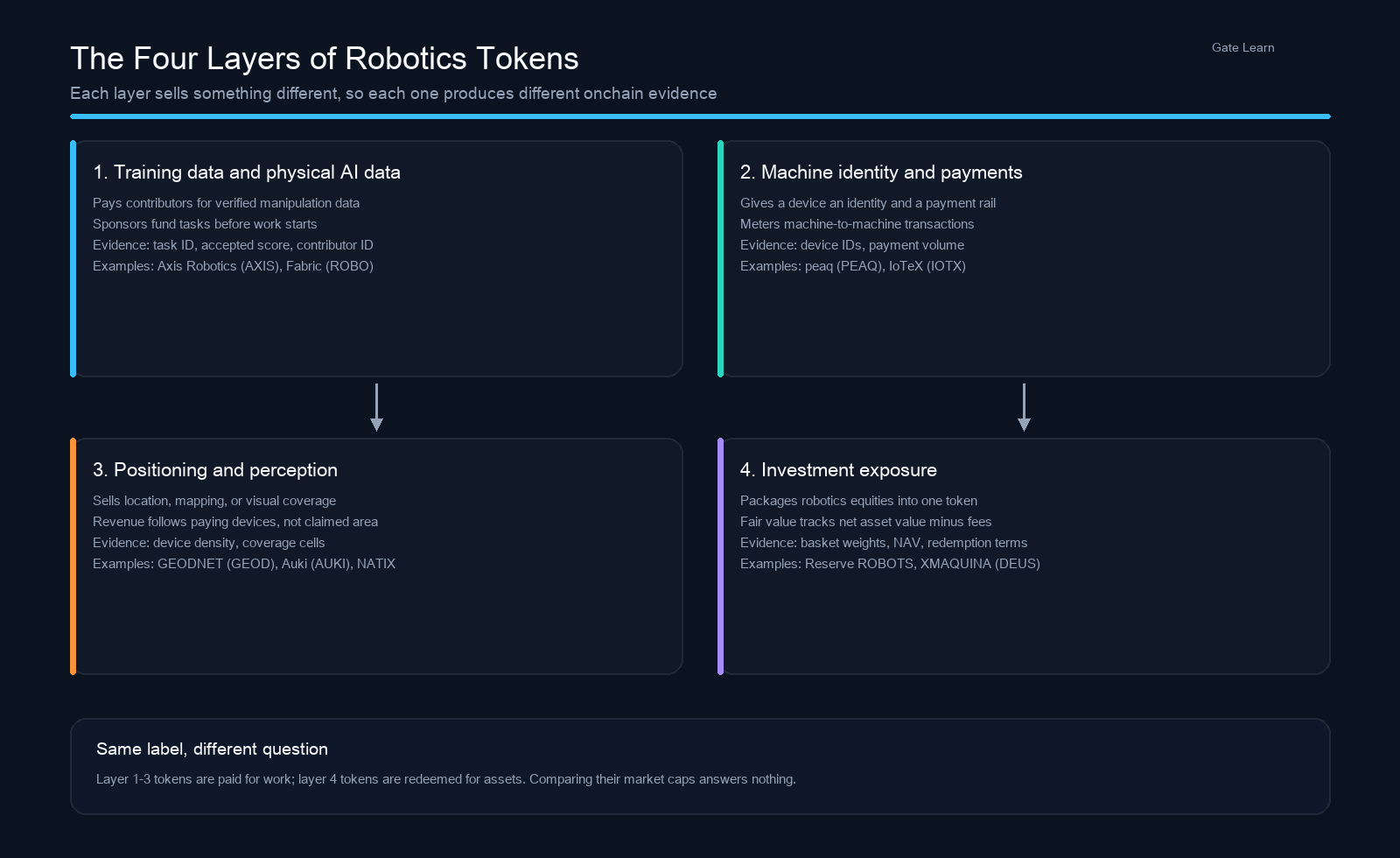
Figure 1. The four layers of the robotics token market: training data, machine identity and payments, positioning and perception, and investment exposure, with the on-chain evidence that can verify each layer.
Why Can't the Four Layers Be Priced With the Same Metrics?
Because the four layers earn revenue in four different ways and sell to different businesses or buyer types. A data network is paid per accepted task, a hardware network per device or per service call, a positioning network per subscription or coverage unit, and an investment vehicle per unit of net asset value. Applying one metric across all four produces the category's most common analytical error.
| Layer |
Metric that fits |
Metric that misleads |
| Training data |
Paying sponsors, accepted tasks, average price per accepted task, contributor retention |
Contributor count and total trajectories, which describe supply rather than demand |
| Machine identity and payments |
Active devices, machine-to-machine payment volume, fee captured per transaction |
Number of "robots onboarded", which may be testnet registrations |
| Positioning and perception |
Paying devices, coverage density in served regions, revenue per device |
Claimed map area or total nodes, which ignore whether anyone pays |
| Investment exposure |
Basket net asset value against secondary price, fees, redemption terms |
Treating the token as an operating company with revenue growth |
The investment-exposure layer deserves separate handling because its mechanics are closer to a fund than to a protocol. Reserve's robotics basket charges a 0.3% mint fee and a 0.6% annual management fee, rebalances quarterly, and caps any single name at 20%, so the token's fair value tracks the underlying shares minus fees rather than the adoption of any robotics network. A widening gap between the secondary price and the basket's net asset value is a liquidity and access signal, not a demand signal for robotics.
Supply structure then distorts the picture further. A network with a small float and a long unlock calendar can show a modest circulating market cap next to a fully diluted valuation many times larger. Axis Robotics, for instance, launched with 165,000,000 of a fixed 1,000,000,000 tokens in circulation, or 16.5% of supply, with full unlock scheduled for 35 months after the token generation event. That is a normal early-stage structure, but it means the circulating figure does not present the value of the entire eventual supply, while the diluted figure does not present current liquid float or current sellable supply.
How Do You Tell Whether a Robotics Token Is Actually Necessary?
Run four questions in order. A token that fails the first two is decorative; a token that passes the first two but fails the third has demand without value capture; a token that passes three but fails the fourth has a supply problem that overwhelms the rest.
Question 1: Does the product work without the token? If sponsors could pay contributors in stablecoins and the robot network would run unchanged, the token is an incentive wrapper rather than infrastructure. Pass means removing the token breaks a function that plain payment cannot otherwise support.
Question 2: Which function does the token perform? Sort it into payment, collateral, access, or governance, with the role clearly defined. An incentive-only token has demand that exists only while emissions last. Payment and collateral tokens are tied to activity, and access tokens are tied to a scarce right that the network controls.
Question 3: Where does the fee flow land? If sponsors pay in the token but the network immediately sells it to fund payouts, the token is a unit of account and captures nothing, so ask whether fees come from actual network users or only from emissions-driven activity. If fees are routed to buybacks, burns, staking rewards, or a treasury controlled by holders, the token has a claim on activity. The distinction between a payout unit and a value-capture unit is the single most useful check in this category, and it follows the same logic as general tokenomics.
Question 4: Does supply growth outrun demand growth? Compare the unlock calendar with the growth in paying usage, not with the growth in contributor count. A network that adds supply faster than it adds paying sponsors is diluting its own unit economics.
| Test |
Pass |
Fail |
| Product independence |
A function cannot run without the token |
Stablecoins or fiat would work identically |
| Token function |
Payment, collateral, or paid access tied to real activity |
Emissions only, with no other role |
| Fee capture |
Fees reach holders through burn, buyback, staking, or treasury |
Token is only a payout unit sold on receipt |
| Supply versus demand |
Unlock pace is slower than paying-usage growth |
Dense unlocks land before any paying demand |
The table is a screening order rather than a score. A token that fails the first row is not made safer by passing the other three, and a token that clears all four still depends on how much paid usage the network can sustain once emissions stop. The fee-capture row is the one worth doing on a screen rather than in prose, and the five-step revenue verification workflow walks through the transfers, wallet clusters, emission comparison, retention test, and burn audit in that order.
What Is Proof of Physical Work? Sensor Data and Three Verification Models Compared
Proof of physical work is the attestation that a physical contribution actually occurred before a reward is released. It is not a consensus mechanism and it does not replace proof of stake; it is the bridge between a sensor reading and a payable record. Three models are in use, and each fails in a different place.
| Model |
How it works |
Trust assumption |
Where it breaks |
| Hardware attestation |
A device signs its own telemetry inside a secure element or trusted execution environment |
The manufacturer's key handling and the supply chain are honest |
Physical key extraction, tampered firmware, and devices that sign fabricated data |
| Stake and slash |
The contributor bonds tokens that are forfeited if the submission fails review |
The bond exceeds the profit from cheating |
Cheap fake submissions at scale, and bonds that are small relative to a successful fraud |
| Multi-party sampling |
Random reviewers or neighbouring devices cross-check the submission |
Reviewers are independent and sampling is dense enough |
Sparse coverage, collusion between reviewers, and low-value tasks that never get sampled |
Academic work shows the mechanism can be real. A Science Robotics study gave physical robots a token economy governed by a smart contract, and a malfunctioning or malicious robot that failed to contribute ran out of tokens and lost influence over the swarm, demonstrated with up to 24 physical robots and more than 100 simulated ones. That result covers coordination inside a controlled swarm, not the commercial question of whether a stranger's robot did a paid job on a street.
The gap between simulation and deployment is where most claims need pressure. A simulated arm replaying a task produces a clean, machine-checkable record, but deployed behavior still has to be tested after launch. Simulation can also reduce the need to collect rare edge-case evidence that is expensive or unsafe to gather in live settings. A real arm in a warehouse produces sensor noise, partial completions, and a human supervisor whose judgement is not onchain, so the time required to validate performance still expands once testing moves into the field. The same weakness appears on the payment side: a wallet embedded in a delivery robot is protected by whatever tamper resistance the hardware offers, which is a different security budget from a server wallet and may also impose operational compliance requirements.
How Do You Check Supply, Stablecoin Payments, and Unlock Terms Before Anything Else?
Read four numbers before reading any roadmap. Supply structure sets the denominator for every other metric, and it is the part of a robotics token that is hardest to change later.
-
Circulating supply against total supply. Divide circulating by total to get the float. A 16.5% float means roughly five-sixths of the supply has not yet met the market.
-
The unlock calendar. Identify the cliff, the linear vesting period, and the fully unlocked date. Axis Robotics publishes a fixed 1,000,000,000 supply with a full unlock at T+35 months, and those published unlock details are necessary to model future supply even though the demand curve is not.
-
The allocation split. Separate ecosystem, contributor rewards, team, private rounds, and liquidity. Team and private allocations create the supply that historically compresses price hardest, because those holders are furthest in profit at launch.
-
The link between unlocks and usage. Ask what the newly released tokens are supposed to fund. If the answer is contributor rewards, then contributors effectively request payment from that newly unlocked supply, so the unlock is simultaneously new supply and a new source of sell pressure from the same cohort.
| Symptom |
What it usually signals |
| Float under 10% with a long calendar |
Price is set by a thin market, and later supply is a structural overhang |
| Contributor rewards as the largest allocation |
Growth depends on continued emission rather than paying demand |
| No published unlock schedule |
Supply risk cannot be modelled, so the token cannot be compared with peers |
| Treasury concentrated in one address |
Governance and buyback claims depend on a single signer |
The mechanics of why this matters are covered in token unlocking: when float expands without matching demand, market capitalization may fail to rise because the same value is spread across more units.
What Risks and Limitations Do Robotics Tokens Carry?
Robotics tokens combine the execution risk of an early hardware sector with the supply risk and cost structure of a new crypto asset. The risks below are structural rather than price-based, and each one has a recognisable trigger.
Demand subsidised by emissions. Token rewards can attract contributors and device operators long before paying customers exist. The trigger to watch is a network whose contributor count grows while sponsor-funded task volume stays flat.
Verification failure. A claim that cannot be independently checked is the category's defining risk. Triggers include simulated-only demonstrations presented as deployment, a single validator role that releases payments, and reputation systems that a new identity can reset.
Supply overhang. A long vesting calendar with a small float concentrates future sell pressure into specific windows. The trigger is an unlock date that lands before the network reports paying usage.
Data and privacy exposure. Manipulation and first-person video datasets can capture homes, workplaces, and bystanders. These networks often depend on data sharing across contributors, devices, or sponsors, so projects need explicit consent, storage, and access rules, and the absence of a published policy is itself a signal.
Narrative migration. A token can be repositioned as a robotics asset after launching under another label. The trigger is a category change without a corresponding change in the product, the customers, or the fee flow.
Liability and machine error. There is little settled framework for who bears a loss when an autonomous machine pays for a service it did not receive, when a software agent spends beyond its mandate, or when faulty code causes the action. This is an operating risk for the networks that route machine payments, and it does not disappear when the payment settles onchain.
How Do You Verify a Robotics Token Is Tradable on Gate?
Verify four fields before treating any ticker as investable, because robotics tokens share symbols with unrelated assets more often than established large caps do.
-
Confirm the spot pair. Search the token's symbol against USDT on Gate's spot market. A live pair with order book depth is different from a listing announcement.
-
Confirm the chain and contract. Match the contract address against the project's own documentation. Axis Robotics, for example, publishes an ERC-20 contract on Base; a token with the same ticker on another chain is a different asset.
-
Confirm the asset class. A robotics infrastructure token, a tokenized basket of robotics equities, and a pre-launch sale receipt can share a theme without sharing a payoff. The basket product settles against net asset value; the infrastructure token settles against network activity.
-
Confirm the trading status. Deposit and withdrawal availability, and any regional restriction, decide whether a verified contract is actually reachable from your account.
Some products also require an extra integration check between the product page, contract, and chain before trading.
Gate lists digital assets on its spot market and separately offers equity exposure through its stock product, so a robotics theme can appear in two different places with two different instruments. Checking the product page rather than the theme page, which is a broad catalog rather than a verification source, avoids most of the confusion.
Summary
Robotics tokens connect physical work, machine identity, and machine data. The category is best read as four layers, because a training-data network, a machine-payment network, a positioning network, and a tokenized equity basket have different buyers, different revenue, and different verification problems, even if some projects also overlap with decentralized physical infrastructure networks. The useful questions are whether the product survives without the token, whether fees reach holders, whether the verification layer can be cheated, and whether supply grows faster than paying usage. None of those questions requires a price forecast, and all of them can be answered from published documentation.
FAQ
What is the difference between robotics tokens and DePIN tokens?
Robotics tokens coordinate machines that move, sense, or generate physical training data, while DePIN tokens coordinate infrastructure resources such as storage, bandwidth, and compute; people often refer to both categories together even though they coordinate different things. A robotics network can be a DePIN network when it depends on distributed hardware, but most DePIN networks serve no robot, and most robotics companies use no blockchain.
Do robotics tokens always have a real use case?
No. Many tokens exist mainly to reward contributors, which means demand lasts only while emissions last. A token has a defensible use case when removing it breaks a function that a stablecoin payment cannot replace, and when fees from real activity reach holders through a burn, buyback, staking reward, or holder-controlled treasury.
What are the main risks of robotics tokens?
The structural risks are demand subsidised by token emissions, verification that cannot prove a physical task happened, supply overhang from long unlock calendars, privacy exposure in collected sensor and video data, and liability gaps when an autonomous machine makes a bad payment. Each has a visible trigger in published documentation.
Can you buy robotics tokens on Gate?
Some robotics tokens trade as spot pairs on Gate, and availability differs by asset and region. Confirm the symbol against USDT, match the contract address to the project's documentation, and check whether the instrument is an infrastructure token or a tokenized basket, because the two settle against different references.
Are robotics tokens the same as AI agent tokens?
No. AI agent tokens pay for software that plans and executes digital actions, so verification concerns logs, transactions, and model outputs. Robotics tokens pay for physical contribution, so verification concerns whether a machine or a person actually performed a task in the real world, which is a harder problem with a different failure mode.