The initial applications of blockchain technology in finance focused primarily on asset issuance, transfers, and cross-chain circulation. As stablecoins, tokenized stocks, and other real-world assets gradually move on-chain, market infrastructure itself is facing new requirements: Assets can circulate across different networks, but trading, clearing, settlement, and risk management still require systems that are efficient, reliable, and capable of continuous operation. The digitization of assets does not mean that traditional market processes have naturally completed their migration on-chain.
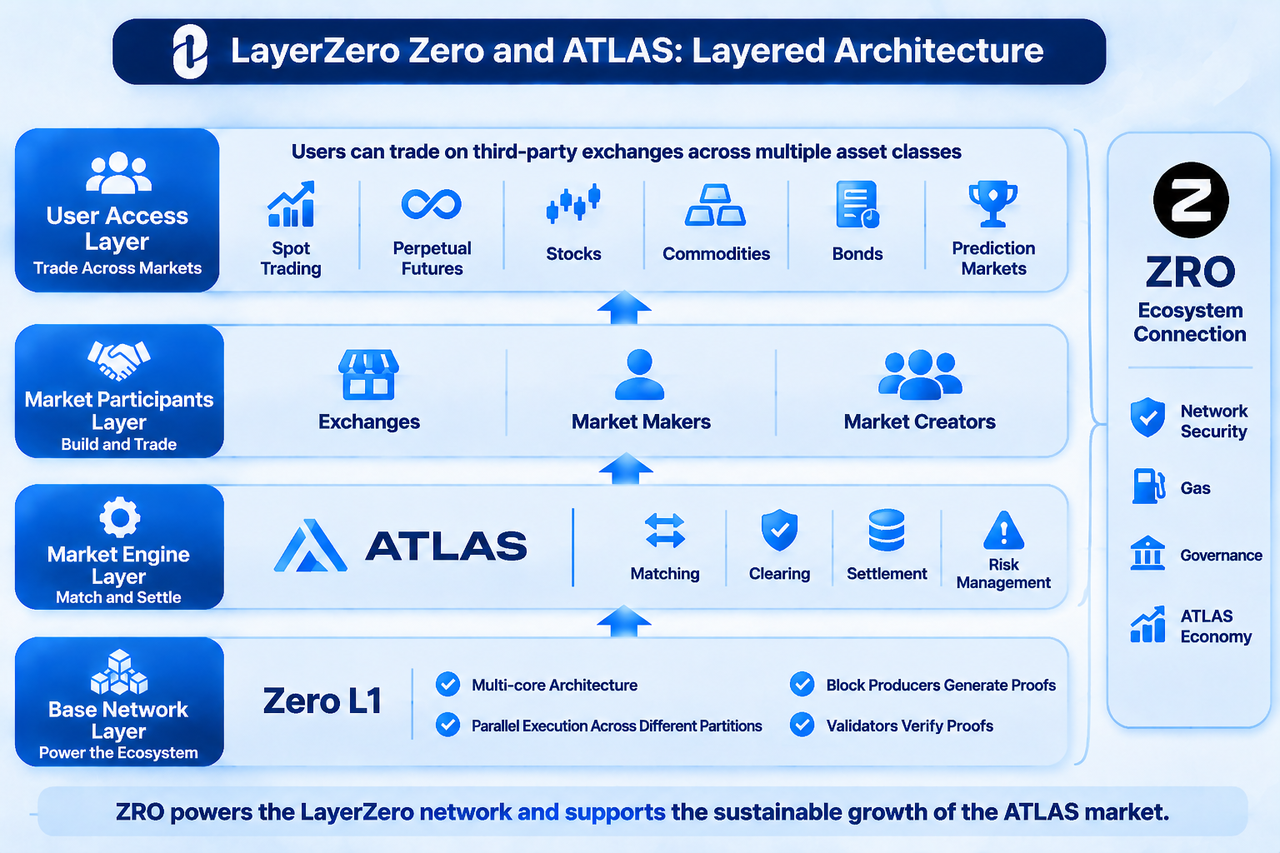
This is the context in which LayerZero has expanded from cross-chain interoperability infrastructure to Zero and ATLAS. Zero provides underlying blockchain execution, verification, and state-recording capabilities, while ATLAS integrates trade matching, clearing, settlement, and risk management into infrastructure designed for trading venues. The two are not the same product. Instead, they assume different responsibilities as the underlying network and market engine, respectively.
Understanding this architecture requires first distinguishing between LayerZero's original cross-chain interoperability protocol, Zero L1, ATLAS, and the ZRO token. They are connected through the ecosystem and their functions, but they cannot simply be treated as synonymous concepts within the same system. This article examines the infrastructure needs of global financial markets and introduces the design rationale, operating model, and potential application boundaries of Zero and ATLAS.
Key Takeaways
-
Zero and ATLAS assume different layers of infrastructure responsibilities: Zero is the Layer 1 blockchain launched by LayerZero, responsible for underlying execution, verification, and state recording; ATLAS is built on Zero and integrates trade matching, clearing, settlement, and risk management capabilities
-
ATLAS uses a frontendless design: It does not directly provide retail users with an independent trading interface. Instead, it provides third-party trading venues with an underlying trading engine, while the venues are responsible for the user experience, market distribution, and specific services
-
Zero organizes different workloads through a multi-core architecture: Different execution partitions can process different types of on-chain activity in parallel. Block Producers execute transactions and generate proofs, while Block Validators verify the proofs to reduce the resource costs caused by redundant execution
-
ATLAS is designed for multiple types of financial markets: Its infrastructure design covers products such as spot markets, perpetuals, stocks, commodities, bonds, and prediction markets. However, whether a specific market can launch still depends on asset arrangements, liquidity, trading venue access, and regulatory requirements
-
ZRO connects the underlying network with market economic mechanisms: ZRO supports network security, Gas, and governance on Zero, while also relating to fee rebates for ATLAS trading venues and the buyback-and-burn mechanism for remaining fees
-
Technical performance does not equal market success: The long-term application value of Zero and ATLAS must also be assessed based on actual network load, validator participation, market liquidity, trading demand, and risk management capabilities
From Cross-Chain Asset Circulation to On-Chain Market Infrastructure
LayerZero initially focused on solving information and asset interoperability issues between different blockchains. Through cross-chain messaging and standards such as OFT, developers can build assets and applications that circulate across multiple networks. This type of infrastructure focuses on how different blockchains can exchange information reliably and how assets can maintain consistent states and interaction capabilities in a multichain environment.
However, the ability of assets to move across chains does not mean that the entire financial market process surrounding those assets has been upgraded. A traditional securities transaction, for example, may involve order matching, trade confirmation, clearing, settlement, asset custody, and risk management. Different institutions and systems may be responsible for different stages, and data must be transferred and reconciled between systems. When trading expands to operate around the clock and assets span multiple markets and regions, the fragmentation and information delays in traditional processes become more pronounced.
Tokenization further amplifies this issue. On-chain assets can be transferred according to smart contract rules and combined for use across different applications. However, market participants still need sufficient liquidity, fair trading rules, clear records of asset ownership, and verifiable settlement results. If the underlying trading infrastructure cannot keep pace with the speed of asset circulation, the efficiency gains from tokenization may be offset by traditional market processes.
LayerZero summarizes this need as an expansion from "technology for optimizing the circulation of assets and information" (Better Money Technology) to "technology for optimizing market trading and settlement" (Better Markets Technology). The former focuses on the cross-chain movement of assets and information, while the latter focuses further on how markets complete trading, clearing, and settlement. Zero and ATLAS represent different layers of infrastructure design developed in this context.
What Roles Do Zero and ATLAS Assume?
Zero is the Layer 1 blockchain launched by LayerZero. It uses a multi-core architecture and aims to improve the network's ability to process highly concurrent workloads while maintaining an open validation mechanism. The official description identifies general-purpose computing, payments, and global financial markets as its primary areas of focus. Compared with networks designed around a single application type, Zero aims to provide relatively independent resource spaces for different types of on-chain activity through different execution zones and validation mechanisms.
ATLAS stands for Aggregated Trading Liquidity and Settlement. It can be understood as infrastructure for aggregated trading liquidity and settlement. It is not an independent Layer 1 or a standalone exchange that provides retail users with a trading interface. Instead, it is a frontendless trading engine built on Zero. ATLAS integrates order matching, clearing, settlement, and risk management into a single technology stack, allowing trading venues to use a complete trading infrastructure without building one from scratch.
The relationship between the two can be understood in terms of their responsibilities: Zero provides the underlying blockchain environment and is responsible for the final recording of transaction states and network validation. ATLAS runs market trading workloads on Zero and organizes processes related to trading. For users, the actual trading experience is provided by third-party trading venues that connect to ATLAS, rather than by a frontend application operated by ATLAS itself.
This layered approach allows different participants to focus on different tasks. Trading venues are responsible for the user interface, market distribution, and trading services. Market creators define the assets and market rules available for trading. Market makers provide liquidity. ATLAS provides the underlying trading engine as shared infrastructure, allowing these participants to conduct business without duplicating the construction of an entire trading system.
Why Does ATLAS Use a Frontendless Design?
Traditional trading platforms typically combine the trading engine, user interface, market operations, and customer relationships on a single platform. This model facilitates centralized management, but it also means that new trading venues seeking to build their own brands, user bases, and market rules often need to invest substantial resources in building their underlying trading systems. Even when connecting to an existing trading platform, they may face limitations involving the user interface, fee structure, and control over their business.
ATLAS uses a frontendless design to separate trading infrastructure from the user-facing product experience. It does not directly operate a consumer-facing trading application. Instead, it provides third-party trading venues with an underlying engine. Trading venues can design frontends around their own user bases and business positioning, then access ATLAS's trading, clearing, and settlement capabilities.
The official configuration of ATLAS is divided into Open ATLAS and Institutional ATLAS. The former is designed for crypto-native trading applications, prediction markets, and other open financial products. The latter is designed for institutions and exchanges seeking to provide around-the-clock global market services. Both configurations use the same core engine, while market participants can set different market rules and access methods based on their business needs.
A frontendless model does not mean that ATLAS does not need a user experience, nor does it mean that every trading venue automatically receives liquidity. It simply delegates the user interface and distribution capabilities to third-party participants. Trading venues still need to address user acquisition, market depth, compliance requirements, customer service, and risk management. The underlying engine can lower the barriers to building infrastructure, but it cannot replace market operations themselves.
How Does Zero's Multi-Core Architecture Support Different Market Activities?
A blockchain designed for global financial markets must process trading orders, asset transfers, payments, and workloads generated by other applications at the same time. If all activity is concentrated in a single execution space, a large number of transactions generated by one type of business during peak periods may consume network resources needed by other businesses. For markets that need to operate continuously, this competition for resources can affect transaction confirmation speeds and system stability.
Zero's multi-core architecture attempts to mitigate this issue by running different execution partitions in parallel. Different execution partitions can support different types of workloads, preventing market activity from having to compete with payments or general-purpose applications for the same execution space. ATLAS runs in its own execution partition, allowing trading activity to operate in a relatively independent environment while the underlying Zero network continues to maintain unified on-chain state and validation systems.
Regarding its validation mechanism, LayerZero describes the respective roles of Block Producers and Block Validators. Block Producers execute ATLAS workloads and generate proofs, while Block Validators verify those proofs without having to re-execute all transaction workloads. By separating execution from verification, the network aims to reduce the resource costs associated with traditional redundant execution models.
The core of this design is not simply adding more servers, but reorganizing blockchain execution and verification tasks. Scenarios involving frequent order changes, market price volatility, and concentrated clearing require large numbers of state updates to be processed in a short period. Partitioning different workloads and using proof verification can improve resource utilization, but the actual results still depend on network deployment, proof-generation costs, node participation, and real market loads.
ATLAS Trading Processes and Participants
ATLAS identifies trading venues, market creators, and market makers as its three primary participant groups. Trading venues connect users with the trading engine and can choose open or institutional market configurations. Market creators define the trading assets, market types, and relevant rules. Market makers help markets establish prices and complete trades by continuously providing bid and ask quotes and liquidity.
Looking at the process for a single trade, a user first submits an order through a third-party trading venue. The venue routes the order to ATLAS, where the trading engine processes the match according to market rules and completes clearing and settlement in subsequent stages. The relevant transaction state is ultimately recorded on Zero, while network validators check the corresponding proofs. In this way, the user experience, trade execution, and underlying state validation are arranged at different layers.
ATLAS is not limited to cryptocurrency markets. LayerZero's official materials state that market creators can define products such as perpetuals, spot markets, stocks, commodities, bonds, and prediction markets. For traditional financial institutions, this design means they can explore operating around-the-clock markets on on-chain infrastructure. For crypto-native teams, it can reduce the cost of building underlying systems when creating new trading venues.
However, the ability of infrastructure to support a market type does not mean that all related assets have already launched, nor does it mean that every market can operate freely in every jurisdiction. Actual trading still requires consideration of asset issuance and custody arrangements, market access rules, liquidity sources, counterparty risk, and local regulatory requirements. ATLAS provides market infrastructure, not automatic authorization for all market products.
High-Performance Design and Practical Application Boundaries
In its materials describing ATLAS, LayerZero discloses sub-millisecond median latency, p95 and p99 latency data from public deployment environments, and initial transaction throughput targets. These metrics reflect the project's design goal of supporting high-frequency, highly concurrent market activity. However, performance data should be reviewed with attention to the testing environment, measurement methodology, and network load conditions.
For example, median latency represents the response time at the midpoint of a set of observations, while p95 and p99 represent the latency levels experienced by the slowest 5% and 1% of requests, respectively. For trading infrastructure, tail latency is also important because the concentrated submission of orders during periods of market volatility may cause some requests to experience longer wait times. Looking only at a single maximum TPS figure or average latency is not enough to fully assess system performance.
In addition, blockchain throughput is not the only condition for the success of a trading market. Markets also need sufficient market makers and genuine trading demand, clear records of asset ownership, stable oracle or price data sources, and reliable risk management rules. Even if the underlying network can process a large number of transactions, users may still face wide bid-ask spreads and significant slippage if the market lacks liquidity.
Therefore, Zero and ATLAS should be evaluated within the broader market system. The underlying architecture determines how transactions can be executed and verified, while market participants, asset supply, liquidity, and the regulatory environment determine whether these capabilities can become sustainable financial services.
The Ecosystem Relationship Between Zero, ATLAS, and ZRO
ZRO is a core token in the LayerZero ecosystem and an important component of the Zero network. According to LayerZero's descriptions of Zero and ATLAS, ZRO contributes to network security through a delegated proof-of-stake mechanism and serves as the network's Gas asset. ZRO holders can delegate their stake to Block Validators responsible for validating the network. The network also uses ZRO-related mechanisms to support protocol upgrades and the addition or adjustment of execution partitions.
In ATLAS's economic design, ZRO is also related to trading venue eligibility for fee rebates. Trading venues can receive tiered fee rebates by staking ZRO and/or reaching a certain trading volume. ATLAS charges a unified trading fee. After the trading venue receives the applicable rebate, the remaining amount is distributed to market creators and the ZRO buyback-and-burn mechanism according to the rules published by the official team.
In its ATLAS product materials, LayerZero states that of the remaining economic proceeds after trading venue rebates, 25% is allocated to market creators and 75% is used to purchase and burn ZRO. This design attempts to connect ZRO with network security, network usage, and market trading activity at the same time. However, the actual scale of fee buybacks and burns depends on real trading volume, fee revenue, and specific allocation rules. The mechanism alone cannot be used to infer future token prices or returns.
Therefore, the relationship between ZRO, Zero, and ATLAS is not simply that "one project token corresponds to one product." ZRO serves underlying network functions and is also incorporated into the economic incentive system for trading venues. Understanding this distinction helps separate ZRO's protocol utility, staking participation, and market trading attributes.
Connection With Gate: Understanding Ecosystem Development Through the ZRO Spot Market
Users who want to monitor the LayerZero ecosystem and ZRO market performance can view relevant trading information through Gate's ZRO/USDT spot market. The spot market reflects market participants' supply, demand, and price expectations for ZRO. It is not the same indicator as the actual use of the Zero network, ATLAS trading activity, or ZRO's protocol functions.
When researching ZRO, users can combine token market data with network-level information, such as Zero validator participation, the amount of ZRO staked, the number of trading venues connected to ATLAS, and the fees generated by actual trading activity. These metrics separately reflect network security, ecosystem participation, market activity, and token economic mechanisms. They cannot replace one another.
Users should note that trading ZRO in the spot market on Gate does not constitute direct participation in Zero validator operations and does not automatically confer eligibility for fee rebates available to ATLAS trading venues. Staking, delegation, and trading are different forms of participation. Specific requirements are subject to LayerZero's official rules and the information displayed on the Gate platform.
Conclusion
Zero and ATLAS demonstrate LayerZero's further exploration of blockchain-based financial infrastructure. Zero provides a multi-core blockchain network and an environment for execution and verification, while ATLAS integrates trade matching, clearing, settlement, and risk management into an underlying engine that third-party trading venues can access. Their layered design responds to the need for market infrastructure to evolve alongside the growth of on-chain assets.
The value of this model lies not only in pursuing higher transaction processing capacity, but also in redefining the responsibilities of infrastructure providers, trading venues, market creators, and liquidity providers. At the same time, network performance cannot automatically create genuine market demand. Trading venues still need to establish liquidity, user distribution, and risk management capabilities.
For users who follow the LayerZero ecosystem over the long term, the operation of the Zero network, market access through ATLAS, and the actual use of ZRO are worth monitoring as three related but distinct dimensions. Only when underlying technical capabilities form a stable connection with real market activity can on-chain infrastructure for global financial markets move from technical architecture toward sustained use.
FAQ
How Is Zero Different From LayerZero's Original Cross-Chain Protocol?
LayerZero's original cross-chain protocol primarily addresses information transfer and asset interoperability between different blockchains. Zero is the Layer 1 blockchain launched by LayerZero, designed for workloads such as high-performance computing, payments, and global financial markets. They belong to different infrastructure layers but together form part of LayerZero's broader ecosystem.
Is ATLAS an Independent Blockchain?
No. ATLAS is frontendless trading infrastructure built on Zero. It integrates trade matching, clearing, settlement, and risk management. Zero is the underlying Layer 1 blockchain responsible for network execution, verification, and final state recording.
Does ATLAS Have Its Own Trading Platform?
ATLAS itself does not provide an independent trading frontend for retail users. Users trade through third-party trading venues connected to ATLAS. These venues are responsible for the user experience, market distribution, and specific services.
What Role Does ZRO Play in Zero and ATLAS?
ZRO supports network security, Gas payments, and protocol governance on Zero. It is also related to ATLAS trading venue fee rebates and the buyback-and-burn mechanism for trading fees. Different use cases are subject to different rules.
Do Zero and ATLAS Serve Only Cryptocurrency Markets?
No. LayerZero's description of ATLAS covers types such as perpetuals, spot markets, stocks, commodities, bonds, and prediction markets. Whether a specific market can launch also depends on trading venue access, asset arrangements, liquidity, and applicable regulatory requirements.