Blockchain scalability challenges are not limited to transaction volume. They also involve how a network allocates computing resources, how nodes verify transactions, and whether different applications compete for block space. When a network simultaneously supports payments, trading, asset transfers, and general-purpose applications, concentrated activity in one type of business can increase confirmation delays for other applications. For financial markets that need to operate continuously, this resource competition can directly affect the trading experience and system stability.
One approach to increasing throughput is to have all nodes continue executing every transaction while continuously improving hardware and software efficiency. Another is to reorganize task execution and the verification process, reduce unnecessary duplicate computation, and allow different types of workloads to run in parallel. Zero’s design primarily follows the latter approach.
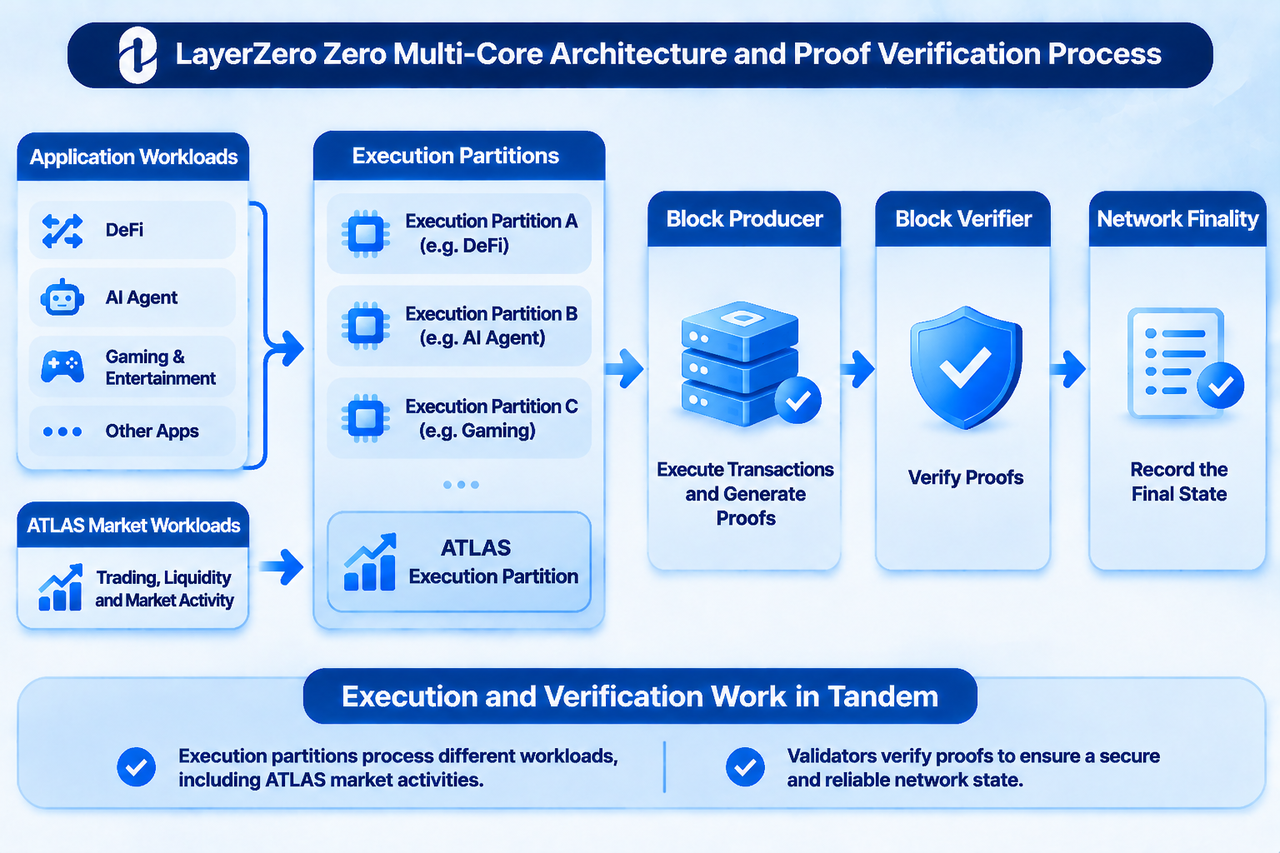
LayerZero describes Zero as a multi-core Layer 1 blockchain that supports parallel workloads through different execution partitions. At the same time, Block Producers and Block Validators have different responsibilities: Block Producers execute transactions and generate proofs, while Block Validators verify those proofs without having to repeat the entire execution process. This article explains from a blockchain architecture perspective how these design elements work together and the technical challenges they may face.
Key Takeaways
-
Zero’s approach to scalability is not limited to increasing the processing capacity of a single execution space. Its multi-core architecture seeks to distribute different types of workloads across multiple execution partitions and run them in parallel, reducing resource competition among payments, trading, and general-purpose applications.
-
Execution partitions are parallel execution areas. Different execution partitions can support different types of on-chain activity, and ATLAS market workloads can run in a relatively independent execution environment. However, all partitions remain part of Zero’s overall network architecture.
-
Execution and verification are handled by different roles. Block Producers execute ATLAS workloads and generate proofs, while Block Validators check the proofs and participate in network consensus without having to repeat the execution of all transactions.
-
Proof verification does not eliminate verification work. Validators still need to check the validity of proofs. Proof generation, verification logic, data availability, and consensus rules all affect network security.
-
Genesis Validator reflects the validator arrangement during the network’s initial phase. The composition of the initial participants can help observers understand node distribution at network launch, but it cannot by itself establish that the network is already sufficiently decentralized.
-
Evaluating scalability requires multiple metrics. In addition to throughput, it is important to consider transaction latency, tail latency, proof generation and verification costs, coordination efficiency among execution partitions, validator participation, and stake distribution.
Scalability Challenges of a Single Execution Space
Traditional blockchains typically process transactions through a unified state machine. After users submit transactions, the network includes them in blocks according to consensus rules. Nodes execute the transactions and update the state according to the same rules. This design helps different nodes reach agreement on the ledger state and enables on-chain data to be publicly verified.
However, a unified execution environment also creates resource competition. When payment applications, trading platforms, and other smart contracts generate large numbers of requests simultaneously, they may compete for the same execution space. A transaction surge from one application can increase network fees, extend transaction confirmation times, and affect the normal operation of other applications. For ordinary transfers, this delay may primarily affect the user experience. In financial scenarios such as order matching, settlement, and risk processing, however, delays can change transaction outcomes and risk exposure.
Scalability designs therefore need to address two questions: how to increase the amount of work a network can process, and how to avoid unnecessary interference among applications. Simply increasing block capacity or shortening block intervals may not solve every problem, because the network must also account for node verification costs, state synchronization, data propagation, and security.
Zero’s multi-core architecture seeks to address the organization of tasks by assigning different workloads to execution partitions that run in parallel. This allows market activity to avoid competing with payments and general-purpose applications for the same execution space. The design does not mean that each execution partition is completely independent of the underlying network. Instead, it aims to improve overall resource utilization through partitioning and parallel execution.
Parallel Execution Through a Multi-Core Architecture and Execution Partitions
Zero’s Multi-Core Architecture can be understood as distributing different workloads within the blockchain network across multiple parallel execution areas. Each execution partition can support specific types of activity, while different execution partitions run in parallel at the network level. This reduces the resource competition that occurs when all applications are concentrated in the same execution environment.
Consider global financial markets as an example. Trading engines may generate large numbers of order updates, cancellations, and settlement requests during periods of market volatility. If these activities share the same execution space with ordinary payment transactions, a surge in trading activity may consume resources needed by payment applications. Assigning ATLAS market activity to its own execution partition can give trading workloads a relatively independent execution environment and reduce direct competition among different business activities.
This parallel design can also help the network organize resources according to the needs of different applications. Payment applications prioritize reliable transfers and settlement, trading markets prioritize order-processing speed and state updates, and general-purpose computing applications may generate other types of execution requirements. By supporting different workloads through different execution partitions, the network can accommodate multiple types of business within its overall architecture without requiring all applications to follow exactly the same resource usage model.
However, parallel execution across partitions does not mean that scalability challenges have disappeared. Different areas still need to coordinate state, process cross-partition interactions, and ensure overall network security. As the number of partitions increases, the system design must define state boundaries, message passing, and verification rules more clearly. The performance gains from parallel execution must be evaluated together with the complexity of cross-partition coordination.
From Repeated Execution to Proof Verification
The core objective of blockchain verification mechanisms is to allow network participants to confirm that transaction execution complies with protocol rules. Under the traditional model, multiple nodes typically execute the same transactions repeatedly so they can independently verify state changes. Repeated execution helps establish a common state result, but it also means that the network must dedicate substantial computing resources to the same work.
The mechanism introduced by Zero separates execution from verification. Block Producers execute ATLAS workloads and generate corresponding cryptographic proofs. Block Validators check these proofs to confirm that the relevant execution meets protocol requirements, without having to re-execute all transactions. In this way, different roles can handle execution and verification, reducing the need for validator nodes to perform duplicate computation.
Proof verification does not mean that validators can stop performing work. Validators still need to check whether proofs are valid and participate in consensus according to network rules. The correctness of proof generation, the security of the verification logic, and the availability of relevant data all affect the reliability of the entire system. If the proof system contains implementation vulnerabilities or the verification process does not cover critical state transitions, the network may still face security risks.
The purpose of separating execution from verification is therefore to change how node responsibilities are distributed, not to eliminate blockchain verification. The network still needs cryptographic mechanisms and consensus rules to ensure that different participants agree on the final state.
Roles of Block Producers and Block Validators
Block Producers are participants that execute workloads and generate proofs. They process transactions, calculate state changes, and generate proofs that allow the execution results to be verified. For trading infrastructure such as ATLAS, Block Producers need to process orders and state updates generated by market activity and convert the execution results into a form that the network can verify.
Block Validators are responsible for verifying proofs and participating in the network’s consensus process. They do not need to re-execute all transactions, but they must be able to confirm that submitted proofs comply with protocol requirements. Their focus shifts from complete execution to proof verification and network security maintenance, which can reduce the resource consumption caused by duplicate computation.
This division of responsibilities is not exactly the same as the node structure of traditional blockchains. Different networks may define the roles of execution nodes, validation nodes, sequencers, and data availability providers differently. Their responsibilities cannot be assumed to be identical based on their names alone. Zero’s design should be understood according to its official technical documentation and specific protocol rules rather than directly mapped onto other blockchain architectures.
Network security also depends on participant distribution, validator operating quality, delegated staking mechanisms, and fault-handling procedures. Even if verification tasks are relatively lightweight, the network may still face centralization risks if the number of validators is insufficient, participation is overly concentrated, or operating environments are unreliable.
Genesis Validator and Security Arrangements During Network Launch
Genesis Validator refers to nodes or validators that participate in verification during the network’s initial phase. At mainnet launch, they handle network consensus and verification tasks and play an important role in early network security, state confirmation, and stable system operation. Compared with mature networks, the validator set during the initial phase is generally more affected by the number and distribution of participants. Validator composition is therefore an important dimension for observing the network’s launch arrangements.
In November 2026, LayerZero announced that Kakao Pay, Samsung Card, and ZAN would participate in Zero’s Genesis Validator arrangements. Four Pillars operates a validator node on behalf of Samsung Card, while ZAN is a Web3 infrastructure platform supported by Ant Digital Technologies. LayerZero stated that these participants would form an initial validator set with geographic distribution together with validators from Europe and North America.
From a blockchain design perspective, the participation of financial services companies and infrastructure providers may bring operational experience, institutional resources, and a foundation for participation across different regions. However, institutional participation alone does not mean that the network has achieved sufficient decentralization. Evaluating a validator set also requires examining the number of nodes, stake distribution, geographic distribution, operational independence, and fault-response mechanisms.
The Genesis Validator list is therefore better understood as information about the participation structure during the network’s launch phase, rather than a final conclusion about its long-term level of decentralization. As the network operates, it is important to continue monitoring whether the validator set expands, whether participation becomes more open, and whether validator weight becomes overly concentrated.
Metrics for Evaluating High-Performance Blockchain Designs
Throughput is usually the most visible metric when evaluating blockchain performance, but it does not fully represent network quality. Transaction latency, tail latency, state synchronization speed, proof generation costs, and stability under peak loads also affect the real-world user experience. In financial markets in particular, even a small number of transactions experiencing significant delays can affect order execution and risk management.
Official materials from Zero and ATLAS disclose sub-millisecond median latency, p95 and p99 latency, and planned throughput capabilities under different deployment environments. These metrics should be understood in the context of their testing environments. Public deployment environments and co-located node environments may differ in network distance, hardware conditions, and communication overhead. Data from one environment cannot be directly treated as the actual experience available to all users.
Security cannot be replaced by performance metrics. A multi-core architecture must handle state coordination among execution partitions. Proof verification must ensure reliability at both the cryptographic and implementation levels. Delegated staking mechanisms must also prevent excessive concentration of validator weight. Performance, decentralization, and security involve complex engineering trade-offs, and different projects may choose different designs based on their target applications.
For researchers, key areas to monitor when evaluating Zero’s actual performance include mainnet operating data, validator participation, resource utilization across different execution partitions, proof generation and verification costs, and transaction latency during real market activity. These metrics are more useful for determining whether the network truly supports its target workloads than citing peak throughput alone.
Connection to Gate: Observing the Zero Ecosystem Through the ZRO Market
Zero’s network security and ecosystem economics are closely related to ZRO. ZRO serves functions in Zero including network security, Gas, and governance. Users may participate in Staking or delegation according to official rules. It is important to note that participating in staking and buying or selling ZRO on a trading platform are different activities. Holding or trading ZRO does not automatically grant users validator status or network governance rights.
Users who want to observe the development of the Zero ecosystem can refer to the Gate ZRO/USDT spot market to view ZRO’s market price and trading activity. They can also consider LayerZero’s official announcements regarding validator arrangements, staking rules, and network operating data to observe the relationship between token market activity and the development of the underlying network.
Gate’s ZRO spot trading provides users with a digital asset trading channel. It does not constitute direct operation of a Zero validator node and does not mean that users automatically participate in protocol staking. Specific trading rules and available features are subject to the information displayed on Gate.
Conclusion
Zero’s multi-core architecture, parallel execution through execution partitions, and proof verification mechanism reflect a shift in blockchain scalability design from simply increasing execution capacity to reorganizing computing and verification tasks. By assigning different workloads to parallel areas and having executors generate proofs while validators check them, Zero seeks to establish a new balance between high performance and open verification.
However, a technical architecture’s design objectives do not equal its actual operating results. Whether the network can consistently maintain low latency, high throughput, and reliable validator participation must be tested using real mainnet data. The multi-core architecture must also address cross-partition coordination, proof system security, and validator weight distribution.
For blockchain researchers, Zero is worth monitoring not only for its performance metrics, but also for how it organizes execution resources, distributes node responsibilities, and connects network security with ecosystem participation through ZRO. Together, these mechanisms determine whether a high-performance blockchain can support the long-term operation of complex financial markets.
FAQ
Why does Zero use a multi-core architecture?
The multi-core architecture is designed to allow different types of workloads to run in parallel across different execution partitions, reducing resource competition for the same execution space among payment, trading, and general-purpose applications.
Are execution partitions independent blockchains?
They should not be understood simply as multiple completely independent blockchains. Execution partitions are parallel execution areas within Zero’s multi-core architecture. Their specific state coordination and verification relationships need to be understood in the context of Zero’s technical design.
What is the difference between Block Producers and Block Validators?
Block Producers execute workloads and generate proofs. Block Validators verify the proofs and participate in network consensus without having to re-execute all transactions.
Does Genesis Validator mean that the network is already fully decentralized?
No. Genesis Validator reflects the validator arrangements during the network’s initial phase. The network’s long-term level of decentralization must also be assessed based on the number of validators, stake distribution, geographic distribution, and openness of participation.
How is ZRO related to Zero’s network security?
ZRO supports Zero’s network security through a delegated proof-of-stake mechanism. Holders can delegate their stake to validators according to official rules. ZRO also serves functions including network Gas and governance.