Stablecoins have become a cornerstone of the digital asset market, evolving from their original role as a medium of exchange into payments, lending, cross-border settlements, and digital financial infrastructure. As blockchain use cases multiply, market demand for stablecoins has shifted from mere price stability to liquidity, settlement efficiency, and network synergies.
In this context, USDT and UUSD are both integral to the stablecoin ecosystem, but they play distinct roles. USDT is currently one of the largest centralized stablecoins by market cap, while UUSD aims to build a unified network encompassing stablecoin issuance, liquidity, and settlement.
What Is UUSD?
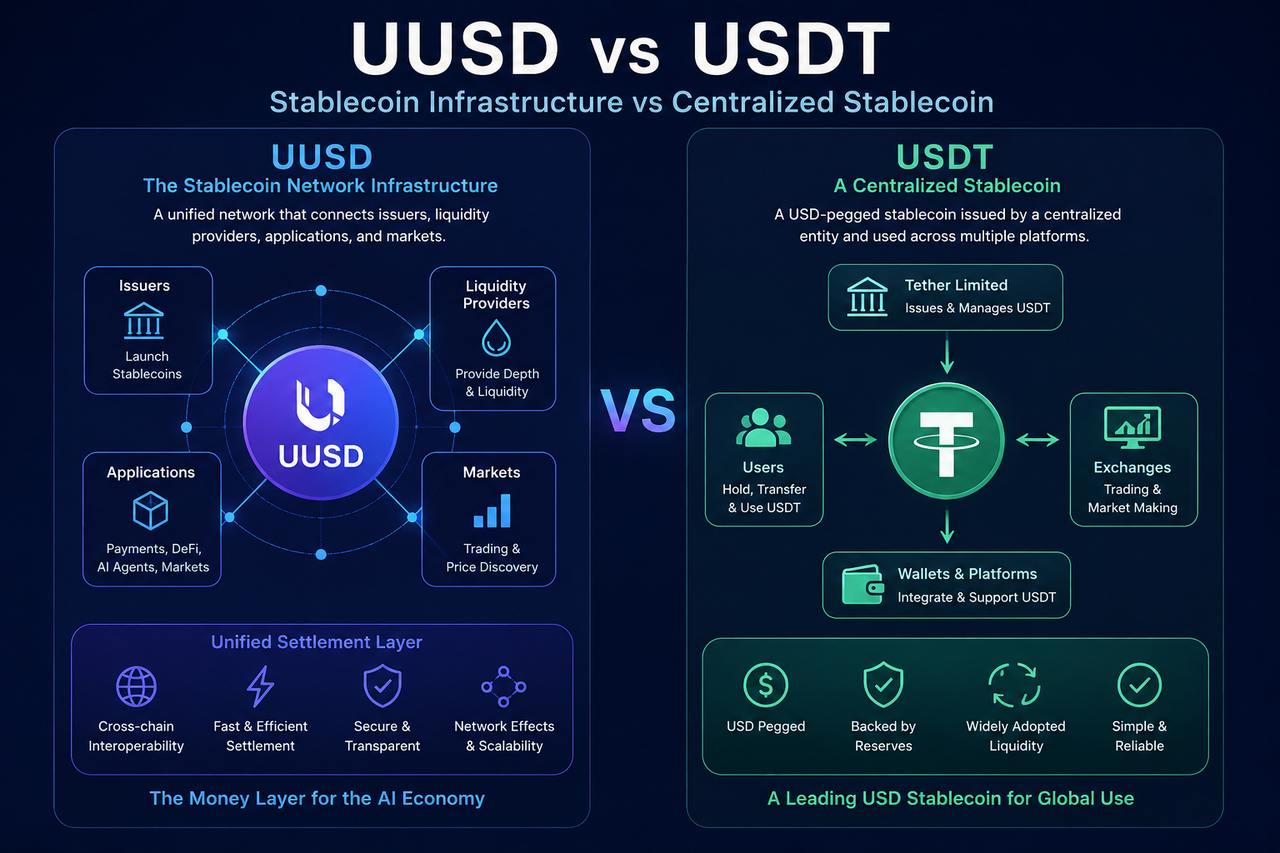
UUSD is a network infrastructure built around stablecoin issuance, liquidity management, and on-chain settlement.
Unlike traditional stablecoin projects, UUSD's focus is not on issuing a single stablecoin, but on creating a unified stablecoin network. This network connects issuers, liquidity providers, developers, and application ecosystems, enabling stablecoins to flow efficiently across different use cases.
UUSD positions itself as “The Money Layer for the AI Economy”—a money layer infrastructure for the AI-driven economy and digital finance.
What Is USDT?
USDT (Tether) is a centralized stablecoin pegged to the U.S. dollar.
Issued by Tether, USDT aims to maintain a 1:1 value peg with the dollar. Users can leverage USDT for trading, payments, asset allocation, and cross-border transfers, making it a long-standing cornerstone of liquidity in the digital asset market.
As the crypto market has grown, USDT has become one of the primary settlement assets across multiple blockchain ecosystems and is widely supported on exchanges, wallets, and payment systems.
How Does Their Positioning Differ?
The most fundamental difference between UUSD and USDT lies in their level of positioning.
USDT is essentially a stablecoin asset—its core function is to maintain price stability and serve as a value-transfer tool. Users typically hold, transfer, or use USDT for payments and trades.
UUSD, on the other hand, is more akin to stablecoin infrastructure. Its goal is not simply to issue an asset, but to provide a unified network for stablecoin issuance, circulation, and settlement.
In short, USDT is an asset running on a network, while UUSD focuses on how the network itself operates.
How Do Their Issuance Models Differ?
USDT uses a centralized issuance model.
Tether issues and redeems USDT based on reserve assets and is responsible for maintaining its value-stability mechanism. Changes in the stablecoin supply are managed by the centralized entity.
UUSD, by contrast, adopts a networked issuance framework.
In the UUSD system, the emphasis is not on a single issuer, but on providing a unified infrastructure that allows different issuers to join the network and access liquidity and application support.
Thus, there is a clear difference in issuance logic: one stresses asset issuance, while the other stresses the issuance network.
How Do Their Liquidity Structures Differ?
Liquidity is a key driver of stablecoin adoption.
USDT’s liquidity comes primarily from its long-established market size and broad adoption. With widespread support across trading platforms, USDT enjoys deep market liquidity.
UUSD aims to improve capital efficiency through a shared liquidity network.
In the traditional model, different stablecoins typically need to build their own liquidity pools. UUSD seeks to aggregate liquidity resources via a unified network, allowing multiple issuers and applications to share the same Markttiefe.
This model emphasizes network synergies rather than the scale of any single asset.
How Do Their Settlement Systems Differ?
USDT primarily serves as a settlement asset in trading and payments.
Users leverage USDT for value transfer, with settlement activities relying on different blockchain networks and application systems.
UUSD, in contrast, seeks to establish a unified settlement layer.
Beyond supporting stablecoin transfers, UUSD focuses on collaborative settlement capabilities across applications, markets, and participants. A unified settlement network reduces the complexity of cross-platform interactions and improves capital flow efficiency.
Therefore, UUSD’s settlement logic leans toward infrastructure building, while USDT leans toward specific asset usage.
How Do Their Risk Structures Differ?
USDT’s risks are mainly tied to reserve asset management, issuer operations, and the regulatory environment.
Because of the centralized issuance model, the market typically scrutinizes reserve transparency, asset security, and redemption mechanisms.
UUSD faces risks more from the network-building perspective.
The number of network participants, liquidity scale, application adoption rate, and ecosystem governance efficiency all affect the network’s overall value. For network-style infrastructure, ecosystem synergy is a key factor in long-term success.
Given their different risk sources, the evaluation dimensions also differ.
UUSD vs USDT: Core Differences
| Dimension |
UUSD |
USDT |
| Core Positioning |
Stablecoin network infrastructure |
Centralized stablecoin |
| Primary Goal |
Build a money layer network |
Provide a stable digital dollar |
| Issuance Model |
Networked issuance framework |
Centralized issuance |
| Liquidity Structure |
Shared liquidity network |
Single-asset liquidity |
| Settlement System |
Unified settlement network |
Asset-level settlement |
| Target Users |
Issuers, developers, application ecosystems |
Traders and payment users |
| AI Economy Suitability |
High |
Medium |
| Network Effect Source |
Growth of ecosystem participants |
Growth of asset scale |
Conclusion
UUSD and USDT are both vital parts of the stablecoin ecosystem, but they operate at different levels.
USDT is a centralized stablecoin whose core value lies in providing a digital asset pegged to the U.S. dollar, widely used as a medium for trading and payments. UUSD, on the other hand, emphasizes stablecoin infrastructure, connecting the entire ecosystem through unified issuance, shared liquidity, and a settlement network.
FAQs
Will UUSD issue its own stablecoin?
UUSD's focus is on building a stablecoin network and money layer infrastructure, not simply issuing a single stablecoin asset.
Why does USDT have such high liquidity?
Through years of development, USDT has been adopted by a vast number of exchanges, wallets, and payment systems, resulting in significant market size and deep liquidity.
What does UUSD's shared liquidity mean?
Shared liquidity means multiple stablecoin issuers and application ecosystems jointly use the same liquidity network, boosting capital efficiency and reducing market fragmentation.
Why does an AI agent need a network like UUSD?
AI Agents require not only stable assets but also infrastructure that supports automated payments and real-time settlements. UUSD aims to provide exactly that unified money layer.
Will UUSD replace USDT?
UUSD and USDT serve different levels. USDT is a stablecoin asset; UUSD is stablecoin infrastructure. Hence, they are not necessarily direct substitutes.